
Table of Contents
Table of Contents
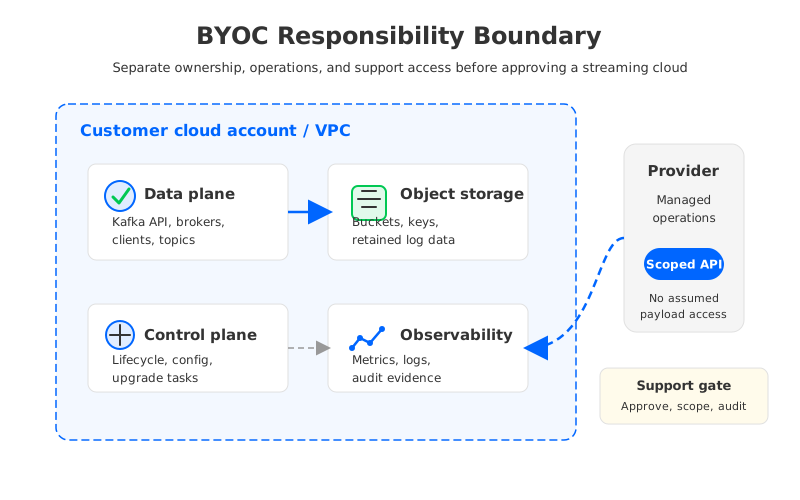
Many searches for a Redpanda Cloud alternative are not really about replacing one streaming engine with another. They start in a security review, a procurement gate, or an architecture board where someone asks a sharper question: where does the data plane run, who owns the storage account, and what external party can reach the environment during normal operations or support? A fully managed streaming service can be a good fit when the priority is fast adoption and lower operational load. The same model becomes harder to approve when the organization requires customer-owned cloud accounts, private network boundaries, explicit IAM permissions, customer-controlled keys, and auditable support access.
Redpanda Cloud deserves a fair reading in that context. Its official documentation describes Serverless, Dedicated, and Bring Your Own Cloud deployment options, and its BYOC model deploys the Redpanda data plane into the customer's VPC or VNet. That is materially different from a simple multi-tenant SaaS service where the data plane is entirely outside the customer's cloud boundary. The evaluation question is narrower: does the operating model, permission model, data path, and support model match your internal definition of BYOC?
That definition matters because "BYOC" is not a single technical standard. One vendor may use it to mean customer-side networking with provider-owned infrastructure. Another may mean provider-managed software running in a customer account. A third may place both control-plane services and data-plane services in the customer VPC. When Kafka workloads carry regulated records, payment events, customer identifiers, or business-critical audit logs, that difference is not a footnote. It is the review.
1Why Teams Look Beyond Managed Streaming Clouds
The usual managed-service pitch is operational relief: fewer brokers to patch, fewer capacity alarms to triage, and fewer late-night upgrades. That is a real benefit, especially for teams that do not want to run Kafka, Redpanda, Connect workers, Schema Registry, storage, and monitoring by hand. But operational relief does not remove the need to explain where business data flows. In many enterprises, the streaming platform sits between production applications and analytical systems, so the message log becomes part of the security perimeter rather than a commodity infrastructure component.
The review often starts with three concrete risks: records must remain in a named cloud account or region, support must be possible without broad standing access, and auditors need evidence for encryption, IAM, networking, logs, metrics, and change history. Those requirements do not automatically rule out Redpanda Cloud, but they do make the architecture boundary more important than the product name.
Redpanda's own documentation reflects this distinction. Redpanda Cloud BYOC places the data plane, including brokers and related data-plane components, in the customer's existing VPC or VNet, while Redpanda manages provisioning, monitoring, upgrades, security policies, and required resources. Redpanda Cloud also documents encryption in transit and at rest, PrivateLink options, IAM policies for BYOC agents, and a shared-responsibility model that changes by deployment type. Those are the right categories to inspect because they reveal the real contract between the customer and the provider.
The mistake is to treat "managed" and "controlled" as opposites. A good BYOC model should preserve managed operations while making the data boundary inspectable. The useful comparison is which responsibilities move to the provider, which stay with the customer, and which become shared enough that they need explicit evidence.
2What BYOC Should Mean for Kafka Workloads
For Kafka-compatible workloads, BYOC should be judged from the data path outward. Apache Kafka's protocol surface includes producers, consumers, topics, partitions, offsets, consumer groups, ACLs, TLS, SASL, quotas, and operational metrics. A replacement or alternative platform may preserve those concepts, but the security review has to map them onto cloud resources: VPCs, subnets, load balancers, IAM roles, KMS keys, buckets, log sinks, metrics exporters, and support channels.
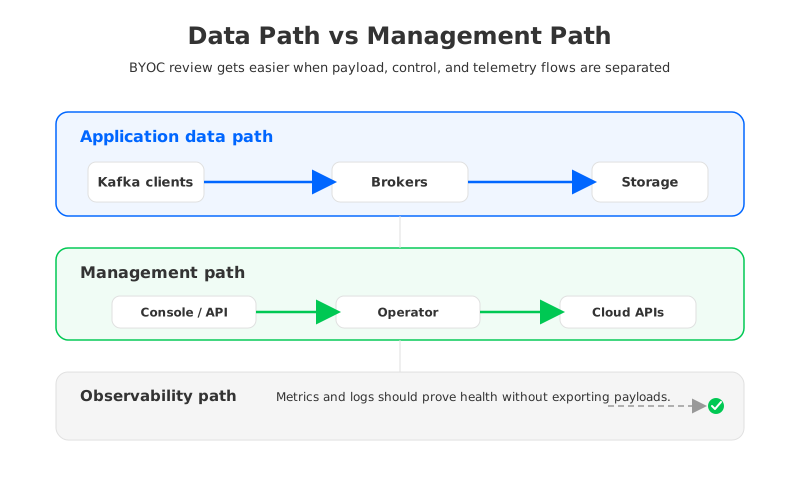
The cleanest review separates three planes:
- The application data path carries Kafka protocol traffic between clients and brokers, plus broker-to-storage writes and reads. This path is where customer records, offsets, and retained log data move.
- The management path provisions clusters, applies configuration, performs upgrades, changes network settings, rotates credentials, and triggers operational tasks.
- The observability path moves logs, metrics, alerts, and traces. It should be designed so operational evidence is available without exporting customer message payloads.
Once those paths are separate, the architecture conversation becomes less emotional. A provider can operate the system without being in the message path. A customer can retain storage and network ownership without manually patching every component. Support can be granted through scoped, time-bound, logged mechanisms instead of standing administrative reach. Those properties should be verified in diagrams, IAM policies, runbooks, and cloud audit logs.
2.1Data Plane Ownership
Data plane ownership starts with the brokers, but it does not end there. For a Kafka-compatible platform, retained logs, metadata, object storage, cache, connectors, schema registry, and private endpoints may all participate in the effective data boundary. If any part stores customer records, derived payloads, credentials, or topic metadata, it belongs in the review.
Redpanda Cloud BYOC is relevant because Redpanda documents that its data plane is deployed into the customer's VPC or VNet and that data remains in the customer environment. The follow-up questions are practical: who owns storage resources, what IAM role can mutate them, whether bucket policies are customer-inspectable, and how upgrades or repairs are performed. A security team should also ask whether payload access is technically prevented or procedurally controlled, and how exceptional access is approved.
AutoMQ enters this discussion as a Kafka-compatible shared-storage option rather than as a generic "managed Kafka" label. AutoMQ's architecture moves Kafka log storage into object storage through S3Stream and makes brokers stateless by separating compute from storage. In AutoMQ Cloud BYOC materials, the BYOC model deploys services in the user's cloud account and describes both control-plane and data-plane resources inside the customer VPC. For teams whose primary concern is customer-owned infrastructure and data-path containment, that combination changes the review from "where are the disks attached?" to "which customer-owned storage, network, and IAM resources define the boundary?"
2.2Networking and IAM
Network review should identify every route by purpose. Client-to-broker traffic may use private endpoints, VPC peering, PrivateLink, or internal load balancers. Management traffic may require a control channel. Object storage traffic may use private endpoints or cloud-native service access. Observability traffic may write to a customer bucket, monitoring system, or provider-operated backend. A good diagram shows these separately because a tidy diagram can still hide a public management endpoint or broad egress path.
IAM is the second half of the same boundary. Redpanda Cloud documents BYOC agent IAM permissions for AWS and states that the permissions allow the agent to create and manage cluster resources. Reviewers should request the same artifacts from any BYOC provider: role trust policy, permission policy, resource scope, credential rotation model, and deletion behavior. Managed BYOC requires permissions; the question is whether they are least-privilege, reviewable, and tied to named operations.
For AutoMQ BYOC, the same review applies. The customer should inspect which roles allow the BYOC environment, control plane, data plane, object storage, and observability components to operate. A Kafka-compatible shared-storage design makes object storage a first-class security resource, so bucket permissions, KMS policies, lifecycle policies, deletion rights, and metadata access deserve the same attention as broker listeners.
2.3Encryption, Keys, and Storage
Encryption claims should be read in layers. Redpanda Cloud documents TLS for data in transit and cloud-provider encryption for data at rest, including storage-specific treatment for Tiered Storage. Apache Kafka documents TLS, SASL, and ACL mechanisms for the Kafka-facing surface. A BYOC review has to connect that protocol security with cloud infrastructure security.
The key questions are straightforward:
| Review area | What to verify | Why it matters |
|---|---|---|
| Client encryption | TLS versions, certificate ownership, private endpoint behavior | Protects producer and consumer traffic |
| Broker credentials | SASL, mTLS, ACLs, service accounts, rotation process | Controls application access to topics |
| Storage encryption | Bucket or volume encryption, KMS ownership, key rotation | Protects retained log data and object storage |
| Metadata exposure | Topic names, consumer groups, schemas, logs, metrics | Prevents "non-payload" data from becoming a blind spot |
| Support access | Approval, duration, scope, audit trail, break-glass path | Keeps managed operations compatible with internal policy |
The storage row is especially important for shared-storage designs. In traditional Kafka, retained data is bound to broker disks and replicated across brokers. In a shared-storage architecture such as AutoMQ, object storage is the durable storage layer, while brokers handle protocol processing, caching, scheduling, and ownership changes. Object storage configuration becomes part of the primary system design, not an optional tier.
3Redpanda Cloud Alternative Criteria
A credible Redpanda Cloud alternative for BYOC is not merely "another Kafka API." It must answer the same security and operations questions with enough detail for a platform team to defend the choice. Redpanda can be a strong option when the team wants Redpanda's runtime, managed lifecycle, and documented BYOC data-plane placement. A different option becomes attractive when the deciding requirement is Kafka compatibility, object-storage-backed shared storage, stateless brokers, or a BYOC model where management and data-plane components run inside the customer's cloud boundary.
The shortlist should be built around evaluation criteria, not vendor categories:
- Kafka compatibility: test real producers, consumers, ACLs, transactions if used, consumer group behavior, client libraries, Connect dependencies, Schema Registry expectations, monitoring tools, and migration strategy.
- Customer-owned boundary: confirm where brokers, storage, metadata, observability, management services, and support tooling run.
- Network posture: verify private connectivity, DNS behavior, endpoint ownership, allowed principals, egress requirements, and region or cross-region behavior.
- Permission model: inspect IAM policies, operator roles, control-plane credentials, storage permissions, and human access workflows.
- Operational contract: understand upgrades, incident response, backup and restore, scaling, retention changes, observability ownership, and deletion semantics.
This is where architecture categories help. A provider-managed BYOC Redpanda deployment, self-managed Kafka deployment, managed Apache Kafka service, and Kafka-compatible shared-storage platform can all satisfy different parts of the checklist. The right comparison is whether the operating model removes the constraint that created the Redpanda Cloud alternative search in the first place.
4How AutoMQ BYOC Fits
AutoMQ is most relevant when the review has two simultaneous requirements: preserve Kafka ecosystem compatibility and move the long-lived data boundary into customer-controlled cloud storage. AutoMQ's public architecture documentation describes a shared-storage model where S3Stream replaces Kafka's native log storage, WAL storage accelerates writes and recovery, object storage acts as the durable layer, and brokers become stateless. The practical implication is that scaling and recovery are less tied to copying broker-local data.
That architecture is not automatically better for every team. If an organization wants Redpanda-specific features, Redpanda operational tooling, or a Redpanda-managed BYOC model, Redpanda Cloud BYOC deserves a direct proof. If the organization wants an Apache Kafka-compatible target with shared storage, stateless broker behavior, object storage as a customer-owned control point, and a BYOC environment where control-plane and data-plane systems can run in the customer VPC, AutoMQ belongs on the shortlist.
The most productive AutoMQ proof is not a generic benchmark. It should reuse the same review artifacts requested from Redpanda Cloud: cloud-account layout, VPC diagram, IAM policies, object storage configuration, KMS posture, metrics and logs path, support workflow, upgrade procedure, and deletion procedure. Then run representative Kafka clients against real topic patterns, retention settings, consumer fan-out, replay behavior, and failure drills.
5BYOC Evaluation Checklist
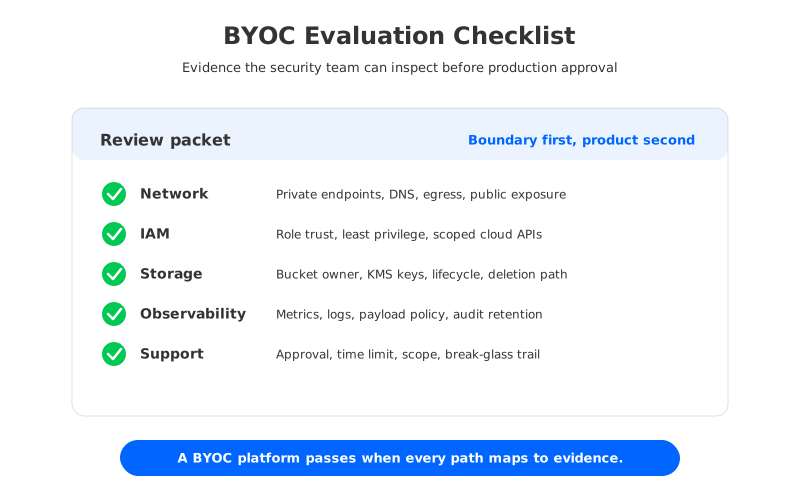
The final review should leave behind evidence that survives beyond the proof of concept. A slide saying "data stays in our VPC" is not enough. The team should be able to point to cloud accounts, route tables, endpoint services, IAM roles, KMS keys, bucket policies, audit logs, dashboards, and support runbooks.
Use this checklist as the minimum review packet:
| Area | Evidence to collect | Red flag |
|---|---|---|
| Control plane | Deployment location, operator role, control channel, change audit | Management path is undocumented or mixed with data path |
| Data plane | Broker location, storage location, metadata storage, client endpoint | Customer records leave the approved boundary |
| Object storage | Bucket owner, encryption, KMS policy, deletion semantics | Provider has broad unscoped storage permissions |
| Network | Private endpoint design, DNS, ingress, egress, public exposure | Private connectivity depends on hidden public routes |
| Observability | Metrics and logs content, destination, retention, access control | Logs can include payloads or secrets without review |
| Support | Approval workflow, time limit, audit trail, break-glass process | Standing access is required for routine operations |
| Operations | Upgrade path, rollback, incident response, scaling, backup | Managed responsibility is unclear during incidents |
The most useful outcome is a documented reason for the choice. Redpanda Cloud BYOC may fit when the organization wants Redpanda's managed experience with a customer-side data plane. AutoMQ BYOC may fit when the team wants Kafka compatibility, shared object storage, stateless brokers, and a customer-owned cloud boundary. Self-managed Kafka may still fit when internal teams intentionally own the whole stack. The decision should follow the boundary, not the marketing term.
The search began with "Redpanda Cloud alternative," but the real question is whether your streaming platform can pass the same scrutiny as the applications it connects. Draw the paths, inspect the permissions, and test support access before the workload becomes critical. If your review points toward Kafka-compatible shared storage and customer-controlled BYOC boundaries, talk to the AutoMQ team with your VPC, IAM, storage, and Kafka workload requirements.
6FAQ
6.1Is Redpanda Cloud BYOC the same as self-managed Redpanda?
No. In Redpanda Cloud BYOC, Redpanda documents that the data plane is deployed into the customer's VPC or VNet while Redpanda manages provisioning, monitoring, upgrades, security policies, and required resources. Self-managed Redpanda gives the customer more direct operational ownership and more responsibility for lifecycle management.
6.2What is the main reason to evaluate a Redpanda Cloud alternative for BYOC?
The main reason is usually not dissatisfaction with Redpanda as an engine. It is a control requirement: customer-owned cloud resources, private network access, explicit IAM scope, storage and key ownership, support controls, or a need to preserve Kafka compatibility while changing the storage model.
6.3Does BYOC guarantee that a vendor cannot access data?
No. BYOC describes where infrastructure runs, not every access path. You still need to review IAM roles, support procedures, observability data, storage permissions, break-glass workflows, and audit logs.
6.4Where does AutoMQ differ architecturally?
AutoMQ is Kafka-compatible but uses object-storage-backed shared storage through S3Stream and stateless brokers. In BYOC discussions, the relevant distinction is that durable Kafka data can be anchored in customer-owned object storage while brokers focus on compute, cache, and scheduling rather than owning long-lived local log data.
6.5What should a proof of concept test?
Test the security boundary and the workload together. Run representative producers and consumers, ACLs, retention, replay, scaling, recovery, monitoring, upgrades, and deletion workflows. Also inspect the VPC design, IAM policies, KMS keys, object storage permissions, log destinations, and support access process.
7References
- Redpanda Cloud overview
- Redpanda Cloud BYOC cluster type
- Redpanda Cloud security
- Redpanda Cloud encryption
- Redpanda Cloud AWS PrivateLink
- Redpanda Cloud AWS IAM policies for BYOC
- Apache Kafka security documentation
- Apache Kafka operations and monitoring
- AutoMQ Cloud BYOC environment overview
- AutoMQ Cloud overview
- AutoMQ architecture overview
- AutoMQ S3Stream overview
- AutoMQ stateless broker documentation
- AutoMQ GitHub repository


