
Table of Contents
Table of Contents
The hardest part of choosing a streaming platform is rarely the first benchmark. It is the responsibility boundary that appears after the benchmark: who patches the cluster, owns the VPC path, explains the bill, proves security controls, and carries the pager when partitions move under load.
That is why "Redpanda Cloud vs self-managed Redpanda vs AutoMQ BYOC" is not a simple product comparison. Redpanda Cloud optimizes for managed-service convenience across Serverless, Dedicated, and BYOC-style cloud options. Self-managed Redpanda gives maximum deployment control, but returns upgrades, capacity planning, failure handling, and cost attribution to the platform team. AutoMQ BYOC is a third operating model: Kafka-compatible infrastructure in the customer's cloud account, with shared storage changing how brokers, storage, and scaling behave.
The useful question is not which one is universally better. The useful question is which boundary your organization can defend in production.
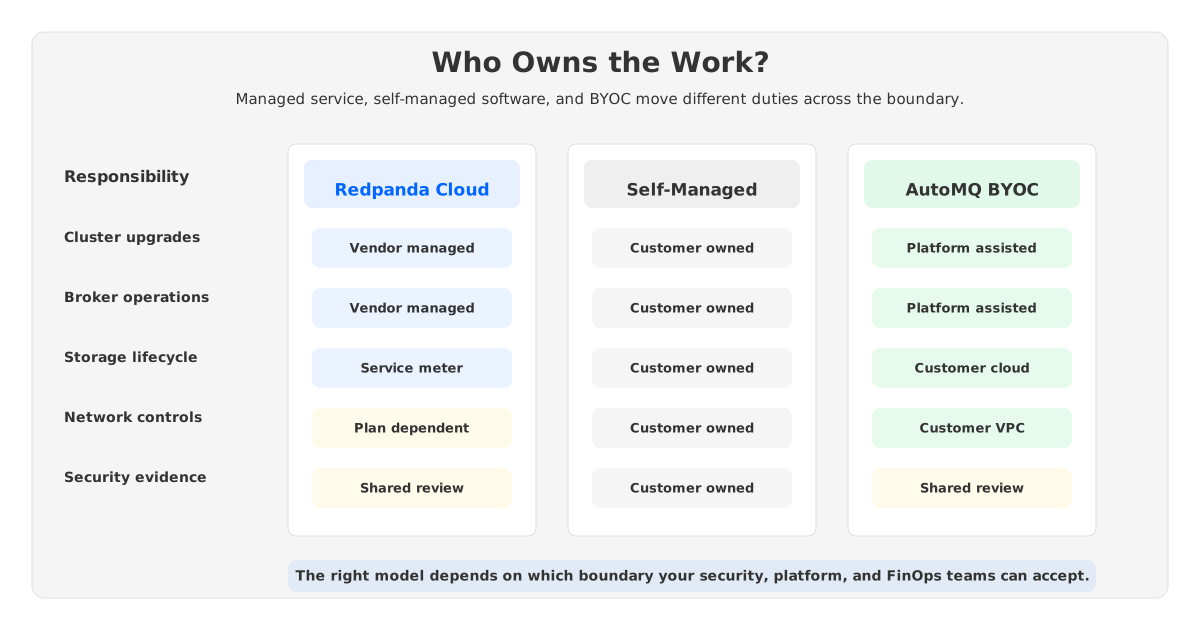
1Three Deployment Models, Three Responsibility Boundaries
Redpanda Cloud is the most service-oriented option. Redpanda's docs describe Serverless, BYOC, and Dedicated clusters, and its billing docs meter usage through uptime, ingress, egress, storage, and, for Serverless, partitions. Teams look at it when they want Redpanda's Kafka API-compatible platform without building the full operational wrapper.
Self-managed Redpanda moves the opposite way. Redpanda's deployment docs point users to Linux or Kubernetes paths for self-hosted environments. That is attractive when a team wants direct control over instance types, disks, operators, monitoring, network policy, and change windows. The trade-off is plain: you own the runtime, not only the application using it.
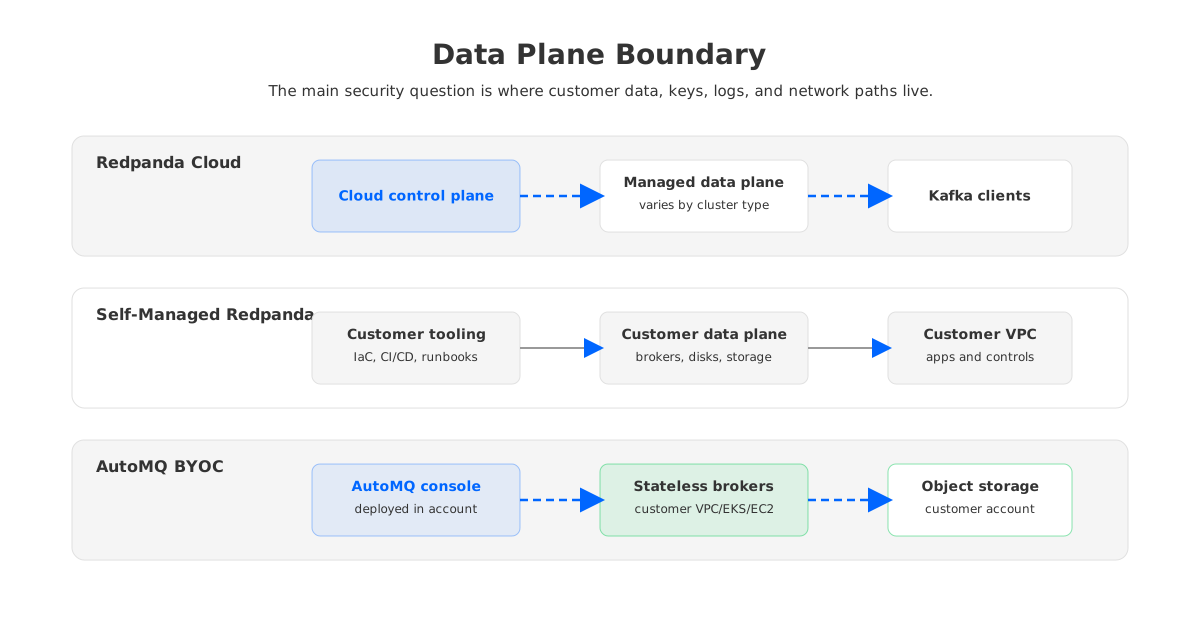
AutoMQ BYOC is different from both. AutoMQ Cloud BYOC deploys the console and data-plane resources inside the customer's cloud account and VPC. AutoMQ's AWS BYOC docs require VPC, S3 access, endpoints, and compute; its architecture docs describe S3Stream shared storage and stateless brokers. The data path and cloud resources sit inside the customer's environment.
| Area | Redpanda Cloud | Self-Managed Redpanda | AutoMQ BYOC |
|---|---|---|---|
| Operating model | Managed Redpanda service | Customer-operated Redpanda software | Customer-cloud deployment with platform-managed experience |
| Data location | Depends on cluster type and cloud/network plan | Customer infrastructure | Customer account, VPC, and storage resources |
| Upgrade owner | Mostly service/vendor boundary | Customer platform team | Shared model, with customer environment constraints |
| Cost lens | Service meters plus support plan | Cloud bill plus engineering labor | BYOC service meters plus customer cloud resources |
| Scaling question | Service limits and selected cluster type | Customer automation and broker/storage capacity | Stateless broker scaling plus shared storage design |
| Migration proof | Redpanda compatibility and cutover plan | Redpanda compatibility plus operations proof | Kafka compatibility, data copy, offsets, and cutover path |
This table is not a scorecard. A managed service fits a small platform team with strict timelines. A self-managed deployment fits a large infrastructure group with mature automation. BYOC fits when the company wants vendor-assisted operations but must keep the data plane inside its cloud boundary.
2Responsibility Boundary: What Actually Moves?
The word "managed" can hide too much. Managed by whom, at which layer, and under which incident path? Draw the boundary across five layers before looking at unit price.
- Control plane: cluster creation, upgrades, policy enforcement, users, and support workflows.
- Data plane: brokers, partitions, topics, client traffic, schemas, connectors, and message paths.
- Storage plane: local disks, object storage, tiered storage, WAL design, backups, retention, and replay.
- Network plane: VPC design, private connectivity, load balancers, DNS, cross-AZ traffic, and client placement.
- Security plane: IAM, RBAC, ACLs, encryption, key ownership, audit evidence, and operational access.
Redpanda Cloud shifts much of the control-plane and operational burden to Redpanda, especially for Serverless and Dedicated usage. Redpanda's BYOC architecture docs describe a split model where the data plane runs in the customer's cloud environment while Redpanda Cloud manages provisioning, operations, and maintenance. That nuance matters: Serverless, Dedicated, and Redpanda BYOC differ in how much cloud ownership and data-plane isolation the customer keeps.
Self-managed Redpanda has the cleanest ownership line because almost everything is yours. That clarity helps in regulated environments with hardened images, approved Kubernetes patterns, logging standards, and incident response. It also means every operational weakness is yours. If partition movement, broker replacement, certificate rotation, or upgrade testing are underdeveloped, self-managed gives you control without removing the problem.
AutoMQ BYOC draws the boundary around customer-cloud ownership and Kafka-compatible operations. The customer prepares and authorizes cloud resources, while AutoMQ provides the platform layer for creating and managing instances. Because AutoMQ replaces Kafka's broker-local storage layer with S3Stream shared storage, the responsibility discussion includes a deeper architecture question: should durable log data stay tied to broker-local storage, or live in shared storage controlled by the customer's cloud account?
3Cost Visibility and Resource Ownership
Cost comparisons fail when they compare a service invoice with an infrastructure bill and ignore labor. Redpanda's billing docs say Serverless pricing depends on data in, data out, data stored, partitions, and uptime; Dedicated depends on uptime, data in, data out, and data stored; Redpanda BYOC depends on compute, data in, data out, and data stored. The answer still depends on region, cluster type, support plan, network design, and workload shape.
Self-managed Redpanda exposes a different model. You pay the cloud provider for compute, storage, network transfer, load balancers, Kubernetes, logging, metrics, backups, and object storage used for tiering. You may also pay for support. Every VM, disk, bucket, and network path can be tagged, but over-provisioned brokers, retained logs, cross-zone traffic, and incident labor are now your cost model.
AutoMQ BYOC mixes both views. AutoMQ's usage-based BYOC billing docs for AWS describe data ingress, data egress, data retention, and cluster uptime, with AWS Marketplace settlement. The underlying cloud resources remain in the customer's account, so FinOps teams can inspect object storage, compute, endpoints, and network paths directly.
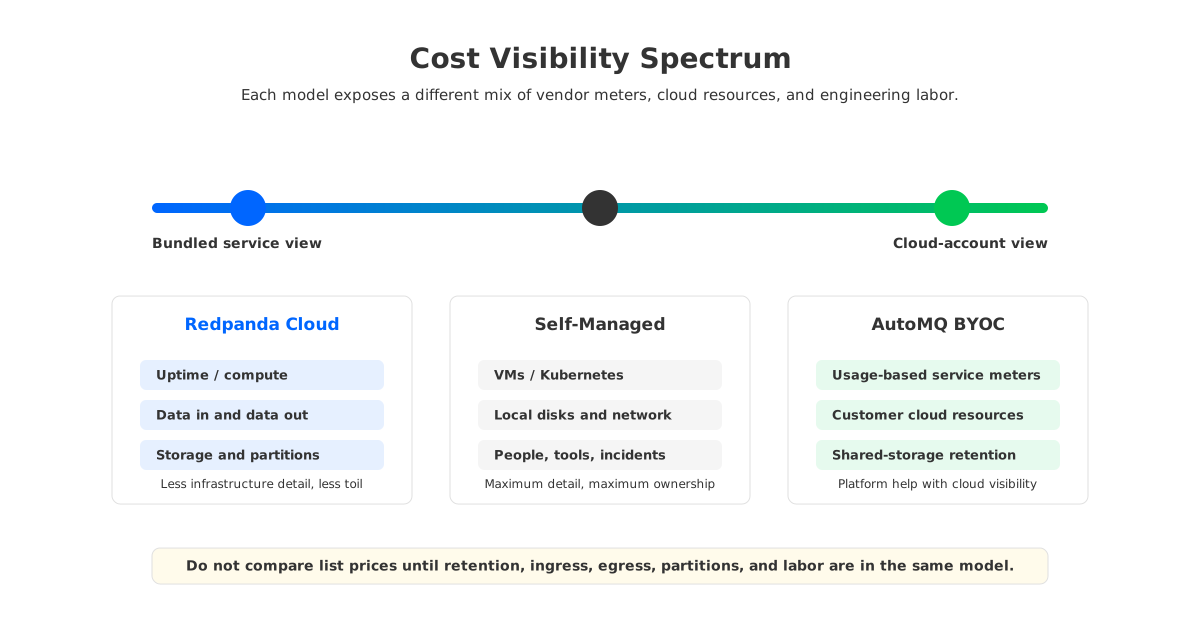
The cost model should include at least these buckets:
| Cost bucket | What to include |
|---|---|
| Service or license | Redpanda Cloud meters, Redpanda support terms, AutoMQ BYOC usage meters |
| Compute | Brokers, controllers, Kubernetes nodes, console nodes, Connect workers |
| Storage | Local disks, object storage, WAL storage, tiered storage, retention |
| Network | Client ingress/egress, cross-AZ traffic, private links, peering, NAT |
| Operations | On-call, upgrades, rebalancing, incidents, security review, audit evidence |
No model always costs less. Redpanda Cloud may reduce operational labor enough to justify the service bill. Self-managed Redpanda may be cost-effective for a team with platform automation and predictable traffic. AutoMQ BYOC may be compelling when retention and elasticity dominate, because shared storage and stateless brokers reduce durable state tied to broker instances.
4Data Control and Security Review
Security teams rarely ask only "is the product encrypted?" They ask where data goes, who can access the environment, how keys are managed, what logs exist, how break-glass access works, and what evidence can be exported. The three models answer differently.
Redpanda Cloud can shorten the review for teams that accept managed data infrastructure. The vendor owns more of the operational surface, reducing direct patching and upgrade work. The review focuses on contractual controls, cloud regions, data processing terms, access controls, private connectivity, support access, and cluster type. If all data-plane resources must live in the customer's VPC, Redpanda Cloud BYOC becomes relevant and should be reviewed as a specific deployment type.
Self-managed Redpanda gives the security team maximum direct control. IAM roles, KMS keys, security groups, Kubernetes policies, host images, scanners, logs, and incident tooling all follow customer standards. That can make audits cleaner when controls are mature, and slower when the streaming team must produce evidence a managed service would normally provide.
AutoMQ BYOC sits in the middle. AutoMQ's AWS docs state that environment components are deployed within the customer's AWS account, and the VPC guide calls out S3 gateway endpoints, EC2 interface endpoints, DNS, subnets, and security groups. Reviewers get concrete cloud objects to inspect, while still covering delegated permissions, console placement, operational authorization, telemetry, and support access.
5Scaling and Operations
Apache Kafka's original design treats partitions and replicas as broker-owned log state. Kafka's docs explain replication through leaders, followers, in-sync replicas, and log durability. Kafka tiered storage adds a local and remote tier: active segments stay on local broker disks, while completed segments can move to remote storage. Broker state and data movement remain central to operations.
Redpanda changes the engine behind the Kafka API, but self-managed Redpanda still requires the operator to own capacity, data placement, storage, upgrades, and failure handling. Redpanda Cloud abstracts more of that work, so the buyer evaluates service limits, cluster type, throughput envelope, support plan, and incident transparency.
AutoMQ changes the scaling conversation by separating compute from durable stream storage. AutoMQ's S3Stream docs describe offloading Kafka's log storage to object storage with WAL acceleration, and its stateless broker docs describe brokers as stateless because storage is separated from compute. Capacity planning still matters, but the question shifts from moving retained data across broker disks to sizing broker compute, WAL, cache, object storage, and network paths.
For operations teams, that architectural difference shows up in four places:
- Scale-out: self-managed systems need automation for broker addition, partition movement, and verification. Stateless brokers can reduce retained data movement with the compute layer.
- Scale-in: stateful brokers make downsizing sensitive because data and ownership must be drained. Shared storage makes compute removal less coupled to retained log volume.
- Recovery: broker failure in a stateful model often means replacement plus replica catch-up. In a shared-storage model, the durable data path is less tied to the failed broker.
- Upgrade risk: managed services reduce customer execution work; self-managed deployments maximize control; BYOC models require clear change windows and rollback evidence.
6Migration Risk and Kafka Compatibility
Migration is where "Kafka API-compatible" needs discipline. Redpanda is Kafka API-compatible, but it is not Apache Kafka internally. AutoMQ is Kafka-compatible while retaining Kafka's compute layer and replacing the storage layer. A quick producer/consumer test is not enough if the estate depends on transactions, idempotent producers, compacted topics, ACLs, Admin API behavior, connectors, offsets, consumer groups, monitoring, or failure semantics.
Apache Kafka's MirrorMaker 2 documentation is a useful baseline because it shows what real migrations involve: topic replication, consumer group offset replication, ACL replication, partition preservation, metrics, and replication flows. AutoMQ's Kafka Linking docs describe byte-to-byte copy, synchronized consumption progress, and a producer proxy path intended to reduce producer cutover downtime. Those claims still need a proof-of-concept against the actual estate, especially when the source is Redpanda rather than vanilla Apache Kafka.
A practical migration plan should prove five things:
| Proof area | What to test |
|---|---|
| Client behavior | Producer retries, idempotence, transactions, compression, batching, timeouts, consumer rebalances |
| Data continuity | Topic configs, partition counts, offsets, compaction behavior, retention, replay, ordering expectations |
| Security | Authentication, ACLs, certificates, secret rotation, network paths, audit logs |
| Operations | Monitoring, lag metrics, alerting, broker failure, rollback, upgrade path |
| Cutover | Dual-write policy, freeze window, proxy or DNS switch, consumer restart behavior, rollback deadline |
Redpanda Cloud can reduce operational migration work if the organization accepts the service boundary. Self-managed Redpanda gives more control, but every migration component becomes a customer responsibility. AutoMQ BYOC makes sense when the goal is Kafka client compatibility, customer-cloud data-plane control, and a different storage/scaling model.
7Decision Table
The cleanest decision is not "which platform has the most features?" It is "which operating model removes the risk we cannot afford while preserving required control?"
| Choose this model when... | Strong fit | Watch carefully |
|---|---|---|
| You want Redpanda with the least day-to-day infrastructure work | Redpanda Cloud | Cluster type, data residency, private networking, support plan, service meters |
| You need full infrastructure control and have a mature platform team | Self-managed Redpanda | Upgrade automation, storage operations, security evidence, hidden labor cost |
| You need customer-cloud data control with managed Kafka-compatible operations | AutoMQ BYOC | Cloud permissions, VPC prerequisites, support access, migration proof |
| Retention and scaling dominate the cost model | AutoMQ BYOC or another shared-storage design | Object storage behavior, WAL design, cache sizing, network paths |
| Security requires direct cloud-resource evidence | Self-managed Redpanda or AutoMQ BYOC | Audit logs, IAM/KMS ownership, operational access boundaries |
If the organization is optimizing for speed to production, Redpanda Cloud deserves a serious look. If it is optimizing for internal platform control, self-managed Redpanda is the more direct model. If it is optimizing for customer-cloud data ownership while reducing stateful Kafka operations, AutoMQ BYOC is the architecture to evaluate.
The wrong answer is to choose by label. "Managed," "self-managed," and "BYOC" only become meaningful when the responsibility boundary is drawn and the bill is modeled with the workload in front of you. If you are evaluating BYOC Kafka-compatible architecture, start with cloud resources and migration path rather than a feature table: review the AutoMQ BYOC AWS deployment guide and map it against your VPC, IAM, storage, and cutover requirements.
8FAQ
8.1Is self-managed Redpanda always less expensive than Redpanda Cloud?
No. Self-managed Redpanda can expose lower raw infrastructure costs in some workloads, but it adds engineering labor, upgrades, monitoring, incident response, capacity planning, and security evidence. A fair comparison includes compute, storage, network, service fees, and labor.
8.2How is AutoMQ BYOC different from self-managed Redpanda?
Self-managed Redpanda is customer-operated Redpanda software. AutoMQ BYOC deploys Kafka-compatible AutoMQ infrastructure in the customer's cloud account while using AutoMQ's platform layer to manage the environment. AutoMQ uses shared storage and stateless brokers, while Redpanda uses its own Kafka API-compatible engine and storage model.
8.3Does BYOC mean the vendor cannot access anything?
No. BYOC usually means customer data-plane resources run in the customer's cloud account or VPC, but the exact vendor access model depends on the product. Review IAM roles, operational authorization, support access, telemetry, logs, and break-glass procedures.
8.4Can Kafka applications move from Redpanda to AutoMQ without code changes?
Often the client path can remain Kafka-compatible, but production migration should be proven rather than assumed. Test producers, consumers, transactions, compaction, ACLs, Admin API usage, connectors, offsets, monitoring, and rollback. AutoMQ's Kafka Linking documentation describes byte-to-byte copy and synchronized consumption progress, but every real estate needs a rehearsal.
9References
- Redpanda Cloud deployment types
- Redpanda BYOC architecture
- Redpanda Cloud billing metrics
- Redpanda self-managed deployment
- Apache Kafka design: replication
- Apache Kafka MirrorMaker 2 / geo-replication
- Apache Kafka tiered storage
- AutoMQ BYOC installation on AWS
- AutoMQ BYOC AWS VPC preparation
- AutoMQ S3Stream shared storage architecture
- AutoMQ stateless broker architecture
- AutoMQ BYOC usage-based billing
- AutoMQ Kafka Linking migration overview
- AutoMQ GitHub repository


