
Table of Contents
Table of Contents
Teams searching for Redpanda competitors are rarely asking a simple vendor question. They are asking whether a Kafka API-compatible engine should become the center of their streaming platform, or whether another operating model fits the workload. Redpanda has a credible position: it speaks the Kafka API, offers Cloud deployment choices, and documents compatibility for Kafka clients 0.11 and later with stated exceptions.
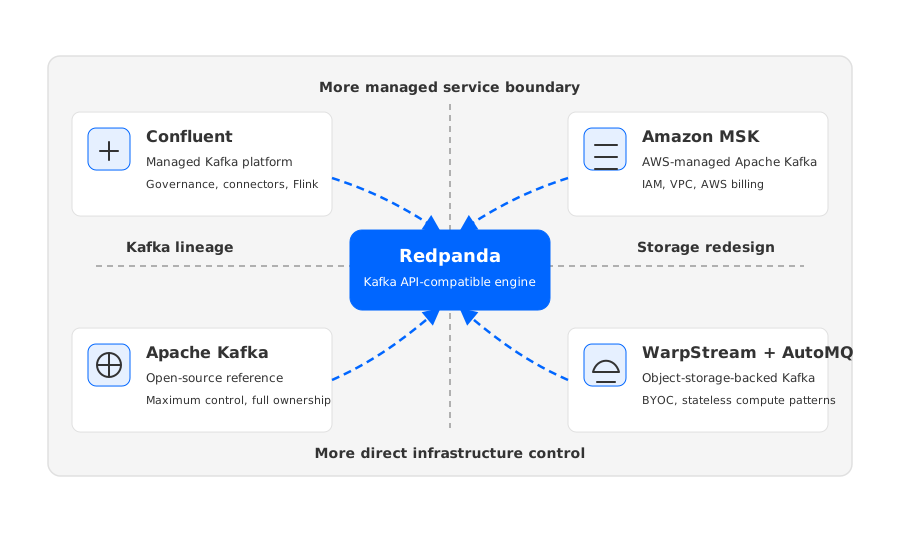
The comparison gets more useful when it stops looking like a ranked list. Confluent, Amazon MSK, WarpStream, Apache Kafka, and AutoMQ compete with Redpanda from different architectural directions: managed platform, AWS-native service, diskless BYOC, open-source baseline, and Kafka-compatible shared storage.
1How to Categorize Redpanda Competitors
A Redpanda shortlist should start with five questions, not five logos. What latency budget does the workload actually need? Which Kafka behaviors must remain identical? Who owns the data plane and cloud account? Which cost driver dominates the bill: compute, storage, replication traffic, retained history, partitions, connectors, or operational labor? How much migration risk can the team absorb?
Those questions create five categories:
- Kafka API-compatible engine: Redpanda fits here. The buyer is choosing an alternative implementation that preserves the Kafka client contract while changing broker internals and operations.
- Managed Kafka platform: Confluent Cloud fits here. The buyer wants Apache Kafka plus a broader platform for governance, connectors, Flink, stream sharing, and managed operations.
- Cloud-provider Kafka service: Amazon MSK fits here. The buyer wants Kafka inside the AWS service boundary, with AWS billing, IAM, networking, and operational integration.
- Diskless or shared-storage Kafka-compatible platform: WarpStream and AutoMQ fit near this category, with different designs. The buyer is questioning whether durable stream data should remain tied to broker-local disks.
- Self-managed open-source Kafka: Apache Kafka itself fits here. The buyer values ecosystem continuity, operational control, and an open-source baseline enough to own the complexity.
This framing keeps the comparison honest. Redpanda may be attractive when engine simplicity and low-latency Kafka-compatible streaming are the main goals. It is less clear when the real constraint is managed governance, AWS procurement alignment, object-storage economics, or a conservative migration path from a large Kafka estate.
2Redpanda as the Baseline Candidate
Redpanda's own documentation describes it as a fault-tolerant transaction log where producers and consumers interact through the Kafka API. Its architecture pages also describe tiered storage as a way to offload log segments to object storage while retaining local storage for recent reads. Redpanda Cloud adds Serverless, Dedicated, and BYOC deployment options; the BYOC model runs in the customer's cloud environment while Redpanda manages provisioning, monitoring, upgrades, and related cloud resources.
That gives Redpanda a sharp baseline profile. It is a Kafka API-compatible engine with its own storage and execution model, plus cloud deployment choices. Redpanda Serverless pricing is usage-based across traffic, retention storage, partitions, and instance time, while BYOC tiers are sized by ingress, egress, partitions, and connections.
The migration claim deserves the same precision. Redpanda documents Redpanda Migrator as a Redpanda Connect-based path that can move messages, schemas, ACLs, topics, and consumer group offset translation from Kafka-compatible systems to Redpanda. Production teams still need to test the source cluster, schema registry behavior, ACL model, offset cutover, client versions, and rollback plan. Kafka compatibility lowers migration risk; it does not remove it.
3Confluent: Broad Managed Kafka Platform
Confluent is the competitor to evaluate when the buying question is broader than brokers. Confluent Cloud offers Basic, Standard, Enterprise, Dedicated, and Freight cluster types, with eCKU-based elastic capacity for several cluster types and CKU-based capacity for Dedicated clusters. Its billing dimensions include data transfer, storage, compute units, and add-on services such as connectors, ksqlDB, and Flink SQL.
That model fits teams that want a managed Kafka platform rather than a Kafka engine decision. Confluent can be compelling when the roadmap includes managed connectors, Stream Governance, Cluster Linking, Flink, Tableflow, private networking, and multi-cloud availability. IBM completed its acquisition of Confluent on March 17, 2026; some buyers will value the IBM portfolio, while others will treat integration as a roadmap review item.
The tradeoff is that the platform boundary becomes part of the architecture. Buyers must model eCKU or CKU behavior, data in and out, stored data, private networking, connector usage, support terms, and exit path. If Redpanda is being considered because the team wants a simpler engine, Confluent may feel expansive. If the goal is less Kafka operations burden and more platform services, Confluent belongs on the shortlist.
4Amazon MSK: AWS-Native Kafka Operations
Amazon MSK is the Redpanda competitor for AWS-first teams that want managed Apache Kafka inside familiar cloud operations. MSK offers provisioned and serverless models. MSK Serverless automatically provisions and scales capacity and uses throughput-based pricing. MSK Provisioned includes Standard and Express brokers; AWS describes Express brokers as offering pay-as-you-go storage, faster scaling, and lower recovery time than Standard brokers under its comparison conditions.
MSK's strongest fit is organizational as much as technical. Procurement, security, IAM, networking, observability, and cloud cost allocation already live in AWS for many teams. MSK tiered storage for Standard brokers also supports longer retention without provisioning the low-cost tier, though AWS documents constraints, including availability only for provisioned clusters, no support for compacted topics, and an expected initial latency increase when reading from the remote tier.
The cost model needs careful handling. AWS pricing calls out broker instance usage, storage, and standard AWS data transfer charges for data transferred in and out of MSK clusters. For workloads with heavy cross-zone client paths, high fan-out, or long retention, the bill is not captured by broker count alone. MSK is often the conservative AWS-native answer, but it is not a shortcut around Kafka's underlying workload math.
5Apache Kafka: Maximum Control, Maximum Ownership
Apache Kafka remains the reference point for this comparison. The official design documentation describes partitions as the unit of replication, each with one leader and zero or more followers under normal operation; reads and writes go through the leader. Kafka's tiered storage documentation describes a local tier on broker disks and a remote tier for completed log segments in external storage such as S3.
That architecture is mature and widely understood. It also explains the operational burden. Kafka teams still need to plan replication factor, leader placement, disk usage, partition count, broker replacement, upgrades, KRaft metadata operations, quotas, client compatibility, and disaster recovery. Those responsibilities are acceptable when the team has strong Kafka automation, predictable workload shape, and a preference for open-source control.
Kafka becomes a weaker fit when the pain is cloud economics and elasticity. Broker-local storage couples durable data to machines. Reassignment and recovery can become data movement projects. Tiered storage helps with retention, but it does not make the broker stateless because the local tier and leader model still matter.
6WarpStream and AutoMQ: Shared-Storage Thinking, Different Designs
WarpStream is relevant because it attacks a different premise: that a Kafka-compatible system must be a cluster of stateful brokers with local disks. WarpStream's documentation describes stateless Agents that speak the Kafka protocol, write data to object storage, and use a Cloud Metadata Store. Its write path acknowledges produce requests after data is written to object storage and metadata is committed, and its billing documentation describes consumption-based dimensions such as cluster-minutes, uncompressed GiB written, and uncompressed GiB stored.
AutoMQ belongs in the same architectural conversation, but not as the same design. AutoMQ is a Kafka-compatible shared-storage platform built around S3Stream. Its documentation describes replacing Kafka's local log storage with shared object storage while using WAL and cache components for write and read paths. Because broker nodes are stateless, scaling and replacement are less tied to moving partition data between local disks.
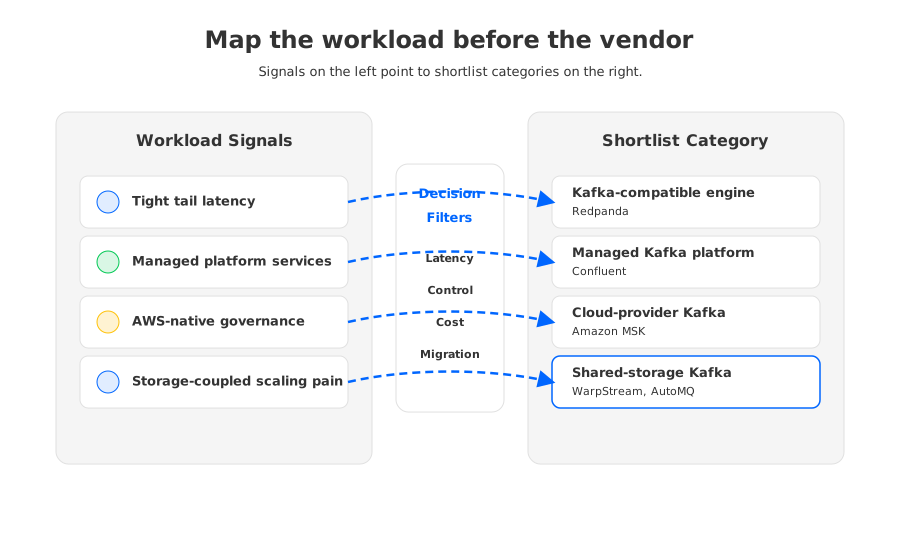
The shared-storage category is worth evaluating when the workload has one or more of these signals:
- Retention is long enough that broker disk sizing drives overprovisioning.
- Recovery, broker replacement, or partition reassignment creates operational risk.
- Cross-zone replication or client data paths create a recurring cloud-network cost line.
- The platform team wants Kafka compatibility but does not want durable data attached to broker lifecycle.
- BYOC data control matters, but the team still wants a vendor-supported operating model.
The honest caution is latency. Object storage is durable and cost-effective, but it changes the write and read path. WarpStream addresses this with batching, metadata coordination, and cache design. AutoMQ addresses it with S3Stream, WAL, and cache architecture. Test producer acknowledgments, message size, batching, fan-out, replay, compaction needs, failure drills, and tail percentiles against the workload that matters.
7Redpanda Competitor Decision Matrix
A decision matrix should not pretend that every competitor answers the same question. It should force the team to name the workload and the operating model before choosing a platform.
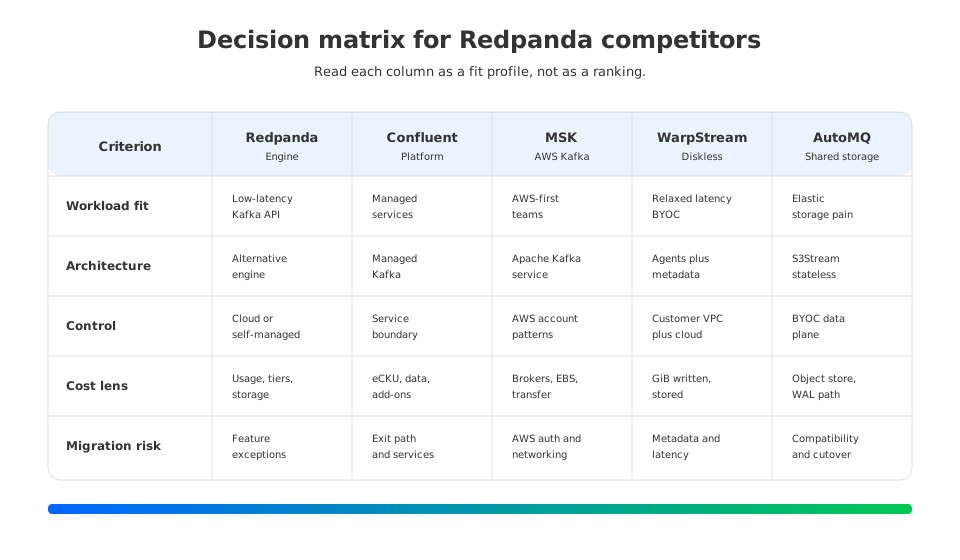
| Candidate | Strong fit | Architecture control | Cost model to inspect | Migration risk focus |
|---|---|---|---|---|
| Redpanda | Teams wanting a Kafka API-compatible engine with simplified operations | Engine and deployment model differ from Apache Kafka | Serverless usage dimensions, BYOC tier, storage, networking, support | Kafka feature exceptions, Redpanda Migrator behavior, client edge cases |
| Confluent | Teams wanting managed Kafka plus governance, connectors, Flink, and platform services | Managed service boundary and IBM portfolio alignment | eCKU/CKU, data transfer, storage, connectors, private networking | Platform dependency, service features, exit path |
| Amazon MSK | AWS-first teams wanting managed Apache Kafka | AWS service boundary, broker type, IAM, VPC design | Broker hours, storage, tiered storage, data transfer, serverless throughput | AWS-specific auth/networking, tiered storage constraints, Kafka version |
| Apache Kafka | Teams with mature Kafka operations and open-source preference | Highest direct control | Compute, disks, replication traffic, operator time | Operational ownership, reassignment, upgrades, disaster recovery |
| WarpStream | Teams wanting diskless Kafka-compatible BYOC for object-storage economics | Agent pool plus Confluent/WarpStream metadata and control services | Cluster-minutes, GiB written, GiB stored, object storage, network path | Metadata dependency, latency profile, Kafka feature depth |
| AutoMQ | Teams wanting Kafka compatibility, shared object storage, stateless brokers, and BYOC control | Kafka-facing behavior with S3Stream-backed shared storage | Cloud infrastructure, object storage, WAL/cache path, managed service fee | Compatibility, migration tooling, storage-path performance |
The matrix usually reveals two shortlists. If the dominant requirement is managed platform capability, compare Redpanda Cloud with Confluent and MSK. If the dominant requirement is changing Kafka's storage economics, compare Redpanda with WarpStream and AutoMQ. If openness and control dominate, keep Apache Kafka in the evaluation.
8How to Run a Fair Proof of Concept
The weakest Redpanda competitor evaluations use a synthetic producer, a tiny topic, and a dashboard screenshot. That kind of test can prove that a cluster boots. It cannot prove that the platform fits production.
Use a workload-fit proof of concept instead:
- Compatibility: Run the actual client libraries, serializers, ACLs, schemas, idempotent producers, compaction settings, consumer group behavior, and observability tools.
- Architecture: Test replacement, scale-out, scale-in, partition movement, retention changes, replay, and failure recovery.
- Control: Map data path, control path, metadata path, IAM permissions, private networking, telemetry, support access, and audit requirements.
- Cost: Model the same ingress, egress, fan-out, retention, partitions, availability zones, storage class, and support level across candidates.
- Migration: Rehearse replication strategy, offset continuity, schema migration, producer switch, consumer switch, rollback, and decommissioning.
This is where AutoMQ should enter naturally for teams that discover their constraint is storage-coupled Kafka operations rather than the Kafka API itself. If durable data should live in shared object storage and brokers should behave more like stateless compute, AutoMQ is a relevant candidate alongside WarpStream and Redpanda. If managed connectors and governance are harder problems, Confluent may deserve more attention. If AWS procurement and managed Apache Kafka are the center of gravity, MSK may win without being the most radical architecture.
The search query starts with "Redpanda competitors," but the real decision is workload ownership. Choose the platform whose tradeoffs match the workload you can name, measure, and migrate. For teams evaluating Kafka-compatible shared storage as part of that shortlist, the practical next step is to test AutoMQ against the same Redpanda baseline with real topics, client settings, retention, and failure drills: talk to the AutoMQ team.
9References
- Redpanda Kafka compatibility documentation
- Redpanda Cloud overview
- Redpanda BYOC documentation
- Redpanda Cloud billing documentation
- Redpanda Serverless pricing page
- Redpanda Migrator documentation
- Confluent Cloud cluster types
- Confluent Cloud billing overview
- Confluent Cloud pricing page
- IBM completion of Confluent acquisition
- Amazon MSK pricing
- Amazon MSK Serverless documentation
- Amazon MSK tiered storage documentation
- Amazon MSK Express brokers documentation
- WarpStream architecture documentation
- WarpStream write path documentation
- WarpStream billing documentation
- Confluent acquisition of WarpStream announcement
- Apache Kafka design documentation
- Apache Kafka tiered storage documentation
- AutoMQ S3Stream overview
- AutoMQ stateless broker documentation
- AutoMQ GitHub repository
- AutoMQ migration documentation
10FAQ
10.1What is the closest Redpanda competitor?
It depends on why Redpanda is on the shortlist. Confluent is closest for managed Kafka platform services. MSK is closest for AWS-native managed Kafka. WarpStream and AutoMQ are closer for object-storage-backed Kafka-compatible architectures. Apache Kafka is the reference option when open-source control matters most.
10.2Is Redpanda a drop-in replacement for Kafka?
Redpanda documents Kafka API compatibility for clients 0.11 and later, with specific exceptions. Treat that as a strong starting point, not a substitute for testing. Validate client versions, ACLs, schemas, compaction, transactions if used, consumer groups, monitoring, failure handling, and rollback.
10.3When should AutoMQ be compared with Redpanda?
Compare AutoMQ with Redpanda when the problem is Kafka's storage and elasticity model in the cloud. AutoMQ keeps Kafka compatibility while using S3Stream, shared object storage, and stateless brokers. That makes it relevant for retention-heavy workloads, storage-coupled scaling pain, broker replacement risk, BYOC requirements, and cost reviews.
10.4Is WarpStream the same kind of competitor as AutoMQ?
They are in the same broader object-storage-backed conversation, but the designs differ. WarpStream uses stateless Agents, object storage, and a Cloud Metadata Store. AutoMQ uses S3Stream, shared object storage, WAL, and cache components. Both require workload testing rather than category labels.
10.5Should teams choose Redpanda, Confluent, MSK, Kafka, WarpStream, or AutoMQ based on price?
Price alone is a weak selector because each platform exposes different cost drivers. Model the same workload across candidates: ingress, egress, retention, partitions, fan-out, availability zones, private networking, support, and migration cost. Choose the architecture whose cost profile remains acceptable under real growth and failure patterns.


