
Table of Contents
Table of Contents
A search for Redpanda Connect alternatives usually starts after the broker decision has already become more complicated. The team may like Redpanda for Kafka API compatibility, but the pipeline estate has its own gravity: CDC jobs, SaaS ingest, S3 sinks, schema conversion, retries, DLQs, secrets, monitoring, and deployment ownership. Replacing the streaming platform without auditing those pipeline responsibilities is how a clean architecture diagram turns into a long migration week.
The first mistake is treating "connector" as one category. Redpanda Connect, Kafka Connect, managed connector services, stream processing frameworks, and a Kafka-compatible platform such as AutoMQ sit at different layers. Some move data between systems; others execute transformations, host workers, or provide the durable Kafka-compatible log. A useful alternative search separates those layers before comparing vendors.

That separation keeps the evaluation honest. AutoMQ can be a Kafka-compatible streaming and storage platform for pipeline topics, especially when a team wants shared storage, stateless brokers, and customer-controlled deployment boundaries. It is not a drop-in replacement for every Redpanda Connect component, processor, or Kafka Connect plugin. The useful question is which runtime owns each pipeline responsibility, and which platform should carry the Kafka-compatible data path.
1Why Connectors Matter in a Redpanda Replacement
Kafka teams often evaluate Redpanda at the broker layer: protocol support, client behavior, latency, storage, operational model, and cloud packaging. Pipeline teams feel a different set of risks. A source connector can restart from the wrong checkpoint. A sink can create duplicates when an external system times out. A schema converter can change subject naming. A DLQ that existed in one runtime may need a different topic, header policy, or alert path in another.
The evaluation should therefore start with five inventory questions:
- Which source and sink systems are in production, and which are business-critical rather than convenience integrations?
- Where does each pipeline store state, offsets, checkpoints, and retry metadata?
- Which schema registry, converter, serialization format, and subject naming rules does each pipeline assume?
- How are bad records handled: fail fast, retry, skip, quarantine, or publish to a dead letter queue?
- Who owns worker sizing, plugin upgrades, logs, metrics, secrets, certificates, and incident response?
Broker compatibility does not answer those questions. It gives the connector runtime a Kafka-compatible endpoint. The runtime still decides how records are acquired, transformed, retried, committed, and delivered.
2Redpanda Connect vs Kafka Connect Concepts
Redpanda Connect and Kafka Connect both appear in Kafka pipeline conversations, but they come from different mental models. Redpanda Connect is derived from Benthos and presents itself as a declarative stream processor for building pipelines from inputs, processors, and outputs. It is useful when a team wants YAML-defined data flows, message-level processing, and connectors that can target Kafka-compatible systems among other endpoints.
Kafka Connect is part of Apache Kafka's integration layer. The Apache Kafka documentation describes Kafka Connect as a framework for scalably and reliably streaming data between Kafka and external systems. Its model is built around connectors, tasks, workers, converters, transformations, and internal topics that hold connector configuration, offsets, and status. That design makes Kafka Connect especially relevant when the team's pipeline estate already depends on the Kafka connector ecosystem.
The distinction is more than naming:
| Evaluation area | Redpanda Connect | Kafka Connect |
|---|---|---|
| Primary model | Declarative pipeline runtime with inputs, processors, and outputs. | Distributed connector framework with workers, connectors, and tasks. |
| Ecosystem shape | Redpanda Connect components and processors, with Kafka-compatible inputs and outputs among many options. | Kafka Connect plugins, converters, SMTs, and a broad vendor/community connector ecosystem. |
| State model | Depends on component and pipeline configuration. Validate checkpoint and replay behavior per pipeline. | Uses Kafka topics for config, offsets, and status in distributed mode. Validate topic settings and worker behavior. |
| Operational unit | Pipeline deployment and runtime resources. | Worker cluster, plugin path, connector config, task parallelism, and rebalance behavior. |
| Migration concern | Component equivalence, YAML semantics, processor behavior, and output guarantees. | Plugin availability, connector config parity, converters, offset migration, and internal topic compatibility. |
This table is a translation guide, not a winner selection. A team with many Kafka Connect plugins should test Kafka Connect compatibility before assuming a Redpanda Connect component provides the same behavior.
3Four Alternative Patterns for Kafka Pipelines
Most Redpanda Connect alternative searches end up in one of four patterns. The right pattern depends on what the team is replacing: pipeline syntax, connector catalog, operational ownership, or the streaming platform underneath the pipeline.
The first pattern is Kafka Connect on a Kafka-compatible platform. This is the most direct path when the pipeline estate depends on Kafka Connect connectors, converters, SMTs, and worker semantics. The platform can be Apache Kafka, a managed Kafka service, or a Kafka-compatible system that supports the client and protocol behavior the workers need. The test is practical: can the workers create and use their internal topics, authenticate, produce and consume at the required rate, and keep connector status stable under restarts?
The second pattern is a managed connector service. This reduces worker operations, plugin packaging, and upgrade work. The tradeoff is service boundary. You need to understand which connectors are available, how private networking works, where data flows, how secrets are stored, how errors are surfaced, and which configuration knobs are hidden by the provider.
The third pattern is Redpanda Connect or another declarative pipeline runtime pointed at a different Kafka-compatible target. This can work when the pipeline logic itself is valuable and the broker target is changing. It keeps the input/processor/output model but moves the durable topic layer. The main risk is output behavior: delivery guarantees, batching, partitioning, headers, TLS/SASL settings, and producer retry behavior must be validated against the target platform.
The fourth pattern is stream processing plus connectors. Apache Flink, Kafka Streams, Spark Structured Streaming, and similar systems can own transformations, joins, stateful processing, or enrichment, while connectors handle source and sink edges. This is powerful when pipeline logic has outgrown connector transforms. It is excessive when the job is a straightforward database-to-topic or topic-to-warehouse movement.
That map prevents overbuying. If your pain is worker operations, a managed connector layer may help. If your pain is broker scaling or long retention cost, changing connector syntax will not solve it.
4Connector Evaluation Criteria
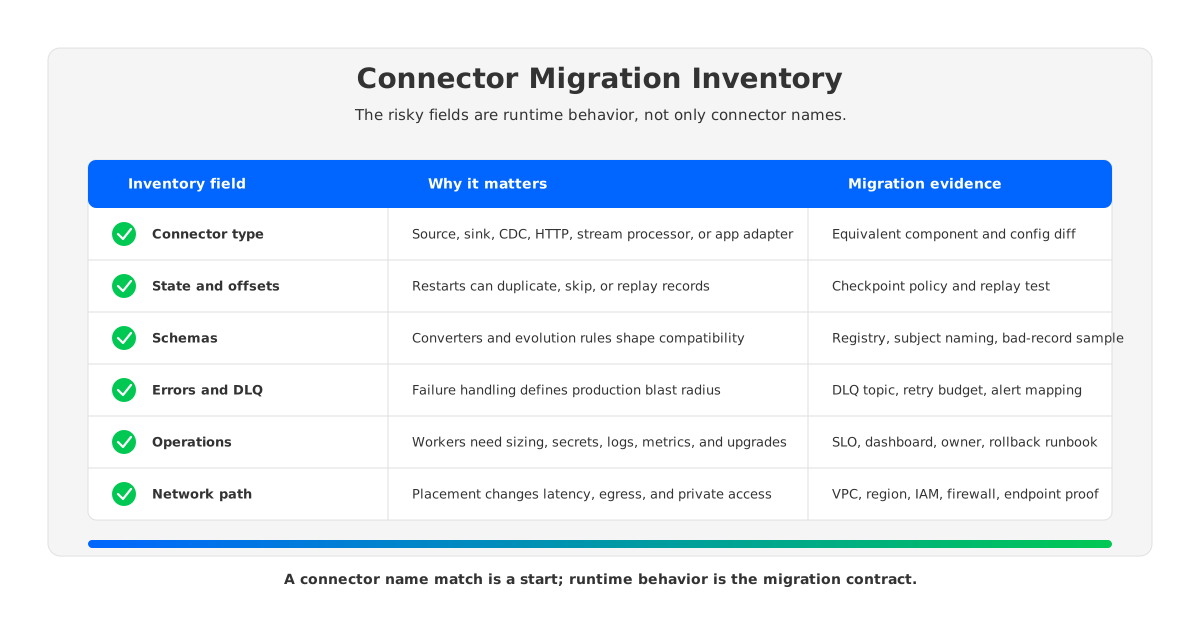
Strong connector evaluation documents look boring at first. They list every pipeline, owner, source, sink, format, authentication method, throughput profile, retry policy, and rollback path. That inventory is how the team avoids discovering during cutover that a "minor" connector was the hidden path feeding a finance table.
4.1Source and Sink Coverage
Coverage starts with names but cannot stop there. "PostgreSQL connector" can mean snapshot support, logical decoding mode, delete semantics, tombstones, and restart behavior. "S3 sink" can mean object naming, rotation policy, compression, partitioning, and downstream file-layout expectations.
For each connector, record the behavior that matters:
- Snapshot, backfill, and restart semantics for sources.
- Idempotency, batching, and transaction behavior for sinks.
- Header, key, partitioning, timestamp, and tombstone handling.
- Limits around message size, throughput, rate limiting, and parallelism.
- Whether the connector is supported by the vendor, community, or an internal team.
Catalog size is useful for search, but production fit depends on the exact component, version, configuration, and failure mode.
4.2Schema and Error Handling
Schema handling is where "it produced a test record" becomes misleading. Kafka Connect pipelines often rely on converters, schema registry behavior, and subject naming strategies; Redpanda Connect and managed connector services may express or constrain those choices differently.
Bad-record behavior deserves the same scrutiny. DLQ behavior must be explicit: topic name, record headers, original payload preservation, error metadata, retention, alerting, replay process, and ownership.
The most useful migration test is not the happy path. Inject a malformed record, a schema-incompatible record, a downstream timeout, and a worker restart. Then compare the observable result with the current production contract.
4.3Operations and Monitoring
Connector operations are a platform responsibility even when the connector code comes from a vendor. Kafka Connect workers need CPU, memory, plugin packaging, rolling upgrades, rebalance control, internal topic health, logs, and metrics. Redpanda Connect pipelines need deployment automation, config management, resource sizing, and component lifecycle control.
Monitoring should be designed around decisions, not dashboards. Operators need to know whether a connector is lagging, retrying, dead-lettering, throttled by a sink, blocked by authentication, or mis-sized.
5Running Connectors with Kafka-Compatible Platforms
Kafka-compatible platforms make connector portability possible, but not automatic. A connector worker is still a Kafka client. It uses producer, consumer, admin, security, and topic APIs. It may create internal topics, depend on compaction, use exactly-once-related settings, or assume certain broker error behavior. That means the validation target is the full connector runtime, not only a sample producer and consumer.
For Kafka Connect, validate the basics first: worker bootstrap, authentication, internal topic creation, config topic compaction, offset topic retention, status topic updates, task restart, and rebalance behavior. Then validate the actual plugin with real data. A platform can be compatible enough for normal producers and consumers while still exposing edge cases in admin APIs, transactions, compaction settings, ACLs, or high-task-count worker behavior.
For Redpanda Connect or other pipeline runtimes, validate Kafka input and output components against the target. Check acknowledgments, compression, batching, headers, partition keys, TLS/SASL, retries, and backpressure. If the runtime reads from Kafka and writes to an external sink, test both sides under failure. The streaming platform is one side of the contract.
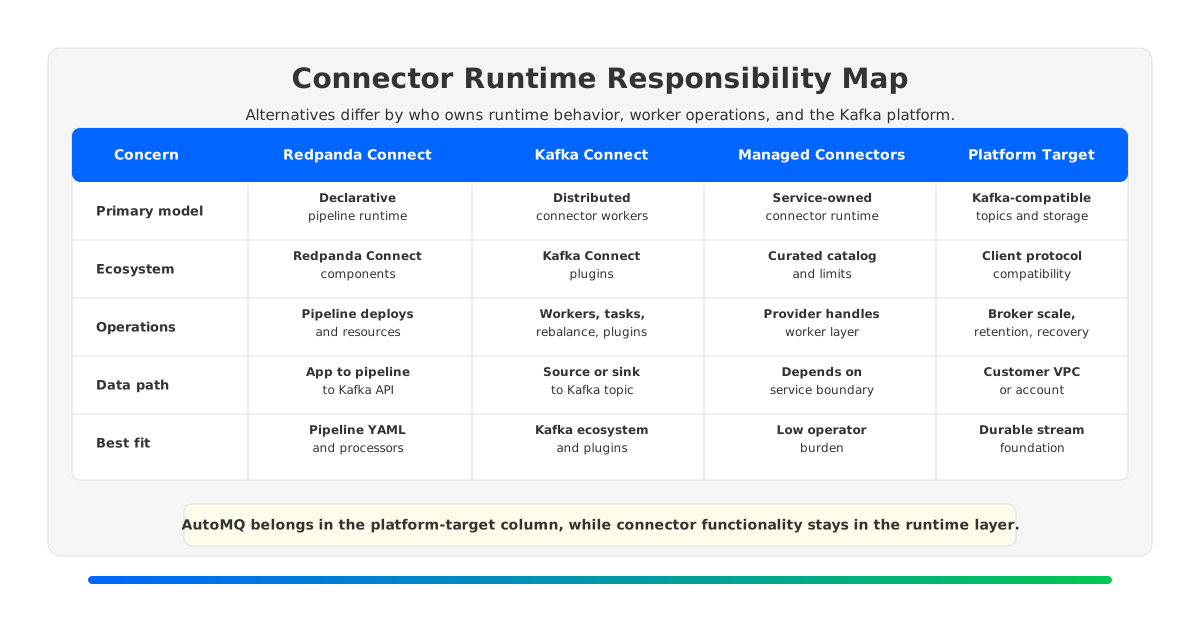
This is also where data path control matters. A managed connector can be operationally attractive but may introduce data movement across service boundaries. A BYOC connector runtime can keep workers, Kafka-compatible brokers, object storage, and private endpoints inside the customer's cloud account or VPC, but the team owns more deployment detail. Neither model is universally better; they optimize different risks.
6Where AutoMQ Fits in a Pipeline Architecture
AutoMQ belongs in the streaming platform layer of this discussion. It is a Kafka-compatible system that reworks Kafka storage around shared object storage and stateless brokers. That makes it relevant when a team wants Kafka protocol compatibility for clients and ecosystem tools, while changing the cost, elasticity, and recovery assumptions of the underlying stream storage layer.
For connector teams, that positioning has a concrete implication: keep the connector runtime decision separate from the platform decision. You might run Kafka Connect workers against AutoMQ topics, use a managed connector service, or keep a Redpanda Connect pipeline and change only the Kafka-compatible target.
The clean boundary is this: AutoMQ can provide the durable Kafka-compatible foundation for pipeline topics and can participate in connector operations through its connector offering. It should not be described as a universal substitute for Redpanda Connect processors, every Kafka Connect plugin, or a stream processing engine. That restraint makes the recommendation more useful, because production pipeline teams already know that integration details are where migrations succeed or fail.
7A Practical Decision Framework
Start by naming the layer you are unhappy with. If Redpanda Connect pipeline syntax, component support, or processor behavior is the constraint, compare declarative pipeline runtimes and Kafka Connect plugin coverage. If worker operations are the constraint, compare self-managed Kafka Connect, managed connectors, and BYOC connector operations. If broker recovery, retention cost, scaling, or cloud data control is the constraint, compare Kafka-compatible streaming platforms.
The short version looks like this:
| If the main pain is... | Evaluate first | Do not confuse it with... |
|---|---|---|
| Missing source or sink coverage | Connector catalog and plugin maturity | Broker architecture |
| Pipeline transformation complexity | Stream processing or declarative pipeline runtime | Basic source/sink movement |
| Worker operations burden | Managed connectors or BYOC managed runtime | Connector semantics |
| Long retention, scaling, recovery, cloud cost | Kafka-compatible platform architecture | Connector count |
| Data residency and private networking | BYOC boundaries and data path | Public feature list |
In production, a "Redpanda Connect alternative" is often a combination: connector runtime, schema registry, observability, secret management, Kafka-compatible platform, and operational ownership.
8Connector Inventory Checklist Before You Switch
Before replacing Redpanda Connect, moving to Kafka Connect, or changing the platform behind connector workloads, run a small but strict audit. The goal is not to produce a beautiful spreadsheet. The goal is to find the one pipeline that can break a cutover.
- List every pipeline, connector, source, sink, owner, and business dependency.
- Export current configuration, secrets references, schema settings, and topic mappings.
- Record offset, checkpoint, snapshot, and replay behavior for each source.
- Document sink idempotency, duplicate handling, and rollback behavior.
- Test malformed records, schema changes, downstream timeouts, and worker restarts.
- Validate metrics, logs, DLQ topics, alert routing, and runbook ownership.
- Run a pilot against the target Kafka-compatible platform before moving a critical connector.
The pilot should include at least one source connector, one sink connector, one schema-bearing pipeline, one DLQ case, one restart test, and the platform behavior that motivated the change: retention, replay, throughput, networking, or recovery.
9References
- Redpanda Docs: Introduction to Redpanda Connect
- Redpanda Docs: Redpanda Connect components
- Redpanda Docs: Managed connectors
- Apache Kafka Docs: Kafka Connect overview
- Apache Kafka Docs: Kafka Connect generated documentation
- AutoMQ Docs: What is AutoMQ
- AutoMQ GitHub: AutoMQ repository
- AutoMQ: Managed Kafka Connector
10FAQ
10.1Is Redpanda Connect the same as Kafka Connect?
No. Redpanda Connect is a declarative pipeline runtime derived from Benthos, organized around inputs, processors, and outputs. Kafka Connect is Apache Kafka's connector framework, organized around workers, connectors, tasks, converters, transformations, and internal Kafka topics. They can both participate in Kafka pipelines, but they are not the same runtime.
10.2Can Kafka Connect run with Redpanda?
Kafka Connect can often work with Kafka-compatible platforms, but production use should be validated with the actual workers, plugins, security settings, internal topics, and connector workloads. Do not rely only on a producer/consumer smoke test.
10.3What is the closest Redpanda Connect alternative?
It depends on what you use Redpanda Connect for. For Kafka ecosystem connectors, Kafka Connect is the natural comparison. For YAML-defined message pipelines and processors, another declarative pipeline runtime may be closer. For reduced operations, managed connectors may be closer.
10.4Does AutoMQ replace Redpanda Connect?
AutoMQ is primarily a Kafka-compatible streaming and storage platform, not a universal replacement for Redpanda Connect components or processors. AutoMQ can be the Kafka-compatible target for connector workloads and offers managed Kafka connector capabilities, but connector-specific behavior still needs validation.
10.5What should I test before migrating connector workloads?
Test connector state, offsets, schema conversion, DLQ behavior, retries, sink idempotency, worker restarts, authentication, internal topics, monitoring, and rollback. The most important test is the failure path, because that is where connector runtimes differ most.
The connector decision and the platform decision are related, but they are not interchangeable. If your pipeline estate depends on Kafka-compatible topics and you are evaluating a platform with shared storage, stateless brokers, and customer-controlled deployment boundaries, start with the AutoMQ documentation and run the connector inventory against your own pipelines.


