
Table of Contents
Table of Contents
Cost optimization for Redpanda should not start with a replacement shortlist. It should start with a map of what the bill and the operating model are actually paying for: compute, storage, retention, data movement, client behavior, recovery headroom, and engineering time. Many expensive clusters are not architecturally wrong. They are under-measured, over-retained, over-partitioned, or shaped by old producer and consumer defaults.
There is also a point where tuning becomes a local fix for a structural problem. If storage grows faster than traffic, peak capacity sits idle for most of the day, scaling requires large data movement, or recovery depends on broker-local state, the cost ceiling may come from architecture rather than configuration. At that point, a Kafka-compatible shared-storage design such as AutoMQ becomes a reasonable architecture to evaluate, not because every Redpanda deployment should move, but because some cost patterns are created by the coupling between broker compute and durable storage.
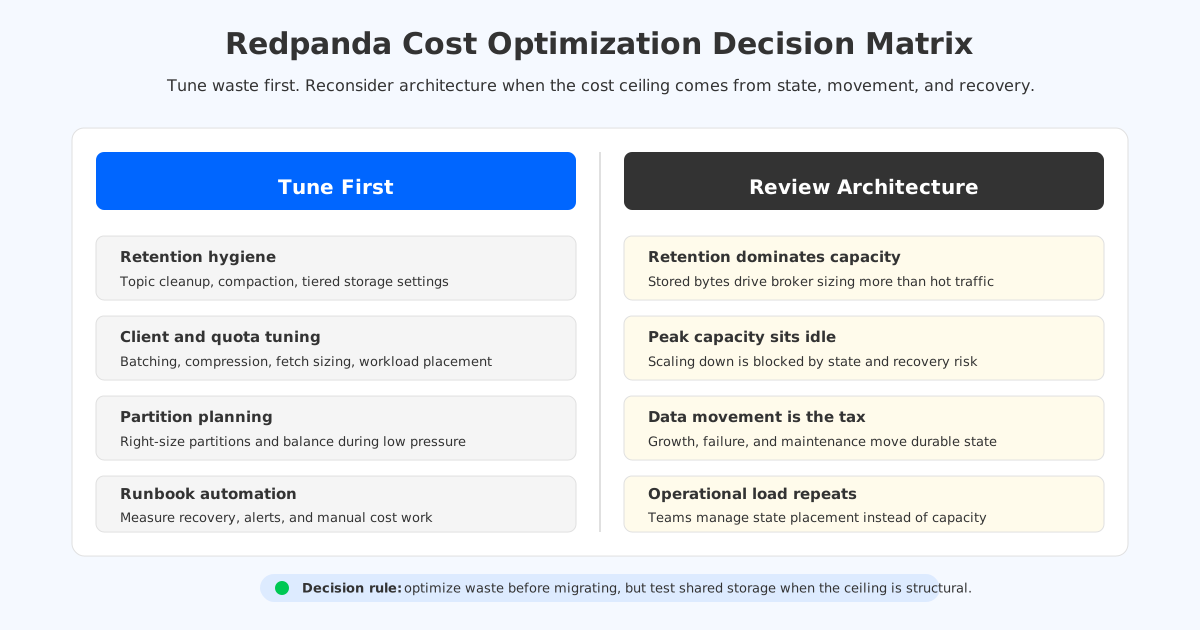
1Start With Low-Risk Cost Tuning
The first pass is workload hygiene. Redpanda Cloud pricing and documentation expose familiar cloud cost categories: deployment model, compute capacity, data in, data out, storage, networking, and operational features. Self-managed deployments add cloud infrastructure, attached disks or local disks, object storage if tiered storage is enabled, monitoring, backup, and staff time. Before changing architecture, make sure these categories are linked to topics, consumers, and retention policies.
Start with retention. Long retention is useful when Kafka-compatible storage doubles as replay, audit, or backfill infrastructure. It is wasteful when topic defaults keep data after consumers no longer need it. Review retention.ms, retention.bytes, cleanup.policy, compaction settings, and topic-level overrides. Apache Kafka's topic configuration model is a good reference point because Redpanda follows Kafka-compatible topic semantics for many operational decisions. The most efficient byte is the one the platform no longer has to store, replicate, scan, or recover.
Next, inspect producer batching and compression. Kafka producer settings such as batch.size, linger.ms, and compression.type control whether the broker receives efficient record batches or many small requests. Poor batching can increase CPU, request overhead, network traffic, and storage metadata pressure. Compression can reduce stored bytes and transfer volume, but it moves work to clients and brokers. The right target is not maximum compression. It is the lowest total cost that still meets latency and CPU budgets.
Consumer behavior is the third tuning area. A slow consumer group can extend retention needs, keep old segments active, and turn normal replay into a recurring infrastructure event. Check consumer lag, fetch sizing, read locality, fan-out, and reprocessing patterns. If several downstream systems re-read the same data across zones or regions, the bill may reflect architecture around the stream rather than the stream itself.
Operational cleanup matters too. Delete abandoned topics. Collapse duplicate streams created for team boundaries rather than data semantics. Revisit partition counts set for a future traffic level that never arrived. Review cluster balancing windows and avoid unnecessary movement when the cluster is resource constrained. Redpanda's cluster balancing and tiered storage documentation make the relationship between partitions, storage, and movement visible.
2Redpanda Cost Drivers To Inspect
A practical Redpanda cost review should cover six drivers. The goal is not to assign blame to a vendor line item. The goal is to find which layer controls the next dollar.
| Cost driver | What to inspect | Typical tuning action |
|---|---|---|
| Retention and storage | Topic retention, compaction, remote storage settings, cold read patterns | Shorten retention where safe, compact key-based topics, separate audit topics from hot topics |
| Compute capacity | Broker CPU, memory, request rate, compression, quotas, peak headroom | Right-size brokers or tiers after measuring peak and failure headroom |
| Client efficiency | Producer batching, compression, consumer fetch, connection behavior | Tune batch and fetch settings, reduce tiny requests, move compression decisions closer to owners |
| Partitions and movement | Partition count, leader distribution, balancing, reassignment windows | Reduce unnecessary partitions, rebalance during low pressure, avoid scaling as the first incident response |
| Network path | Cross-zone reads, replication, public egress, remote consumers | Keep clients near brokers where possible, review private networking and downstream fan-out |
| Operations | Upgrade effort, incident load, manual balancing, recovery drills | Automate runbooks, set cost alerts, measure recovery and balancing work as part of TCO |
This inspection often finds actionable work. A team may reduce retained bytes by separating replay topics from audit topics. A latency-insensitive pipeline may tolerate a larger producer linger. A batch analytics consumer may move closer to the cluster. A set of topics may carry more partitions than throughput requires. These are tuning problems. Solve them before asking whether the architecture is wrong.
The warning sign is repetition. If the same cost review returns every quarter with a larger storage number, the same peak-capacity argument, and the same reluctance to resize, local optimization may have reached its boundary.
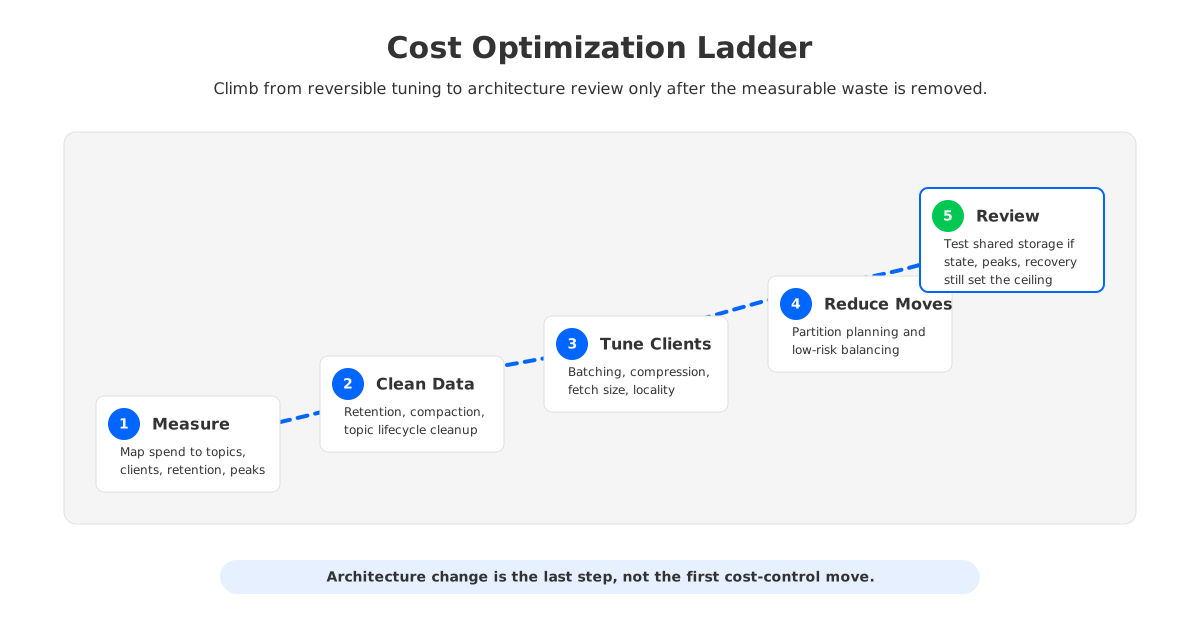
3When The Cost Problem Is Architectural
The boundary between tuning and architecture is easiest to see through six patterns: retention growth, peak-to-average mismatch, local disk coupling, data movement, recovery, and operational load.
3.1Retention Growth
Retention-heavy streaming changes the economic center of a cluster. When hot data is small but retained data is large, broker capacity planning starts to follow stored bytes rather than active throughput. Redpanda tiered storage can offload log segments to object storage and is a valid optimization to evaluate. It can reduce pressure on local storage and help with longer retention use cases.
Tiered storage is still not the same as a fully shared-storage architecture. Local storage, cache behavior, remote reads, and broker lifecycle still matter. If the business keeps increasing retention because Kafka-compatible topics are becoming the replay system of record, then cost planning should ask where durable data should live by default. Object storage as a retention tier and object storage as the primary durable layer create different scaling and recovery models.
3.2Peak-To-Average Mismatch
Many streaming workloads are bursty: market open, nightly ingest, campaign traffic, batch CDC windows, or regional business hours. If the cluster must be sized for peak but runs far below that peak most of the day, tuning can reduce waste but cannot remove the need for peak headroom. Reducing producer overhead and cleaning up consumers helps, but the reserved capacity problem remains.
This is where compute and storage coupling matters. If broker capacity includes both the compute needed for today's traffic and the local state needed for retained data, scaling down after a burst is hard to justify. The platform team may pay for idle brokers because downsizing would create movement, risk, or future recovery work. That is an architectural cost signal.
3.3Local Disk Coupling
Local storage can be efficient for low-latency hot paths, but it binds durable state to broker lifecycle. Broker replacement, disk expansion, partition balancing, and failure recovery become data-placement questions. This coupling affects cost even when no invoice line says "local disk coupling." It appears as overprovisioning, conservative maintenance windows, slower resizing, and higher operational effort.
If your cost plan depends on keeping every broker large enough for both throughput and retained bytes, right-sizing becomes a negotiation with state. A Kafka-compatible architecture with stateless brokers changes that negotiation. Compute can be evaluated as serving capacity, while durable storage can be evaluated separately.
3.4Data Movement
Data movement is a hidden tax in Kafka-compatible systems. It consumes network, disk I/O, CPU, and human attention. Partition reassignment or balancing may be required after growth, failure, or topology changes. In cloud environments, movement across zones can also interact with data transfer pricing. AWS, for example, publishes explicit data transfer pricing categories for EC2 traffic, and similar concepts exist across cloud providers.
Tuning can reduce avoidable movement. It cannot make a stateful broker architecture behave like one where durable data is already in shared storage. If the team avoids resizing because movement is too disruptive, the cost problem is no longer a tuning problem. It is a scaling architecture problem.
3.5Recovery
Recovery headroom is part of cost optimization. A cluster sized only for steady-state traffic may look efficient until a broker fails, a zone degrades, or a cold replay begins. If recovery requires rebuilding local state or moving large partitions while production traffic continues, the platform needs spare capacity. That spare capacity is not waste. It is insurance.
The question is how much insurance the architecture requires. A stateless-broker design still needs capacity, cache, networking, and storage-layer durability, but broker replacement is not the same exercise as restoring a broker's local durable log. For teams paying a steady premium for recovery headroom, architecture can change the shape of the insurance policy.
3.6Operational Load
The final signal is human. If cost optimization requires repeated manual analysis, careful balancing calendars, special-case topic cleanup, and incident reviews after every growth event, the true TCO includes operational load. This is hard to model but easy to feel. FinOps may see compute and storage. Platform teams see the hours required to keep those numbers from becoming an outage.
Operational load does not automatically justify migration. It does justify measuring architecture alternatives with the same rigor used for infrastructure spend.
4How Shared-Storage Kafka Changes The Cost Ceiling
Shared-storage Kafka changes the question from "Which broker size should hold this workload?" to "Which serving capacity and storage substrate should this workload use?" AutoMQ is one example. It is Kafka-compatible, uses object-storage-backed shared storage, and is designed around stateless broker behavior. In BYOC deployments, the data plane can run in the customer's cloud environment, giving platform and FinOps teams direct visibility into cloud resources while retaining a Kafka-compatible application surface.
The natural AutoMQ evaluation is not a promise of a fixed savings percentage. Avoid that style of analysis. Instead, compare the cost drivers:
- Are retained bytes priced and scaled separately from broker compute?
- Can brokers be replaced or resized without treating local disks as the source of truth?
- Does scaling require large partition data movement, or mainly capacity and metadata changes?
- How does the system behave during cold reads, consumer fan-out, and recovery?
- Does BYOC give the security and finance teams enough control over networking, storage, and observability?
This evaluation is especially relevant when Redpanda tuning has already addressed topic hygiene, batching, compression, and consumer lag, but the cluster remains shaped by long retention, bursty demand, and careful movement windows. In that case, AutoMQ should enter the discussion as an architecture re-evaluation option: Kafka-compatible clients, shared object storage, stateless brokers, and a BYOC operating model.
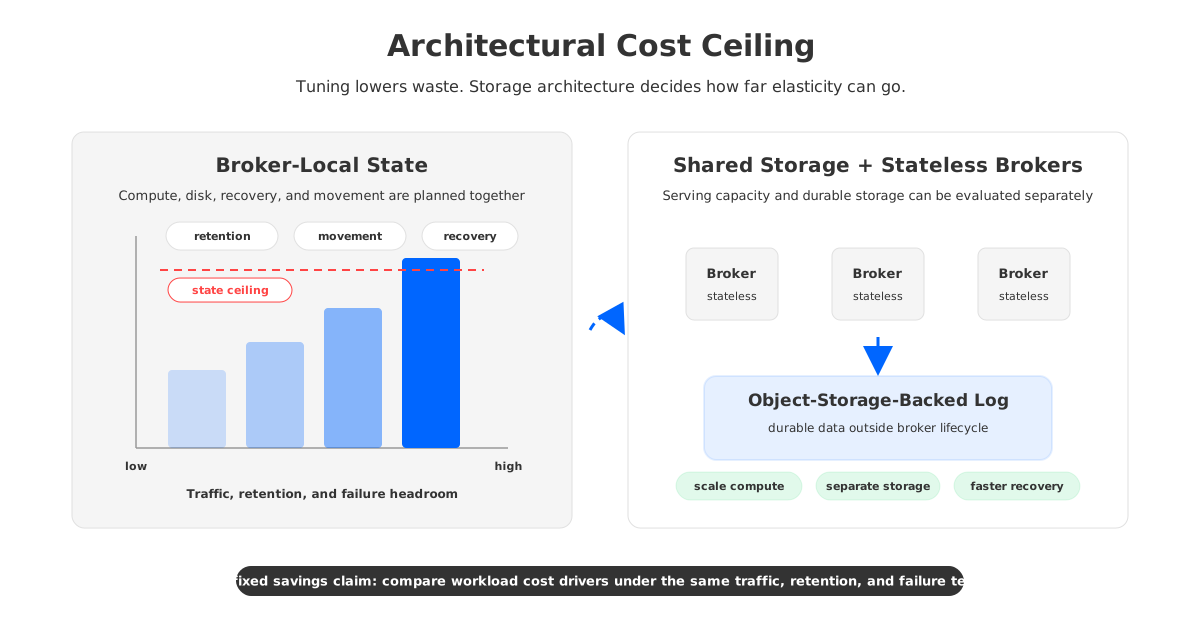
5Optimize Or Reconsider Architecture
Use the following decision table before starting a migration conversation.
| Symptom | Tune first | Reconsider architecture when |
|---|---|---|
| Storage cost is growing | Review retention, compaction, topic cleanup, and tiered storage | Retained data dominates capacity planning and keeps growing independent of hot throughput |
| Peak capacity is expensive | Tune batching, quotas, autoscaling policies, and right-sizing windows | Average utilization remains low because downsizing would create data movement or recovery risk |
| Data movement is painful | Improve partition planning and balance during low pressure | Scaling, failure recovery, and maintenance repeatedly require risky movement of durable state |
| Consumer fan-out is costly | Improve locality, fetch sizing, and downstream architecture | Cross-zone or replay traffic is inherent to the product design, not an accidental placement issue |
| Recovery needs too much headroom | Test failure drills and tune operational runbooks | The architecture requires large spare capacity because broker-local state makes replacement slow |
| Operations consume too much time | Automate cleanup, alerts, and balancing workflows | The team spends recurring engineering cycles managing state placement rather than serving capacity |
The strongest signal is compound pressure. Long retention alone may be handled with tiered storage. Bursty traffic alone may be handled with right-sizing. Consumer lag alone may be handled in the application. But long retention plus bursty demand plus slow data movement plus recovery headroom points to an architectural ceiling.
6A Practical Assessment Plan
Run a two-track assessment. Track one is Redpanda optimization. Measure current spend and resource use by topic family, client group, retention policy, and traffic window. Apply safe tuning changes one at a time, then verify latency, throughput, and recovery behavior.
Track two is architecture validation. Build a representative workload profile: write rate, read fan-out, message sizes, partition counts, retention, replay windows, failure scenarios, and cloud placement. Use that profile to evaluate Redpanda with tuning, Redpanda tiered storage if relevant, and a Kafka-compatible shared-storage option such as AutoMQ. Include not only steady-state cost but also scaling, recovery, cold reads, and human operations.
The decision should be boring in the best possible way. If tuning solves the problem, keep the architecture and document the new guardrails. If tuning improves the bill but does not change the ceiling, run a controlled proof of concept for shared-storage Kafka. Cost optimization is not a single move. It is a sequence: remove waste, measure the ceiling, then change architecture only when the ceiling is the problem.
7FAQ
7.1What is the first step in Redpanda cost optimization?
Start by mapping cost to workload behavior: topic retention, stored bytes, producer batching, compression, consumer lag, partition count, data transfer, and operational work. Avoid changing architecture until basic topic and client tuning has been measured.
7.2Does Redpanda tiered storage solve retention cost?
It can help when long retention is the main pressure because it offloads log segments to object storage. It does not make brokers stateless or remove every local storage, cache, remote read, recovery, or movement consideration. Test it with your retention and replay patterns.
7.3When is Redpanda cost a tuning problem?
It is usually a tuning problem when waste comes from over-retention, abandoned topics, poor batching, weak compression choices, slow consumers, excessive partitions, or avoidable cross-zone traffic. These should be fixed before evaluating a replacement.
7.4When should teams consider AutoMQ for cost reasons?
Consider AutoMQ when the cost issue is tied to architecture: retained data dominates broker sizing, peak-to-average mismatch drives idle capacity, scaling requires heavy data movement, or recovery depends on broker-local state. AutoMQ provides a Kafka-compatible shared-storage and stateless-broker model that can be evaluated under the same workload.
7.5Should cost optimization include operational labor?
Yes. A cluster that needs repeated manual balancing, careful resizing windows, special cleanup projects, and recovery rehearsals has an operational cost even if the cloud bill looks controlled. Include engineering hours and incident risk in the TCO model.
8References
- Redpanda: Pricing
- Redpanda Docs: Redpanda Cloud deployment options
- Redpanda Docs: Tiered Storage
- Redpanda Docs: Cluster balancing
- Apache Kafka Docs: Producer configuration
- Apache Kafka Docs: Topic-level configuration
- Apache Kafka Docs: Replication and operations
- AWS: Amazon EC2 On-Demand Pricing - Data Transfer
- AutoMQ Docs: Architecture overview
- AutoMQ Docs: What is AutoMQ
- AutoMQ: Pricing calculator
- AutoMQ GitHub: AutoMQ repository


