
Table of Contents
Table of Contents
Searching for redpanda alternatives usually means the team is no longer debating whether Kafka-compatible streaming matters. Redpanda may already be running in a proof of concept, a few production workloads, or a broader architecture review. The harder question is whether the current platform assumption can carry the whole application estate through more topics, longer retention, stricter data boundaries, larger replay jobs, cloud cost scrutiny, or a procurement reset.
An exit plan is different from a replacement list. A list names vendors. An exit plan names the contracts that must survive when hundreds of producers, consumers, dashboards, ACL rules, runbooks, and finance models are moved or revalidated. Redpanda, Confluent, Amazon MSK, Apache Kafka, Aiven, AutoMQ, WarpStream, and other Kafka-compatible options can all be reasonable in the right context. The exit planning question is narrower and more useful: which parts of your Kafka estate are portable, which parts are platform-specific, and which architectural constraint created the need to look again?
1Why teams search for Redpanda alternatives
Redpanda has a clear place in the Kafka ecosystem: it offers a Kafka API-compatible streaming platform with a different implementation and operating model from traditional Apache Kafka. Teams often evaluate it because they want to reduce parts of classic Kafka operations while preserving Kafka clients and event-streaming patterns. That is a serious evaluation, not a detour.
The search for alternatives tends to begin when the estate becomes larger than the first use case. A data platform can accept one workload-specific trade-off when only a few services are involved. It becomes harder when product analytics, fraud detection, observability, CDC pipelines, internal data buses, and customer-facing integrations all rely on the same Kafka surface.
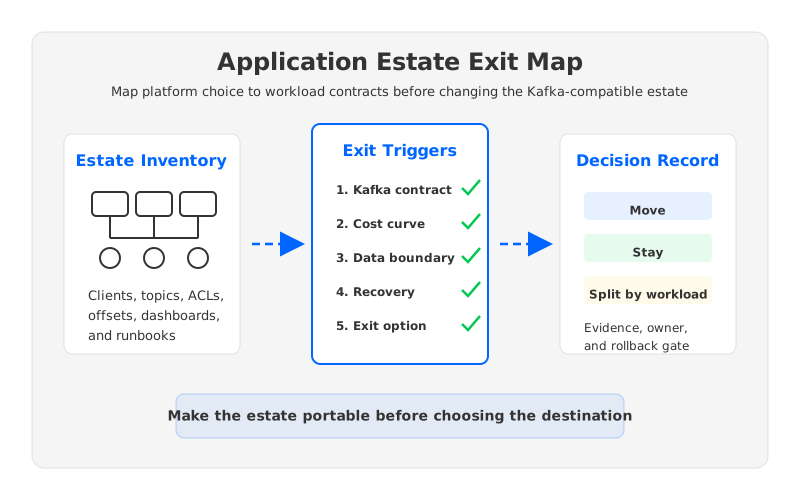
Most teams reach that point for one of five reasons:
- Kafka behavior has become an application contract. Client libraries, offset handling, transactions, ACLs, topic automation, monitoring, and operational scripts are now embedded in service ownership.
- The cost discussion has moved from instance price to byte path. Replication, retained data, read fan-out, private connectivity, cross-zone traffic, object storage operations, and migration overlap all appear in the same budget review.
- The data boundary matters more than the product name. Security teams need to know where records, metadata, metrics, keys, support access, and control-plane actions live.
- Recovery expectations have changed. A small cluster can tolerate manual repair. A shared application estate needs predictable behavior during broker failure, zone impairment, scaling, backlog replay, and rollback.
- Procurement wants a credible exit option. Even if the team keeps the current platform, it needs evidence that the Kafka estate is not trapped by assumptions nobody documented.
This is why broad comparison pages often feel thin to platform owners. They can surface candidate names, but they rarely describe how to leave one Kafka-compatible platform without breaking the estate.
2Build an estate inventory before picking a destination
The first exit-planning step is to inventory the Kafka surface your applications actually use. Apache Kafka is not only a wire protocol. It includes producer acknowledgments, batching, compression, idempotent writes, transactions, consumer group coordination, offset commits, retention, compaction, ACLs, quotas, topic administration, Connect, Streams, schema workflows, observability conventions, and a long tail of scripts that grew around the platform. A candidate can pass a basic produce-consume test while still failing an estate migration.
Inventory work should be owned jointly by platform engineering, SRE, application owners, security, and FinOps. Each group sees a different failure mode: cluster behavior, client edge cases, recovery, boundaries, and cost-driving byte paths.
| Estate area | What to inventory | Exit-planning risk |
|---|---|---|
| Client behavior | Languages, library versions, acks, retries, transactions, idempotence, compression, batching | A compatible API still behaves differently under retries, failover, or backpressure. |
| Topic design | Partition counts, compaction, retention, message size, hot keys, quotas | The destination may scale or recover differently for the same topic layout. |
| Consumer state | Group IDs, offset policy, lag alerts, replay jobs, manual commits | Cutover can create duplicate processing, missed records, or slow catch-up. |
| Security and governance | Authentication, ACLs, private networking, audit logs, key ownership | The target operating boundary may fail security review after the technical PoC. |
| Operations | Dashboards, alerts, runbooks, upgrades, incident drills, support access | A migration can succeed technically and still increase on-call risk. |
Exit planning is won in boring details. If a workload owner cannot say how a consumer group will resume after cutover, the estate is not portable yet. If security cannot trace where metrics and support metadata go, the platform decision is not ready.
3Separate platform fit from architecture fit
Kafka-compatible platforms can expose similar application surfaces while making very different architecture choices. Traditional Apache Kafka stores active log data on broker-attached storage and uses replication across brokers for durability. Kafka tiered storage adds remote storage for completed log segments, reducing local storage pressure while keeping the active write path broker-centric. Managed services such as Amazon MSK or Confluent Cloud shift operational responsibility, but teams still need to understand scaling units, network placement, supported behavior, and service-specific meters.
Redpanda makes its own trade-offs around implementation, performance, and operational model. It can be a strong fit when those trade-offs match the workload. The exit question appears when long retention, replay-heavy analytics, multi-account governance, cross-zone traffic, or independent compute and storage scaling become the dominant constraint.
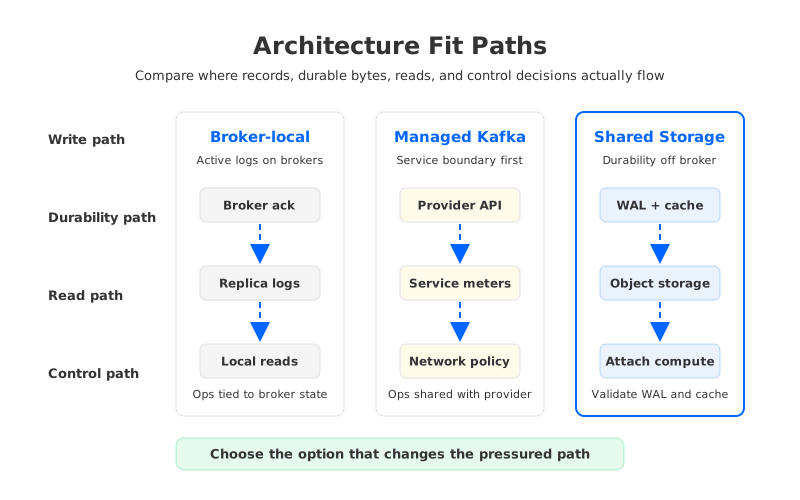
Architecture fit should be described in four paths:
- Write path. Where does a fresh record land before the producer receives an acknowledgment, and what protects that record during node or zone failure?
- Durability path. Is the durable copy tied to broker-local disks, a remote tier, shared object storage, or a service-managed abstraction that the team cannot directly inspect?
- Read path. How are tailing reads, catch-up reads, replay jobs, and high fan-out consumers served without surprising latency or network cost?
- Control path. Which system owns metadata, upgrades, scaling, policy enforcement, support access, metrics, and audit evidence?
Those paths matter more than the vendor category. A managed service may reduce staffing burden while increasing dependence on provider-specific networking and billing models. A broker-local system may be attractive for latency-sensitive workloads while making retained data and recovery more stateful. A shared-storage system may reduce unique local broker state, while demanding proof around WAL design, cache behavior, metadata coordination, and object-store performance.
4Model cost as a migration and recovery curve
Cost planning for a Redpanda exit should not start with a single monthly estimate. Streaming cost behaves like a curve because the expensive component changes as the workload changes. Compute may dominate one workload, while retained data, historical reads, cross-zone movement, or migration overlap dominates another.
AWS publishes separate pricing surfaces for Amazon MSK, EC2 data transfer, PrivateLink, and S3, which is a useful reminder even when the final platform is not AWS-specific: cloud bills are assembled from multiple meters. A Kafka estate can look affordable at the broker layer while carrying material cost in cross-zone movement, private connectivity, object requests, observability, or recovery events. The exit plan should make those paths visible before the business case is approved.
The cost question is not "which platform is lower cost?" The useful question is "which meter grows fastest for this estate, and which architecture changes that slope?"
Use the same traffic model for every candidate. For each representative workload class, model current state, 12-month growth, and a stress case that includes replay, broker failure, migration overlap, or large consumer catch-up. Keep commercial discounts out of the first pass; discounts change the final price, but they do not change the architecture slope.
A practical model includes at least these dimensions:
- Producer write volume by zone or network boundary.
- Replication or durability behavior, including how many durable copies are created and where they live.
- Consumer read fan-out, including replay and catch-up traffic.
- Retention size and access pattern for historical data.
- Private connectivity, load balancing, observability, and support requirements.
- Migration overlap, including dual writes, mirroring, backfill, validation, and rollback windows.
This model prevents a common procurement mistake: treating exit as a one-time project cost. Migration is temporary, but the destination cost curve is permanent.
5Design the migration around reversibility
A Kafka-compatible migration is safest when reversibility is designed before cutover. Compatibility reduces the application change, but it does not remove migration risk. Producers can duplicate records, consumers can commit offsets in the wrong place, security mappings can drift, and dashboards can turn green while the wrong system is being watched.
The exit plan should define four gates. Gate one proves the destination can accept representative traffic with the correct security and observability controls. Gate two proves consumers can read, commit, replay, and recover according to the workload contract. Gate three switches producers under a rollback plan. Gate four closes the rollback window and records the operational handoff. Teams often document the first three gates and leave the fourth vague, which is exactly where risk becomes expensive.
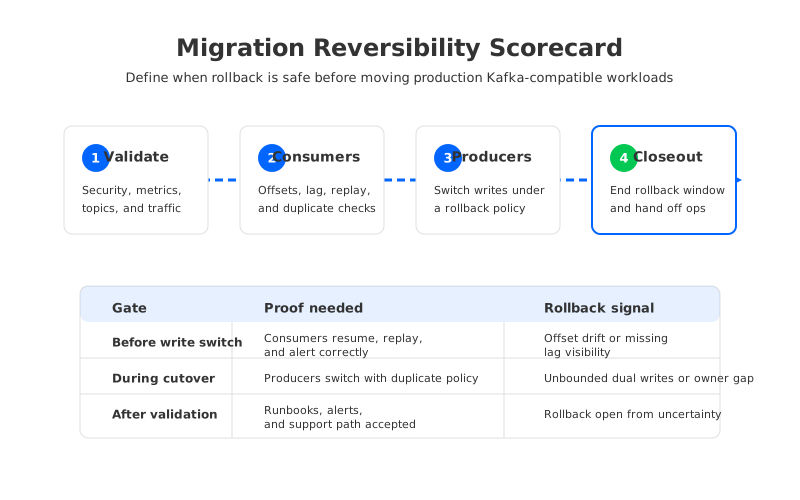
Choose the first migration workload carefully. It should be important enough to exercise real client behavior and operational tooling, but contained enough to rollback without a major incident. A better candidate has a known producer, at least one meaningful consumer group, representative ACLs, normal lag behavior, dashboards, and an owner willing to rehearse failure.
Migration tooling can include MirrorMaker 2, cluster linking where available, connector-based replication, application dual writes, or vendor-assisted migration paths. Each creates a different consistency model. The exit plan should state which system is authoritative at each gate, how offsets are validated, how duplicates are detected, and when rollback becomes more dangerous than forward fix.
6How AutoMQ fits the evaluation
AutoMQ becomes relevant after the estate inventory, architecture paths, cost curve, and migration gates are clear. It is a Kafka-compatible, cloud-native streaming system that keeps Kafka protocol compatibility while using S3Stream, Shared Storage architecture, stateless brokers, and WAL storage to decouple durable stream data from broker-local disks. That places AutoMQ in a different architectural category from broker-local Kafka-compatible systems and from managed services where the underlying storage model is mostly hidden from the customer.
That distinction matters when the exit trigger is durable-state ownership, elastic scaling, recovery behavior, or cloud network cost rather than a general desire to change vendors. If durable data sits in shared object storage and brokers are more replaceable, scaling and recovery are less dominated by moving unique broker-local logs. If the data path can avoid cross-AZ replication traffic for Kafka writes, the FinOps model changes for workloads where zone movement is a major cost line. These claims still need workload-specific validation around latency, WAL choice, cache sizing, object storage behavior, and deployment model.
AutoMQ should be evaluated with the same discipline as every other candidate. Test the Kafka clients, admin scripts, ACLs, topic configurations, transactions if used, consumer offsets, lag recovery, monitoring, and rollback path. Model cost with the same write rate, read fan-out, retention, and network placement used for Redpanda, MSK, Confluent, or Apache Kafka.
7Governance checklist for the final decision
By the time the team asks for executive approval, the exit plan should be specific enough that staying with the current platform is also a valid outcome. A mature plan does not force migration; it shows what would happen if the estate stayed, moved, or split by workload class.
| Decision gate | Pass condition | Bad signal |
|---|---|---|
| Estate portability | Critical producers, consumers, ACLs, offsets, topics, and runbooks are inventoried and tested. | The PoC uses sample clients and assumes production behavior will match. |
| Architecture fit | The target changes the path that caused the search: storage, recovery, network, operations, or governance. | The team cannot explain what architecture assumption is being replaced. |
| Cost curve | Current, growth, and stress cases are modeled from byte paths and operational events. | The business case compares subscription quotes without replay or migration overlap. |
| Reversibility | Cutover, rollback, validation, and closeout gates are rehearsed before production traffic moves. | Rollback is mentioned but not owned, tested, or bounded. |
| Operating ownership | Data plane, control plane, metrics, logs, secrets, support access, and incident response are documented. | Security and SRE review begins after procurement has selected the platform. |
The governance outcome may be a full migration, a workload-specific split, a contract renegotiation, or a decision to keep Redpanda for the workloads where it fits. That is the advantage of exit planning over list-building: it gives every option a fair test against the estate rather than against a generic checklist.
The search that began with redpanda alternatives should end with an engineering decision record. Name the constraint, prove the workload contract, model the byte paths, rehearse the rollback, and document who owns the destination after cutover. If shared-storage Kafka compatibility is part of that evaluation, start with the AutoMQ Cloud Console and run one representative workload through the same estate, cost, migration, and governance checks.
8References
- Apache Kafka documentation
- Apache Kafka Tiered Storage documentation
- Apache Kafka producer configuration
- Apache Kafka authorization and ACLs
- Redpanda documentation: Kafka Compatibility
- AWS pricing: Amazon MSK
- AWS pricing: Amazon EC2 data transfer
- AWS pricing: AWS PrivateLink
- AWS pricing: Amazon S3
- AutoMQ documentation: Compatibility with Apache Kafka
- AutoMQ documentation: S3Stream Shared Streaming Storage
- AutoMQ documentation: WAL storage
- AutoMQ documentation: Inter-zone traffic overview
9FAQ
9.1What does Redpanda exit planning mean?
It means documenting how a Kafka-compatible application estate could move, stay, or split across platforms without breaking application behavior, security boundaries, cost assumptions, or operational ownership. It is broader than choosing a vendor name.
9.2Are Redpanda alternatives always better for Kafka workloads?
No. Redpanda can be a strong fit when its architecture and operating model match the workload. Alternatives should be evaluated only against the constraint that created the search, such as storage scaling, data boundaries, migration governance, network cost, or recovery behavior.
9.3What should be inventoried before migrating Kafka-compatible workloads?
Inventory client versions, producer settings, consumer groups, offset policies, transactions, ACLs, topic configuration, retention, compaction, schemas, dashboards, alerts, runbooks, and cost-driving byte paths. The migration risk usually hides in these details.
9.4How should teams compare the cost of Redpanda alternatives?
Use the same workload model for every candidate and include write volume, replication or durability behavior, read fan-out, retention, replay, cross-zone or private networking, observability, support, and migration overlap. Compare the cost curve, not only the entry price.
9.5Where does AutoMQ fit in a Redpanda alternatives evaluation?
AutoMQ fits when the team wants Kafka-compatible APIs while testing Shared Storage architecture, stateless brokers, and object-storage-backed durability. It is most relevant when the exit trigger involves retained data, elastic scaling, cloud network cost, recovery, or customer-controlled deployment boundaries.


