
Table of Contents
Table of Contents
The hard part of choosing a streaming platform on AWS is rarely the Kafka API. Most serious candidates can speak to producers and consumers well enough for a demo. The harder question is where the control plane lives, which account owns the data plane, what storage layer carries retention, and which team holds the pager when scaling pressure arrives.
That is why "Redpanda for AWS" should not be evaluated as a product name search alone. Redpanda, Amazon MSK, and AutoMQ represent three different AWS platform decisions. Redpanda is a Kafka API-compatible engine that can run through Redpanda Cloud, BYOC, or self-managed infrastructure. Amazon MSK is AWS-managed Apache Kafka. AutoMQ BYOC is a Kafka-compatible cloud-native streaming platform that runs in the customer's AWS environment and changes the storage model through S3Stream, Shared Storage architecture, and stateless brokers.
The right comparison starts with AWS ownership boundaries, not a feature checklist.
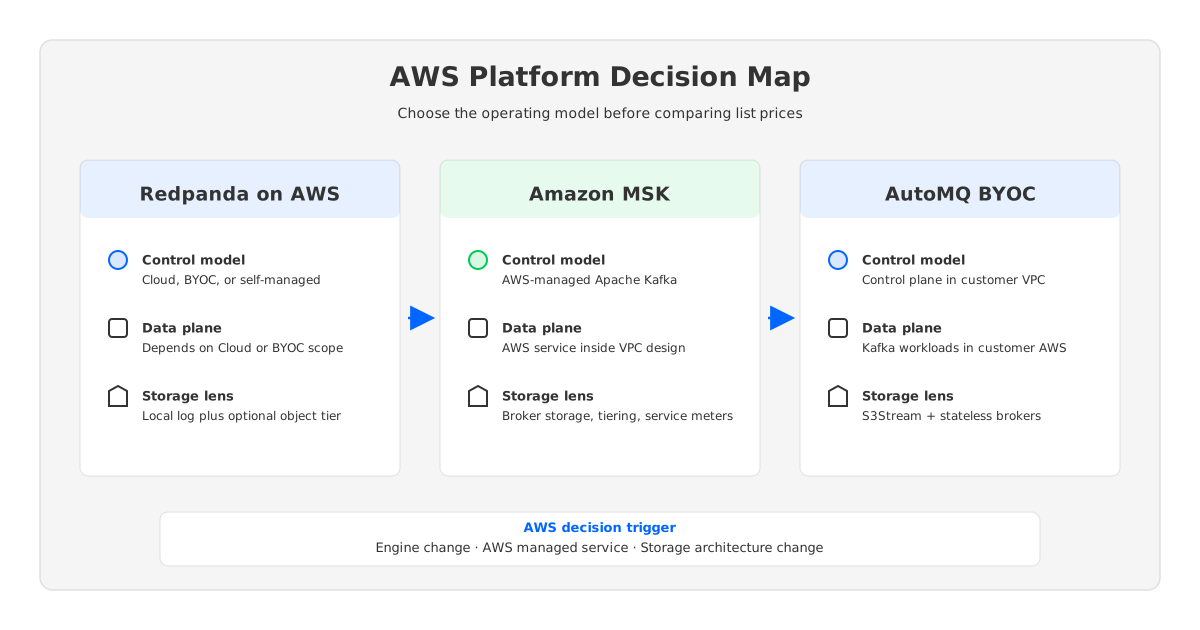
1Start With the AWS Platform Decision
An AWS platform team is usually optimizing for security review, cost visibility, operational control, and compatibility risk. Those goals pull in different directions. A managed AWS service can simplify procurement and reduce broker operations. A BYOC product can keep the data plane in the customer's cloud account, but the vendor's control path, permissions, and support model still need review. A self-managed deployment gives the most infrastructure authority and the most operational work.
The first pass should classify each option by what layer it changes:
| Decision layer | Redpanda on AWS | Amazon MSK | AutoMQ BYOC on AWS |
|---|---|---|---|
| Engine | Redpanda's Kafka API-compatible engine | Open-source Apache Kafka managed by AWS | Kafka-compatible engine built around S3Stream |
| Deployment model | Redpanda Cloud, Redpanda BYOC, or self-managed | AWS-managed service: Provisioned, Express, or Serverless | BYOC with control plane and data plane in customer AWS environment |
| Data plane ownership | Depends on selected mode; BYOC runs in customer cloud | AWS service integrated with customer VPC design | Customer AWS account / VPC |
| Storage architecture | Local log with optional Tiered Storage to object storage | Broker storage, tiered storage, or service-specific storage meters | Shared Storage architecture using S3 storage plus WAL storage |
| Primary evaluation risk | Engine and BYOC boundary validation | AWS service limits, cluster type, and Kafka operations | Object-storage-backed architecture and customer AWS resource design |
This table is not a winner-takes-all scorecard. MSK can be the conservative default for teams that want Apache Kafka under an AWS-managed service boundary. Redpanda can fit teams that want Redpanda's engine and are ready to validate compatibility under their own workload. AutoMQ becomes relevant when the main AWS problem is not "who manages Kafka?" but "why does durable streaming data still behave like broker-local disk in the cloud?"
2Deployment Model: Cloud Service, AWS Service, or Customer-Owned BYOC
Redpanda's AWS story has multiple forms, and conflating them creates bad estimates. Redpanda Cloud can be consumed as a managed cloud service, Redpanda BYOC places the data plane in the customer's cloud environment while Redpanda Cloud provides management, and self-managed Redpanda places more responsibility on the customer. That boundary affects IAM, network access, telemetry, upgrades, and incident response.
Amazon MSK is a different contract. AWS runs the managed service and exposes Kafka-compatible endpoints through AWS networking patterns. Security teams already understand IAM, VPC, AWS PrivateLink, KMS, CloudWatch, and AWS support workflows. The tradeoff is that Provisioned, Express, and Serverless are not interchangeable cost or operations models.
AutoMQ BYOC draws a stricter customer-environment boundary. Its control plane and data plane are deployed in the customer's own cloud account VPC, while AutoMQ Cloud is used as the environment management portal rather than a hosted data-plane service. AWS preparation includes customer-side resources such as VPC, EKS, S3, and IAM permissions. That model fits teams that want managed lifecycle automation without giving up infrastructure ownership or resource-level cost visibility.
The procurement label matters less than the diagram. Ask each vendor to show the data plane, control plane, telemetry path, support access, and upgrade authority.
3Data Path, IAM, and VPC Boundaries
AWS reviews often get stuck on whether a service is "in the VPC." That phrase is too coarse for Kafka. A real review has to separate producer and consumer traffic from management, storage, monitoring, and vendor support traffic. Those paths have different blast radius and different permissions.
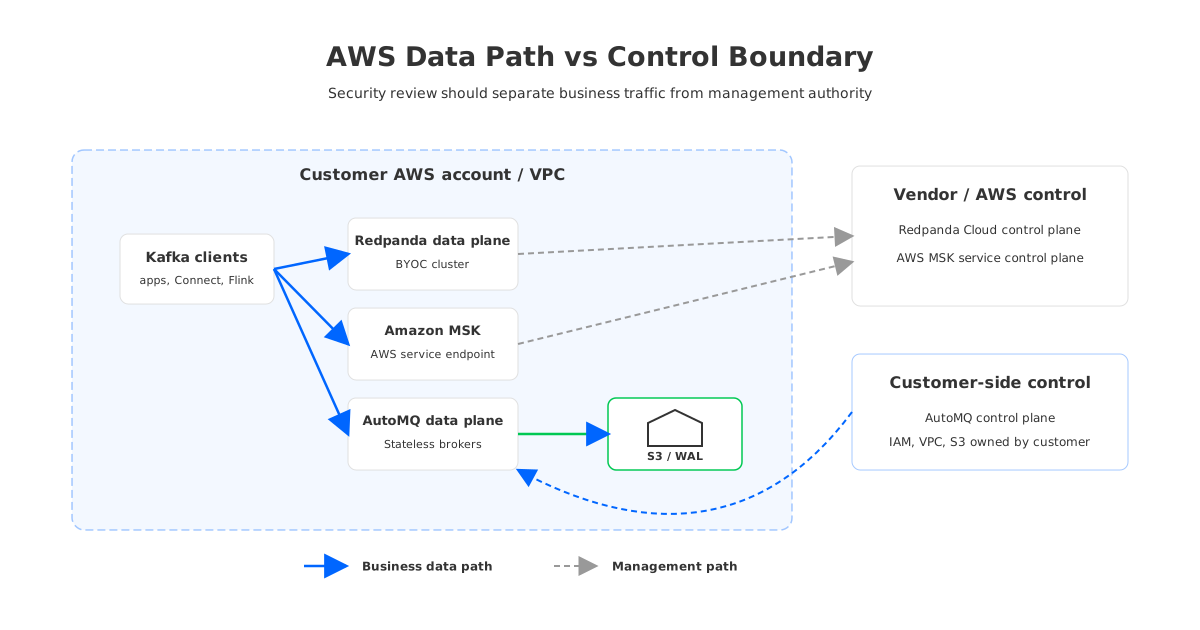
For Redpanda BYOC, the cluster data plane can run in the customer's cloud environment. The review should still trace how Redpanda Cloud manages the cluster, what outbound connectivity is required, what permissions are granted, what operational metadata leaves the account, and how upgrades are scheduled.
For Amazon MSK, the model is familiar to AWS-native teams. Clients connect to an AWS-managed Kafka service endpoint; access patterns can involve private networking, IAM authentication, security groups, and service integrations. MSK can be easier to approve when the organization has standardized on AWS-managed services. Teams still need to design subnets, client placement, authentication, encryption, multi-VPC connectivity, monitoring, and disaster recovery.
For AutoMQ BYOC, Kafka workload traffic and storage paths stay in the customer's AWS environment. The AutoMQ data plane serves Kafka clients, while durable data is stored through customer-controlled S3-compatible storage paths and WAL storage. That makes IAM review explicit: which roles can create clusters, access buckets, manage EKS resources, read logs, or open an ops tunnel during troubleshooting?
4Storage Architecture Changes the Cost Curve
Kafka on AWS is expensive in ways that do not always show up as "Kafka" on the bill. Compute is visible. Storage, inter-AZ movement, private connectivity, replay reads, over-provisioned headroom, and operational time are easier to underestimate.
Apache Kafka's original storage model ties partition replicas to brokers. That design is robust and well understood, but in cloud environments it couples compute scaling with durable data placement. Adding brokers, replacing brokers, changing retention, or rebalancing partitions can become a data movement problem.
Redpanda takes a different engine path, but the hot log is still local to the broker architecture, with Tiered Storage available to offload older data to object storage. Tiered Storage can help when retention grows, but it is not the same as making object storage the primary durable storage layer. Local storage, partition ownership, cache behavior, and tier retrieval patterns still belong in the sizing model.
AutoMQ changes this layer more directly. Its architecture replaces Kafka's local log storage with S3Stream, using S3 storage as the primary storage layer and WAL storage for write durability and recovery. Brokers are stateless in the AutoMQ architecture, so durable data is not anchored to broker-local disks in the same way. The operational question becomes: how should Shared Storage architecture, WAL storage, cache, and compute scale for this workload?
5AWS Cost Drivers to Model
No serious AWS comparison should stop at per-broker or per-hour pricing. The same workload can produce different bills depending on retention, consumer fan-out, cross-zone placement, replay frequency, and private connectivity. AWS MSK pricing shows why: Provisioned clusters, Express brokers, and Serverless clusters expose different charge dimensions, including instance or cluster hours, storage, data in, data out, partition hours, and service-specific meters.
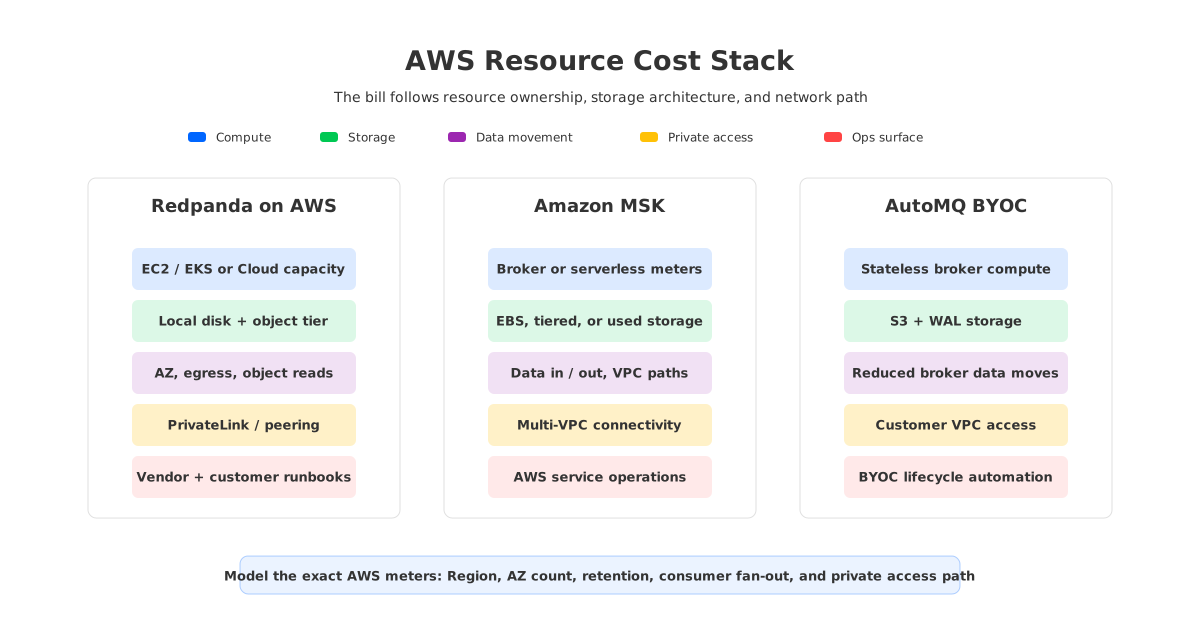
For a fair Redpanda, MSK, and AutoMQ model, use the same workload assumptions:
- Write rate and read fan-out. Producer throughput alone is not enough; multiple consumer groups can turn reads and network paths into dominant cost drivers.
- Retention and replay. Long retention changes the storage decision, while frequent replay changes object storage request and retrieval assumptions.
- Availability Zone strategy. Multi-AZ deployment improves resilience but can create different data movement paths across platforms.
- Private connectivity. PrivateLink, peering, NAT, load balancers, and multi-VPC access can become meaningful at scale.
- Operational labor. Low infrastructure cost can still be expensive if upgrades, failures, and rebalancing consume a specialist team.
Redpanda cost depends heavily on whether the team uses Redpanda Cloud, Redpanda BYOC, or self-managed infrastructure. Public Redpanda pricing pages route buyers through a current get-started or estimate path rather than a single static table for every AWS scenario. MSK cost should be modeled from AWS's current pricing page for the chosen cluster type and Region. AutoMQ BYOC cost should include customer AWS resources, storage, WAL choice, AutoMQ licensing, and operations.
6Scaling and Operations: What Happens on a Bad Day?
Scaling stories often sound clean during architecture review: add capacity, move load, restore balance. The test is what happens when a cluster is already under pressure. In broker-local storage systems, scaling can involve partition movement, leadership changes, disk headroom, replication traffic, cache churn, and consumer lag risk.
Amazon MSK reduces a large amount of undifferentiated Kafka infrastructure work. AWS handles many service operations, broker lifecycle tasks, and integration points. Platform teams still own Topic design, partition counts, client placement, consumer lag response, quota choices, connector operations, and workload-specific tuning.
Redpanda changes the runtime and tooling, so operations should be validated as Redpanda operations rather than assumed from Kafka experience. Run the failure cases you expect to survive: broker loss, AZ impairment, client reconnect storms, tiered-storage reads, rolling upgrades, partition growth, and audit-driven access changes.
AutoMQ's operating argument is different because stateless brokers and Shared Storage architecture reduce the amount of durable data tied to each compute node. Scaling and replacement can focus more on compute ownership, cache warm-up, and traffic routing than copying retained logs between broker disks. WAL storage, S3 request behavior, cache sizing, network placement, and object-store latency still need production-shaped testing.
7Compatibility and Migration Surface
All three options can be part of a Kafka-oriented architecture, but they do not carry the same compatibility risk. MSK runs Apache Kafka, so it is the closest fit when the organization depends on exact Kafka broker behavior, Kafka Connect assumptions, Kafka Streams behavior, Admin APIs, ACL semantics, and open-source tooling.
Redpanda documents Kafka client compatibility and supports many Kafka API paths, but it is not Apache Kafka internally. That distinction is not a criticism; it is the core design choice. The migration proof should cover real usage: idempotent producers, transactions if used, compaction, ACLs, quotas, topic automation, monitoring, consumer group behavior, and connector workflows.
AutoMQ should be tested as a Kafka-compatible architecture change. Existing Kafka clients and ecosystem tools may remain relevant, but the storage layer, scaling behavior, and operational metrics change. A fair proof should include throughput, latency distribution, failover, retention growth, cold reads, object storage permissions, and cost under the same traffic mix.
8When Each Option Fits Best
Choose Amazon MSK when the platform decision is to standardize on AWS-managed Apache Kafka. This is often the clean path for organizations that value AWS procurement, AWS-native security primitives, and conservative Kafka compatibility. The main design work is selecting the right MSK type and proving that the workload's storage and traffic shape fit the service economics.
Choose Redpanda on AWS when the platform decision is to adopt Redpanda's engine and operating model. That can be attractive for teams that want Kafka API compatibility, Redpanda tooling, and deployment flexibility across Cloud, BYOC, or self-managed modes. The main design work is compatibility validation and a clear responsibility matrix.
Choose AutoMQ BYOC when the platform decision is to keep Kafka compatibility while changing the cloud storage and scaling architecture. It is most relevant when long retention, elastic capacity, broker replacement, cross-AZ data movement, or customer-account control are central to the business case. The main design work is AWS resource preparation, Shared Storage architecture validation, WAL storage choice, and workload-shaped testing.
The useful shortcut is simple: MSK changes the service boundary, Redpanda changes the engine, and AutoMQ changes the storage architecture. Many teams need one of those changes more than the other two.
9AWS Decision Checklist
Before a final vendor bake-off, turn the comparison into questions that expose platform fit:
| Question | Why it matters |
|---|---|
| Which AWS account owns the data plane? | Determines data residency, IAM review, audit scope, and incident authority. |
| Where does the control plane run? | Determines vendor access, upgrade authority, telemetry paths, and outage behavior. |
| Is durable data tied to broker-local storage? | Determines scaling mechanics, retention economics, and recovery operations. |
| Which exact pricing meters apply? | Prevents comparing Redpanda Cloud, MSK Serverless, MSK Provisioned, and BYOC infrastructure as if they were the same product. |
| What happens during broker or AZ failure? | Reveals whether the runbook depends on data movement, service automation, or metadata/compute reassignment. |
| How will existing Kafka clients be validated? | Protects migrations from hidden assumptions in libraries, connectors, security, and admin tooling. |
Return to the opening question before signing off: what layer are you trying to change on AWS? If you want AWS to manage Apache Kafka, center the evaluation on MSK. If you want Redpanda's Kafka-compatible engine, run a workload-specific Redpanda proof. If broker-local storage is the long-term cost and operations problem, include AutoMQ BYOC in the same AWS test plan.
For the architecture-change path, start with the AutoMQ architecture overview and validate the design against your own AWS Region, VPC layout, retention policy, and failure scenarios.
10FAQ
10.1Is Redpanda available on AWS?
Yes. Redpanda can be evaluated on AWS through Redpanda Cloud options, Redpanda BYOC, or self-managed deployment, depending on the commercial and operational model selected. The important evaluation question is which model you mean, because data plane ownership, control plane connectivity, AWS permissions, and cost drivers differ.
10.2Is Redpanda the same as Amazon MSK?
No. Amazon MSK is an AWS-managed service that runs Apache Kafka. Redpanda is a Kafka API-compatible streaming platform with its own engine. Both can serve Kafka-style clients, but they have different compatibility, operations, and deployment-model implications.
10.3How does AutoMQ compare with Redpanda and MSK on AWS?
AutoMQ is best viewed as an architecture alternative rather than another broker service wrapper. AutoMQ BYOC keeps Kafka compatibility while using S3Stream, Shared Storage architecture, and stateless brokers in the customer's AWS environment. It is most relevant when storage economics, elastic scaling, retention, and AWS data control are the evaluation drivers.
10.4Which option has the lowest AWS cost?
There is no universal answer. MSK pricing depends on cluster type, Region, storage, partitions, data in/out, and connectivity. Redpanda cost depends on deployment mode plus AWS resources and commercial terms. AutoMQ BYOC depends on customer AWS resources, storage, WAL choice, licensing, and operations.
10.5Does BYOC mean the vendor has no control plane?
Not necessarily. BYOC means the data plane runs in the customer's cloud account in many vendor models, but the control plane can still be vendor-hosted or customer-deployed depending on the product. Redpanda BYOC and AutoMQ BYOC draw this boundary differently, so security review should inspect both data path and management path diagrams.
11References
- Redpanda documentation: BYOC architecture
- Redpanda documentation: Redpanda Cloud cluster types
- Redpanda documentation: Tiered Storage
- Redpanda website: Redpanda pricing / get started path
- AWS documentation: What is Amazon MSK?
- AWS documentation: Amazon MSK pricing
- AWS documentation: MSK Provisioned clusters
- AWS documentation: MSK Serverless clusters
- AWS documentation: MSK Express brokers
- AWS documentation: Multi-VPC private connectivity for Amazon MSK
- Apache Kafka documentation: Apache Kafka documentation
- AutoMQ documentation: Architecture overview
- AutoMQ documentation: Install AutoMQ on AWS
- AutoMQ documentation: Prepare VPC for AutoMQ on AWS
- AutoMQ GitHub: AutoMQ/automq


