
Table of Contents
Table of Contents
Putting a Kafka-compatible streaming platform on Kubernetes sounds like a clean consolidation move. Your platform team already has GitOps, node pools, CNI policy, CSI storage, Prometheus, and incident workflows. Redpanda also brings a compelling Kubernetes story: Helm, an Operator, Kafka API compatibility, and a single-binary broker model. The difficult part starts after the first cluster is healthy. Streaming systems are not interchangeable Pods; they carry broker identity, durable log state, partition leadership, client routing, and recovery expectations.
Kubernetes gives you the right primitives for this class of workload, but those primitives expose the tradeoff rather than removing it. StatefulSets provide stable identity and storage. PVCs keep broker data attached across rescheduling. Services and listeners make brokers reachable. An Operator can reconcile resources and automate safer workflows. Each piece becomes part of the operational contract.
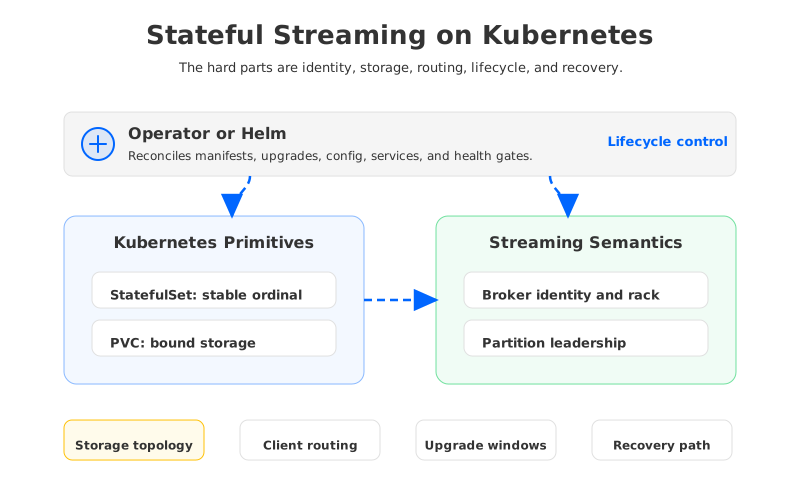
The question is not whether Redpanda can run there; its documentation covers deployment, storage, scaling, networking, monitoring, and upgrades. The question is whether the operating model fits your failure domains, storage topology, scaling rhythm, and recovery objectives.
1Why streaming on Kubernetes is hard
Kubernetes treats stateless application replicas as replaceable units. Kafka-like brokers are different because the broker is part of a distributed log. Clients discover partition leaders, leaders serve reads and writes, replicas stay in sync, and metadata maps partitions to brokers. When a Pod moves, Kubernetes can recreate the process; it cannot decide whether to keep the old broker identity, bind the same disk, move leadership, rebuild replicas, or advertise a different endpoint.
Kubernetes StatefulSet documentation is explicit about why the abstraction exists: sticky Pod identity for applications that need persistent storage or stable network identity. That maps directly to Kafka-compatible systems. A broker usually needs a durable identity, a PersistentVolume-backed data directory, and listener configuration that matches how clients and brokers reach it.
Three Kubernetes layers carry most of the production risk:
- Storage topology. A PVC may be bound to a specific zone, disk type, or local device. Kubernetes StorageClass settings such as
volumeBindingMode: WaitForFirstConsumermatter because they influence when and where volumes are provisioned. - Broker reachability. Kafka clients do not only connect to a bootstrap address. They receive broker metadata and then connect to the broker that owns the partition leadership they need.
- Disruption control. Node maintenance, autoscaler decisions, upgrades, PodDisruptionBudgets, and rolling restarts all interact with replication and leader movement.
Redpanda, Apache Kafka, and Kafka-compatible alternatives all need an answer to these layers.
2Redpanda on Kubernetes: what to evaluate
Redpanda's Kubernetes documentation positions two deployment paths: Helm for installation and upgrades, and the Redpanda Operator for production lifecycle management. The Operator is the more important artifact for serious environments because it reconciles Redpanda resources and is designed for managed upgrades, dynamic configuration, health checks, lifecycle automation, and multi-cluster management. That is a sensible direction: stateful streaming needs application-aware automation.
The first evaluation point is the control boundary. Helm can install a StatefulSet, a headless service for internal communication, and services for external access. The Operator adds reconciliation around that base. Your team still owns the cluster, node update policy, storage class, network exposure, TLS and SASL wiring, and observability backend. Redpanda's deployment overview warns that managed automatic node updates can lead to downtime, data loss, or quorum instability and recommends unmanaged node updates from the start.
That warning means the Kubernetes platform cannot treat Redpanda nodes like ordinary web-serving nodes. If a cluster autoscaler drains a broker host at the wrong time, the streaming platform sees a broker event, not a routine Pod shuffle. Redpanda's scaling documentation also cautions against Kubernetes autoscalers for broker scaling because CPU and memory do not capture the full scaling problem.
For a platform team, the practical review looks like this:
| Area | What Kubernetes provides | What the streaming team still owns |
|---|---|---|
| Stateful identity | StatefulSet ordinal, stable DNS, PVC templates | Broker IDs, advertised listeners, partition leadership behavior |
| Storage | PV, PVC, StorageClass, CSI integration | Disk sizing, zone placement, filesystem choice, reclaim policy, recovery path |
| Lifecycle | Helm, Operator, rollout mechanics | Version sequencing, health gates, rollback limits, client impact |
| Scaling | Declarative replica count and node pools | Broker addition, decommission, replica movement, capacity rebalancing |
| Observability | ServiceMonitor, Prometheus, Kubernetes events | Lag, disk pressure, under-replication, leadership churn, client error rates |
This is the shape of running a stateful streaming system inside a general-purpose orchestrator.
3Storage and recovery tradeoffs
Redpanda stores its data directory on Kubernetes PersistentVolumes when persistent storage is enabled. Its documentation shows Operator and Helm configuration for PVC creation, recommends verifying that PVCs are bound and mounted correctly, and calls out filesystem requirements such as ext4 or XFS. Those details define what happens when a worker node, disk, or zone becomes unavailable.
Local-first storage has a strong advantage: it can serve low-latency reads and writes from broker-local media. The cost is that durable state remains attached to the broker. If you move brokers to a different worker node type, Redpanda documentation describes making new worker nodes available, deleting each worker node individually, deleting the Pod PVC, and keeping the PV reclaim policy as Retain for rollback. If local PersistentVolumes are used, scale-out also requires added worker nodes with suitable disks.
Tiered Storage changes the retention story, but it does not automatically make brokers stateless. It can place older data in object storage and provide recovery mechanisms, yet the hot path still has local broker state. During upgrades, Redpanda documents mixed-version considerations for Tiered Storage, including cases where object storage uploads pause until all brokers are upgraded. That belongs in the runbook before production traffic arrives.
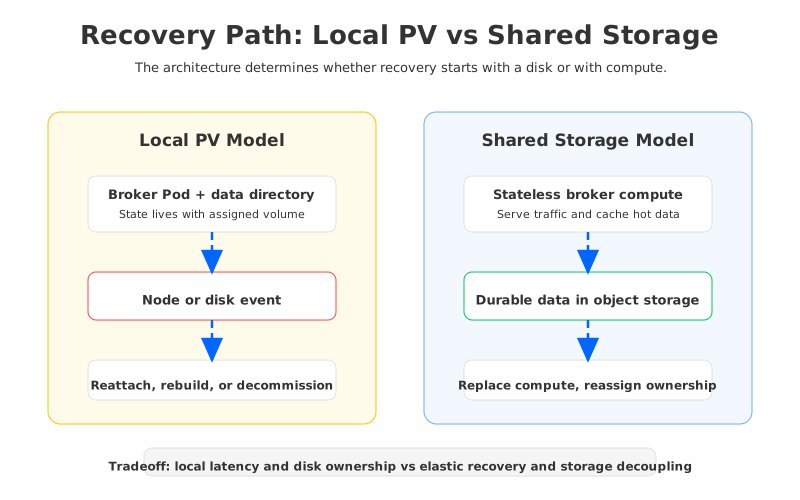
The architectural alternative is to move durable log storage out of broker-local disks and into a shared storage layer. Broker replacement becomes less about preserving a specific local volume and more about reattaching compute to durable data and metadata. Kafka-compatible shared-storage systems do not remove the need for Kubernetes discipline, but they change the blast radius of node replacement and scaling.
4Broker identity, networking, and advertised endpoints
Networking is where many Kubernetes streaming deployments become deceptively hard. Internal clients can use fully qualified domain names for broker Pods and listener ports. External clients require LoadBalancer, NodePort, custom services, DNS, certificates, and advertised listener values to line up. Redpanda's Kubernetes networking docs make this visible by separating internal and external connectivity and showing that Kafka API clients need correct endpoints, credentials, and TLS assets.
This is familiar to Kafka operators. Apache Kafka's broker configuration includes node.id, broker.id, advertised.listeners, and broker.rack. advertised.listeners controls the addresses clients receive from metadata, and rack or zone awareness influences replica placement. If Kubernetes DNS, service exposure, TLS names, and advertised addresses disagree, clients can connect to bootstrap and then fail when they try to reach the partition leader.
The useful mental model is to separate three identities:
- Kubernetes identity: Pod name, StatefulSet ordinal, service DNS, node name, and zone labels.
- Broker identity: Kafka-compatible broker ID, Redpanda node identity, rack or zone mapping, and membership state.
- Client identity: Bootstrap endpoint, advertised broker endpoint, TLS name, SASL principal, ACLs, and network path.
Production readiness means these identities are intentionally mapped. For multi-AZ clusters, the mapping affects cost and availability: a broker in one zone serving clients from another zone can generate cross-zone traffic, a volume bound in one zone can constrain replacement scheduling, and a public endpoint may bypass internal routing assumptions.
5Upgrades, scaling, and recovery windows
Redpanda's Kubernetes upgrade documentation is a reminder that rolling updates are distributed-systems events. New features appear after all brokers are upgraded and restarted, only one feature release can be upgraded at a time, and rollback rules are limited. Broker restarts can also mean higher latency, stale metadata, NOT_LEADER_FOR_PARTITION, under-replicated partitions, and temporary CPU spikes.
Those are normal Kafka-family behaviors, but Kubernetes can make them easier to trigger. For streaming clusters, the rollout gate has to include application health, replication health, client error rates, disk headroom, and version compatibility. A StatefulSet rollout status is necessary, but it is not enough.
Scaling has the same shape. Redpanda supports vertical and horizontal scaling, but its docs warn against Kubernetes autoscalers for broker scaling. Horizontal scale-out requires worker nodes, storage, external access readiness if enabled, health checks before and after the change, and StatefulSet rollout completion. Scale-in requires broker decommissioning. This is a deliberate operational workflow, not a generic HPA action.
Shared-storage Kafka-compatible systems change this part of the evaluation. If durable data is not bound to broker-local disks, adding or replacing compute becomes more like changing serving capacity than moving log segments. Metadata, controllers, object storage credentials, WAL choices, and network policy still matter. The difference is that scaling pressure moves away from "where is the data on disk?" toward "how quickly can the cluster assign ownership and serve traffic from shared durable storage?"
6AutoMQ on Kubernetes with shared storage
Once the hard part is framed as "stateful log data tied to broker-local volumes," AutoMQ becomes relevant as a Kafka-compatible shared-storage option rather than as a generic Redpanda replacement. AutoMQ keeps Kafka protocol compatibility while using S3Stream and object storage as the primary durable storage layer. Its architecture documentation describes stateless brokers, shared storage, WAL storage, and S3-compatible object storage; its Kubernetes documentation covers EKS, GKE, AKS, and Helm-based deployment for AutoMQ Software.
In Kubernetes terms, broker Pods are no longer the long-term home of Kafka log data. Brokers still process Kafka requests, hold leadership, cache data, and participate in coordination. But persistent records live in shared storage, so broker replacement and partition reassignment depend less on copying broker-local logs. AutoMQ's documentation describes partition reassignment and scale-out or scale-in in seconds as technical advantages of this shared-storage architecture.
That distinction matters most for three Kubernetes scenarios:
- Node replacement. If the node is the failure domain, local PV recovery asks whether the original volume can be reattached or rebuilt. Shared storage asks whether a replacement broker can serve data already held in the storage layer.
- Elastic capacity. If demand changes faster than data can be moved, local-disk systems resist frequent scaling. Stateless brokers reduce the coupling between traffic capacity and retained log volume.
- Multi-cloud or BYOC ownership. If data must remain in the customer's cloud account or private environment, an object-storage-backed data plane can align with existing storage, IAM, audit, and lifecycle controls.
AutoMQ is not a magic switch that makes Kubernetes operations disappear. You still need to validate Kafka feature compatibility, client behavior, security, observability, object storage latency, WAL configuration, and deployment boundaries. The narrower point is more useful: shared storage changes which Kubernetes failure modes become expensive.
7Kubernetes readiness checklist
Use this checklist before standardizing on any Kafka-compatible platform on Kubernetes.
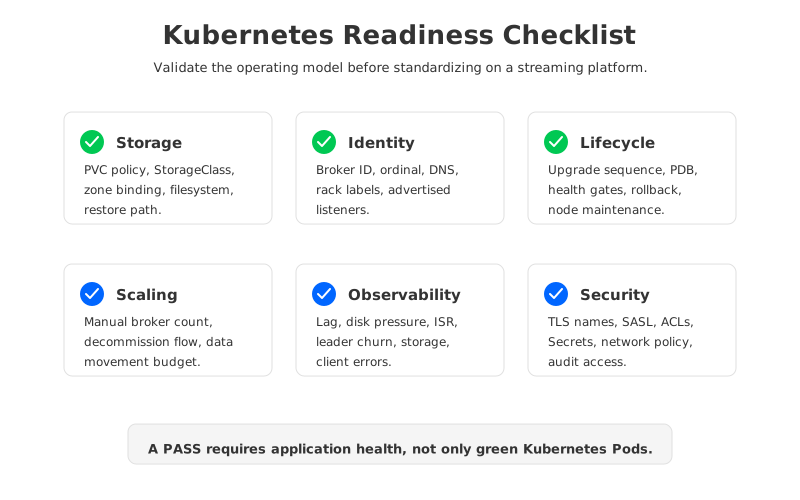
The first gate is storage. Decide whether broker-local disks are part of your desired operating model or a constraint you are accepting. Review PVC reclaim policy, StorageClass topology, volume expansion, filesystem, disk monitoring, backup and restore, and zone placement. If Tiered Storage or shared storage is part of the architecture, document which data is local, which data is remote, and what happens during mixed-version upgrades or object storage incidents.
The second gate is identity and networking: broker IDs, StatefulSet ordinals, DNS, external advertised listeners, TLS names, and rack or zone labels must agree. Test clients from inside the cluster, other VPCs, and every production network path.
The third gate is lifecycle. Require health checks before and after upgrades, controlled node maintenance, PodDisruptionBudget policy, version compatibility review, and a rollback plan that matches the product's actual downgrade rules. For Redpanda specifically, review Kubernetes compatibility and feature-release sequencing before upgrade windows.
The fourth gate is scaling. Decide who can change broker count, how decommissioning works, how long rebalancing may take, and whether infrastructure autoscalers can touch broker nodes. If the platform depends on Karpenter or cluster autoscaler, mark broker nodes with explicit disruption controls and test those controls.
The fifth gate is observability. Redpanda exposes /public_metrics and /metrics endpoints through the Admin API port, Apache Kafka exposes server and client metrics through JMX, and AutoMQ adds storage-layer metrics around S3Stream, WAL, object storage, cache, and self-balancing. Dashboards should reflect the architecture you choose, not only Kubernetes Pod health.
8How to decide
Choose Redpanda on Kubernetes when your team values Redpanda's Kafka-compatible API, latency profile, Operator-driven lifecycle model, and is prepared to operate broker-local state with Kubernetes storage and network discipline.
Choose a shared-storage Kafka-compatible architecture when the main pain is not installation complexity but the coupling between brokers, disks, retained data, and scaling windows. AutoMQ belongs in that evaluation when Kubernetes is the deployment substrate, object storage is already a trusted durability layer, and the team wants Kafka compatibility without making broker-local volumes the center of the operating model.
The useful decision is not "Redpanda or Kubernetes." Kubernetes is the substrate. The real decision is whether your streaming platform should behave like a stateful local-disk cluster managed by Kubernetes, or a Kafka-compatible compute layer attached to shared durable storage. If the second model matches your goals, review the AutoMQ Kubernetes and architecture docs, then run the same readiness checklist against a real workload before you move production traffic.
9FAQ
9.1Is Redpanda supported on Kubernetes?
Yes. Redpanda provides Kubernetes documentation for Helm, the Redpanda Operator, storage, networking, monitoring, scaling, and rolling upgrades. The Operator is positioned as the production-oriented lifecycle option.
9.2Can I use Kubernetes autoscaling for Redpanda brokers?
Redpanda's scaling documentation says not to rely on Kubernetes autoscalers for broker scaling. Broker scaling must account for storage, replicas, cluster health, external access, and decommissioning.
9.3Does Tiered Storage make Redpanda brokers stateless?
No. Tiered Storage can move older data to object storage and improve retention economics, but Redpanda still uses broker-local state for its data directory and hot path.
9.4What is the main Kubernetes risk for Kafka-compatible systems?
The main risk is the interaction between broker identity, persistent storage, and client routing. A recreated Pod still has to preserve or reconstruct the broker's role in the distributed log.
9.5Where does AutoMQ fit as a Redpanda alternative on Kubernetes?
AutoMQ fits when the team wants Kafka protocol compatibility but prefers shared storage and stateless brokers over broker-local durable logs, especially for scaling, node replacement, retention, or BYOC data ownership.
10References
- Redpanda documentation: Redpanda in Kubernetes
- Redpanda documentation: PersistentVolumes for the Redpanda data directory
- Redpanda documentation: Scale Redpanda in Kubernetes
- Redpanda documentation: Connect to Redpanda in Kubernetes
- Redpanda documentation: Upgrade Redpanda in Kubernetes
- Redpanda documentation: Monitor Redpanda in Kubernetes
- Kubernetes documentation: StatefulSets
- Kubernetes documentation: Storage Classes
- Apache Kafka documentation: broker configuration
- Apache Kafka documentation: monitoring
- AutoMQ documentation: Kubernetes deployment overview
- AutoMQ documentation: shared storage architecture
- AutoMQ GitHub repository


