
Table of Contents
Table of Contents
The fastest streaming system is not automatically the right streaming system. That sounds obvious until a platform team is sitting in a vendor benchmark review, staring at a P99 latency chart, and trying to decide whether a few milliseconds are worth a different cost model, a different scaling model, and a different operations model. Redpanda, Apache Kafka, AutoMQ, WarpStream, Pulsar, and Bufstream all answer the same basic question differently: what should a streaming platform optimize for when latency, cost, and operational simplicity pull in different directions?
That tradeoff is where most Kafka evaluations get slippery. A publish latency number tells you how fast a producer got an acknowledgment. An end-to-end latency number tells you when a consumer actually sees the record. A monthly cloud bill tells you what it costs to keep that latency promise across replication, storage, cross-AZ traffic, and idle capacity. Those numbers live together in production, even when benchmark pages present them separately.
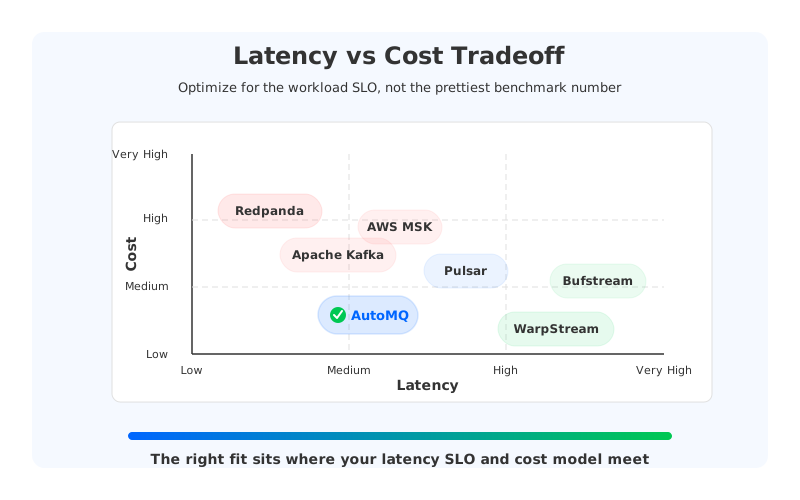
The useful question is not "which product is fastest?" It is "what latency SLO does the workload actually need, and what is the lowest sustainable cost to meet it?" A fraud decision in the payment path, a multiplayer game event stream, an observability pipeline, and an Iceberg ingestion stream do not have the same answer. Treating them as if they do is how teams end up paying for latency they do not use, or saving money in a place where the tail latency really does matter.
1Latency Is Not One Number
Kafka-style systems expose several latency surfaces, and they move for different reasons. Producer latency is the time between a client sending a record and receiving an acknowledgment. End-to-end latency includes producer batching, broker write path, replication or storage commit, fetch scheduling, consumer polling, and sometimes downstream processing. P50 tells you what the typical path looks like, while P99 tells you what happens when the system is under pressure.
That distinction matters because each architecture optimizes a different part of the path. Redpanda's C++ runtime, thread-per-core design, and local NVMe path attack broker-side execution and disk latency. Apache Kafka relies on the JVM, page cache, batching, and broker replication, which can deliver strong throughput but often produces noisier tails under disk or page-cache pressure. Diskless platforms such as AutoMQ and WarpStream move the storage center of gravity toward shared or object storage, which changes the cost equation first and the latency equation second.
Here is the honest comparison frame:
| Platform | Primary optimization | Vendor-published latency reference | Cost shape |
|---|---|---|---|
| Redpanda | Low tail latency on local disk/NVMe | Redpanda's OpenMessaging Benchmark chart shows NVMe publish P99 around 7-8 ms with write caching | High-performance compute and replicated local storage |
| Apache Kafka | Mature throughput and ecosystem compatibility | AutoMQ's benchmark comparison lists Kafka median produce latency at 5 ms and P99 at 100 ms under page-cache thrashing | Broker, EBS/local disk, 3x replication, cross-AZ traffic |
| AutoMQ | Balanced latency, cloud elasticity, lower infrastructure cost | AutoMQ lists AWS Multi-AZ produce latency at 5 ms median and 20 ms P99; its FSx WAL test reports 6.34 ms average write latency and 17.50 ms P99 | Stateless brokers plus shared/object storage |
| WarpStream | Low storage cost and simple BYOC operations | WarpStream docs list S3 Standard produce latency at p50 250 ms / p99 500 ms; S3 Express plus Lightning Topics can reach p50 under 35 ms / p99 under 50 ms for produce latency | Object storage first, lower storage cost, higher latency tradeoff |
These numbers are not apples-to-apples benchmark results. They come from vendor-published tests with different workloads, instance types, storage media, and measurement definitions. They are still useful because they reveal each product's intent. Redpanda is engineered to chase the low-latency edge. Apache Kafka is the reliable default with a mature ecosystem and familiar operational tradeoffs. AutoMQ is trying to make cloud Kafka cost and elasticity sane without leaving the millisecond-latency envelope. WarpStream is willing to trade more latency for object-storage economics and operational simplicity.
2Redpanda: Low Latency, Disk-Bound Economics
Redpanda is the clearest example of a product built around the low-latency end of the spectrum. It removes the JVM, bypasses a large part of the traditional Kafka execution model, and uses a thread-per-core architecture to reduce scheduling noise. In its own OpenMessaging Benchmark write-caching results, the NVMe configuration keeps publish P99 roughly in the 7-8 ms range, and the average end-to-end latency chart sits around 3.5-4 ms for the same workload. For teams running latency-sensitive workloads on dedicated hardware, that is a meaningful result.
The tradeoff is that Redpanda keeps the local-storage model. Production durability still means data lives on broker-attached storage and is replicated across nodes. In the cloud, that brings back the expensive parts of disk-bound streaming: high-performance instances, persistent storage, replication traffic, and data movement during scaling or recovery. A faster engine reduces one part of the bill, but it does not remove the cost structure that comes from keeping data tied to stateful brokers.
This is why Redpanda makes the most sense when the latency target is aggressive enough to justify the storage model. Real-time bidding, market-data distribution, synchronous fraud paths, and parts of game infrastructure can fall into that category. The workload is not asking for "Kafka, but somewhat lower cost." It is asking for very low and stable tail latency, and the team is willing to pay for the hardware and operational discipline that comes with it.
3Apache Kafka: Throughput First, Cloud Cost Later
Apache Kafka's strength has never been a single latency benchmark. Its strength is the combination of protocol maturity, ecosystem depth, operational familiarity, and sustained throughput. Teams choose Kafka because the APIs are everywhere, client behavior is well understood, Kafka Connect and stream processing integrations are mature, and the failure modes are familiar enough to operate at scale.
That maturity comes from a design that predates today's cloud cost model. Kafka's shared-nothing brokers store partition data locally, replicate it to other brokers for durability, and move data physically when partition ownership changes. In a private data center, where machines were long-lived and east-west traffic did not show up as a separate line item, this was a reasonable design. In AWS, GCP, or Azure, every one of those assumptions turns into a cost or elasticity constraint.
The latency profile follows the same pattern. Kafka can produce excellent median latency when the workload is well tuned and the page cache is behaving. But the P99 tail is exposed to broker load, disk pressure, garbage collection, partition imbalance, ISR replication, and rebalance activity. AutoMQ's public benchmark comparison lists Kafka at 5 ms median produce latency and 100 ms P99 in a page-cache-thrashing scenario, which is exactly the kind of gap platform teams care about: the median says "healthy," while the tail says "watch the dashboard."
4AutoMQ: A Balanced Point in the Middle
AutoMQ starts from a different premise: most Kafka workloads do not need the lowest possible latency number; they need predictable millisecond latency at a cost that still makes sense after replication, retention, cross-AZ traffic, and scaling are included. That is a narrower claim than "faster than everything," and it is a more useful one. Observability pipelines, user activity streams, CDC fanout, machine-learning feature ingestion, and many event-driven applications can tolerate tens of milliseconds at P99 far more easily than they can tolerate runaway infrastructure cost.
The architecture is built around that compromise. AutoMQ keeps Kafka compatibility but replaces the local-disk storage assumption with a diskless architecture based on shared storage and object storage. Brokers become stateless compute nodes. The WAL layer absorbs the low-latency write path before data is persisted to object storage, while the durable log is no longer tied to the broker's local disk. That means scaling is mostly metadata movement rather than terabytes of partition migration.
The public numbers put AutoMQ in the balanced part of the quadrant. AutoMQ's website lists AWS Multi-AZ produce latency at 5 ms median and 20 ms P99. Its AWS FSx WAL benchmark reports 460 MB/s writes plus 1,840 MB/s reads, with write latency averaging 6.34 ms and P99 at 17.50 ms; end-to-end latency averages 9.40 ms with P99 at 28.00 ms. Those numbers will not beat Redpanda's strongest NVMe result in a pure low-latency shootout, and they do not need to. They are intended to cover the large middle of production Kafka workloads while changing the cost and scaling behavior underneath.
Cost is where that architecture shows up most clearly. In AutoMQ's 300 MB/s, 50 TB, Multi-AZ comparison, AWS MSK is listed at $70,529/month and AutoMQ at $21,513/month. Apache Kafka self-managed is listed at $80,043/month, while Redpanda is listed at $93,065/month in the same scenario. The exact bill will depend on workload, region, read fanout, retention, and pricing assumptions, but the direction is architectural: when data no longer has to be replicated across broker-attached disks, the storage and cross-AZ lines change.
5WarpStream, Bufstream, and Pulsar Fit Different Corners
WarpStream pushes further toward object-storage economics. In its default S3 Standard configuration, WarpStream documents produce latency at p50 250 ms and p99 500 ms. With S3 Express One Zone and Lightning Topics, it documents produce latency under 35 ms at p50 and under 50 ms at p99, while end-to-end latency remains under 200 ms at p50 and under 400 ms at p99. That is a valid tradeoff for workloads where storage cost, BYOC simplicity, and decoupled operations matter more than tight tail latency.
Bufstream is interesting for a different reason. It is not trying to be a drop-in answer for every Kafka workload. Its center of gravity is schema-first streaming and lakehouse-oriented ingestion, especially where Kafka-compatible streams connect directly into object storage and table formats. For teams thinking in terms of governed data products rather than only broker performance, that direction is worth watching, but the latency/cost discussion should be tied to the actual ingestion path and consistency model.
Apache Pulsar sits outside the Kafka-native line but belongs in the conversation because it separated serving and storage earlier than most mainstream streaming systems. BookKeeper gives Pulsar a different durability and storage model, and tiered storage can make long retention more cost-effective. The price is operational complexity. ZooKeeper/BookKeeper/Pulsar coordination, namespace management, and multi-component operations can be exactly the kind of burden Kafka teams were trying to avoid.
6Choose by Workload, Not by Vendor Category
A clean selection process starts with the workload's latency budget, then works backward to the system architecture. If the business path needs single-digit millisecond P99 and the budget supports high-performance local storage, a low-latency engine such as Redpanda deserves serious evaluation. If the team needs maximum ecosystem compatibility and already has Kafka operational muscle, Apache Kafka or MSK can still be the pragmatic default, especially for stable workloads where capacity is predictable.
The decision changes when cost and elasticity become first-class requirements. Long retention, high write throughput, Multi-AZ replication, unpredictable traffic, and frequent scaling all punish stateful broker architectures. In those cases, a diskless Kafka architecture such as AutoMQ becomes more attractive because it changes the thing that drives the bill and the operational bottleneck. The goal is not to win every latency benchmark; the goal is to meet the SLO while removing the structural waste around it.
For many teams, the decision table looks like this:
| Workload type | Latency priority | Cost sensitivity | Better architectural fit |
|---|---|---|---|
| Trading, real-time bidding, synchronous fraud checks | Very high | Medium | Low-latency local disk/NVMe systems |
| Observability, logs, CDC, user activity streams | Medium | High | Diskless Kafka with shared/object storage |
| Lakehouse ingestion and governed data products | Medium to low | High | Object-storage-native streaming |
| Stable internal Kafka with mature operations | Medium | Medium | Apache Kafka or managed Kafka |
| Elastic traffic with long retention on AWS | Medium | Very high | AutoMQ-style stateless brokers |
The important move is to stop treating latency and cost as two separate evaluations. They are one design space. A system that delivers 5 ms better P99 but forces permanent peak provisioning may be the wrong system for an observability pipeline. A system that saves heavily on storage but adds hundreds of milliseconds to the consumer path may be the wrong system for fraud detection. The right answer is the one whose tradeoff matches the business path.
7The Practical Recommendation
If you are comparing Redpanda vs Kafka vs AutoMQ, start with a written latency SLO before looking at product claims. Decide whether the workload needs sub-10 ms P99, sub-50 ms P99, sub-500 ms P99, or "fast enough for downstream processing." Then calculate the cost of meeting that SLO across compute, storage, replication, cross-AZ traffic, read fanout, and operations. That exercise usually changes the conversation.
For the narrow set of workloads where every millisecond matters, paying for the lowest tail latency can be rational. For the much larger set of Kafka workloads where the business needs reliable millisecond-level streaming, not micro-optimization, the better question is whether the system keeps cost and operations proportional as traffic grows. That is the territory AutoMQ is designed for: Kafka compatibility, stateless brokers, object-storage economics, and enough latency performance for the center of production streaming.
The benchmark is still useful. It tells you what a system can do when the test is shaped around its strengths. Your cloud bill tells you what that decision costs after the test is over.


