
Table of Contents
Table of Contents
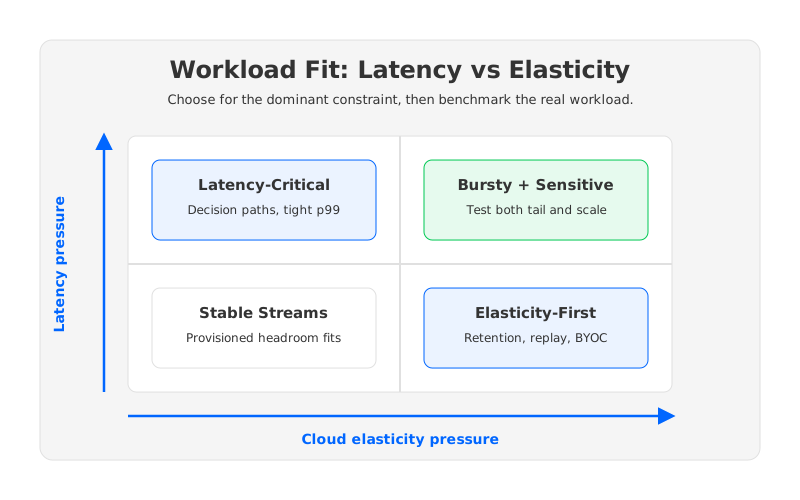
Redpanda earns attention because latency matters. If your event stream sits directly in a trading path, fraud decision, ad auction, online game loop, or user-facing control system, reducing latency variance can be worth more than reducing infrastructure elasticity friction. In those cases, a platform optimized around local execution, predictable hardware, and tight control over the hot path deserves a serious look.
The harder question is whether the same latency-first architecture is the right default for every Kafka-compatible workload in the cloud. Many teams run a mixed estate: some topics are latency critical, some are retention heavy, some are bursty, and some exist because every downstream analytics, ML, search, and compliance system wants its own replay window. Lowest possible p99 latency is not always the dominant constraint. Sometimes the decisive constraint is how quickly you can add and remove capacity, how much data must sit on premium local storage, and whether recovery turns into a data movement project.
That is the real Redpanda low latency versus cloud elasticity tradeoff. It is a workload-fit decision about which bottleneck hurts more.
1When Low Latency Should Dominate The Decision
Redpanda's own documentation frames it as a Kafka API-compatible streaming platform designed for high performance and low latency. Its architecture page describes topics as partitions, partitions as Raft groups, and events as log entries appended to disk and replicated across nodes. It also documents a thread-per-core model built on Seastar, with pinned application threads intended to avoid context switching and blocking. That is a coherent engineering choice: keep the hot path close to CPU, memory, disk, and network resources that the broker can control.
For latency-first workloads, this shape can be attractive. You care about tail behavior, not only average throughput. You tune producer batching, replication acknowledgements, compression, client placement, disks, CPU isolation, and broker configuration as one system. Redpanda's local-storage-first design gives operators a clear place to reason about the partition leader, its replicas, and the hardware underneath them.
These are the cases where low latency should dominate the decision:
- Synchronous application paths: The producer waits because a user-facing decision waits. Added latency may affect conversion, risk scoring, game state, or a machine-control loop.
- Small-message, high-frequency workloads: The workload is not only large throughput. It is a steady stream of small records where batching too aggressively would violate the service-level objective.
- Tightly bounded retention: The stream mainly serves recent events. Long historical replay exists, but it is not the primary economic or operational driver.
- Stable peak capacity: The cluster is sized for a known envelope, and paying for always-on headroom is acceptable because latency predictability is the product requirement.
The last point matters more than most benchmarks admit. Production teams do not operate "a benchmark." They operate a workload with changing traffic shape, failure domains, client behavior, consumer lag, retention rules, and upgrade windows. If latency is the thing that pays the bill, the cluster should be engineered around it.
2When Cloud Elasticity Matters More
Cloud elasticity becomes the stronger requirement when the workload's pain comes from capacity shape rather than per-record latency. A log analytics topic may tolerate a modest latency envelope but punish you with large retention. A CDC pipeline may burst during backfills. A compliance stream may be read rarely, but when it is read, the full historical window matters. The question shifts from "how low can the broker latency go?" to "how much state has to be attached to each broker for the system to stay useful?"
Local storage is not wrong in the cloud, but it has consequences. When hot durable state is tied to brokers, the operator must size local disk, plan replica placement, monitor disk watermarks, manage partition balancing, and handle the cost of moving or restoring state. Redpanda's disk management documentation is explicit that local disk space must be managed to keep the cluster stable, and that a critically low disk condition can block client writes. Tiered Storage helps by offloading segments to object storage, but the system still has to reason about local capacity.
Redpanda Tiered Storage is useful, and it should not be dismissed. The architecture docs say it can offload log segments to object storage, support long-term retention, and allow consumers to read recent offsets from local storage while historical reads come from object storage. The important distinction is that object storage extends the local log; it does not automatically turn brokers into stateless compute nodes.
Cloud elasticity has a different center of gravity:
- Compute elasticity: Can you add or remove brokers without waiting for large local data movement to settle?
- Storage elasticity: Can retention grow independently of broker-local disk?
- Recovery elasticity: Can a failed node be replaced as compute, rather than rebuilt as a storage owner?
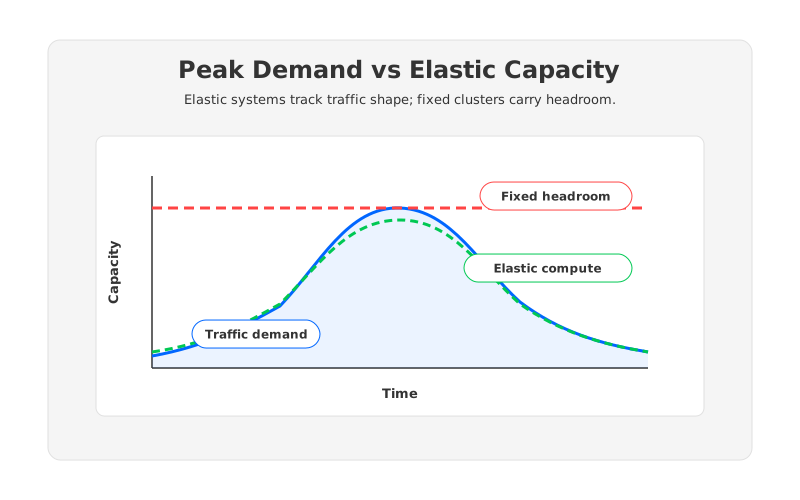
- Cost elasticity: Can you scale down after a peak, or does the cluster keep the same local storage and instance footprint because the data is still attached?
- Data control: Can the data plane stay inside your own cloud account, VPC, and object storage while the platform remains Kafka-compatible?
This is where shared-storage Kafka architectures enter the discussion. They are not trying to win every latency-first benchmark. They are trying to change which parts of the system are stateful.
3The Workload-Fit Matrix
The best platform choice usually becomes clearer when you classify topics by workload shape. The mistake is treating "Kafka replacement" as one decision. A single company may need more than one answer, and a single cluster may carry topics that should never have been grouped together.
| Workload shape | Primary success metric | Architecture pressure | Likely fit |
|---|---|---|---|
| Latency-critical command or decision streams | p99 latency and jitter | Hot path control, stable hardware, tight batching | Latency-first local-storage designs such as Redpanda may fit well |
| Retention-heavy event logs | Retention cost and replay window | Storage grows faster than compute | Shared storage or tiered storage deserves priority evaluation |
| Bursty ingestion and backfills | Scale-out and scale-in speed | Compute demand changes faster than data lifecycle | Stateless broker models are often attractive |
| Regulated or BYOC workloads | Data location, audit, network boundary | Data must remain in customer-controlled infrastructure | BYOC shared-storage Kafka can be a strong option |
| Mixed analytics fanout | Consumer replay and storage economics | Many readers, uneven lag, long catch-up windows | Evaluate cache, object storage, and catch-up read behavior |
This matrix is not a vendor ranking. It is a way to stop arguing about a single word, "performance," as if it means the same thing for every team. Performance for a payment decision may mean tight latency variance. Performance for a data platform may mean absorbing a traffic burst without long-lived over-provisioned capacity. Performance for a FinOps team may mean the platform can keep years of events without forcing compute and storage to grow together.
The more your workload moves rightward toward retention, replay, burst, and governance, the more cloud elasticity becomes part of performance. A system that is extremely fast when fully provisioned can still be the wrong economic fit if the cluster spends most of its life waiting for peaks that arrive twice a day.
4Where AutoMQ Fits
If the core requirement is "lowest possible latency on a stable, carefully tuned local-storage cluster," AutoMQ should not be presented as the automatic answer. That would be lazy architecture advice. The more useful point is that some Kafka-compatible workloads are not latency-first; they are elasticity-first, retention-first, or data-control-first.
AutoMQ fits that second group. It is a Kafka-compatible shared-storage architecture that separates broker compute from durable storage. AutoMQ's public architecture documentation describes S3Stream as the layer that replaces Kafka's native log storage with WAL storage, object storage, and data caching. The result is a stateless broker model: brokers handle Kafka protocol, request processing, scheduling, and cache, while durable data lives in shared storage.
That changes the tradeoff. A shared-storage design accepts that object storage is not the same as local NVMe. It then adds a WAL and cache layer so the hot path is not a naive object-storage request path. The WAL absorbs write persistence and IOPS pressure. Object storage becomes the primary durable repository. Cache helps with tailing reads and catch-up reads. Compute and durable data can scale on different axes.
For cloud teams, the practical upside is not an abstract architecture diagram. It is operational optionality:
- Brokers can be treated more like replaceable compute because durable data is not bound to broker-local disks.
- Retention sizing can lean on object storage economics instead of making local disk carry the full burden.
- Scaling decisions can follow traffic more closely because adding compute does not require moving the same amount of durable data.
- BYOC deployment can keep the data plane in the customer's cloud account, which matters for security, procurement, and compliance reviews.
There is still a benchmark to run. AutoMQ Open Source and commercial editions expose different WAL options, and WAL choice affects latency, durability profile, and deployment model. A serious evaluation should test the edition, WAL backend, cloud region, client configuration, topic count, partition count, and retention policy you plan to run. Shared storage is an architectural advantage for elasticity, not a reason to skip workload validation.
5How To Benchmark Your Own Workload
Most vendor benchmark arguments fail because they collapse too many variables into one headline. If you compare Redpanda, Apache Kafka, AutoMQ, or any other Kafka-compatible platform, make the benchmark boring enough to be useful. The result should map to a production decision.
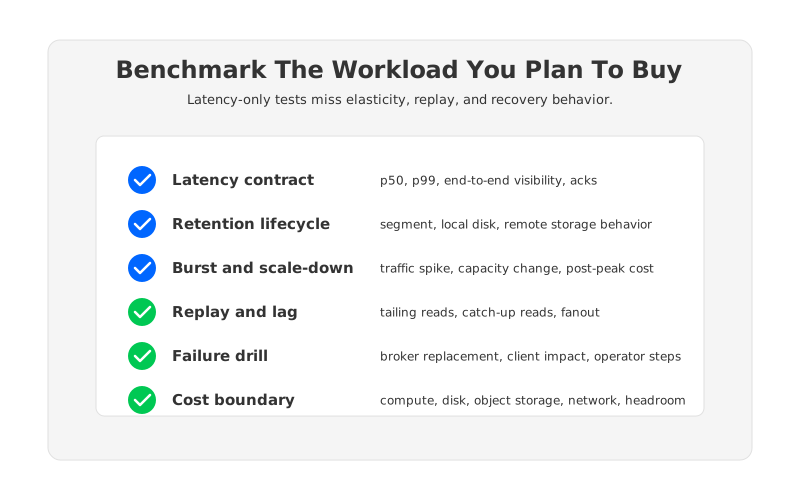
Start with the latency contract. Are you optimizing p50, p95, p99, or p999? Are you measuring producer send latency, broker append latency, end-to-end consumer visibility, or application-level processing time? Kafka producer settings such as acks, linger.ms, batch.size, compression, and idempotence can change the result, so record them. Redpanda's Raft documentation and Apache Kafka's producer documentation both make acknowledgements part of the durability-latency discussion; benchmark results without acknowledgement settings are hard to interpret.
Then model the cloud behavior often left out:
- Retention: Run long enough for retention and segment lifecycle behavior to matter. A short test may never expose storage pressure.
- Burst: Include a traffic spike and a post-spike scale-down period. Elasticity is a time-based property, not a steady-state metric.
- Replay: Add lagging consumers and catch-up reads. Historical reads exercise different parts of the storage path than tailing reads.
- Failure: Replace a broker or node. Measure client impact, recovery behavior, and operator steps, not only throughput after the cluster is healthy again.
- Cost boundary: Track compute, local disk, object storage, inter-zone traffic, and headroom separately. A single monthly total hides the cause.
The point is to make each platform prove the thing you plan to buy. If you are buying Redpanda for latency, test tail latency under the exact acknowledgement, replication, and hardware conditions you will use. If you are buying a shared-storage Kafka alternative for elasticity, test scale events, replay windows, retention growth, and recovery.
6Decision Guidance
Choose Redpanda when its latency-first architecture aligns with the application requirement. That includes systems where the stream is in the synchronous path, retention is bounded, traffic supports headroom, and your team is ready to tune hardware and broker behavior together.
Choose a shared-storage Kafka approach when the primary problem is that compute, storage, and recovery are too tightly coupled. AutoMQ is one option in that category: Kafka-compatible, object-storage-backed, stateless at the broker layer, and available in BYOC-oriented deployment models. It is most compelling when the business pain is over-provisioning, retention cost, slow reassignment, recovery complexity, or data-control requirements.
The cleanest answer is often split by workload. Put the latency-sensitive path on the architecture that gives it the tightest tail behavior. Put retention-heavy, bursty, replay-heavy, or BYOC-governed workloads on an architecture that treats cloud elasticity as a first-class requirement. The expensive mistake is not choosing Redpanda or AutoMQ. The expensive mistake is using one benchmark headline to decide for every topic.
If your Kafka-compatible estate is starting to look more elastic than latency-bound, review AutoMQ's architecture and run a workload benchmark with retention, replay, scaling, and recovery. That is where the real tradeoff shows up.
7FAQ
7.1Is Redpanda always the better choice for low latency?
No platform is automatically better for every low-latency workload, but Redpanda is explicitly designed and positioned around high performance and low latency. It is a strong candidate when your workload is latency-critical, retention is bounded, and you can tune the cluster around stable hardware and traffic assumptions.
7.2Does Tiered Storage make Redpanda stateless?
No. Redpanda Tiered Storage offloads log segments to object storage and lets historical reads come from the remote tier, while recent reads continue to use local storage. That improves retention and recovery options, but it is still different from a shared-storage architecture where object storage is the primary durable repository and brokers are designed to be stateless.
7.3Is shared-storage Kafka too slow for production?
That depends on the workload and the WAL/cache design. A naive object-storage-only path would not be appropriate for many streaming workloads. Practical shared-storage Kafka systems use WAL and cache layers to protect the hot path while using object storage as the durable repository. Benchmark the exact latency percentile and deployment option you need.
7.4When should AutoMQ be evaluated as a Redpanda alternative?
Evaluate AutoMQ when the problem is cloud elasticity, retention cost, fast scaling, broker replacement, BYOC data control, or Kafka-compatible operations with stateless brokers. Do not evaluate it only by asking whether it wins a latency-only microbenchmark; evaluate it against the operational problem you are trying to solve.
7.5What should a fair Redpanda vs AutoMQ benchmark include?
A fair benchmark should include producer acknowledgement settings, batching, replication, topic and partition count, retention policy, traffic burst shape, consumer lag, catch-up reads, node replacement, and cost boundaries. It should report p50 and tail latency separately and avoid hiding cloud elasticity behind a steady-state throughput number.
8References
- Redpanda Docs, How Redpanda Works
- Redpanda Docs, Manage Disk Space
- Apache Kafka Docs, Producer configuration: acks
- Apache Kafka Docs, Replication
- AutoMQ Docs, Architecture Overview
- AutoMQ Docs, Stateless Broker
- AutoMQ Docs, Difference with Tiered Storage
- AutoMQ GitHub, AutoMQ repository


