
Table of Contents
Table of Contents
Redpanda is attractive for a reason. It speaks the Kafka API, removes ZooKeeper from the operational picture, and is designed around a high-performance broker path that can make very good use of local NVMe storage. For teams frustrated by Kafka cluster tuning, JVM behavior, and operational sprawl, that engineering story is easy to understand.
The hard part starts when that architecture meets a cloud bill. A local-storage streaming system does not pay only for "streaming." It pays for the instances that hold the log, the disk capacity attached to those instances, the replicas needed for durability, the headroom required before the next resize, and the operational work of changing the cluster shape after traffic changes. Redpanda can still be the right choice, but the pricing conversation has to include the storage architecture that makes it fast.
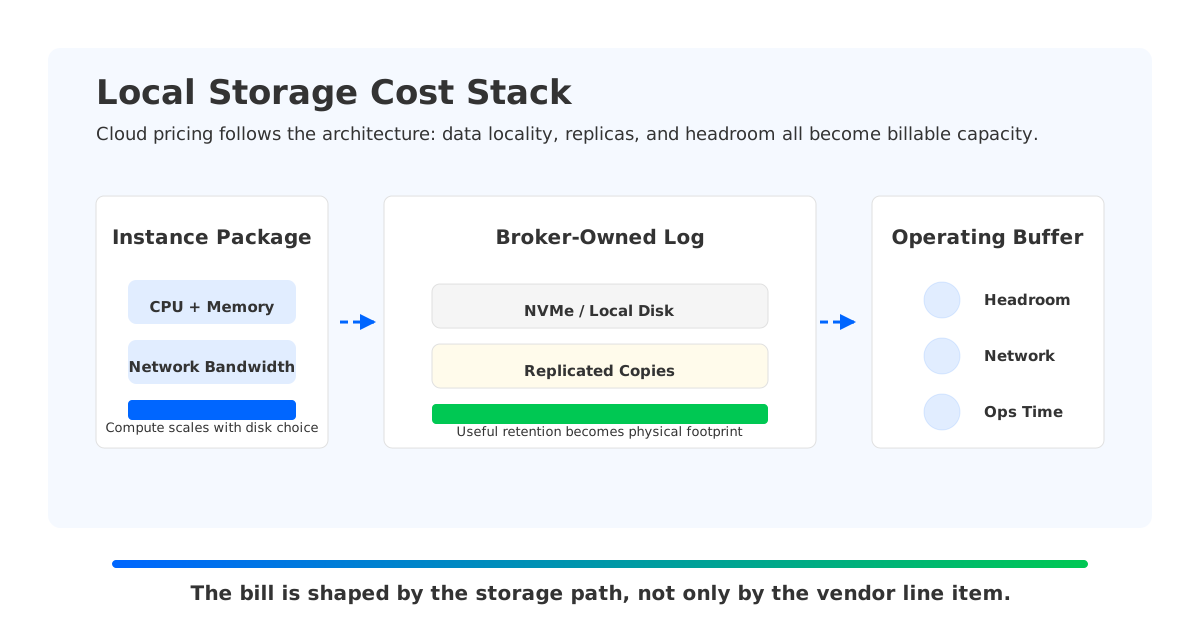
That is the useful way to read Redpanda pricing: not as one line item, but as a cost model produced by an architecture. The key question is whether your workload benefits enough from broker-local performance to justify the cloud economics around NVMe, replication, capacity planning, and retained data.
1Why Redpanda Is Attractive
Redpanda's core appeal is that it keeps the application contract familiar while changing the broker implementation. Producers and consumers can use Kafka-compatible APIs, so teams do not start by rewriting every application. At the same time, Redpanda's storage and execution path is designed for predictable broker performance, especially where local disk and low-latency networking matter.
That combination matters in real production estates:
- Kafka API compatibility lowers migration friction. Existing clients, topic concepts, consumer groups, and ecosystem expectations remain central to the evaluation.
- A single-binary broker model can simplify operations. Teams that dislike managing multiple moving pieces in traditional Kafka may find Redpanda's operational shape compelling.
- Local storage can be excellent for latency-sensitive workloads. When the hot path benefits from data close to compute, broker-local storage is not an accident. It is part of the performance design.
- Managed and BYOC options create deployment flexibility. Redpanda Cloud includes Serverless, Dedicated, and BYOC-style choices, each with different billing and ownership boundaries.
None of that should be dismissed. A fair cost analysis starts by acknowledging why the architecture exists. The mistake is treating the performance story and the pricing story as separate topics, because in the cloud they are the same topic viewed from two angles.
2The Cloud Cost Drivers Behind Local-Storage Streaming
Local storage feels simple when the cluster is small: put brokers on fast machines, replicate the log, and let the broker own the data. The cloud changes the economics because the storage medium, durability model, and compute shape are packaged together. If the workload needs more retained bytes, more write throughput, or more replication capacity, the bill often moves through instance sizing and cluster headroom rather than through storage alone.
The cost drivers usually fall into six buckets:
| Cost driver | Why it matters in a local-storage architecture |
|---|---|
| Compute instance size | Local NVMe capacity and throughput often arrive with larger instance families, so storage needs can pull compute upward. |
| Local disk capacity | Broker-owned disks must hold active data plus operational cushion, not only the average retained bytes. |
| Replication | Durability requires multiple copies of the log, so useful retained data can translate into several times the physical storage footprint. |
| Headroom | Streaming clusters need spare capacity for bursts, broker replacement, rolling operations, and partition movement. |
| Network paths | Replication, consumer fan-out, cross-AZ traffic, and migration overlap can create material cloud transfer cost. |
| Operations | Resizing, balancing, recovery, observability, and incident response add labor cost even when the vendor service removes some management work. |
The subtle cost is coupling. If storage and compute scale together, a retention-heavy workload may pay for compute it does not need because the cluster needs disk. If a throughput-heavy workload needs more CPU, it may also receive disk capacity it does not need. Local NVMe is fast, but the package is not infinitely granular.
Tiered storage can reduce pressure on local disk by moving older segments to object storage. That helps, and it deserves to be modeled. But tiering is not the same as an object-storage-native architecture. The broker still has to manage a hot local tier, local capacity still shapes the cluster, and the team still needs to understand how reads, compaction, retention, and recovery behave when data spans tiers.
3Pricing Questions To Ask Before Committing
Redpanda Cloud pricing depends on the service shape. Public documentation describes Serverless billing around dimensions such as throughput, storage, partitions, and requests; Dedicated clusters around infrastructure-oriented dimensions; and BYOC with customer-owned cloud resources plus Redpanda service terms. Exact packaging can change, so the safest model is dated and region-specific.
Before choosing a plan or sizing a BYOC deployment, answer these questions with workload numbers rather than averages from a slide:
- What is the hot data window? If most reads hit recent data, local storage may be well aligned. If retained data is large and mostly cold, object storage economics become more important.
- How much replication is required? Model usable retained data separately from physical replicated bytes. A small-looking retention policy can become large after replication and headroom.
- Which cloud region and instance family are assumed? NVMe instance availability and cost differ by region. A US East model should not be reused for Europe or Asia without checking the current cloud pricing page.
- How elastic is the workload? Bursty traffic changes the value of autoscaling, but scale-in is harder when brokers own data that must be moved or drained.
- What happens during broker replacement? Recovery time, data movement, and temporary overprovisioning affect both cost and risk.
- Who owns the data plane? In BYOC, the customer usually pays the underlying cloud bill directly, so vendor pricing and cloud infrastructure cost must be modeled together.
This is where FinOps and platform engineering need the same worksheet. A platform team may see a clean broker architecture. A FinOps team may see expensive instance families, replicated storage, and idle headroom. Both are looking at the same system.
4Redpanda vs Object-Storage-Native Kafka Cost Model
An object-storage-native Kafka architecture starts from a different premise: durable log data should not be tied to a broker's local disk. Brokers can become more stateless, while object storage becomes the durable system of record and a write-ahead log layer handles the low-latency write path. This does not make the system free; it changes which cloud services carry the cost.
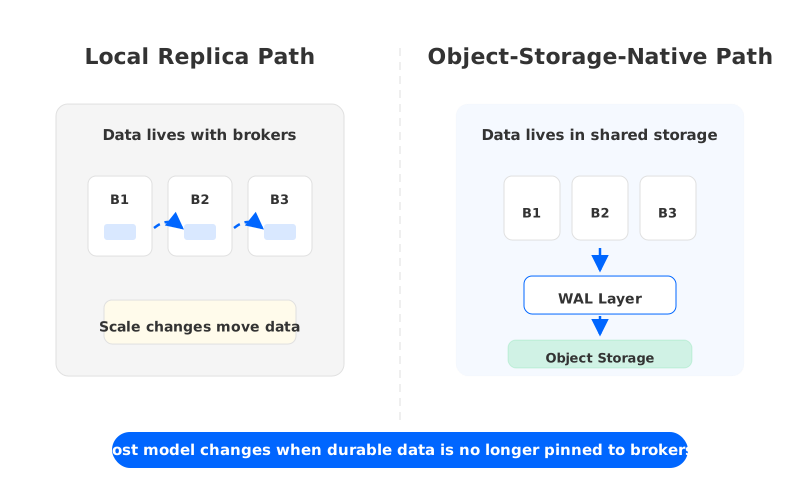
That distinction is why AutoMQ belongs in a Redpanda pricing discussion. AutoMQ is Kafka-compatible and redesigns the storage layer around stateless brokers, WAL storage, and object storage. Instead of asking teams to buy enough local disk for every broker, the architecture separates compute scaling from retained data growth.
The comparison is not "fast vs slow" or "expensive vs cost-effective." It is a workload fit question:
| Dimension | Redpanda-style local storage | AutoMQ object-storage-native model |
|---|---|---|
| Hot-path performance | Optimized around broker-local execution and disk behavior | Uses stateless brokers with WAL plus shared storage for durability |
| Retention economics | Local disk and tiered storage design both matter | Retained data primarily follows object storage economics |
| Scaling behavior | Broker data placement can make scale-in and replacement operationally significant | Brokers can be added or removed with less durable data tied to each node |
| Cost modeling | Instance family, local disk, replication, headroom, and service fees | Compute, WAL storage, object storage, traffic, requests, and service terms |
| Best fit | Latency-sensitive workloads that benefit from local storage | Workloads that need Kafka compatibility with stronger storage elasticity |
The useful architectural question is where the durable log should live. If it lives on broker-local storage, the cluster buys performance and locality, but it also inherits the cost mechanics of replicated disks attached to compute. If it lives in shared cloud storage with a purpose-built WAL path, the system pays for different cloud primitives and can scale retained data without reshaping the broker fleet in the same way.
5Workload Fit Guide
No streaming platform wins every workload. The right answer depends on the shape of latency, retention, traffic, and operational ownership.
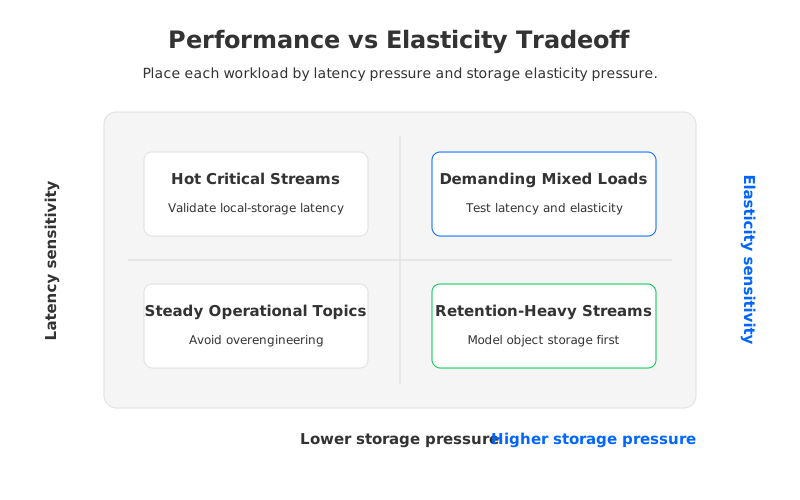
Redpanda is often worth serious evaluation when the workload is latency-sensitive, operationally demanding, and benefits from local storage. This can include critical event pipelines, workloads with tight p99 latency expectations, and teams that want Kafka API compatibility with a different broker implementation.
AutoMQ becomes more interesting when the workload has a different pressure point: large retention, variable traffic, frequent scaling, or expensive broker-local storage. In those cases, the architectural prize is not a faster broker. It is a different cost model where durable data is not trapped inside the broker fleet.
A practical evaluation usually separates workloads into three groups:
- Hot, latency-sensitive streams. Test Redpanda and any alternative under real p99 latency, replication, and failure scenarios. Local storage may be worth the cost.
- Retention-heavy analytical streams. Model object storage, tiered storage, consumer fan-out, and replay behavior. The storage architecture will dominate the long-term bill.
- Elastic platform workloads. Measure how quickly capacity can be added and removed, and how much operational work is required after traffic drops.
That segmentation prevents a common mistake: forcing every topic into the same architectural answer. The right platform choice for a compacted metadata topic may not be the right choice for a high-throughput clickstream with long retention.
6Sources
- Redpanda Cloud billing
- Redpanda BYOC tiers and regions
- Redpanda Tiered Storage
- Redpanda Kafka compatibility
- Redpanda Cloud overview
- AWS EC2 On-Demand pricing
- AWS EBS pricing
- AutoMQ compatibility with Apache Kafka
- AutoMQ stateless broker
- AutoMQ WAL storage
- AutoMQ pricing
7FAQ
7.1Does Redpanda cost less than Kafka?
Not automatically. Redpanda can reduce some operational complexity and may improve performance for certain workloads, but cloud cost depends on instance sizing, local storage, replication, headroom, network paths, managed service fees, and retention. A fair comparison needs a region-specific TCO model.
7.2Why does NVMe affect Redpanda pricing?
NVMe affects pricing because local high-performance storage is usually tied to specific cloud instance families. When storage, CPU, memory, and network capacity come as an instance package, a storage-heavy workload may pay for compute headroom it does not fully use.
7.3Does Redpanda Tiered Storage remove the local disk cost problem?
It can reduce pressure on local disk by moving older data to object storage, but it does not make the architecture identical to object-storage-native Kafka. The broker still manages a hot local tier, and teams still need to model local capacity, read patterns, object storage requests, and recovery behavior.
7.4When should I consider AutoMQ instead of Redpanda?
Consider AutoMQ when Kafka compatibility matters but the main problem is storage elasticity, long retention, scaling flexibility, or the cost of broker-local disks. Redpanda is more naturally aligned with workloads where local-storage performance is central to the value proposition.
7.5What is the biggest mistake in Redpanda cost estimation?
The biggest mistake is modeling only the vendor bill or only the cloud bill. Redpanda pricing analysis should combine service terms, cloud instances, local storage, replication, headroom, traffic, object storage if tiering is used, and migration overlap cost.


