
Table of Contents
Table of Contents
Replacing a streaming platform is not the same decision as replacing a logging library or a dashboard. The blast radius includes producers, consumers, stream processors, connectors, replay workflows, incident playbooks, billing models, and the people who get paged when a rebalance takes longer than expected. That is why a serious Redpanda replacement discussion should begin with a colder question than "Do we like Redpanda?" The better question is: has the workload outgrown the architecture, operating model, or commercial shape that made Redpanda attractive in the first place?
Redpanda has a clear appeal for many teams. It offers a Kafka API-compatible streaming platform, a compact operational footprint, and a performance-oriented design that can be compelling for latency-sensitive workloads. Searching for a Redpanda replacement does not invalidate those strengths. It usually means the surrounding constraints have changed: the cluster moved deeper into public cloud economics, retention grew, procurement changed the deployment rules, or the platform team now values elasticity and data control more than a single-node performance story.
1When Redpanda May No Longer Fit
The first replacement trigger is cost shape, not raw price. A streaming platform can look efficient at one traffic level and become awkward at another if storage, replication, reserved capacity, and operational headcount scale differently from workload demand. Redpanda's own product family includes self-managed and cloud deployment paths, and Redpanda Cloud also supports BYOC models where the data plane runs in the customer's cloud environment. That range is useful, but it does not remove the need to inspect where durable data lives, how capacity is provisioned, and whether the bill follows actual usage or the peak you had to reserve.
The second trigger is scaling friction. Kafka-compatible systems are often adopted because teams already have Kafka clients, consumer group semantics, offset-based replay, and ecosystem tools around Kafka Connect or stream processors. The moment the cluster needs frequent expansion, contraction, or recovery, storage architecture becomes more than an implementation detail. Local-disk designs keep durable state close to brokers. That can be fast and familiar, but it can also make broker replacement, partition movement, and capacity planning feel like storage operations disguised as compute operations.
The third trigger is ecosystem fit. Redpanda documents Kafka client compatibility and positions itself around Kafka API-compatible usage, but replacement planning should still test the real estate your applications occupy: client versions, authentication, transactions, idempotent producers, admin APIs, schema workflows, Kafka Connect, stream processing jobs, and operational tooling. Compatibility is not a checkbox. It is a matrix of behaviors that only becomes visible when you map your own producers, consumers, connectors, and failure modes.
The fourth trigger is governance. Some teams move off a platform because security, compliance, or procurement teams require clearer ownership of the data plane. BYOC can help here, but BYOC is not one thing. Redpanda BYOC, Confluent-style managed services, self-managed Apache Kafka, and AutoMQ BYOC all draw the line between vendor responsibility and customer control in different places. A replacement decision should name that line explicitly: who owns the cloud account, who can access the data plane, who performs upgrades, and what telemetry leaves the environment?
2Cases Where Staying On Redpanda Is Reasonable
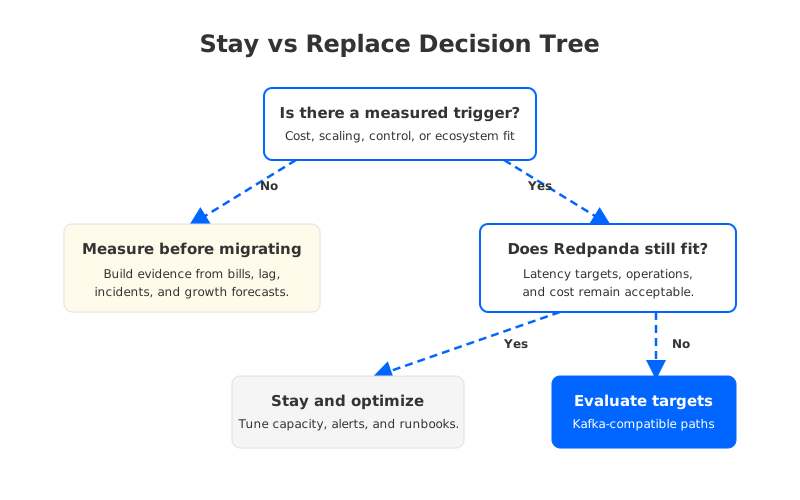
A replacement guide is not useful if it treats migration as the default answer. If Redpanda is meeting latency targets, the team understands its operational model, the cost curve is predictable, and your Kafka compatibility surface is narrow, staying put may be the least risky choice. A stable streaming system has value precisely because nobody has to think about it during a normal week.
Staying also makes sense when the replacement motivation is vague. "We want something more cloud native" is not yet a business reason. "We need to scale brokers down after nightly ingest without moving terabytes of local state" is a business reason. "We need data to remain in our account while reducing cluster overprovisioning" is a business reason. The difference matters because migration risk is concrete while architectural dissatisfaction can be foggy.
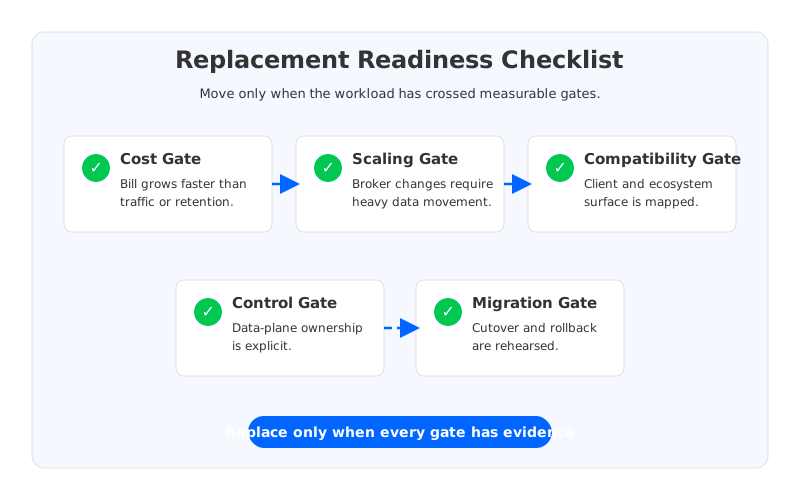
Use the following gates before writing a migration plan:
- Cost gate: Can you point to the line items that are growing faster than traffic, such as compute reservation, attached storage, cross-zone transfer, or operations effort?
- Scaling gate: Do broker changes require storage movement, extended balancing windows, or conservative overprovisioning that the business no longer accepts?
- Compatibility gate: Do you know which Kafka features, client versions, and ecosystem tools must behave the same after the move?
- Control gate: Has the security or platform team defined where data, credentials, logs, and metrics are allowed to live?
- Migration gate: Can you run dual-write, replication, offset validation, rollback, and cutover drills before production traffic moves?
If those gates produce weak answers, the next action is not migration. It is measurement.
3Replacement Criteria For Kafka-Compatible Workloads
The safest replacement target is rarely the one with the longest feature list. It is the one that changes the fewest application assumptions while solving the pressure that started the replacement discussion. For Redpanda users, that usually means preserving Kafka protocol expectations, consumer group behavior, offset-based replay, and operational visibility while changing the storage, deployment, or cost model underneath.
| Criterion | What to Validate | Why It Matters |
|---|---|---|
| Kafka compatibility | Client versions, transactions, idempotent writes, consumer groups, admin APIs, connectors, and stream processors | A small incompatibility can become a large application migration |
| Storage architecture | Local disk, tiered storage, object storage-backed shared storage, or fully managed SaaS storage | Storage placement drives recovery, elasticity, and cost behavior |
| Operating model | Self-managed, managed SaaS, BYOC, or private deployment | The team must know who owns incidents, upgrades, and data-plane access |
| Cost model | Compute, storage, replication, network transfer, retention, reserved capacity, and support | FinOps needs a workload-linked model, not a vendor slogan |
| Migration path | Replication tooling, offset preservation, traffic switch, rollback, and validation | The target architecture is irrelevant if the cutover is unsafe |
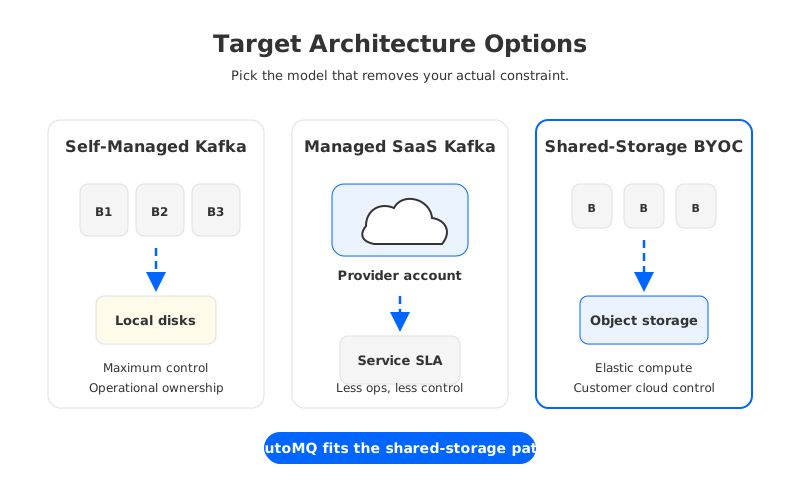
Apache Kafka remains the reference point because it defines the ecosystem gravity: protocol, clients, consumer groups, transactions, Kafka Connect, Kafka Streams, and a large body of operational knowledge. A Redpanda replacement can stay close to that center in different ways. Self-managed Apache Kafka gives maximum control but keeps the team responsible for storage, balancing, and upgrades. A managed Kafka service reduces operational burden but may move more responsibility and data-plane control to the provider. A shared-storage Kafka architecture keeps Kafka compatibility while changing the relationship between brokers and durable data.
That last category is where the replacement conversation has shifted for cloud workloads. If brokers no longer own durable local state, then scaling a broker fleet can look more like changing compute capacity and less like reassigning data. The architectural claim is not "faster in every workload." The claim is narrower and more useful: cloud infrastructure already provides durable object storage, elastic compute, and account-level isolation, so a streaming system can use those primitives instead of binding every scaling event to local broker disks.
4Why Shared-Storage Kafka Changes The Equation
Redpanda supports Tiered Storage, which moves log segments to object storage for retention and read-path economics. That is different from making object storage the primary durability layer behind stateless brokers. Tiered storage still leaves the hot path and broker-local state central to the operating model. Shared-storage Kafka changes the failure and scaling question: what if broker compute can be replaced or resized without treating local disks as the source of truth?
This is where AutoMQ fits as one candidate rather than a universal answer. AutoMQ is a Kafka-compatible streaming platform built around object-storage-backed shared storage and stateless broker behavior. In a replacement evaluation, that means existing Kafka applications can be assessed against a Kafka-compatible target while the platform team evaluates different economics for storage, elasticity, and recovery. AutoMQ BYOC also gives teams a model where resources can run in the customer's cloud environment, which matters when data-control requirements are part of the reason to move.
The trade-off is that shared storage should be evaluated under your workload, not accepted as a diagram. Latency-sensitive workloads, compacted topics, high fan-out reads, long retention, bursty ingest, and disaster recovery targets stress different parts of the system. The right test is not a generic benchmark. It is a replay of the patterns that make your current Redpanda cluster expensive or hard to operate.
That evaluation usually reveals three classes of replacement options:
- Stay close to self-managed control: Apache Kafka or a Kafka distribution may fit teams that want maximum ecosystem familiarity and are willing to keep operational ownership.
- Move toward managed service convenience: Redpanda Cloud, Confluent Cloud, or cloud-provider Kafka services can reduce day-to-day operations, with different trade-offs in pricing, feature surface, and data-plane control.
- Move toward shared-storage elasticity: AutoMQ and other storage-decoupled Kafka-compatible systems are worth testing when the main pressure is cloud cost elasticity, faster scaling, or BYOC-style data control.
The important point is not which bucket sounds most attractive. The important point is matching the bucket to the failure mode you actually have.
5Migration Readiness Checklist
Migration planning starts with inventory. List every producer and consumer group, then mark which applications require idempotence, transactions, strict ordering by key, long replay windows, or coordinated deployment windows. Include the less glamorous pieces: ACLs, quotas, schemas, monitoring dashboards, runbooks, Terraform modules, alert thresholds, and client bootstrap configuration. These details determine whether the replacement is a controlled cutover or a six-week archaeology project.
The next step is compatibility testing. Use a non-production target cluster and run representative clients against it. Validate produce, consume, rebalance, offset commit, failure retry, schema access, connector behavior, and stream processing state. For systems that claim Kafka compatibility, this is where abstract confidence turns into operational evidence. Apache Kafka's own documentation is the reference surface, but your estate is the real test suite.
Data movement deserves its own plan. MirrorMaker 2, vendor migration tools, dual-write patterns, and managed linking features all make different promises about offsets, ordering, consumer progress, and downtime. AutoMQ documentation, for example, describes migration paths using MirrorMaker 2 for open source scenarios and Kafka Linking in commercial editions for byte-to-byte synchronization and cutover workflows. Those capabilities may reduce application disruption, but the safe posture is still to test them against your topics, retention, authentication, and rollback needs before committing production traffic.
Before cutover, insist on a rollback story. A migration is not ready because the target cluster is green. It is ready when the team knows what happens if producer traffic switches but consumer lag spikes, if a connector behaves differently, if a topic-level setting was missed, or if a compliance reviewer asks where diagnostic logs are stored. The uncomfortable questions cost far less in rehearsal than during the incident bridge.
6How To Choose
Choose Apache Kafka when ecosystem fidelity and operational control matter more than changing the storage model. This is common for teams with deep Kafka expertise, existing automation, and a willingness to keep running brokers, disks, balancing, and upgrades themselves. The benefit is familiarity. The cost is that many of the operational responsibilities that made you reconsider Redpanda may remain.
Choose a managed Kafka or Redpanda Cloud path when the main pain is staffing, patching, upgrades, or support coverage. This path can be strong when the organization wants a provider to absorb operational work and the data governance model is acceptable. The evaluation should be very specific about networking, private connectivity, support boundaries, feature availability, and billing behavior under real traffic.
Choose a Kafka-compatible shared-storage option when the reason to move is architectural: local-disk coupling, overprovisioning, slow scaling, or a need to keep data-plane resources under your cloud account while changing cost elasticity. AutoMQ belongs in this category. The natural proof point is not a slide about object storage; it is a migration test showing that existing Kafka clients can keep their semantics while the platform gains a better scaling and recovery model.
Replacing Redpanda is worth doing only when the replacement removes a constraint that the business can name. Start with the gates, run the workload tests, and make the migration plan earn the risk it introduces. If your review points toward Kafka-compatible shared storage and BYOC data control, evaluate AutoMQ with your real topics, clients, and cutover requirements rather than a generic proof of concept. The right replacement is the one that makes next year's operating model less fragile than this year's.
7FAQ
7.1Is Redpanda compatible with Kafka?
Redpanda is designed as a Kafka API-compatible streaming platform and documents support for Kafka clients. Compatibility still needs workload-level validation because real estates include client versions, authentication, transactions, connectors, schemas, stream processors, and operational tooling.
7.2When should a team move off Redpanda?
Move only when there is a concrete trigger: cost grows out of proportion to traffic, scaling requires too much storage movement or overprovisioning, data-control requirements changed, or the Kafka ecosystem surface no longer matches what the team needs. Migration should follow measurement, not frustration.
7.3Is shared-storage Kafka the same as tiered storage?
No. Tiered storage typically extends retention by moving older log segments to object storage. Shared-storage Kafka uses object storage or cloud storage as the primary durable layer behind brokers, which changes scaling, recovery, and data placement behavior.
7.4Can AutoMQ replace Redpanda without application changes?
AutoMQ is Kafka-compatible, so many Kafka client applications can be evaluated without rewriting application logic. The safe answer depends on your client versions, features, authentication, schemas, and migration tooling. Run compatibility and cutover tests before making a production decision.
7.5What should be tested before replacing Redpanda?
Test producer semantics, consumer group behavior, offset continuity, transaction or idempotent producer usage, connector behavior, stream processing jobs, topic configuration, authentication, monitoring, rollback, and cost under representative traffic. The migration plan should include both functional validation and operational rehearsal.
8References
- Redpanda Docs: Kafka clients
- Redpanda Docs: Tiered Storage
- Redpanda Docs: BYOC Architecture
- Redpanda: Pricing / deployment contact page
- Apache Kafka: Official documentation
- AutoMQ Docs: What Is AutoMQ
- AutoMQ Docs: Architecture overview
- AutoMQ Docs: Migration overview
- AutoMQ Docs: Migrate to AutoMQ Cloud overview
- AutoMQ GitHub: AutoMQ repository


