
Table of Contents
Table of Contents
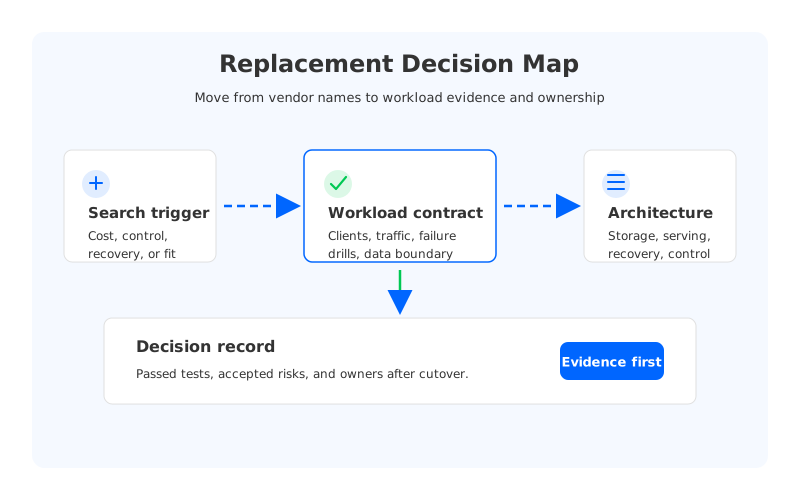
When a Kafka platform owner searches for redpanda alternatives, the team is usually past casual browsing. Redpanda is already known to them: it speaks the Kafka API, has a strong low-latency story, and removes parts of the classic JVM-based Kafka operating model. The search starts when the production conversation changes from "can this run our streams?" to "does this still fit our cost model, data boundary, migration risk, and next architecture review?"
That distinction matters because a Redpanda replacement decision should not become a ranked vendor page. Kafka workloads are too different for that. A fraud stream with strict tail latency, an observability pipeline with long retention, a regulated SaaS data plane, and an internal analytics bus may all use Kafka clients, yet they need different answers. The useful question is not "which alternative is better?" It is "which platform assumption do we need to replace?"
1Why teams search for Redpanda alternatives
Redpanda can be a good fit when the main pain is operating traditional Kafka. Its official documentation describes Kafka client compatibility for clients developed for Apache Kafka 0.11 or later, with documented limitations that teams should test. That makes it a practical candidate for organizations that want Kafka-style producers and consumers without carrying every classic Kafka operational habit forward.
Replacement pressure tends to appear around the workload, not around a single feature. One team may find that retained data and replay traffic are growing faster than broker capacity. Another may need a BYOC boundary because customer data must stay inside a controlled cloud account. A third may need upstream Apache Kafka behavior because its scripts, connectors, or security workflows depend on specific admin APIs. Finance may ask why capacity has to be sized for peak traffic while much of the cluster sits idle outside busy windows.
Those are not the same problem, so they should not produce the same shortlist. Treat the phrase "Redpanda alternative" as a signal that one of five assumptions needs to be challenged:
- Kafka compatibility assumption: Can the candidate preserve the client, admin, security, and ecosystem behavior your applications actually use?
- Storage assumption: Does durable state live on broker-local disks, an archive tier, object storage, or shared storage that changes recovery behavior?
- Cloud cost assumption: Which meters grow with writes, reads, retention, replication, cross-zone traffic, private networking, and idle headroom?
- Operations assumption: Who owns upgrades, incidents, monitoring, capacity planning, support access, and rollback?
- Migration assumption: Can the team cut over producers and consumers while preserving offsets, ordering expectations, ACLs, schemas, and a credible exit path?
This is also why generic review-style pages can feel unsatisfying to platform teams. They may help identify names, but they rarely settle architecture. Workload owners need evidence that maps to the production system they will operate after the purchase order is signed.
2Start with the workload contract
Before comparing platforms, write the workload contract in engineering language. Kafka compatibility is not a checkbox; it is a surface area. Apache Kafka exposes producer and consumer behavior, transactions, idempotent producers, consumer groups, ACLs, quotas, topic configuration, Connect, Streams, admin tooling, and observability conventions. A candidate can pass a happy-path produce-and-consume test while still breaking a cutover script, an ACL workflow, or a lag recovery process.
The workload contract should be concrete enough that an SRE can run it and a procurement lead can understand the risk. Include traffic shape, message size distribution, topic and partition counts, retention classes, compaction behavior, read fanout, replay jobs, peak windows, client languages, security modes, schema dependencies, and non-production clusters. Then add the operational events that usually get skipped in demos: broker failure, zone impairment, scaling down, backlog replay, certificate rotation, quota changes, and a rollback drill.
| Question | Evidence to collect | Decision owner |
|---|---|---|
| What Kafka surface is in use? | Client versions, admin commands, ACLs, transactions, connectors, monitoring agents | Platform engineering |
| What traffic shape must survive? | Ingress, egress fanout, retained data, replay windows, hot partitions | Data platform and app owners |
| What failure modes matter? | Broker loss, storage impairment, zone issues, lag recovery, migration overlap | SRE |
| What cost slope is acceptable? | Current and growth-case TCO tied to provider meters | FinOps |
| What data boundary is required? | Data path, metadata path, keys, support access, network controls | Security and cloud architecture |
This table is deliberately practical. A replacement project succeeds when the candidate can pass the contract, not when it has the most attractive architecture diagram. Redpanda, Apache Kafka, Confluent Cloud, Amazon MSK, WarpStream, AutoMQ, and other Kafka-compatible systems all make different trade-offs. The workload contract turns those trade-offs into testable claims.
3Architecture criteria behind the shortlist
Kafka platform choices separate quickly when you ask what has to move during scale and recovery. Traditional Kafka keeps durable logs on broker-local storage and relies on replication across brokers for availability. That model is familiar and ecosystem-compatible, but capacity changes often involve partition movement, disk planning, and careful leadership management. Managed Kafka services such as Amazon MSK and Confluent Cloud reduce parts of the operational burden, while still requiring teams to understand the service's scaling units, networking model, supported versions, and cost meters.
Redpanda uses a different implementation from Apache Kafka, but it remains closer to a broker-centric serving model than to an object-storage-primary design. That can be valuable when hot-path latency is the dominant constraint. The evaluation changes when retention, replay, recovery speed, or cloud-account control becomes more important than keeping durable state tightly coupled to serving nodes.
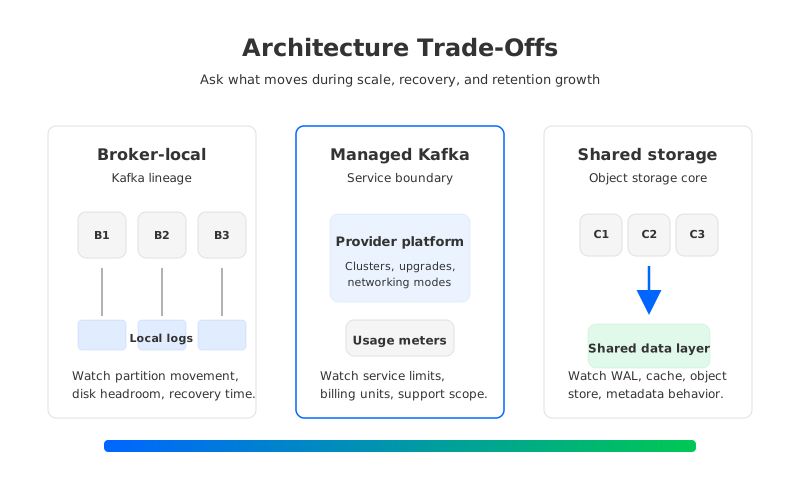
Systems built around Shared Storage architecture challenge that coupling. Instead of treating object storage as a secondary archive, they use it as a core durability layer and make serving nodes more replaceable. This can change the cost and recovery discussion because large broker-local logs do not have to be moved in the same way during broker replacement. The trade-off is that latency, cache behavior, write-ahead logging, metadata coordination, and object-store performance become part of the proof.
For a Redpanda replacement evaluation, the architecture conversation should cover four criteria:
- Serving path: Where do fresh writes land, how are acknowledgments produced, and what happens to p99 latency under bursty traffic?
- Durability path: Which system owns durable bytes, how many copies are created, and where do those copies sit across zones or regions?
- Recovery path: When a node disappears, does the platform rebuild local state, reassign partitions, warm cache, or attach compute to shared data?
- Control path: Which control plane manages metadata, upgrades, support access, telemetry, and policy enforcement?
The last item is easy to underweight. A platform can keep data in the customer's cloud account while sending operational metadata elsewhere. That may be acceptable, but it should be visible in the security review. Draw the data path and metadata path separately; do not let the phrase "managed" or "BYOC" hide the details.
4Cost questions that survive vendor pricing pages
Pricing pages are useful for screening, but Kafka cost is workload-shaped. The bill is not only cluster hours or storage. It includes retained data, replicated writes, read fanout, private networking, cross-zone or cross-region transfer, object storage operations, load balancers, observability, support tiers, migration overlap, and idle headroom. AWS publishes separate pricing for Amazon MSK and EC2 data transfer, which is a reminder that managed service charges and cloud network charges must be modeled together.
A credible cost model needs the same input workload for every candidate. Use current traffic, a committed growth case, and a stress case. Keep discounts and enterprise terms out of the first pass; they can change the final number, but they do not change the slope. If a platform's cost grows with retained bytes, high fanout, peak compute, cross-zone reads, or support tier, the slope will appear once the workload is mapped.
The useful FinOps artifact is not a single monthly estimate. It is a cost curve that shows which meter becomes dominant as retention, replay, or fanout grows.
This is where architecture becomes financial. Broker-local systems may require more local storage and headroom when retention grows. Managed Kafka platforms may simplify operations while introducing service-specific meters. Shared-storage platforms may move durable bytes into object storage and reduce the amount of state tied to serving nodes, while introducing object-store requests, WAL choices, cache sizing, and cloud-account infrastructure into the model. None of these is automatically the lowest-cost answer; each moves the expensive line item.
The replacement question is therefore precise: which cost line created the search in the first place? If the issue is a contract extension, procurement should lead. If it is cross-zone traffic, storage replication, or idle capacity, the architecture team needs to model the data path. If it is SRE time, the operating model matters as much as the infrastructure bill.
5Migration and ownership questions for platform teams
Migration is where broad compatibility claims become operational facts. A Redpanda replacement can be Kafka-compatible and still require careful handling of offsets, ACLs, topic configuration, schemas, consumer group behavior, monitoring, and runbooks. The team should prove the migration path before it treats the PoC as successful.
Start with the applications that are hardest to move, not the ones that are easiest to demo. Long-lived consumer groups, transactional producers, compacted topics, large messages, strict ordering assumptions, Kafka Connect pipelines, and security-sensitive clients should enter the test first. If those pass, simpler workloads are unlikely to surprise you. If those fail, a broad compatibility statement will not rescue the project.
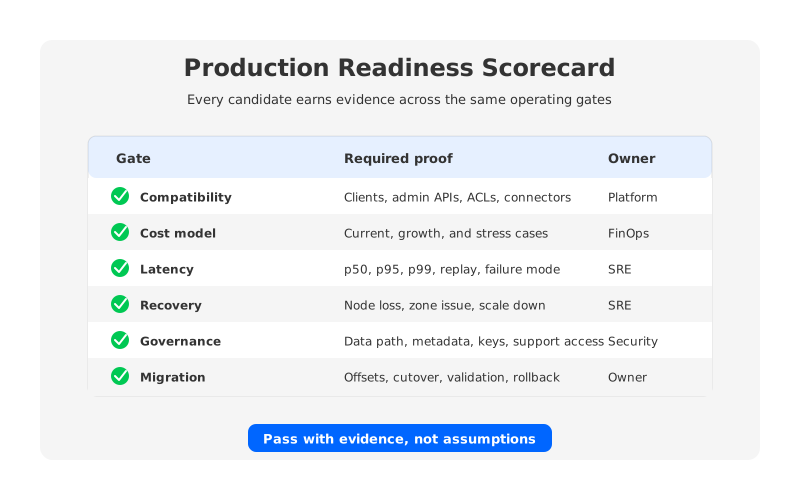
The migration plan also needs a rollback boundary. Dual writes, MirrorMaker 2, Cluster Linking, vendor migration tools, and application cutovers all create different divergence risks. Decide how long the team can run in overlap, how offsets will be validated, when producers freeze writes, and what conditions trigger rollback. A migration plan without rollback is not a plan; it is a hope dressed as a runbook.
Ownership is the second half of migration. After cutover, somebody owns alerts, upgrades, support escalation, quota changes, cost review, incident response, certificate rotation, and audit evidence. Managed services reduce some tasks, but they do not remove accountability. BYOC deployments improve control for some teams, but they add cloud-account, IAM, quota, and networking responsibilities. The correct answer depends on which team is actually staffed to operate the chosen model.
6How AutoMQ fits the evaluation
AutoMQ belongs in this conversation after the workload and architecture criteria are clear. It is a Kafka-compatible streaming system that keeps the Kafka protocol surface while using S3Stream, Shared Storage architecture, stateless brokers, and a WAL layer to decouple durable data from broker-local disks. Public AutoMQ documentation also describes compatibility with Apache Kafka, an architecture built around object storage, and stateless broker behavior.
That architecture is relevant when the replacement pressure comes from cloud cost structure, recovery behavior, elastic capacity, or data-control boundaries rather than from a dislike of Redpanda itself. In an AutoMQ evaluation, the proof points should be the same as for every other candidate: client compatibility, admin workflows, security integration, producer latency, consumer replay, failure recovery, migration path, and operational ownership. The value is not that AutoMQ is another name on the alternatives list. The value is that it tests a different storage assumption.
For teams with strict hot-path latency requirements and small retention windows, a broker-centric design may still be the right fit. For teams with long retention, heavy replay, bursty compute demand, or BYOC requirements, shared storage is worth testing seriously. AutoMQ's Zero cross-AZ traffic positioning and stateless broker model should be validated against your actual region, network, WAL, cache, and object-store choices rather than treated as a generic promise.
The search that began with redpanda alternatives should end with a decision record, not a preference ranking. State which workload contract passed, which risks were accepted, and which operating model your team can own. If shared-storage Kafka compatibility is part of that shortlist, review the AutoMQ Cloud overview or contact the AutoMQ team with your workload profile, migration constraints, and target cloud boundary.
7References
- Apache Kafka documentation
- Redpanda Kafka client compatibility
- Amazon MSK pricing
- AWS EC2 data transfer pricing
- Confluent Cloud cluster types
- AutoMQ compatibility with Apache Kafka
- AutoMQ architecture overview
- AutoMQ stateless broker documentation
- AutoMQ Cloud overview
8FAQ
8.1What should Kafka workload owners ask before replacing Redpanda?
Start with the workload contract: Kafka features in use, traffic shape, retention, replay patterns, security requirements, failure drills, cost model, and migration rollback. A vendor comparison is useful after those requirements are testable.
8.2Is Redpanda compatible with Kafka clients?
Redpanda documents compatibility with Kafka clients developed for Apache Kafka 0.11 or later, with limitations that should be reviewed in its documentation. Production teams should still test their actual clients, admin scripts, security settings, and ecosystem tools.
8.3Which Redpanda alternatives should be considered?
Common candidates include Apache Kafka, Amazon MSK, Confluent Cloud, WarpStream, AutoMQ, and other Kafka-compatible platforms. The right shortlist depends on whether the driver is upstream Kafka behavior, managed operations, object-storage economics, BYOC control, latency, or migration risk.
8.4How should FinOps teams compare Redpanda alternatives?
Use the same workload inputs for every candidate and model current, growth, and stress cases. Include service charges, storage, network transfer, object-store operations, private connectivity, observability, support, idle capacity, and migration overlap.
8.5When does AutoMQ make sense in a Redpanda replacement evaluation?
AutoMQ is worth evaluating when the team wants Kafka compatibility while testing a shared-storage architecture with stateless brokers and object-storage-backed durability. It is most relevant when cloud cost structure, elastic recovery, retained data, replay, or data-control boundaries are major decision factors.


