
Table of Contents
Table of Contents
Search for "Redpanda streaming" and the first ambiguity is not technical at all. Some readers mean Redpanda Streaming, the Redpanda product for running a Kafka API-compatible event streaming platform. Others are trying to compare Redpanda with Apache Kafka, Kafka Streams, or managed Kafka services. Those are different questions, and mixing them together leads to bad architecture decisions.
Redpanda is not Kafka Streams, the Java stream processing library in the Apache Kafka project. Redpanda Streaming is a streaming data platform: it stores event streams, exposes Kafka-compatible client APIs, and runs brokers that accept produce and consume traffic. Kafka Streams applications may connect to a Redpanda cluster because they use Kafka topics as input and output, but Redpanda itself is the broker-side platform, not the processing library.
That distinction matters because the evaluation criteria are different. A processing library is judged by state stores, windowing, joins, and application runtime behavior. A streaming platform is judged by durability, compatibility, operational model, elasticity, cost structure, data control, and failure behavior. Redpanda should be evaluated in that second category.
1What Redpanda Streaming Means
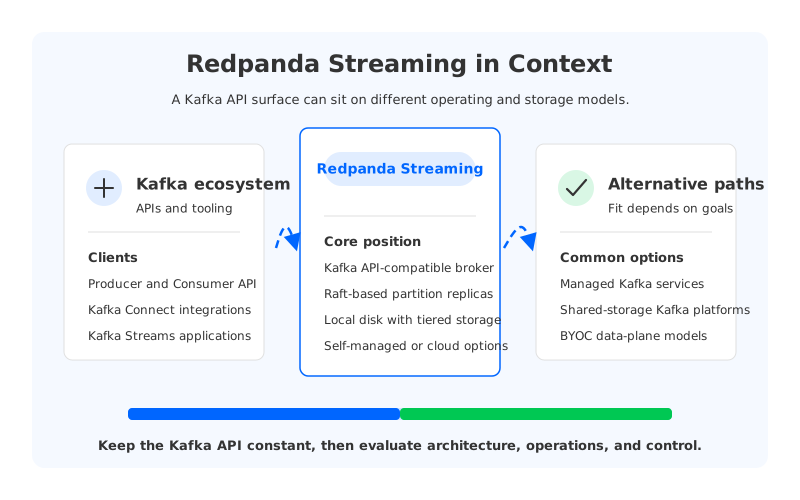
Redpanda's own architecture documentation describes Redpanda as a fault-tolerant transaction log for storing event streams. Producers and consumers interact with it using the Kafka API, and Redpanda organizes events into topics and partitions. That makes Redpanda familiar to teams that already understand Kafka concepts such as producers, consumers, offsets, consumer groups, and topic retention.
The architectural difference is below the API. Apache Kafka traditionally stores partition logs on broker-local disks and replicates those partitions across brokers. Redpanda also keeps the Kafka-facing abstraction, but its implementation is written in C++ and uses a Raft-based replication model for partitions. Redpanda documentation emphasizes a thread-per-core model through Seastar, local disk performance, and broker-level optimization for current server hardware.
This framing is useful, but it has a limit. "Kafka-compatible" does not mean "identical to Apache Kafka in every feature, admin behavior, or ecosystem assumption." Redpanda's Kafka compatibility documentation says Kafka clients from version 0.11 onward are compatible, while also listing unsupported Kafka features and API differences. For most application teams, client compatibility is the first gate. For platform teams, compatibility validation must go deeper.
2How Redpanda Relates to Kafka
Apache Kafka defines a broad event streaming model: publish and subscribe to event streams, store streams durably, and process streams as they occur or retrospectively. Kafka's official introduction explains the core abstractions: events, topics, partitions, producers, consumers, replication, and APIs including Producer, Consumer, Admin, Kafka Streams, and Kafka Connect. Redpanda fits into this world by implementing a Kafka API-compatible broker platform, not by replacing every Kafka ecosystem component with another interface.
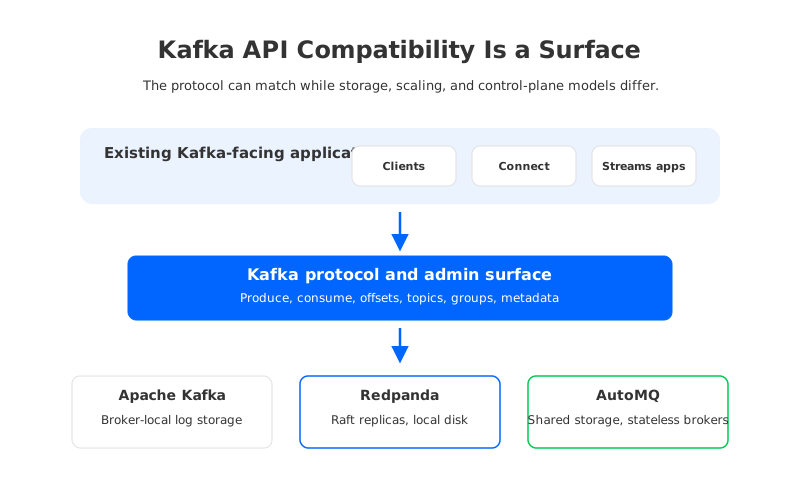
That means a Redpanda evaluation usually starts with a compatibility map. Treat compatibility as a set of surfaces to validate, not a binary label:
- Client protocol compatibility. Existing producers, consumers, and many Kafka protocol clients may work with Redpanda, but teams should validate exact client versions, authentication modes, transactions, idempotence behavior, and admin APIs used by internal tooling.
- Ecosystem compatibility. Kafka Connect connectors, schema registry usage, monitoring integrations, and stream processing frameworks can introduce assumptions that go beyond basic produce and consume calls.
- Commercial and licensing compatibility. Redpanda Community Edition is source-available under BSL terms, while enterprise features require a license key. That is not the same decision profile as Apache Kafka under the Apache License.
The right conclusion is neither "Redpanda is Kafka" nor "Redpanda is incompatible with Kafka." It is more precise to say that Redpanda is a Kafka API-compatible streaming platform with its own broker implementation, storage behavior, enterprise feature boundaries, and operational model. That framing keeps the evaluation technical instead of tribal.
3Common Redpanda Use Cases
Redpanda tends to enter the shortlist when a team is already committed to event streaming and wants a compact, high-performance broker layer. The strongest fit is usually a workload where Kafka API compatibility is valuable, latency and local-disk performance matter, and the team is comfortable adopting Redpanda-specific operations and licensing terms.
- Kafka-like ingestion pipelines. Producers write application, telemetry, CDC, or transaction events into topics, while downstream services consume them asynchronously. Redpanda gives these teams a Kafka-facing API surface without requiring a JVM-based Kafka broker stack.
- Low-latency event distribution. Workloads that prioritize hot data reads and writes can benefit from an architecture tuned around CPU cores, memory, and local storage.
- Self-managed streaming clusters. Teams that want to run the data plane themselves may consider Redpanda Streaming because it gives them direct control over brokers, storage, networking, and deployment topology.
- Managed cloud streaming with data locality options. Redpanda Cloud includes Serverless, Dedicated, and BYOC cluster types. In Redpanda BYOC, the cluster runs in the customer's cloud environment while Redpanda manages provisioning and operations.
None of these use cases automatically excludes Apache Kafka, Confluent, Amazon MSK, WarpStream, AutoMQ, or another Kafka-compatible platform. The point is narrower: Redpanda is a credible option when the team's main question is "Can we keep Kafka-like application semantics while changing the broker implementation and operating model?" Once the question shifts to cloud storage economics or data-plane ownership, the shortlist should widen.
4When Redpanda Is a Strong Fit
Redpanda is easier to justify when the primary workload shape is clear. If most traffic is hot, retention is moderate, and performance depends on tight broker execution rather than object-storage economics, Redpanda's local-storage-centered design can be a good match. The platform team's mental model stays close to clusters, brokers, partitions, replicas, and local capacity.
The decision gets stronger when the organization is comfortable with Redpanda's enterprise feature boundaries. For example, Redpanda's Tiered Storage documentation describes offloading log segments to object storage, but the feature requires an enterprise license. Redpanda's licensing documentation also lists enterprise capabilities such as Cloud Topics, Continuous Data Balancing, Remote Read Replicas, Tiered Storage, and several security or governance features. If those features are part of the intended design, licensing is not a procurement footnote; it is part of the architecture.
5When to Evaluate Alternatives
Alternatives become worth evaluating when the target operating model starts to diverge from Redpanda's strengths. This is not a criticism of Redpanda; it is how infrastructure selection should work. A streaming platform that is excellent for one workload can become awkward when the dominant constraint changes.
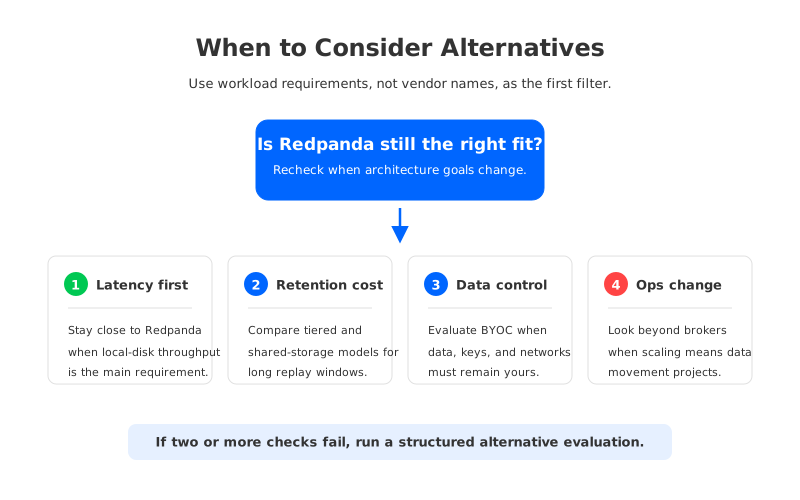
The most useful alternative framework is to ask which constraint is forcing the decision. The same team can make different choices for hot operational streams, long-retention audit logs, and customer-facing event products:
| Decision pressure | Why it matters | Alternatives to compare |
|---|---|---|
| Long retention and replay-heavy workloads | Local disk capacity, tiered storage behavior, and object storage access patterns start shaping cost and performance. | Managed Kafka with tiered storage, shared-storage Kafka-compatible platforms, or data lake-oriented pipelines. |
| Elastic scaling | If adding or removing brokers implies partition movement or capacity planning work, the operating model may not match bursty traffic. | Serverless Kafka, shared-storage architectures, or platforms with stateless broker designs. |
| BYOC and data control | Security teams may require customer-owned networks, storage, keys, and data-plane isolation. | BYOC Kafka services, Redpanda BYOC, AutoMQ BYOC, or self-managed Apache Kafka. |
| Kafka ecosystem fidelity | Some teams need exact Kafka behavior across clients, admin APIs, governance tooling, or migration paths. | Apache Kafka, managed Kafka services, or Kafka-compatible platforms with validated compatibility for the required surface. |
| Licensing and exit path | Source availability, enterprise features, and service restrictions affect long-term platform risk. | Apache Kafka, commercial Kafka services, or vendors with deployment models aligned to procurement constraints. |
If the current pain is latency on hot data, Redpanda may remain the right answer. If the current pain is long-retention economics, frequent scaling, or customer-owned data-plane requirements, alternatives deserve a real proof of concept rather than a brand-level comparison.
6Cloud Cost and Retention
Retention is where many streaming platform evaluations become less intuitive. Kafka-style systems are not only compute services; they are durable storage systems with read amplification, replication, and recovery behavior. A cluster that looks efficient for 24 hours of retention can become expensive or operationally heavy when the business asks for weeks or months of replay.
Redpanda Tiered Storage addresses part of this by offloading log segments to object storage. The important word is "tiered." Recent data continues to live on local storage, while historical data can be read from object storage through the same API. That can reduce local disk pressure, but it is not the same as making object storage the primary storage layer for all durable log data.
This is where shared-storage Kafka-compatible architectures enter the conversation. AutoMQ, for example, keeps Kafka protocol and semantics while replacing Kafka's broker-local log storage with S3Stream, a storage layer that writes durable data to shared object storage with a WAL layer for write efficiency. Brokers become closer to stateless compute nodes because the durable log is not owned by local broker disks. The trade-off is architectural: you evaluate object storage, WAL choices, cache behavior, and cloud integration rather than only broker disks.
7BYOC and Data Control
BYOC is not one thing. Redpanda BYOC documentation says Redpanda deploys into the customer's existing cloud network and that data stays in the customer's environment, while Redpanda manages provisioning, monitoring, upgrades, security policies, and required resources.
Other BYOC designs make different control-plane and data-plane choices. AutoMQ BYOC is also designed around customer-owned cloud resources, with Kafka-compatible data-plane clusters running in the customer's environment and durable data stored in customer-owned object storage. In that model, the evaluation should focus on where the control plane runs, what permissions the operator needs, where data and metadata flow, how upgrades are performed, and whether the organization accepts the management channel.
8Scaling and Operations
Scaling is the place where broker architecture becomes visible to application teams. When a cluster is small and stable, any Kafka-compatible platform can look straightforward. When traffic spikes, retention changes, or a broker fails under load, the storage model decides how much data must move before the cluster is healthy again.
Traditional Kafka's shared-nothing model ties partition data to brokers and local storage. Redpanda's architecture is different from Apache Kafka internally, but it still uses broker storage and partition replicas as central operating concepts. Shared-storage systems take another route: durable data is decoupled from broker-local disks, so scaling compute can become more about leadership, metadata, routing, and cache warmup.
That difference is why AutoMQ naturally appears in this evaluation, but only for a specific class of requirements. If you want Kafka compatibility, customer-owned cloud storage, stateless brokers, and fast elasticity, AutoMQ is one option to test alongside Redpanda Cloud BYOC, managed Kafka, and other Kafka-compatible systems. It is not a drop-in answer for every Redpanda workload. It is a candidate when the operating pain is caused by stateful brokers and cloud storage economics rather than by the Kafka API itself.
9A Practical Evaluation Checklist
Use this checklist before a proof of concept. It keeps the test anchored to workload facts instead of a vendor demo path:
- Compatibility surface. List the exact clients, versions, authentication mechanisms, admin APIs, connectors, stream processing jobs, schema registry usage, and monitoring tools that must work.
- Data model and retention. Capture topic count, partition count, replication requirements, retention period, hot-read window, replay frequency, and expected growth.
- Elasticity target. Define whether scaling should take seconds, minutes, or hours, and whether scaling events can tolerate data movement.
- Control boundary. Document where brokers, control plane, object storage, logs, metrics, keys, and support access live.
- Commercial boundary. Identify which required features are community, enterprise, managed-service-only, or license-restricted.
10How to Think About AutoMQ in This Evaluation
AutoMQ is best understood as a Kafka-compatible shared-storage option, not as a generic claim that every Redpanda workload should migrate. Its architecture keeps Kafka clients and ecosystem semantics in view while changing the storage layer: durable data is moved from broker-local logs into S3-compatible object storage through S3Stream, and brokers are designed to be stateless from the perspective of long-term data ownership.
A fair comparison should include Redpanda's strengths. Redpanda's implementation is tightly optimized around its broker runtime, Raft replication, and local hardware usage. AutoMQ's strength is the separation of compute and storage for cloud elasticity and object-storage economics. Those are different bets. The right platform is the one whose bet matches your workload.
If that evaluation points toward a Kafka-compatible shared-storage model, the next step is to inspect the AutoMQ architecture overview and test the open source project against your own clients and replay patterns. The useful signal is not whether a platform looks elegant in isolation; it is whether it removes the constraint that made you search for an alternative in the first place.
11References
- Redpanda Streaming documentation
- Redpanda: How Redpanda Works
- Redpanda Kafka Compatibility
- Redpanda Tiered Storage
- Redpanda Cloud BYOC
- Redpanda Licenses and Enterprise Features
- Apache Kafka Introduction
- Apache Kafka Streams documentation
- AutoMQ Architecture Overview
- AutoMQ GitHub repository
12FAQ
12.1Is Redpanda Kafka?
Redpanda is not Apache Kafka itself. It is a Kafka API-compatible streaming platform with its own broker implementation, storage model, licensing, tools, and operational behavior. Existing Kafka clients may work, but production migrations should validate the exact compatibility surface.
12.2Is Redpanda Streaming the same as Kafka Streams?
No. Redpanda Streaming is a broker-side event streaming platform. Kafka Streams is a client-side stream processing library in the Apache Kafka ecosystem. Kafka Streams applications can use Kafka topics as input and output and may connect to Kafka-compatible brokers, but that does not make Redpanda a stream processing library.
12.3Is Redpanda open source?
Redpanda documentation describes Redpanda Community Edition as free and source-available on GitHub under the Business Source License. It also states that Redpanda Enterprise Edition requires a license key and includes additional features. Check the current Redpanda licensing page before making a procurement or compliance decision.
12.4When should I consider a Redpanda alternative?
Consider alternatives when your main constraint is not Redpanda's core strength. Common triggers include long retention, heavy historical replay, strict BYOC data-control requirements, fast elasticity goals, exact Kafka behavior requirements, or licensing constraints around enterprise features.
12.5Where does AutoMQ fit compared with Redpanda?
AutoMQ fits the Kafka-compatible shared-storage category. It is most relevant when a team wants Kafka protocol compatibility, stateless brokers, object-storage-backed durability, and BYOC deployment in the customer's cloud environment. Redpanda may remain a stronger fit for teams prioritizing local-disk hot-path performance and Redpanda's specific operational model.


