
Table of Contents
Table of Contents
Redpanda TCO is not the same question as Redpanda pricing. Pricing asks what a vendor or cloud provider charges for a unit of service. TCO asks what your streaming workload will cost through growth, retention changes, failover requirements, replay events, operational labor, support contracts, and peak traffic arriving when the budget model used an average. That distinction matters because streaming platforms are not static subscriptions. They turn workload shape into infrastructure, network paths, storage growth, and human work.
Redpanda's official pricing and cloud documentation should be the source of truth for current commercial terms. Rather than inventing a Redpanda price list or assuming private discounts, a credible model gives FinOps, procurement, and platform teams a workload-driven worksheet for Redpanda Cloud, self-managed Redpanda, Apache Kafka, and shared-storage Kafka-compatible systems such as AutoMQ. The goal is to make assumptions auditable before a renewal, migration, or architecture review turns them into a contract.
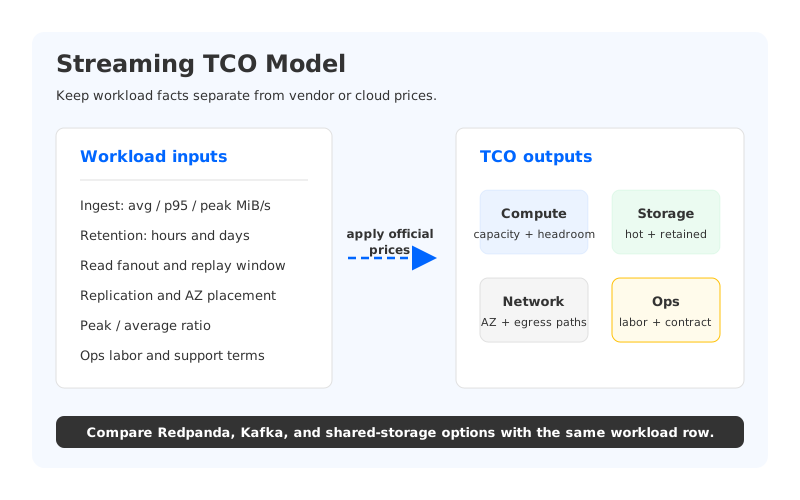
The fastest way to improve a TCO conversation is to separate inputs from prices. Workload inputs are facts you own: ingest rate, read fanout, retention, peak behavior, replication, network topology, operations, and support needs. Prices are then applied using official vendor and cloud-provider references.
1Pricing vs TCO
Pricing pages are necessary because they define the billable dimensions. Redpanda Cloud, for example, exposes cloud service concepts such as serverless, dedicated, and BYOC-style deployment options, while its billing documentation describes usage dimensions including streaming compute, storage, data transfer, and related cloud resources. Those documents are the right place to verify current metric names and plan-specific rules.
TCO starts one layer below that. A workload writing 25 MiB/s with a 2:1 peak ratio, 3 steady consumers, and 7 days of retention is a different economic object from a workload writing the same monthly volume in short spikes, retaining 90 days, and replaying into analytics every weekend. A pricing page can tell you how units are charged. It cannot know which of those units your architecture will create.
The TCO model should answer four questions before anyone compares vendors:
- What workload behavior creates bytes, capacity, and network movement?
- Which durability model multiplies those bytes through replication or storage layout?
- Which deployment boundary decides whether costs appear as a managed-service bill, a cloud invoice, or internal labor?
- Which assumptions change when traffic grows, retention expands, or consumers multiply?
That last question is where many cost models break. A spreadsheet that looks accurate at today's average rate can be wrong for the renewal period because the platform team's real risk is slope, not current state.
2Workload Inputs for a Streaming TCO Model
A streaming cost model should begin with one row per workload, topic family, environment, or tenant. Do not start with broker count. Broker count is an output of throughput, storage, partitions, availability, and headroom assumptions. Starting there hides the reasons the cluster exists.
Use MiB/s consistently for throughput. Keep retention in both hours and days. Track read fanout as read copies per written byte. If a topic has one fraud detection consumer, one search indexer, one warehouse ingest pipeline, and one replay-heavy investigation tool, its steady fanout may be 3 while replay behavior needs a separate column.
| Input | Unit | Why it changes TCO |
|---|---|---|
| Average ingest | MiB/s | Drives baseline compute, storage growth, and monthly volume. |
| Peak ingest | MiB/s | Drives headroom, throttling risk, and autoscaling or reserved capacity decisions. |
| Peak/average ratio | ratio | Shows whether the workload is steady, bursty, or seasonally spiky. |
| Retention | hours and days | Converts a streaming pipe into a storage commitment. |
| Replication or durability model | factor or architecture | Determines whether bytes are stored multiple times on brokers, offloaded, or held in shared storage. |
| Read fanout | read copies per write | Exposes consumer-side capacity and data transfer. |
| Replay profile | window and frequency | Captures backfills, incident investigation, migration validation, and DR drills. |
| Network topology | AZ, VPC, account, region | Determines cross-AZ, private connectivity, internet egress, and inter-region exposure. |
| Operations labor | hours or FTE allocation | Captures upgrades, incidents, capacity planning, observability, governance, and on-call. |
| Support and contract terms | plan, SLA, term | Captures vendor support, committed spend, reserved capacity, and negotiated limits. |
This table is vendor-neutral. It can feed a Redpanda Cloud estimate, a self-managed Redpanda plan on cloud instances and disks, an Apache Kafka baseline, or an AutoMQ comparison. If every option uses different workload assumptions, the exercise becomes a sales comparison instead of a TCO model.
3Redpanda TCO Components
Redpanda is a Kafka API-compatible streaming platform with its own engine and operational model. For buyers, the relevant TCO question is not whether Redpanda looks like Apache Kafka internally. It is how a Redpanda deployment maps workload inputs into compute, storage, networking, operational responsibility, and commercial terms.
3.1Compute
Compute modeling starts with throughput, partitions, CPU headroom, memory, network bandwidth, and peak behavior. For Redpanda Cloud, the compute line may appear through the managed service's pricing and billing dimensions. For self-managed Redpanda, it becomes cloud instance types, instance count, reserved or on-demand terms, Kubernetes or VM overhead, and the capacity buffer needed for failure scenarios.
The model should separate steady-state compute from failover compute. A multi-AZ production cluster is sized for degraded operation when a node or zone is unavailable. If your spreadsheet uses average ingest and ignores failure headroom, it may understate the capacity you need to buy or reserve.
Peak/average ratio changes whether over-provisioning is quiet waste or necessary insurance. A steady workload can be modeled with a narrow buffer. A bursty workload needs elastic capacity, higher committed headroom, or an explicit throttling policy that application owners accept.
3.2Storage and Retention
Storage cost begins with retained bytes, but the multiplier depends on architecture. Apache Kafka retention can be controlled by time and size, and Kafka's tiered storage feature adds remote storage settings for older log segments. Redpanda also documents tiered storage behavior that moves older log data to object storage while keeping the active write path on local storage. The TCO model should treat those as distinct layers, not one generic "storage" cell.
For local-disk-first systems, retention can increase attached storage requirements, broker count, recovery time, and data movement during balancing. Tiered storage can reduce local retention pressure, but it does not make the active storage path disappear. You still need to model hot data, local disk, remote object storage, retrieval behavior, and request patterns.
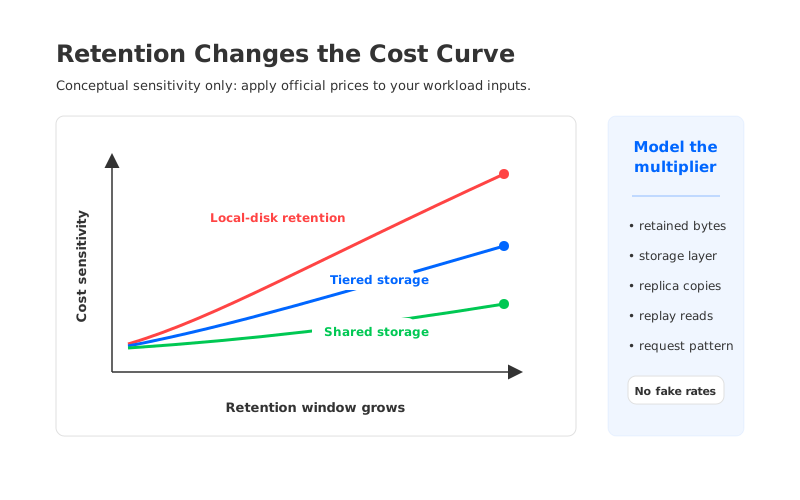
Retention is where small policy changes become budget events. Moving from 24 hours to 7 days is not a formatting change in a YAML file; it changes stored bytes by a large multiple before compression, replication, or tiering assumptions are applied. That is why retention should be owned by the data owner, not buried as a platform default.
3.3Replication and Durability
Replication is both an availability strategy and a cost multiplier. In Kafka-style local storage architectures, replication factor affects stored copies, broker network traffic, recovery behavior, and cross-AZ movement when replicas span availability zones. Redpanda uses Raft-based replication, so the modeling question is still concrete: how many durable copies exist, where are they placed, and what network paths do they traverse?
For production clusters, avoid modeling replication as a simple factor written next to storage. Break it into three related assumptions: storage copies, network copies, and failure-domain placement. A replication factor may create multiple stored copies, but cross-AZ placement can also create billable data transfer depending on the cloud provider and traffic direction. Cloud pricing pages, not blog posts, should be used to assign exact rates.
This is also where self-managed and managed-service boundaries diverge. A managed service may abstract the replica placement mechanics, but the workload still produces durability-related cost somewhere. The TCO model should show whether that cost is embedded in the service unit, passed through as cloud infrastructure, or exposed through network and storage line items.
3.4Networking
Networking is the part of streaming TCO that teams often discover after the platform is already live. Producer ingress, consumer egress, replication traffic, private connectivity, cross-AZ movement, cross-region DR, and internet data transfer can all have different owners and different bill paths. AWS, for example, publishes separate pricing references for EC2, VPC networking, S3, and EBS rather than one universal "Kafka network" number.
Model byte paths before assigning prices. Producers may run in one VPC, consumers in another account, stream processors in Kubernetes, analytics in a data warehouse, and disaster recovery in a second region. A single written byte can become multiple read bytes, multiple replica bytes, and multiple replay bytes. If the model only tracks ingress, it misses the reason streaming bills surprise people.
Private connectivity deserves its own row. PrivateLink-style endpoints, NAT, load balancers, peering, transit gateways, and managed-service networking features can be the right security decision while still changing the economic path of traffic. A good TCO worksheet does not treat security architecture as free context.
3.5Operations, Support, and Contract Cost
Operations cost is not a punishment line for self-managed systems. It is part of every streaming platform. Managed services reduce or shift some operational work, but application onboarding, topic governance, schema or data contract ownership, quota policy, client behavior, incident response, cost reporting, and change control still need owners.
For Redpanda Cloud, include the value of managed operations, support plan, SLA, committed spend, and renewal terms. For self-managed Redpanda, include deployment automation, upgrades, monitoring, security patching, incident response, capacity planning, backup and restore testing, and vendor support if applicable. For internal labor, use your organization's loaded cost model rather than a number copied from another company's blog.
Migration cost should be modeled separately from run rate. A migration scenario may include dual-running clusters, replication tooling, client cutovers, offset validation, ACL and topic policy migration, schema registry considerations, test environments, rollback windows, and temporary extra network traffic. Smearing this into monthly TCO hides one-time risk that decision-makers need to see.
4How Shared Storage Changes TCO Assumptions
The strongest TCO lever is not a smaller node count on a spreadsheet. It is changing which workload inputs force the platform to move or duplicate data. Local-disk architectures bind compute and storage together: adding throughput, increasing retention, or recovering from failure often means reasoning about broker-local state. Tiered storage improves long-retention economics, but it still leaves an active local layer that must be sized and operated.
Shared-storage Kafka-compatible architectures change the model by separating durable stream storage from broker compute. AutoMQ is an example of this category: it keeps Kafka protocol compatibility while using object storage as shared storage and stateless brokers for the compute layer. In a TCO worksheet, that does not erase cost. It remaps cost into object storage, WAL, compute, network, and BYOC operational boundaries.
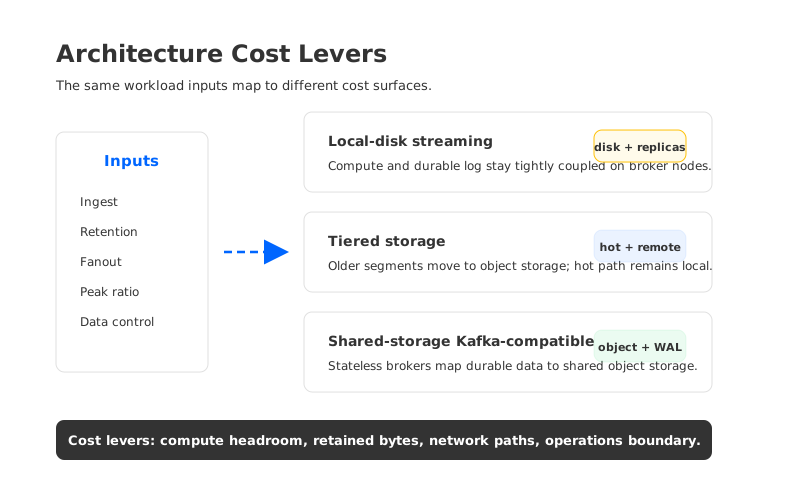
This remapping matters most when the workload has long retention, uneven peaks, high growth uncertainty, or data-control requirements. Object storage can become the primary retained-data substrate. Stateless brokers can make compute scaling less tied to moving large amounts of broker-local log data. BYOC deployment can keep the data plane in the customer's cloud account, which changes both governance and the cloud invoice owner.
The fair comparison is architecture to architecture. Redpanda may be a strong fit for teams that value its low-latency engine, Kafka API compatibility, and operational model. AutoMQ may be worth modeling when the expensive parts of the workload are retention growth, elastic scaling, cross-AZ replication pressure, or a requirement to keep data infrastructure in the customer's own cloud environment. The model should show which assumption drives the decision instead of turning the comparison into a brand preference.
5TCO Worksheet Fields
A useful worksheet has fewer magic formulas and more named assumptions. Start with the workload table, then add architecture-specific tabs. One tab can map the inputs to Redpanda Cloud billing dimensions using current official pricing. Another can map the same inputs to self-managed cloud resources. A third can map them to a shared-storage architecture such as AutoMQ.
At minimum, include these fields:
- Workload identity: owner, environment, topic family, compliance level, and business criticality.
- Traffic shape: average ingest, p95 ingest, peak ingest, peak/average ratio, message size, compression ratio, and growth forecast.
- Reads: steady fanout, replay fanout, replay window, largest expected backfill, and consumer locations.
- Storage: retention hours, retention days, hot data window, remote storage policy, object storage class, and deletion policy.
- Durability: replication factor or durability architecture, AZ placement, region placement, DR target, and recovery objective.
- Network: producer location, consumer location, private connectivity, cross-AZ paths, cross-region paths, and internet egress exposure.
- Operations: deployment owner, upgrade owner, on-call owner, observability cost, support plan, contract term, and migration cost.
After the first pass, group workloads into economic patterns: steady baseline, bursty ingest, long retention, high fanout, replay-heavy, regulated BYOC, and migration candidate. This grouping is more useful than one grand monthly number because different architectures improve different parts of the cost curve.
6References
- Redpanda Pricing
- Redpanda Cloud billing documentation
- Redpanda Tiered Storage documentation
- Apache Kafka documentation
- Apache Kafka generated topic configuration reference
- AWS EC2 On-Demand Pricing
- Amazon EBS Pricing
- Amazon S3 Pricing
- Amazon VPC Pricing
- AutoMQ Pricing
- AutoMQ Documentation
7FAQ
7.1What is the difference between Redpanda pricing and Redpanda TCO?
Redpanda pricing describes current billable units, plan terms, and product-specific commercial dimensions. Redpanda TCO combines those prices with workload inputs, cloud infrastructure, network paths, operational labor, support, contract terms, and migration cost. Pricing is a source. TCO is the model built from your workload.
7.2Which workload input matters most for a streaming TCO model?
No single input is enough. Average ingest in MiB/s is necessary, but peak ingest, peak/average ratio, retention, read fanout, replay behavior, replication, and network topology often explain why two workloads with similar monthly volume produce different costs.
7.3Should I include operations labor in a Redpanda TCO model?
Yes. For managed Redpanda, include the value and cost of managed operations, support, contract terms, and the work your team still owns. For self-managed Redpanda, include deployment, upgrades, observability, incident response, capacity planning, and on-call. Use your organization's own labor model rather than external guesses.
7.4How does tiered storage affect TCO?
Tiered storage can reduce pressure from long local retention by moving older log data to object storage, but the model still needs separate assumptions for hot data, local storage, remote storage, request patterns, retrieval behavior, and operations. It is not the same model as fully shared storage with stateless brokers.
7.5Where does AutoMQ fit in a Redpanda TCO review?
AutoMQ fits as a Kafka-compatible shared-storage and stateless-broker option to model beside Redpanda, Apache Kafka, and managed Kafka services. It is especially relevant when the TCO pressure comes from long retention, bursty traffic, cloud elasticity, cross-AZ data movement, or BYOC data-control requirements.
7.6Can a TCO model prove that one platform is always lower cost?
No. A credible model should show which workload assumptions favor which architecture. Redpanda, self-managed Kafka, managed Kafka services, and AutoMQ can each be reasonable under different latency, operations, ecosystem, retention, and governance constraints. The point is to make those constraints visible before committing to a platform.


