
Table of Contents
Table of Contents
An AWS team comparing Redpanda and Amazon MSK is usually not choosing between "Kafka" and "not Kafka." It is choosing between two answers to the same pressure: keep Kafka-style producers, consumers, partitions, and offsets, but reduce the operational pain of running streaming infrastructure in AWS. Amazon MSK keeps you close to open-source Apache Kafka under an AWS-managed service boundary. Redpanda keeps the Kafka API surface for many client paths while replacing the engine with Redpanda's own implementation.
That distinction changes how you should read every cost estimate. MSK is attractive when the requirement is "managed Apache Kafka inside AWS." Redpanda is attractive when the team wants a Kafka API-compatible platform and is comfortable validating a different engine. If the problem is durable data tied to broker-local storage, a third category belongs in the discussion: Kafka-compatible shared-storage systems such as AutoMQ.
1Quick Answer for AWS Teams
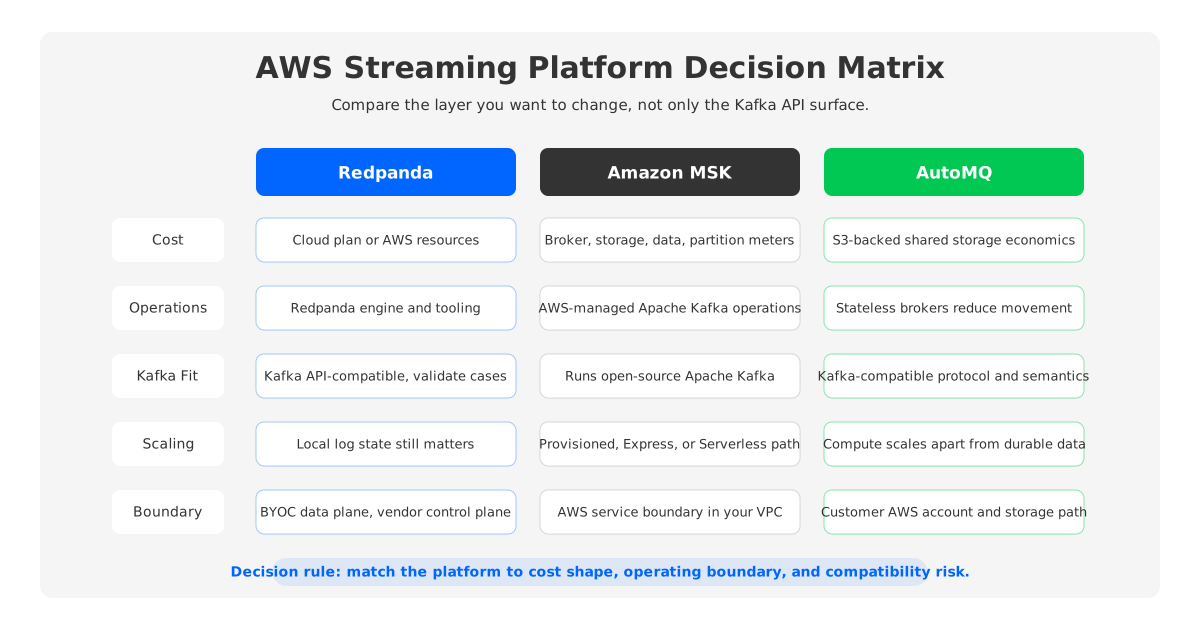
Choose Amazon MSK when you want AWS-native managed Apache Kafka, strong fit with AWS networking and IAM patterns, and a conservative compatibility story for existing Kafka applications, tools, and plugins. AWS describes MSK as a fully managed service that runs open-source Apache Kafka versions, handles control-plane operations such as creating and updating clusters, and lets applications use Apache Kafka data-plane operations to produce and consume data.
Evaluate Redpanda when you want Kafka API compatibility but are open to a different streaming engine, Redpanda tooling, and Redpanda Cloud or self-managed deployment. Redpanda's compatibility docs say Kafka clients version 0.11 or later are compatible, with validations and exceptions documented by Redpanda. The important phrase is "validations and exceptions." For real estates, compatibility is not proven by one producer and one consumer; it is proven by clients, transactions, admin workflows, connectors, security, monitoring, and failure drills.
Bring AutoMQ into the shortlist when the pain is storage economics, scaling friction, or strict cloud-account control rather than the basic Kafka API. AutoMQ is a Kafka-compatible streaming platform that replaces broker-local durable storage with S3Stream shared storage and stateless brokers.
| Axis | Redpanda | Amazon MSK | AutoMQ |
|---|---|---|---|
| Core identity | Kafka API-compatible Redpanda engine | AWS-managed open-source Apache Kafka | Kafka-compatible shared-storage platform |
| Fit | Teams accepting a different engine behind Kafka clients | Teams standardizing on Apache Kafka in AWS | Teams targeting S3 economics and stateless scaling |
| Proof | Validate Kafka behavior against real workloads | Validate managed-service limits and Kafka version | Validate Kafka behavior plus shared storage |
| Boundary | Redpanda Cloud, BYOC, or self-managed | AWS managed service in your VPC design | BYOC with customer AWS resources and storage |
The table should not become a vendor scorecard. It is a way to prevent a common mistake: comparing list prices before you know which layer you are changing.
2Architecture and Kafka Compatibility
MSK's compatibility story is straightforward because it runs Apache Kafka. The AWS documentation says existing applications, tooling, and plugins from partners and the Apache Kafka community are supported without application-code changes. Testing still matters because Kafka versions, quotas, authentication, networking, and managed-service limits vary, but the underlying broker remains Apache Kafka. That is valuable when your estate depends on Kafka Streams, Kafka Connect, Admin API behavior, ACL semantics, or operational tooling built around Kafka conventions.
Redpanda starts from a different premise. It presents a Kafka-compatible API surface but does not run Apache Kafka internally. A reimplementation can simplify deployment and change performance or operational characteristics, but it also means an AWS team should test Redpanda as Redpanda, not as a transparent Kafka distribution. If a workload uses idempotent producers, transactions, compacted topics, complex ACLs, custom admin scripts, or connector assumptions, those paths belong in the proof.
For Redpanda vs MSK, a practical compatibility checklist should include clients, operational APIs, ecosystem components, failure behavior, and upgrades:
- Application path: language libraries, protocol versions, retries, batching, idempotence, transactions, compression, and timeout handling under load.
- Platform path: topic creation, partition expansion, config changes, ACLs, quotas, connector behavior, consumer lag tooling, and observability integrations.
- Incident path: leader changes, broker replacement, network interruption, client reconnects, recovery time, replay behavior, and rolling upgrades.
MSK starts closer to the Apache Kafka reference path. Redpanda may still fit very well, but the burden of proof shifts from "does it speak the Kafka API?" to "does it behave like our Kafka estate needs it to behave?"
3AWS Cost Model Comparison
Cost is where Redpanda vs MSK gets slippery. A Redpanda Cloud quote, a self-managed Redpanda deployment on EC2, an MSK Provisioned cluster, an MSK Express cluster, and an MSK Serverless cluster are not the same pricing object. They expose different meters. They also move work between vendor fee, AWS infrastructure, data transfer, and engineering time.
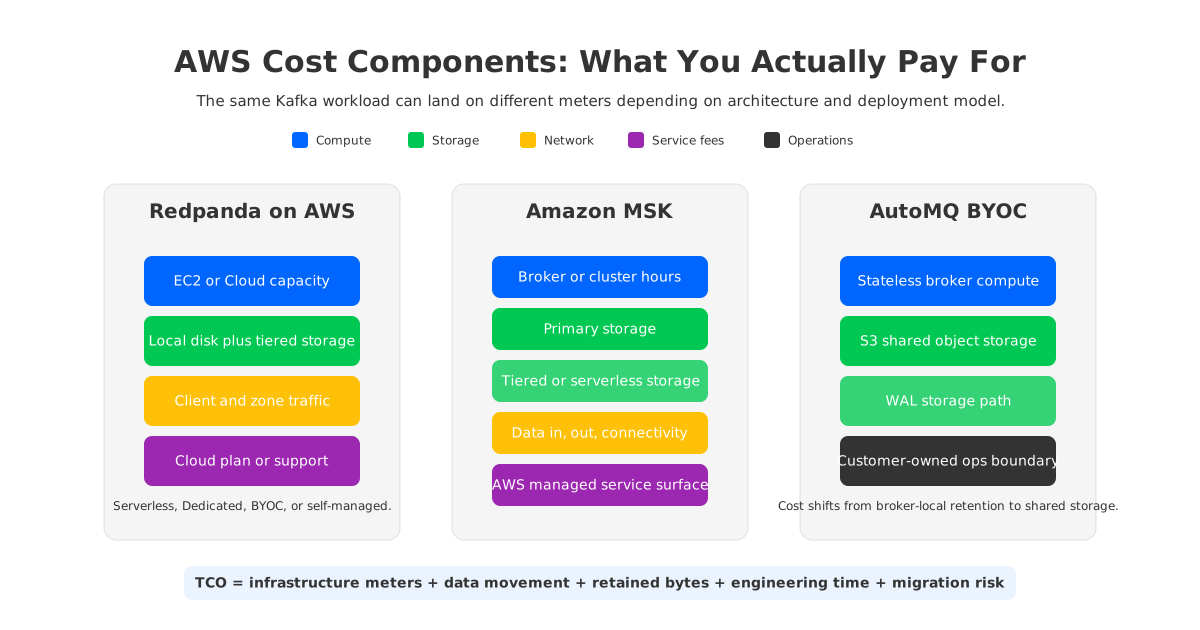
For MSK Provisioned with Standard brokers, AWS pricing says you pay broker instance usage, provisioned storage, optional provisioned storage throughput, and standard AWS data transfer for data transferred in and out of clusters. Express brokers add instance usage, storage used, and a per-GB rate for data written to an Express broker; AWS also states that broker and metadata-node replication is not charged as data transfer. MSK Serverless prices cluster hours, partition hours, storage consumed, data in, and data out.
Redpanda has a different set of paths. Redpanda Cloud may be consumed as Serverless, Dedicated, or BYOC, while self-managed Redpanda uses the customer's AWS infrastructure and any enterprise/support costs. As of May 29, 2026, the public Redpanda pricing path routes users into a trial/get-started and estimator-oriented experience rather than a simple static table, so buyers should anchor the model in the exact deployment plan they will purchase. For BYOC, Redpanda's documentation makes the control-plane/data-plane split central: the cluster data plane runs in the customer's cloud environment, while Redpanda Cloud provides management.
The useful cost model has five buckets: compute, storage, data movement, managed service surface, and operations. Compute covers broker or cluster hours for MSK, Redpanda Cloud capacity or EC2/EKS resources for Redpanda, and stateless broker compute for AutoMQ. Storage covers EBS or broker storage, tiered storage, object storage, retention, replay, and request patterns. Data movement covers producer ingress, consumer egress, cross-VPC/private connectivity, cross-region replication, and any path that leaves a service boundary.
This is why a narrow "Redpanda vs MSK cost" claim can mislead. A low broker count may still be expensive if retention, cross-zone traffic, or operational labor dominates. A managed service may look expensive beside raw EC2 until you include the team that has to run the cluster.
4Storage and Retention
Storage is the cost line that grows quietly. MSK Standard brokers charge for provisioned storage, and AWS pricing also describes a low-cost tier for tiered storage with retrieval charges. Express brokers charge for storage used. Serverless charges for storage consumed. Each model asks the same question: how much data must remain available, at what read pattern, and with what recovery expectation?
Redpanda also has storage choices. Local log storage remains central to the hot path, while tiered storage can offload older segments to object storage depending on configuration and product plan. That can help retention economics, but tiered storage is not the same as making object storage the primary durable layer. The broker still has state, local capacity still matters, and scaling still has to respect partition ownership.
This is where AutoMQ enters as a different category rather than a "third managed Kafka brand." AutoMQ's architecture documentation describes shared storage that replaces Apache Kafka's native log storage with S3Stream, making broker nodes stateless while using object storage as the primary data repository and a WAL storage layer for write efficiency. That changes the question from "how much broker-local storage should I provision?" to "how should I design the shared storage and WAL path?"
5Cross-AZ and Data Transfer
AWS data transfer deserves its own line in the spreadsheet because it is easy to hide in architecture diagrams. MSK pricing says broker and metadata-node replication is not charged as data transfer for Provisioned broker paths, but standard AWS data transfer still applies for data transferred in and out of MSK clusters, and private connectivity has its own hourly and per-GB dimensions.
Redpanda on AWS depends on placement. Self-managed clusters must account for EC2 networking, cross-AZ traffic, load balancers, object storage access, private links, and consumer placement. Redpanda Cloud BYOC keeps the data plane in the customer's cloud environment, but the team should still map every producer, broker, consumer, connector, and object-storage path.
AutoMQ's shared-storage model is designed to reduce the amount of durable data copied between brokers during scaling and reassignment. It does not make AWS networking free; it changes which paths dominate. Instead of repeatedly moving retained log replicas between broker disks, the platform can keep durable data in shared storage and move ownership/compute responsibilities with less data copying.
6Operations and Scaling
Operations is the part of TCO that rarely fits in a pricing table. Amazon MSK removes a large amount of undifferentiated Kafka work: cluster creation, broker replacement, integration with AWS service primitives, and managed lifecycle operations. It does not remove Kafka-shaped decisions: cluster type, networking, quotas, topic and partition layout, consumer lag, upgrades, and limits still matter.
Redpanda changes a different set of operational assumptions. Its single-engine design and Redpanda Cloud options can reduce some complexity, especially for teams that prefer Redpanda's tooling. But the SRE burden moves into compatibility validation and platform-specific runbooks. If you use BYOC, you need to understand what Redpanda manages, what remains in your AWS account, and how support access, telemetry, maintenance, and incident response work.
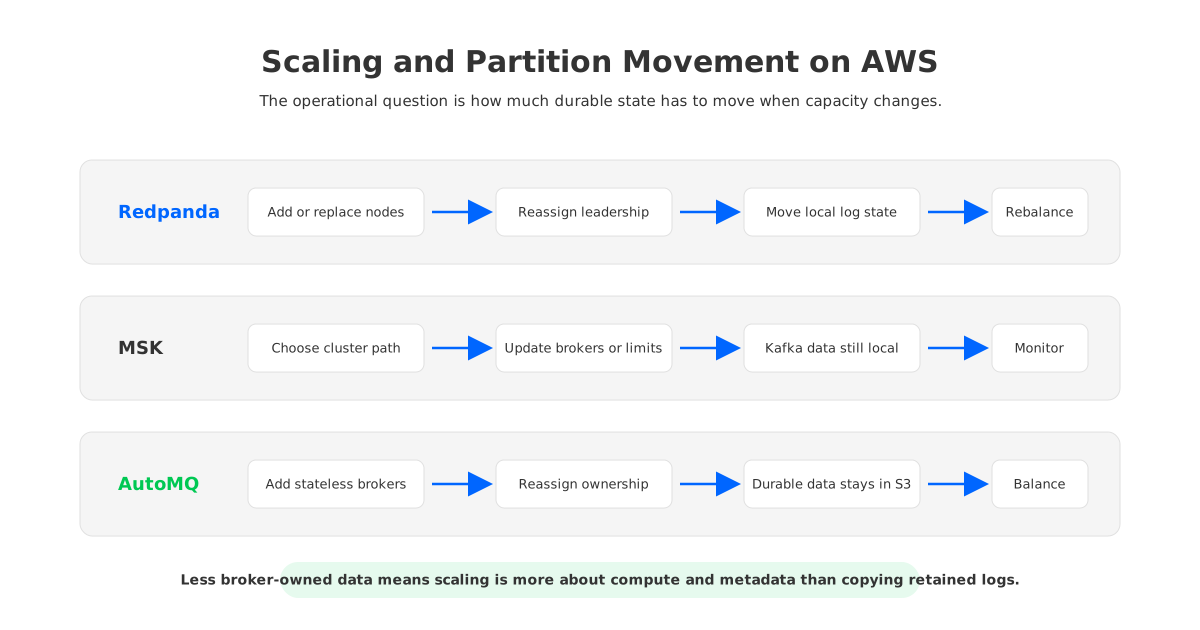
Scaling is the most concrete operational test. In broker-local storage systems, adding capacity is not only adding compute. It can involve partition reassignment, replica movement, leadership changes, storage balancing, and monitoring the blast radius on producers and consumers. MSK improves the managed-service experience, but Apache Kafka data remains tied to brokers in important ways. Redpanda's implementation differs, yet local log state still matters for the hot path.
AutoMQ's stateless broker model changes the failure and scaling exercise. When durable data is in S3-backed shared storage, adding or replacing broker compute can be more about assigning ownership and serving traffic than moving retained logs across brokers. WAL configuration, cache behavior, object-store latency, and request cost still need production tests, but the operating curve is different enough to matter when scaling pain is the driver.
7AWS Data and Control Boundary
The AWS boundary question is not only "where is the data?" It is also "who can operate the control plane, what telemetry leaves the account, and what happens during maintenance?" MSK is an AWS-managed service with customer VPC integration and an AWS-owned managed-service control surface. For many AWS-centric organizations, that is a feature: procurement, security, and operations already understand the AWS trust model.
Redpanda Cloud BYOC draws the boundary differently. Redpanda documentation describes a control plane/data plane architecture for BYOC, with BYOC clusters deployed in the customer's cloud environment and managed through Redpanda Cloud. That can be attractive when the team wants the data plane in its own AWS account, but it also creates vendor-control-plane questions: network connectivity, permissions, diagnostic data, upgrade authority, and emergency access.
AutoMQ's AWS BYOC story is relevant for teams whose requirement is stronger cloud-account control plus Kafka compatibility. Compute and storage resources can live in the customer's AWS environment, with data stored through customer-controlled cloud storage paths. That makes AutoMQ interesting for regulated or platform-governed workloads where the team wants Kafka semantics without long-lived broker disks at the center of the durability model.
8Decision Guidance
Pick MSK first when the decision is procurement-first or ecosystem-risk-first. If your platform standard is AWS and your applications depend on Apache Kafka behavior across clients, Connect, Streams, and admin automation, MSK is the clean default. The main work is choosing the right MSK type and proving that the pricing meters match your traffic shape.
Pick Redpanda first when the decision is engine-change-first. If your team wants a Kafka API-compatible platform with Redpanda's implementation and is ready to test workload behavior directly, Redpanda can be a strong AWS option. The evaluation should be honest about what is being changed: not only the managed service, but the underlying broker engine and operating model.
Evaluate AutoMQ when the decision is architecture-change-first. If the costly part of your Kafka-on-AWS estate is broker-local storage, retained-log movement, over-provisioned capacity, or strict control over the AWS data path, a shared-storage Kafka-compatible platform changes the question. The proof should include your actual producers, consumers, retention, replay, failure drills, object storage configuration, and bill model.
Return to the original AWS question: what layer are you trying to change? If the answer is the managed service boundary, compare MSK and Redpanda Cloud carefully. If the answer is the Kafka implementation, run a deep Redpanda compatibility test. If the answer is the storage and scaling cost curve, include AutoMQ in the same proof before the architecture hardens around another broker-local design.
For the shared-storage path on AWS, start with the AutoMQ architecture overview and test your own traffic, retention, and failure scenarios.
9FAQ
9.1Is Redpanda a drop-in replacement for Amazon MSK?
Not exactly. Redpanda can work with many Kafka clients, but it is not Amazon MSK or Apache Kafka internally. Treat it as a Kafka API-compatible platform that needs workload-specific validation across clients, admin operations, security, connectors, monitoring, and failure behavior.
9.2Is Amazon MSK more compatible with Kafka than Redpanda?
MSK runs open-source Apache Kafka versions, so it is the closer fit when the requirement is Apache Kafka behavior and ecosystem compatibility. Redpanda documents Kafka client compatibility, but its engine is different. The answer depends on which Kafka APIs, tools, and workflows your organization uses.
9.3Which is lower cost: Redpanda or MSK?
There is no universal answer. MSK pricing depends on cluster type, storage, partitions, data in/out, tiered storage, and connectivity. Redpanda cost depends on Cloud plan, BYOC or self-managed deployment, AWS resources, storage, traffic, and support. Model the exact workload.
9.4When should AWS teams consider AutoMQ?
Consider AutoMQ when Kafka compatibility still matters but the main pain is broker-local storage, retention cost, scaling friction, or data-control requirements in your AWS environment. AutoMQ changes the storage and scaling model rather than only changing who operates the brokers.
9.5Does BYOC mean the vendor has no control plane?
No. BYOC means different things across vendors. Redpanda BYOC places the data plane in the customer's cloud environment while Redpanda Cloud provides the management control plane. For any BYOC product, ask for a diagram of data plane, control plane, telemetry, permissions, maintenance access, and emergency procedures.
10References
- AWS documentation: What is Amazon MSK?
- AWS documentation: Amazon MSK pricing
- AWS documentation: MSK Provisioned
- AWS documentation: MSK Serverless
- AWS documentation: MSK Express brokers
- Redpanda documentation: Kafka Compatibility
- Redpanda documentation: BYOC Architecture
- Redpanda documentation: Redpanda Cloud cluster types
- Redpanda website: Redpanda get started and pricing path
- Apache Kafka documentation: Kafka documentation
- AutoMQ documentation: Architecture overview
- AutoMQ GitHub: AutoMQ/automq


