
Table of Contents
Table of Contents
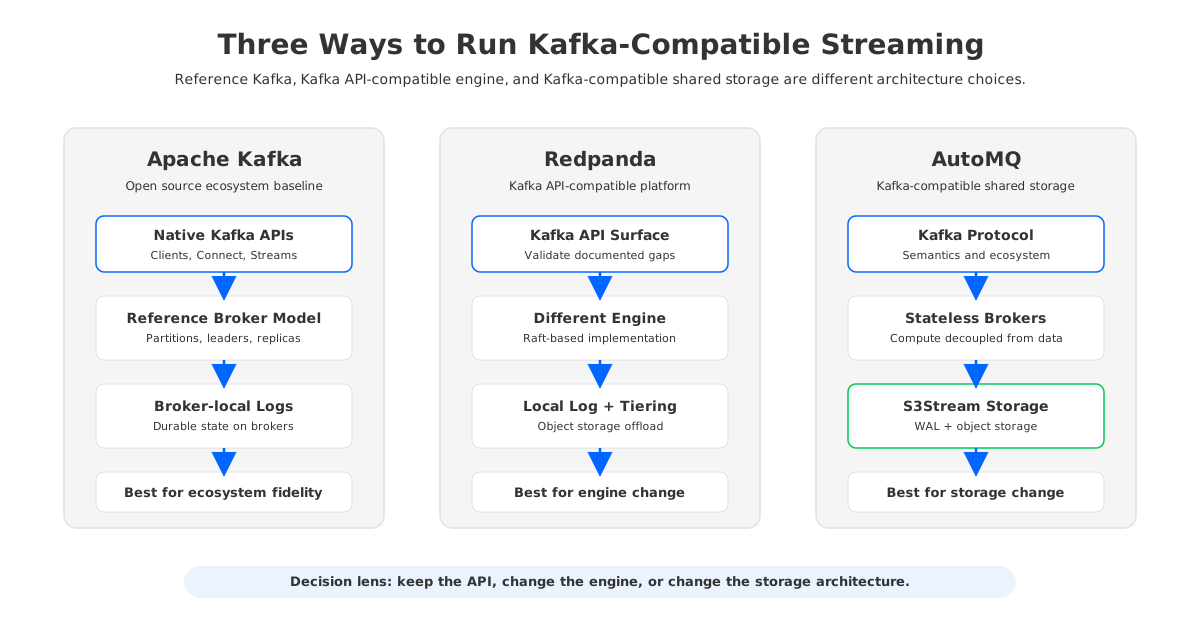
Searches for "Redpanda vs Apache Kafka" usually start with a familiar question: can a team keep Kafka-style applications while changing the platform underneath? That question gets harder once AutoMQ enters the shortlist, because the comparison is no longer a simple engine-to-engine decision. Apache Kafka, Redpanda, and AutoMQ all serve Kafka-compatible streaming workloads, but they make different bets about what should stay stable and what should change.
Apache Kafka is the open source Kafka project and the ecosystem baseline. Redpanda is a Kafka API-compatible streaming platform, not an Apache Kafka distribution. AutoMQ is a Kafka-compatible shared-storage streaming system that keeps Kafka protocol and semantics while moving durable data into object storage through its S3Stream architecture. Treating those three as interchangeable "Kafka options" hides the real decision: are you trying to preserve the reference implementation, change the broker engine, or change the storage architecture?
1Quick Comparison
The table below is a category map, not a benchmark. Performance and cost depend on message size, batching, partitions, retention, replication settings, cloud region, instance type, client behavior, and operational maturity. A fair evaluation starts by comparing architectural assumptions before comparing throughput charts.
| Dimension | Apache Kafka | Redpanda | AutoMQ |
|---|---|---|---|
| Product identity | Open source Apache Kafka project and reference ecosystem | Kafka API-compatible streaming platform with its own engine | Kafka-compatible shared-storage streaming system |
| Compatibility anchor | Native Kafka protocol, clients, Streams, Connect, Admin APIs, and ecosystem | Kafka API compatibility with documented limitations and validations | Kafka protocol and semantics compatibility while changing the storage layer |
| Storage model | Broker-local partition logs, replication across brokers, optional tiered storage in Kafka distributions or services | Local log storage with tiered storage for object storage offload | S3Stream shared storage with WAL plus object storage as the durable data layer |
| Scaling model | Stateful brokers; scaling and reassignment can involve data movement | Kafka-compatible engine with broker-local state and Redpanda-specific operations | Stateless brokers; durable data is decoupled from broker-local disks |
| Operations fit | Teams that want the reference ecosystem and can operate Kafka deeply | Teams open to a Kafka API-compatible engine and Redpanda tooling | Teams that want Kafka-compatible cloud elasticity and object-storage-backed durability |
| Cloud cost shape | Compute, local disks or cloud volumes, replication traffic, rebalancing, operator time | Compute, local storage, tiered storage, managed or self-managed Redpanda operations | Compute, WAL, object storage, cache behavior, object requests, BYOC operations |
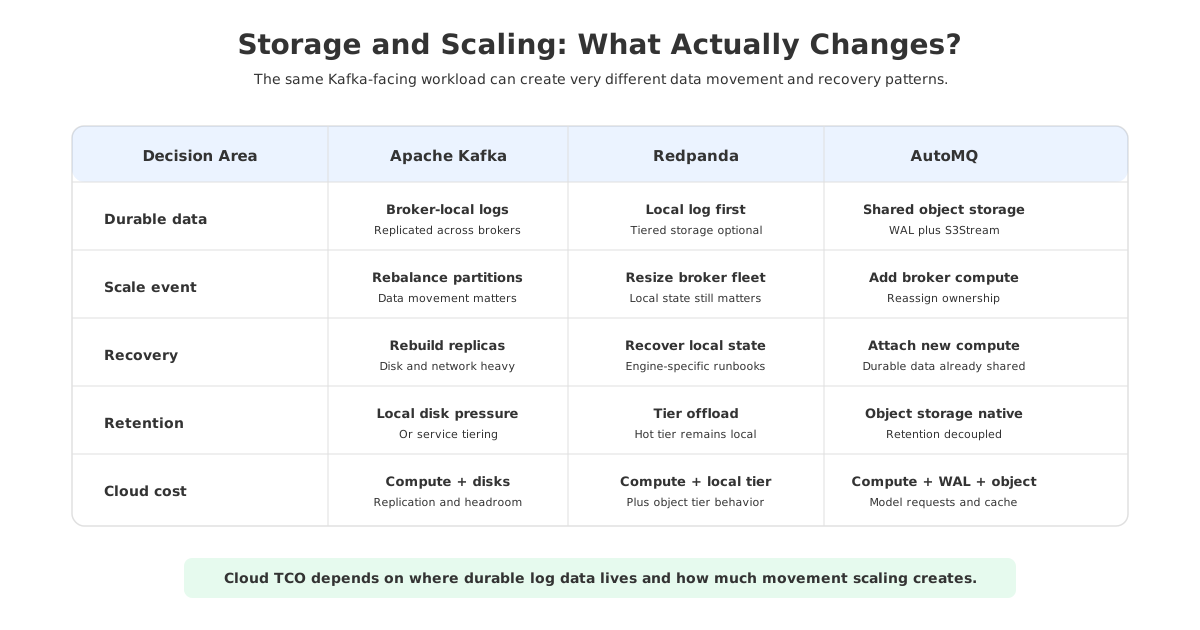
The first practical lesson is that "Kafka-compatible" does not answer the whole question. Compatibility tells you whether your producers, consumers, tools, and integrations can speak to the platform. Architecture tells you what happens when traffic grows, retention expands, a broker fails, or a FinOps team asks why a streaming cluster behaves like both a compute fleet and a storage system.
2Apache Kafka: The Open Source Baseline
Apache Kafka remains the cleanest baseline because it is the project most of the ecosystem was built around. The official Kafka documentation describes event streaming as capturing streams of events, storing them durably, processing them in real time or retrospectively, and routing them to other systems. In operating terms, Kafka gives teams topics, partitions, producers, consumers, Admin APIs, Kafka Connect, Kafka Streams, security features, and a large body of operational knowledge. That maturity shows up when an organization already has runbooks, dashboards, client standards, ACL policies, Terraform modules, and incident muscle memory built around Apache Kafka behavior.
The tradeoff is broker state. Kafka stores partition logs on brokers and replicates data across brokers for durability and availability. Current Kafka versions use KRaft for metadata rather than ZooKeeper, but KRaft does not make the data plane stateless. Brokers still own log segments, serve reads, handle replication, and participate in reassignment or recovery work when topology changes.
For stable workloads with experienced operators, that model is completely rational. For cloud workloads with fast growth, long retention, or frequent scaling events, the pressure usually comes from storage, replication traffic, capacity headroom, and the work required to move state safely.
3Redpanda: Kafka API Compatibility With a Different Engine
Redpanda enters the evaluation from a different direction. It keeps a Kafka-facing API surface so Kafka clients can connect, but it is not Apache Kafka repackaged. Redpanda documentation describes Kafka clients version 0.11 or later as compatible, while also documenting exceptions and compatibility considerations. That wording matters: client compatibility is a strong starting point, but it is still a surface to validate.
Architecturally, Redpanda is its own streaming platform. Its documentation describes Redpanda as a fault-tolerant transaction log where producers and consumers interact through the Kafka API. It uses Redpanda-specific implementation choices, including Raft-based replication and a single-binary operating model. The risk is a category mistake: Redpanda should not be evaluated as "Kafka, but faster" or "Kafka without operations." It is a different system with a familiar protocol surface, so teams need to test clients, transactions, admin APIs, security, metrics, failure behavior, upgrades, tiered storage, and tooling under their real workload.
Redpanda's local-first storage model also matters for cloud fit. Redpanda Tiered Storage can offload log segments to object storage for retention and replay use cases, but tiered storage is not the same thing as shared primary storage. Hot data and broker-local state remain important to the operating model. That distinction becomes visible when the main pain is elastic scaling or long-retention economics rather than broker packaging.
4AutoMQ: Kafka-Compatible Streaming With Shared Object Storage
AutoMQ belongs in the same evaluation only after the question shifts from "Which engine implements Kafka APIs?" to "Which architecture should carry Kafka-compatible workloads in the cloud?" AutoMQ is a Kafka-compatible streaming system that keeps Kafka protocol and semantics while replacing broker-local log ownership with S3Stream shared storage. In AutoMQ's architecture, brokers are designed as stateless compute nodes, while durable data is stored through a WAL layer and shared object storage.
That is a different bet from both Apache Kafka and Redpanda. Apache Kafka keeps the reference implementation and ecosystem behavior but ties durable partition data to stateful brokers. Redpanda changes the engine while retaining a Kafka API-compatible surface and a local-storage-centered hot path. AutoMQ changes the storage architecture while preserving the Kafka-facing contract that applications depend on.
This is why AutoMQ often appears in Redpanda and Kafka evaluations when the search is really about cloud economics. Object storage is not a magic performance answer, and it still requires validation around WAL design, cache hit rate, object request patterns, failure recovery, and network placement. But moving durable data out of broker-local disks changes the unit of scaling. Teams can test a shared-storage architecture without telling every application team to abandon the Kafka protocol; the proof is whether their own producers, consumers, retention settings, replay scenarios, and failure drills behave correctly.
5Compatibility Is More Than Producer and Consumer Success
The most misleading migration demo is a producer writing records and a consumer reading them back. That test is necessary, but it covers only the cleanest part of the system. Kafka estates accumulate connector behavior, schema governance, client retries, consumer lag dashboards, admin automation, ACL conventions, quotas, transactional processing, and incident runbooks.
Use compatibility as a validation stack:
- Client behavior. Test exact language clients, versions, retries, batching, compression, idempotence, transactions, offset commits, and timeout settings.
- Platform APIs. Validate topic creation, partition expansion, config changes, ACLs, quotas, Admin APIs, and automation scripts.
- Ecosystem services. Include Kafka Connect, Kafka Streams, Flink jobs, schema registry usage, observability tools, and security integrations.
- Failure behavior. Rehearse broker loss, zone loss, network partitions, rolling upgrades, leader movement, consumer group rebalance, and replay after retention pressure.
- Operational ownership. Confirm who owns metrics, logs, storage, keys, control plane access, cloud resources, support escalation, and rollback.
Apache Kafka has the advantage of being the default ecosystem target. Redpanda has the advantage of a Kafka API-compatible path that can reduce application rewrite work if the required surfaces pass validation. AutoMQ has the advantage of preserving the Kafka-facing contract while changing storage ownership. None of those advantages removes the need for a compatibility lab.
6Operations: What Your SRE Team Actually Owns
Operational fit is where a vendor comparison becomes an on-call reality. Apache Kafka asks the team to understand brokers, partitions, leaders, followers, replication, controller behavior, disk pressure, network pressure, quotas, upgrades, and rebalancing. Redpanda changes that surface rather than removing it: the team evaluates Redpanda-specific metrics, tools, Raft behavior, tiered storage configuration, deployment model, and support boundaries. AutoMQ changes a different part of the runbook. Because brokers are stateless from the perspective of durable log ownership, scaling and recovery decisions focus more on compute, metadata, WAL configuration, object storage, cache behavior, and cloud integration.
The honest comparison is not "Which system has fewer knobs?" It is "Which knobs align with the team we have?" A Kafka-heavy platform team may prefer Apache Kafka's known complexity. A team comfortable with Redpanda's operating model may prefer a Kafka API-compatible engine. A cloud platform team optimizing elastic capacity and storage separation may prefer AutoMQ's shared-storage model.
7Cost: Count Data Movement, Not Only Nodes
Streaming cost is often presented as a node-count problem. That framing is too small. A Kafka-compatible streaming platform is both a compute service and a durable storage system, so the bill is shaped by peak throughput, local disk or volume sizing, replication traffic, retention, replay, network placement, object storage requests, support model, and operator time. Apache Kafka's model is easiest when traffic and retention are stable; uneven growth can force broker changes, partition movement, and operational risk. Redpanda can change compute efficiency and packaging, but the cost model still includes local storage, tiered storage behavior, cluster sizing, managed service terms, and the operational work of a different platform.
AutoMQ shifts more durable data cost toward object storage and separates broker compute from long-term data ownership. That can be compelling for long retention, bursty traffic, and cloud environments where over-provisioned broker disks are the tax nobody wants to defend. It also means the cost model must include WAL resources, object storage capacity, request patterns, cache behavior, and cloud network topology. Lower cost is not something to assume from a product category; it has to be modeled against your traffic shape.
8Cloud Fit and Deployment Boundaries
Cloud fit is not only about whether a product can run on AWS, GCP, Azure, Kubernetes, or a private environment. It is about where the data plane runs, where durable data lives, which account owns the storage, what permissions the operator needs, how private networking works, and how much of the control plane a security team is willing to accept. Apache Kafka gives the most flexible deployment base because it can be self-managed almost anywhere and is available through many managed services, but that flexibility comes with integration responsibility. Redpanda offers self-managed and cloud options, including BYOC-style deployment paths documented by Redpanda. AutoMQ is strongest when the cloud requirement is to make object storage and customer-owned infrastructure central to the architecture.
9Which One Fits Your Workload?
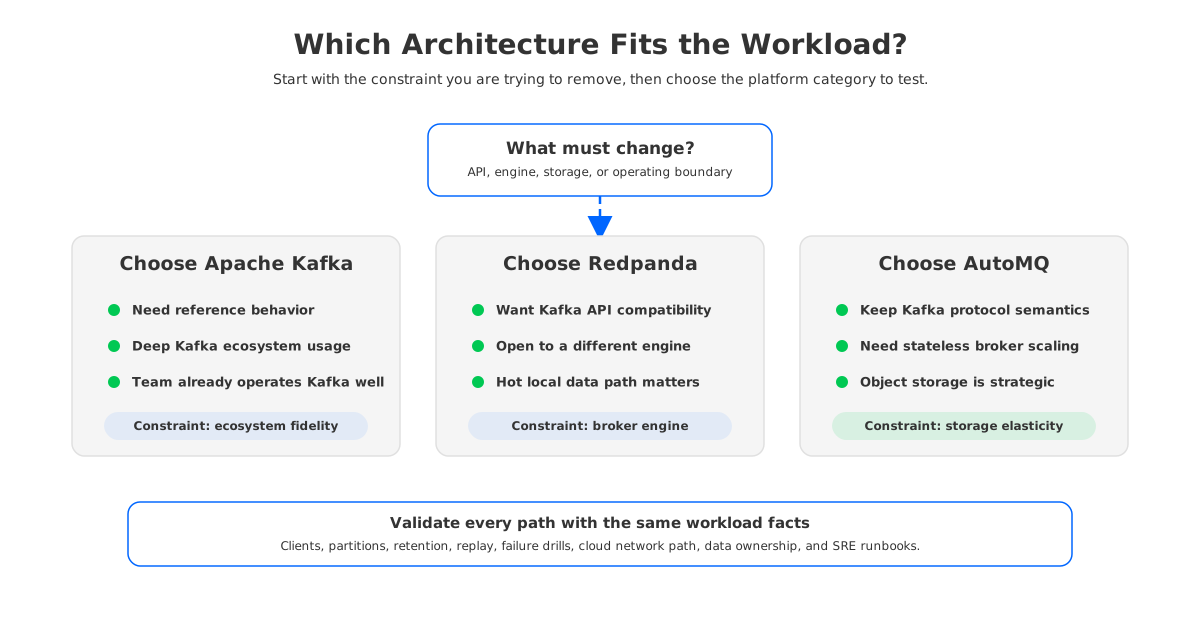
Choose Apache Kafka when ecosystem fidelity is the dominant requirement. If your platform already depends on Kafka Connect, Kafka Streams, mature runbooks, exact Admin API behavior, and a team that knows Kafka deeply, changing platforms should require a strong reason. Kafka is also a sensible default for organizations that prefer open source infrastructure and can afford the operational investment.
Choose Redpanda when the team wants Kafka API compatibility but is willing to adopt a different streaming engine. That can fit latency-sensitive hot-data workloads, compact deployment preferences, or teams that prefer Redpanda's operational model after testing it. The validation should be practical: do your clients, admin tools, failure drills, security controls, and tiered storage expectations work under production-like pressure?
Choose AutoMQ when the main pain is broker-local storage, elastic scaling, long retention, or cloud cost structure, and the team still wants Kafka protocol and semantics. AutoMQ is not a generic replacement for every Redpanda or Kafka cluster. It is a candidate when decoupling compute from durable log storage is the architectural change that matters most.
The clean decision memo has three pages. One page lists the compatibility surfaces that must work. One page describes the storage and scaling model. One page models cost and operational ownership for the actual workload. Once those pages exist, "Redpanda vs Apache Kafka vs AutoMQ" stops being a brand debate and becomes an architecture decision.
If your evaluation points toward Kafka-compatible shared storage, start with the AutoMQ architecture overview and test the open source project with your own clients, retention settings, replay patterns, and failure scenarios.
10References
- Apache Kafka documentation: Apache Kafka 4.3 documentation
- Apache Kafka documentation: Introduction to Apache Kafka
- Apache Kafka documentation: Kafka APIs
- Apache Kafka documentation: Kafka design
- Redpanda documentation: Kafka Compatibility
- Redpanda documentation: How Redpanda Works
- Redpanda documentation: Tiered Storage
- AutoMQ documentation: Architecture Overview
- AutoMQ documentation: S3Stream Shared Streaming Storage
- AutoMQ GitHub: AutoMQ/automq
11FAQ
11.1Is Redpanda the same as Apache Kafka?
No. Apache Kafka is the open source Kafka project and reference ecosystem. Redpanda is a Kafka API-compatible streaming platform with its own implementation, storage behavior, tools, licensing, and operational model. Kafka clients may work with Redpanda, but production teams should validate the exact compatibility surface they use.
11.2Is AutoMQ a Kafka distribution?
AutoMQ is better described as a Kafka-compatible shared-storage streaming system. It preserves Kafka protocol and semantics while changing the storage architecture to use S3Stream, WAL, and shared object storage. That makes it different from a conventional Apache Kafka distribution that keeps broker-local log ownership as the primary storage model.
11.3Which is more compatible with Kafka: Redpanda or AutoMQ?
The answer depends on what you mean by compatibility. Redpanda documents Kafka API compatibility for Kafka clients with exceptions and validations. AutoMQ focuses on Kafka protocol and semantics compatibility while changing the storage layer. For either platform, validate clients, admin APIs, connectors, transactions, security, monitoring, and failure behavior before production migration.
11.4Is tiered storage the same as shared storage?
No. Tiered storage offloads some log data, often older segments, to object storage while keeping a local hot tier. Shared storage makes object storage part of the primary durable data layer and can make brokers more stateless. This difference affects scaling, recovery, retention cost, and the operational work required when cluster topology changes.
11.5When should I choose Apache Kafka over Redpanda or AutoMQ?
Choose Apache Kafka when the reference ecosystem, open source baseline, known operational behavior, and exact Kafka tooling compatibility matter more than changing the architecture. It is a strong fit for teams with Kafka expertise, stable workloads, and a low appetite for compatibility surprises.
11.6When should I evaluate AutoMQ as a Redpanda alternative?
Evaluate AutoMQ when the reason for leaving or questioning Redpanda is not the Kafka API but the cloud operating model: long retention, elastic scaling, broker-local state movement, BYOC data control, or object-storage economics. It should be tested with the same producers, consumers, retention policies, replay patterns, and failure drills you would use for any production Kafka-compatible platform.


