
Table of Contents
Table of Contents
Teams comparing Redpanda and Confluent usually want a clean answer: which one costs less for Kafka-compatible streaming? The uncomfortable part is that a clean answer can be wrong. Redpanda Cloud and Confluent Cloud do not expose cost in the same shape, do not package the same ecosystem surface, and do not always put the same data-plane costs on the same invoice. A fair comparison starts by refusing to compare a visible vendor line item with an incomplete operating model.
The official pricing pages are still the right first stop. They tell you what each vendor chooses to meter and package. They do not know your write rate, read fanout, retention policy, availability-zone layout, private networking pattern, connector footprint, renewal terms, or migration overlap. Those inputs decide whether the dominant cost is cluster capacity, storage, egress, managed connectors, support, or the human work of running the platform.
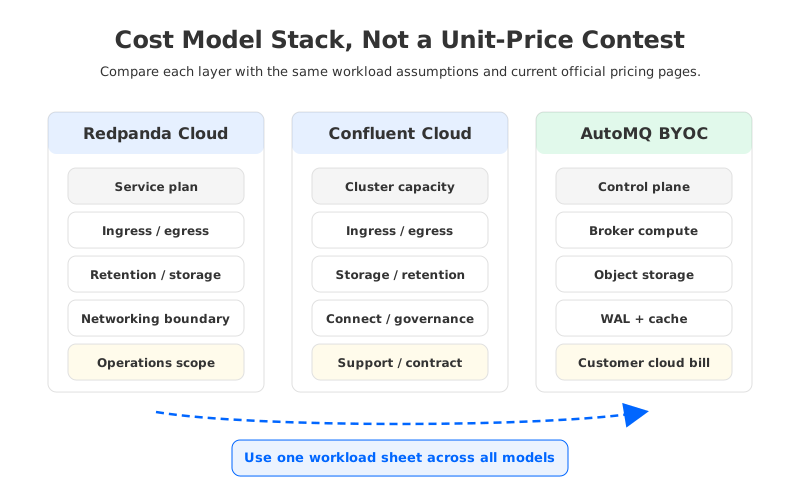
This article avoids static unit-price claims because cloud service pricing changes by region, date, marketplace channel, plan, and contract. The goal is more durable: build a comparison model that procurement, FinOps, and platform teams can defend when the proof of concept turns into a production budget.
1Why Pricing Pages Are Not Enough
Pricing pages are optimized for buying motion, not architecture review. They help you understand the billable dimensions, but they compress a lot of technical choices into plan names and meters. That compression is useful when a workload is simple. It becomes risky when the workload has multi-AZ durability, long retention, private connectivity, many consumer groups, or a migration window where source and target clusters run at the same time.
Redpanda and Confluent also enter the conversation from different strengths. Redpanda positions Redpanda Cloud across Serverless, Dedicated, and BYOC-style deployment choices, with billing documentation that calls out dimensions such as cluster uptime, ingress, egress, storage, partitions, requests, and RPUs depending on plan. Confluent Cloud organizes Kafka clusters into Basic, Standard, Enterprise, Freight, and Dedicated families, and its billing documentation points buyers to dimensions such as ingress, egress, storage, CKUs or eCKUs, connectors, stream processing, and support. Those are not identical shopping carts.
The first mistake is to ask, "Which vendor has the lower headline price?" The better question is, "For my workload, which model makes the largest cost driver predictable, controllable, and operationally acceptable?" A low entry price can be the right choice for a small workload. A higher managed-service bill can be rational if it replaces meaningful operational burden. A BYOC design can be attractive if the team needs cloud-account visibility and data-plane control. The answer changes when the workload changes.
2Redpanda Cost Components To Verify
Redpanda cost modeling should begin with the deployment model. Serverless-style pricing is useful when you want consumption-oriented entry and less up-front capacity planning. Dedicated clusters shift the question toward provisioned capacity and predictable isolation. BYOC changes the boundary again because the service may be managed by the vendor while the data plane runs in the customer's cloud environment.
That boundary matters because the "Redpanda cost" may be split across a Redpanda invoice and a cloud provider bill. In a fully managed model, the vendor abstracts more infrastructure. In BYOC or self-managed patterns, the buyer has to account for compute, storage, network, observability, load balancing, and any surrounding cloud services. Exact terms should come from the current Redpanda pricing page and billing documentation, but the categories to inspect are stable:
- Base capacity and service plan. Confirm whether the workload maps to Serverless, Dedicated, BYOC, or a negotiated enterprise plan. The same throughput target can produce different cost behavior under each model.
- Traffic meters. Check how ingress, egress, requests, and partition limits are measured. A write-heavy workload and a replay-heavy workload can look similar in average cluster size but very different in data transfer.
- Storage and retention. Determine whether retained data sits in a hot local path, tiered object storage, or another managed abstraction. Retention is where "small" streaming workloads quietly become large budgets.
- Networking. Private networking, cloud region, availability-zone layout, NAT, endpoint, and cross-region consumer access can shift cost outside the vendor quote.
- Support and operations. Clarify what the managed service includes, what remains with the customer team, and how incidents, upgrades, security reviews, and migrations are handled.
Redpanda's architecture can be compelling for latency-sensitive Kafka API-compatible workloads. The cost model should therefore treat performance requirements honestly. If a workload values tight tail latency and a local hot path, the infrastructure cost may be justified. If the same workload mainly stores retained data for infrequent replay, the model should expose how much of the spend is really storage growth rather than active streaming.
3Confluent Cost Components To Verify
Confluent cost modeling starts with a broader platform surface. Confluent Cloud is not only managed Kafka clusters; many buyers also evaluate Schema Registry, Stream Governance, managed connectors, ksqlDB, Apache Flink, networking options, marketplace procurement, and support tiers. That breadth can simplify platform ownership, but it also means a Kafka-only comparison may miss the services that actually appear in production.
Confluent's cluster type documentation describes multiple cluster families, with different capacity, networking, and feature implications. Dedicated clusters use CKUs, while newer elastic cluster families use eCKUs. Billing documentation also calls out costs for Kafka cluster usage dimensions, data transfer, storage, connectors, support, and related services. The practical implication is straightforward: a Confluent quote should be reviewed as a platform bill, not just a broker bill.
| Cost area | What to verify in Redpanda | What to verify in Confluent |
|---|---|---|
| Cluster model | Serverless, Dedicated, BYOC, or self-managed boundary | Basic, Standard, Enterprise, Freight, Dedicated, CKU/eCKU model |
| Traffic | Ingress, egress, requests, partitions, cloud region | Ingress, egress, networking, private connectivity, cloud region |
| Storage | Hot retention, tiering, object storage behavior, retention limits | Kafka storage, retention, tiering or product-specific storage behavior |
| Ecosystem | Connectors and surrounding tooling if used | Connectors, Schema Registry, governance, ksqlDB, Flink if used |
| Operations | Managed scope, BYOC responsibilities, support | Managed scope, support tier, platform services, contract terms |
The table is intentionally category-based. It does not say one vendor is inherently lower-cost, because that would be pretending the workload does not matter. A team using many managed connectors and governance features may value Confluent's platform breadth. A team focused on a smaller Kafka API-compatible footprint may see a different profile in Redpanda. A team under data-control or cloud-account constraints may care less about the first quote and more about where the data plane runs.
4Workload Inputs For A Fair Comparison
The cleanest way to compare Redpanda and Confluent is to create a neutral workload sheet before entering either pricing calculator. That sheet should be boring, explicit, and tied to production telemetry. If a number cannot be measured yet, mark it as an assumption and run sensitivity analysis around it.
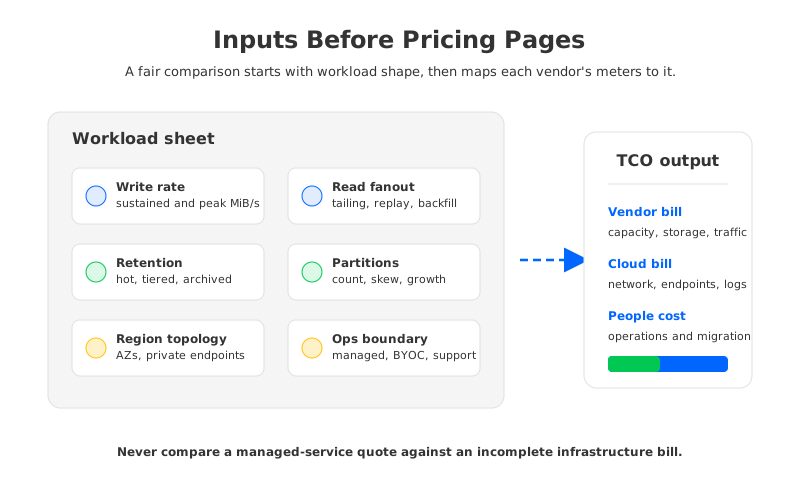
Start with write throughput. Use sustained MiB/s, peak MiB/s, and peak duration rather than a single average. Then add read fanout: the number of independent consumer applications, whether they tail near the latest offset, and how often they replay old data. A workload with modest writes and heavy replays can stress network and storage paths more than a workload with higher writes and low read fanout.
Retention needs the same discipline. Record hot retention, total retention, compaction behavior, expected growth, and whether retained data is frequently reread. Apache Kafka's replication model exists to keep partition logs available across brokers, and Kafka-compatible systems still need a durability story even when the implementation differs. That durability story turns into stored bytes, network movement, object storage use, or service-level abstractions. You need to know where it appears.
The remaining inputs usually decide whether the estimate survives procurement review:
- Availability-zone and region layout. Multi-AZ durability, cross-zone consumers, disaster recovery, and cross-region analytics can create data transfer that is not obvious in a cluster-size estimate.
- Private connectivity. PrivateLink, VPC peering, transit gateways, NAT, load balancers, and endpoint services can be material for enterprise deployments.
- Partition count and skew. Partition count can affect limits, capacity planning, metadata pressure, and plan fit even when byte throughput looks modest.
- Connector and stream processing usage. Managed connectors, Schema Registry, governance, ksqlDB, Flink, or external processing fleets should be listed explicitly instead of treated as "platform overhead."
- Migration overlap. During migration, the source and target often run together. Replication, validation, dual writes, backfills, and rollback windows can temporarily double parts of the cost base.
The comparison becomes much more useful when it has a low, expected, and high case. Vary read fanout, retention days, peak traffic, and private networking path. If a small change in one input flips the decision, the renewal conversation should focus on that input rather than on vendor preference.
5AutoMQ As A BYOC Cost-Control Option
Some teams reach the Redpanda vs Confluent comparison and realize the real issue is not only vendor price. They want Kafka compatibility, but they also want the data plane in their own cloud account, clearer infrastructure visibility, and a cost model where retained data growth does not force the same broker fleet growth. That is where BYOC and shared-storage architecture become part of the evaluation.
AutoMQ fits this discussion as a Kafka-compatible shared-storage system with stateless brokers, WAL storage, and S3-compatible object storage as the durable storage layer. The important distinction is not that it is "another Kafka vendor." The important distinction is that the durable log is no longer primarily tied to broker-local disks. Brokers focus on protocol handling, scheduling, caching, and active traffic, while retained data is placed in shared object storage.
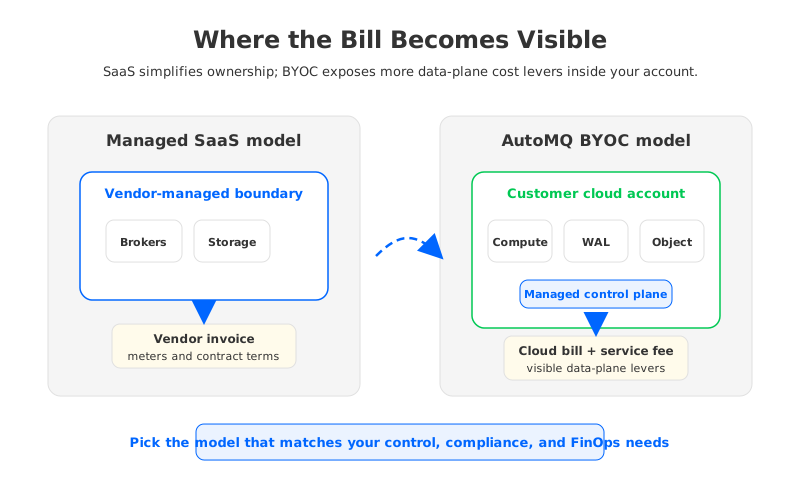
That architecture changes the cost levers. In a local-storage or provisioned-cluster model, storage, compute, failover headroom, and broker replacement can become tightly coupled. In a shared-storage BYOC model, the buyer can examine broker compute, WAL, object storage, cache, network locality, and control-plane service cost more separately. It does not remove cost. It makes different costs visible and gives FinOps teams different knobs.
This matters most in a few recurring cases. Retention-heavy workloads may want object-storage economics without treating tiering as an afterthought. Bursty workloads may want compute elasticity without moving large volumes of partition data during scale events. Regulated teams may want data-plane resources inside their cloud account for network, IAM, KMS, audit, and procurement reasons. Existing Kafka users may also prefer a migration path that keeps Kafka clients and ecosystem tools relevant.
AutoMQ should be evaluated with the same rigor as Redpanda and Confluent. Use the same write rate, read fanout, retention, region, availability, and migration assumptions. Include object storage requests, WAL cost, cache behavior, control-plane/service fees, and the customer's own cloud networking. A shared-storage model can improve TCO for the right workload, but the credible claim is workload-specific, not universal.
6Questions To Ask Before Renewal Or Selection
A good vendor review meeting should produce fewer surprises, not more slides. Bring a worksheet, ask for the exact metering dimensions, and force every ambiguous line item into either the vendor bill, the cloud bill, or the operations bill. If a cost cannot be placed, it is not gone; it is only unmodeled.
Use these questions before signing or renewing:
- Which cluster or deployment model is assumed, and what happens to cost when throughput doubles for a short peak?
- Which dimensions are metered directly: cluster capacity, uptime, ingress, egress, storage, partitions, requests, connectors, stream processing, support, or private networking?
- Which costs appear outside the vendor invoice in the customer's cloud account?
- How are cross-AZ, cross-region, PrivateLink, VPC peering, NAT, endpoint, and load balancer costs handled?
- What retention profile is assumed, and how do hot reads, backfills, and replay-heavy consumers change the bill?
- Which ecosystem services are included in the comparison: connectors, schema management, governance, stream processing, monitoring, and audit?
- What is the migration overlap cost, and how long must source and target platforms run together?
- What operational responsibilities remain with the customer team under managed, BYOC, or self-managed models?
The right answer may be Redpanda, Confluent, AutoMQ, or a staged plan that changes over time. Redpanda can make sense when the team wants Kafka API compatibility with a specific operating and performance profile. Confluent can make sense when the team values a broad managed data streaming platform and ecosystem services. AutoMQ can make sense when Kafka compatibility, BYOC control, stateless brokers, and shared-storage cost levers match the workload's real constraints.
Cost comparisons become useful when they stop asking for a universal winner. Bring the workload, expose the hidden meters, and make the architecture carry its own budget logic. If your current comparison shows that retention growth, burst headroom, or data-plane visibility is the hard part, talk to the AutoMQ team with the assumptions you want to test.
7References
- Redpanda Cloud billing documentation
- Redpanda pricing overview
- Redpanda Cloud overview
- Confluent Cloud pricing
- Confluent Cloud billing documentation
- Confluent Cloud Kafka cluster types
- Confluent Cloud networking documentation
- Apache Kafka documentation: design and replication
- Apache Kafka documentation: operations
- AutoMQ documentation: What is AutoMQ
- AutoMQ documentation: Compatibility with Apache Kafka
- AutoMQ documentation: Stateless broker
- AutoMQ pricing
8FAQ
8.1Is Redpanda less expensive than Confluent?
It depends on workload, deployment model, region, support terms, and which ecosystem services are included. Redpanda may be attractive for teams focused on Kafka API-compatible streaming with a specific performance and deployment profile. Confluent may be attractive when the buyer values a broader managed streaming platform with connectors, governance, stream processing, and enterprise packaging. Use current official pricing and the same workload assumptions for both.
8.2Why not compare Redpanda and Confluent by price per GB?
Price per GB misses important streaming cost drivers. Write throughput, read fanout, retention, replay behavior, private networking, partitions, connectors, support, and migration overlap can dominate the final TCO. A per-GB comparison can be useful as one worksheet row, but it should not be the full decision model.
8.3What is the biggest hidden cost in managed Kafka comparisons?
The common hidden costs are network paths, read fanout, long retention, private connectivity, and migration overlap. Ecosystem services can also matter: managed connectors, governance, schema management, and stream processing may be valuable, but they should be modeled explicitly.
8.4When should AutoMQ be included in a Redpanda vs Confluent evaluation?
Include AutoMQ when the cost concern is tied to BYOC control, data-plane visibility, retention growth, burst elasticity, or broker-local storage coupling. AutoMQ's Kafka-compatible shared-storage architecture changes the cost model by separating broker compute from durable object storage, which can be relevant for cloud-native Kafka workloads.
8.5Should procurement use vendor calculators?
Yes, but only after building a neutral workload sheet. Vendor calculators are useful when the inputs are accurate. They are less useful when read fanout, retention, private networking, connector usage, or migration overlap are guessed. Record the date and source for every input that comes from a pricing or billing page.


