
Table of Contents
Table of Contents
Redpanda vs Confluent is a more useful search when you stop treating both names as interchangeable Kafka vendors. They overlap around Kafka clients, streaming workloads, managed cloud deployment, and enterprise procurement. They differ in what they optimize. Redpanda is a Kafka API-compatible streaming platform with its own engine, single-binary operational model, and Redpanda Cloud packaging. Confluent is built around Apache Kafka and a broad data streaming platform that includes managed Kafka clusters, connectors, Schema Registry, stream processing, governance, networking, and enterprise support.
That distinction changes the buying question. If your team mainly needs a Kafka-compatible broker with a different implementation and a compact operational model, Redpanda belongs in the evaluation. If your team wants the deepest Kafka ecosystem surface and a managed platform around connectors, schemas, stream processing, and governance, Confluent is hard to ignore. If your cloud pain is neither ecosystem breadth nor broker packaging, but the cost and elasticity limits of broker-attached storage, a third category becomes relevant: Kafka-compatible shared-storage platforms such as AutoMQ, which keep the Kafka protocol while moving durable stream data to object storage in a BYOC-friendly architecture.
1Quick Answer by Use Case
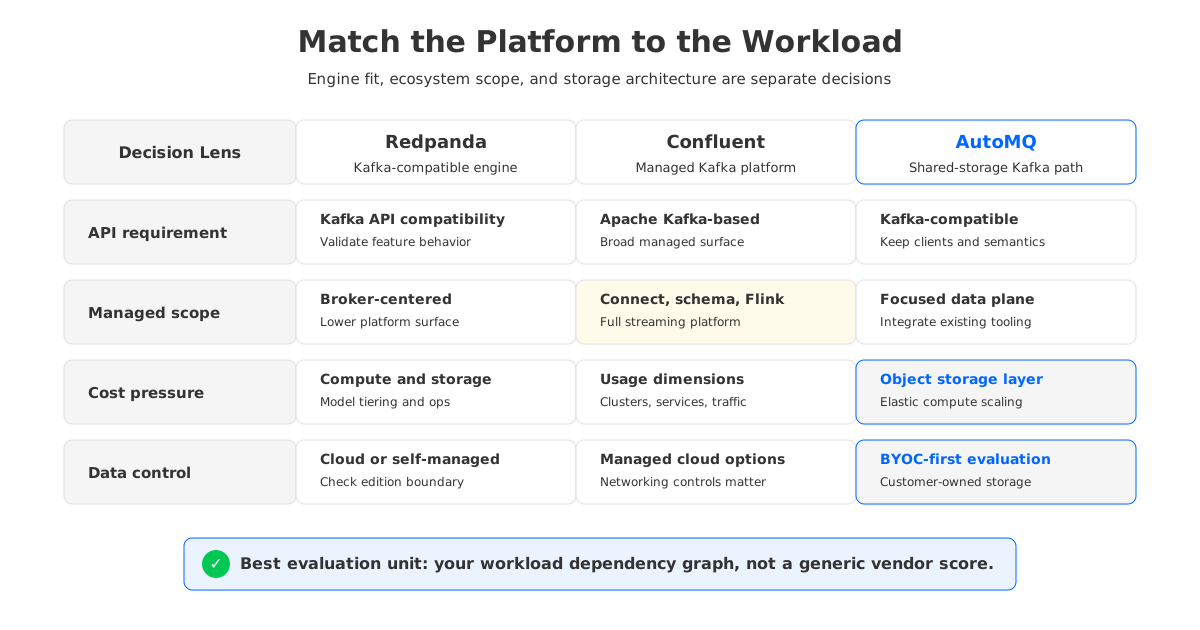
Choose Redpanda when your workload is centered on Kafka producer and consumer APIs, your team values a non-JVM engine and a smaller operational surface, and you are comfortable validating Kafka compatibility against exact clients, admin operations, security settings, and tooling.
Choose Confluent when the platform is more than brokers. Confluent Cloud has multiple cluster types, managed connectors, Schema Registry, Flink, ksqlDB, governance capabilities, and enterprise networking options. That matters when migration risk sits in connectors, schemas, stream processing applications, and operational integrations.
Consider AutoMQ when the evaluation has moved from "which Kafka vendor?" to "which cloud architecture should carry Kafka workloads?" AutoMQ is Kafka-compatible and uses shared object storage as the durable storage layer, with stateless brokers and BYOC deployment options. Its natural fit is teams that want to preserve Kafka clients and semantics while changing the cost and elasticity profile of cloud Kafka.
The right answer is usually visible in your dependency graph. A company with many managed connectors, Schema Registry compatibility rules, stream processing jobs, and governance workflows is not buying the same thing as a company running producers and consumers against a small broker fleet. One is choosing a streaming data platform. The other may be choosing an engine.
2Product and Architecture Differences
Redpanda and Confluent start from different design centers. Redpanda's documentation describes a Kafka-compatible system where Kafka clients can connect to Redpanda, subject to documented compatibility details. Its architecture uses its own implementation rather than Apache Kafka brokers. It is commonly evaluated by teams that want a familiar Kafka API without operating the classic Kafka stack.
Confluent's center of gravity is Apache Kafka plus the surrounding platform. Confluent Cloud cluster types include Basic, Standard, Enterprise, Dedicated, and Freight clusters, each aimed at different availability, networking, performance, and operational requirements. Around those clusters, Confluent offers managed connectors, Schema Registry, stream processing, governance, and billing constructs that turn Kafka into a managed data streaming platform. That breadth can reduce integration work, but it also means the buyer is adopting a larger platform surface.
The architecture comparison has three layers:
- Broker and protocol layer. Redpanda asks whether a Kafka-compatible implementation can satisfy producer, consumer, Admin API, transaction, security, and operational requirements.
- Platform layer. Confluent competes on ecosystem completeness, managed service depth, and enterprise integration.
- Cloud cost layer. Both still need a model for compute, storage, network traffic, support, and operator time.
This is why "Redpanda or Confluent?" can be a misleadingly small question. A fair comparison should not score Redpanda down because it is not Confluent's full ecosystem, or score Confluent down because it is a broader platform. The real question is whether your workload needs the extra surface area.
3Kafka Ecosystem and Compatibility
Apache Kafka's official documentation defines a broad API and operations surface: Producer, Consumer, Streams, Connect, Admin, security, configuration, and cluster operations. Production Kafka estates often accumulate serializers, Schema Registry conventions, connector tasks, ACL automation, monitoring dashboards, partition management scripts, consumer lag tooling, and upgrade runbooks. The deeper that surface becomes, the more expensive compatibility testing becomes.
Redpanda's Kafka compatibility story is practical for many workloads, but it should be validated behavior by behavior. A basic produce-consume smoke test proves very little. Test idempotent producers, transactions if you use them, consumer group rebalances, offset commits, ACLs, SASL/TLS settings, Admin API calls, topic configuration changes, compaction, retention, retry behavior, and exact Kafka client versions. The value of a Kafka-compatible platform is that you can run those tests without rewriting applications first.
Confluent's ecosystem advantage appears when the platform team owns more than broker uptime. Confluent Cloud provides managed connectors and managed Schema Registry; Confluent also documents cloud-native stream processing options such as Flink and ksqlDB. Those services reduce the amount of infrastructure your team has to assemble, especially when the data platform spans operational databases, object storage, warehouses, SaaS applications, and internal event-driven services.
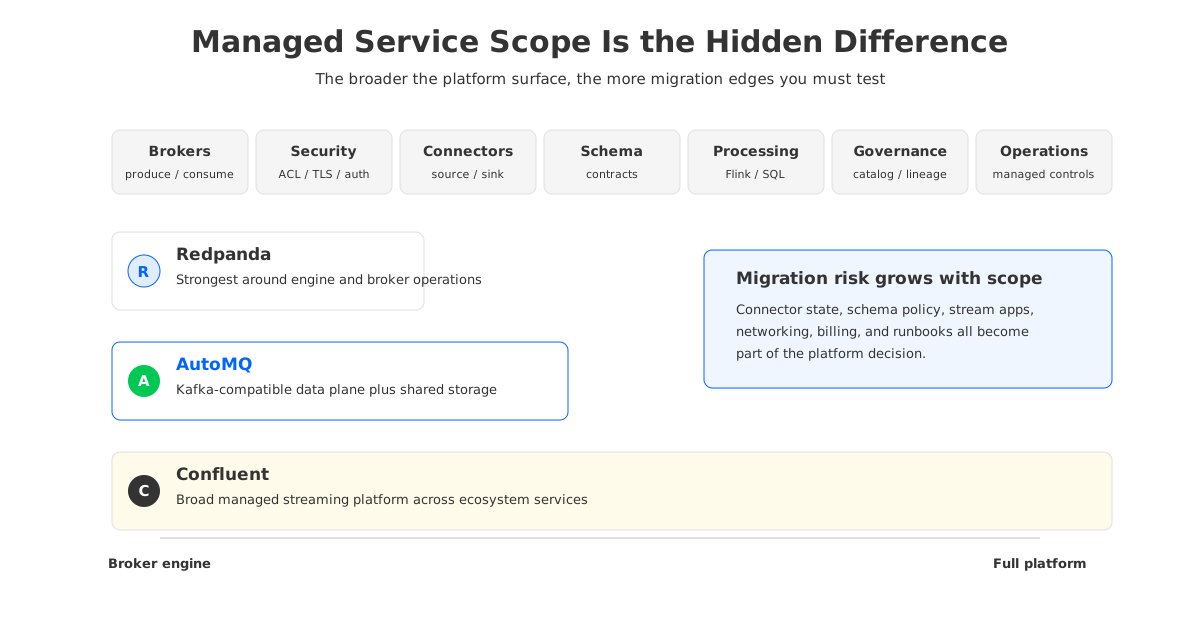
There is a tradeoff hiding inside that convenience. A broader managed platform can shorten delivery time, but it can also make the exit plan more complex. If a workload depends on a specific connector catalog, schema workflow, stream processing runtime, networking pattern, or billing construct, migration is no longer a broker swap.
4Cost and Pricing Model Comparison
Cost is the hardest part of a Redpanda vs Confluent comparison because neither platform is priced as a single universal unit. Redpanda Cloud packaging and billing differ by cloud offering and deployment model. Confluent Cloud pricing depends on cluster type and billable dimensions such as capacity units, storage, networking, connectors, stream processing, and other managed services. The useful comparison is not "which is lower cost?" It is "which cost model matches the workload's growth curve?"
Start with workload shape before opening a pricing page:
- Throughput pattern. A steady high-throughput workload, a spiky workload, and a mostly idle development workload should not share the same assumptions.
- Retention and replay. Long retention, catch-up reads, and replay-heavy consumers make storage behavior matter as much as broker CPU.
- Network topology. Cross-zone and cross-region traffic can become material when producers, brokers, consumers, connectors, and object storage endpoints sit in different places.
- Managed-service scope. Connectors, Schema Registry, stream processing, governance, and support should be counted as value and cost.
- Operator time. Self-managed clusters can look lower on a bill of materials while consuming scarce SRE time.
Redpanda may be more direct when the workload is close to the broker layer: publish, consume, retain, replicate, observe. Confluent may be stronger when the managed ecosystem replaces several internal services and integrations. AutoMQ enters when the uncomfortable line item is the architecture of storage itself. If durable data remains bound to broker-local disks or volumes, scaling and recovery often bring data movement with them. A shared-storage architecture changes that premise by making object storage the durable layer and letting brokers behave more like elastic compute.
That does not make one pricing model universally better. The cost model should be tied to the technical reason you are evaluating a platform. If the problem is integration velocity, a broad platform can be worth the premium. If the problem is engine operations, a compact Kafka-compatible implementation can be attractive. If the problem is cloud storage elasticity and over-provisioning, changing the storage architecture may produce a cleaner answer than tuning node sizes.
5Data Control, Networking, and Operations
The data-control question is often where procurement and architecture meet. Redpanda Cloud documents deployment options that include BYOC, and Confluent Cloud provides multiple cloud networking and cluster options for enterprise environments. The details matter because "managed" can mean several responsibility boundaries: vendor-hosted SaaS, dedicated clusters, customer-cloud deployments, private networking, or self-managed software.
Responsibility boundaries shape the operational model:
- In a managed SaaS model, the vendor operates the core service, while the customer manages clients, data contracts, access policies, and cost controls.
- In a BYOC model, the service runs in the customer's cloud account or environment, but the vendor may still provide orchestration, upgrades, monitoring, or support workflows.
- In a self-managed model, the customer owns the full control loop: provisioning, upgrades, observability, incident response, capacity planning, and security operations.
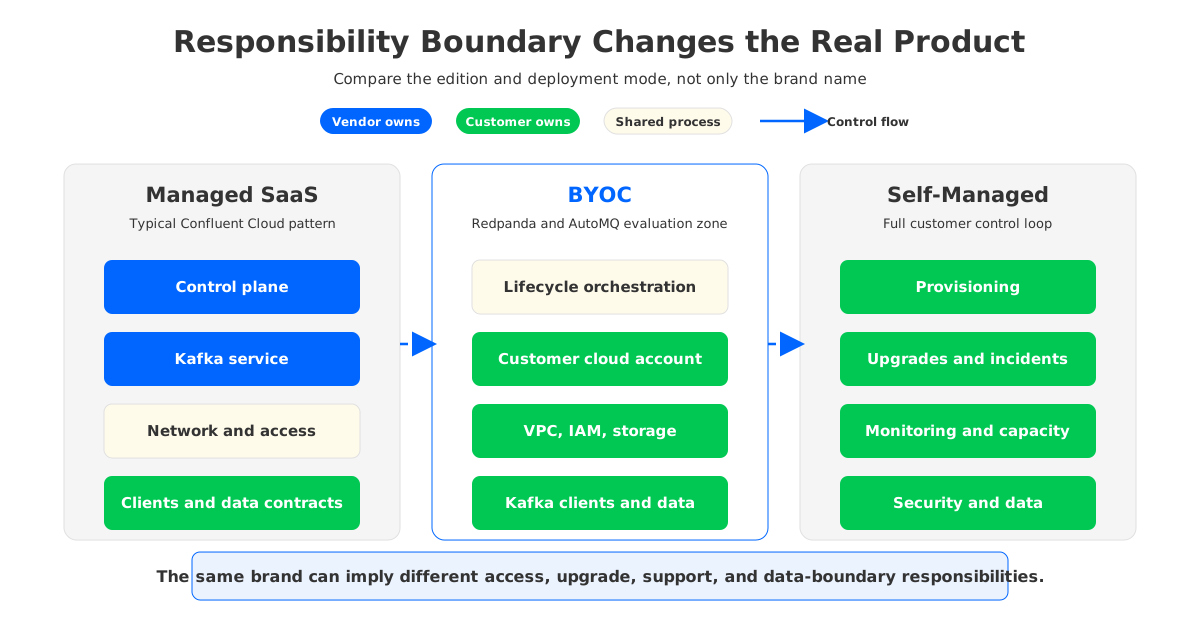
Redpanda and Confluent can both appear in more than one operational shape, so compare the actual product edition or deployment mode, not only the brand. A Confluent Cloud Dedicated cluster is not the same operational contract as a self-managed Kafka deployment. Redpanda BYOC is not the same as operating Redpanda yourself on Kubernetes. The distinction affects metadata access, network flow, upgrade scheduling, support interaction, and incident response.
This is also where AutoMQ's BYOC story is clearest. AutoMQ's control plane and data plane can run inside the customer's cloud environment, while the Kafka-compatible data path stores durable stream data in customer-owned object storage. The claim is narrow: teams that need Kafka compatibility, cloud elasticity, and strong data-control boundaries should evaluate whether shared storage inside their own cloud account is a better fit than broker-local storage or a vendor-hosted streaming platform.
6Migration Risk: What to Test Before Choosing
A Redpanda vs Confluent decision should end in a proof-of-workload, not a slide deck. Migration risk rarely appears in the first happy-path producer. It appears in error handling, consumer rebalances, topic configuration, schema evolution, connector retries, network rules, quotas, and the runbooks that turn a cluster from "it works" into "we can operate this at 2 a.m."
Use a test plan that matches your dependency surface. For Redpanda, emphasize exact Kafka client versions, API features, metrics, logs, upgrades, and alerting. For Confluent, test client behavior plus managed connectors, Schema Registry modes, Flink or ksqlDB dependencies, quotas, networking, and support paths. In both cases, run realistic traffic, trigger rebalances, rewind consumers, rotate credentials, apply topic config changes, and replay enough data to stress storage and billing assumptions. The outcome should be boring. Boring is underrated in streaming infrastructure.
7Where AutoMQ Fits as a Third Option
AutoMQ belongs in this comparison after the reader has separated three decisions: API compatibility, ecosystem scope, and storage architecture. Redpanda and Confluent mostly compete across the first two. AutoMQ is most relevant in the third, especially for teams that want to keep Kafka clients and operational semantics while changing the cloud cost physics underneath.
AutoMQ is Kafka-compatible, uses object-storage-backed shared storage, and is designed around stateless brokers. Durable stream data is not tied to a specific broker's local disk in the same way traditional Kafka-style architectures are. That can reduce the amount of data movement involved in scaling, broker replacement, and recovery. In BYOC deployments, the data path and infrastructure can remain in the customer's cloud environment.
This does not replace every reason to choose Confluent. If your core need is a full managed data streaming platform with a large connector ecosystem, schema governance, stream processing, and enterprise workflows, Confluent may still be the stronger fit. It also does not replace every reason to choose Redpanda. If your core need is a Kafka-compatible engine with Redpanda's operational model, Redpanda may be the right answer.
AutoMQ is the third path when the architecture question dominates: keep the Kafka API, keep data in your cloud, and make object storage the durable layer so compute can scale more elastically.
8Decision Checklist
Bring one question into the architecture review before procurement turns the comparison into a price spreadsheet: are you buying a broker, a managed streaming platform, or a cloud storage architecture for Kafka-compatible workloads? From there, assign owners. Application teams validate client behavior and Kafka API usage. Platform teams validate operational boundaries, upgrades, monitoring, and incident response. FinOps models throughput, storage, connectors, stream processing, network traffic, and replay. Security and procurement validate data control and vendor risk. The result is not a generic Redpanda vs Confluent winner. It is a platform choice that fits the workload you actually run.
If that workload needs Kafka compatibility with cloud-native storage economics and BYOC control, review the AutoMQ architecture documentation and the AutoMQ GitHub project as part of the same proof-of-workload.
9FAQ
9.1Is Redpanda the same thing as Confluent?
No. Redpanda is a Kafka API-compatible streaming platform with its own engine. Confluent is a broader data streaming platform built around Apache Kafka and managed ecosystem services such as connectors, Schema Registry, and stream processing.
9.2Is Confluent always better for Kafka workloads?
No. Confluent is often strongest when the workload needs the broader Kafka ecosystem as a managed platform. If the workload is mainly producer and consumer traffic and the team wants a different Kafka-compatible engine, Redpanda can be a credible fit. If the workload's biggest issue is cloud storage cost and elasticity, a shared-storage Kafka-compatible platform such as AutoMQ may be worth evaluating.
9.3Is Redpanda compatible with Kafka clients?
Redpanda documents Kafka client compatibility, but production teams should validate the specific clients, API features, security settings, admin operations, and failure scenarios they use. Compatibility is a behavior to test, not a label to assume.
9.4How should teams compare Redpanda vs Confluent cost?
Model the workload rather than comparing list prices in isolation. Include throughput, retention, storage growth, replay behavior, network traffic, managed connectors, Schema Registry, stream processing, support, and operator time. Confluent's broader platform can replace internal work; Redpanda's broker-focused model can reduce platform surface. The right cost answer depends on what you would otherwise operate.
9.5Where does AutoMQ fit in a Redpanda vs Confluent evaluation?
AutoMQ fits when the team wants Kafka compatibility and BYOC data control, but the main pressure is broker-local storage economics and cloud elasticity. It is not a full Confluent ecosystem substitute. It is a Kafka-compatible shared-storage architecture for teams that want durable stream data in object storage and brokers that scale more like compute.
10References
- Redpanda Kafka compatibility documentation
- Redpanda architecture documentation
- Redpanda Cloud overview
- Redpanda Cloud billing and support documentation
- Confluent Cloud cluster types
- Confluent Cloud billing documentation
- Confluent Cloud managed connectors
- Confluent Cloud Schema Registry
- Apache Kafka documentation
- AutoMQ architecture overview
- AutoMQ GitHub repository


