
Table of Contents
Table of Contents
Most Redpanda vs Kafka searches are not really asking whether one product can publish and consume events. They are asking a more expensive question: can a team keep the Kafka API and operating habits it already depends on while changing the engine underneath? Apache Kafka is the reference implementation and ecosystem gravity center. Redpanda is a Kafka API-compatible streaming platform, not an Apache Kafka distribution. That distinction matters when you validate clients, connectors, admin scripts, transactions, metrics, security, runbooks, and cost assumptions.
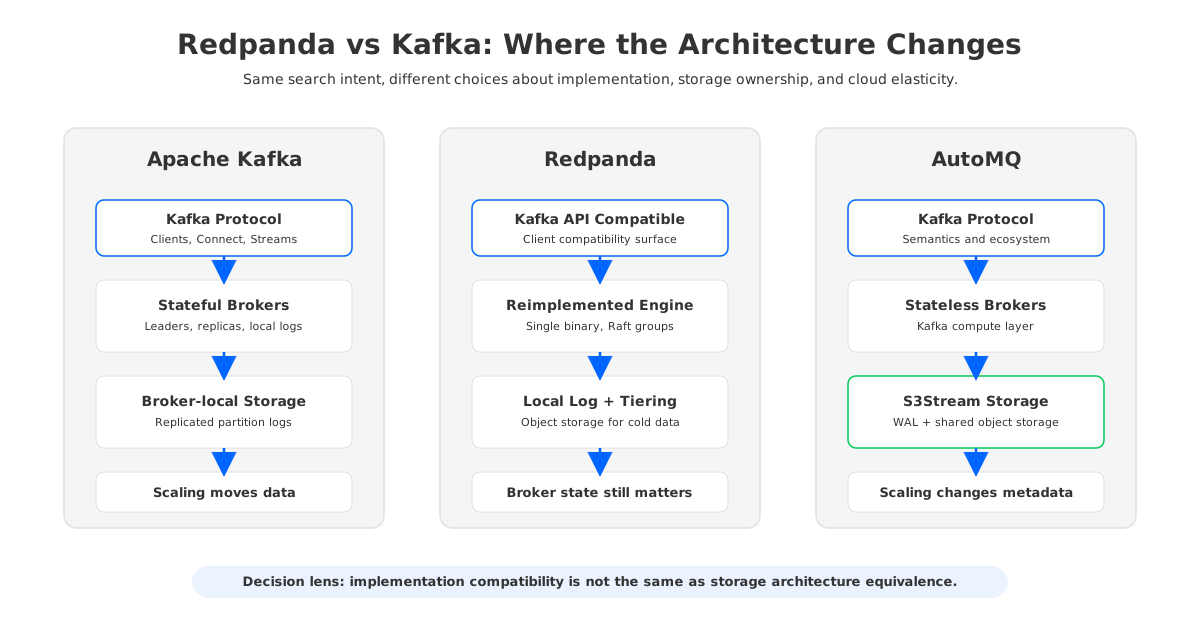
The useful comparison starts with architecture. Kafka keeps durable partition logs on brokers and replicates them across brokers. Redpanda reimplements a Kafka-compatible platform around a different engine, using single-binary design and Raft-based replication. Both can serve Kafka clients in common application paths, but they do not expose the same operator surface. A platform team should compare compatibility layer by layer, then decide whether the real problem is the Kafka API, broker-local storage, or cloud operations.
1Quick Comparison
| Dimension | Apache Kafka | Redpanda | What to validate |
|---|---|---|---|
| Product identity | Apache Kafka project and reference ecosystem | Kafka API-compatible streaming platform | Avoid treating compatibility as identical implementation |
| Client interface | Kafka protocol, clients, Admin, Streams, Connect | Kafka API compatibility with documented exceptions | Client versions, retries, idempotence, transactions |
| Storage model | Broker-local logs, optional tiered storage | Local logs plus Redpanda Tiered Storage | Retention, replay, broker replacement |
| Replication and consensus | Kafka replication model with KRaft metadata quorum in current versions | Raft groups for topic partition replication and controller metadata | Failure drills, leader election, quorum behavior, operational metrics |
| Ecosystem fit | Deepest default support across Kafka tools and managed services | Strong fit where Kafka-compatible clients are enough and Redpanda tooling is accepted | Connectors, Schema Registry, monitoring, ACLs, CLI automation |
| Cloud cost shape | Compute, local disks or cloud volumes, replication traffic, operations | Compute, local storage, tiered storage, Redpanda Cloud or self-managed operations | Storage growth, cross-zone traffic, object requests, support model |
The table is not a winner-takes-all scorecard. Kafka can be the conservative choice when ecosystem depth and known runbooks matter more than operational simplicity. Redpanda can be attractive when teams want Kafka-compatible client access with a different engine and compact deployment model. The risk is comparing them at the wrong layer.
2What Redpanda and Kafka Have in Common
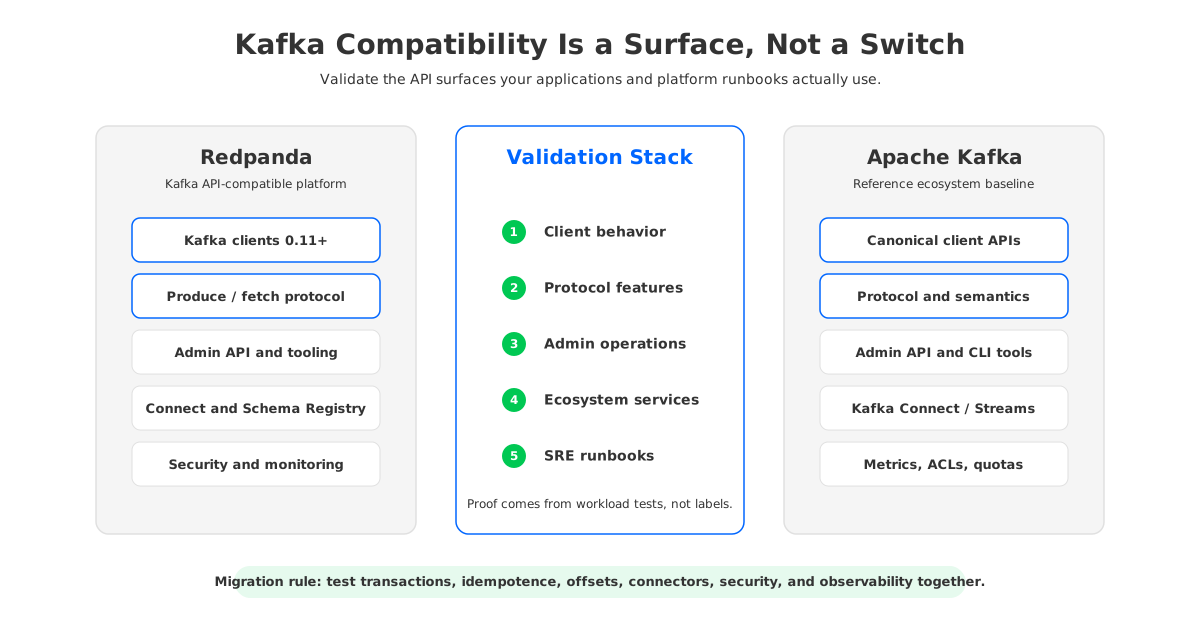
Redpanda and Kafka overlap where most application developers spend their time: producers write records, consumers read records, topics are divided into partitions, offsets define position, and consumer groups coordinate parallel consumption. Redpanda's documentation describes Kafka clients version 0.11 or later as compatible with Redpanda, while also listing validations and exceptions. That is why many application teams can test Redpanda without rewriting every producer and consumer.
This shared surface is valuable. It means the first migration question can be practical: do the clients, serializers, idempotent producers, transactions, offset commits, consumer groups, and admin operations used by your estate behave correctly? Kafka compatibility is not a yes/no badge; it is a collection of behaviors that need to survive load, upgrades, retries, and failure injection.
Kafka also remains more than a broker binary. The Apache documentation covers producer, consumer, Streams, Connect, Admin, security, operations, KRaft, and tiered storage because the ecosystem has become a broad operating standard. Redpanda's compatibility story should be evaluated against the parts of that standard your organization uses. A team running custom producers and consumers has a different risk profile from a team with hundreds of connectors, Kafka Streams applications, dashboards, and automation around kafka-* CLI behavior.
3Where the Architectures Differ
Kafka was built around a shared-nothing storage model. Each broker stores partition log segments locally, and topic replication creates additional partition replicas on other brokers. Current Kafka deployments use KRaft rather than ZooKeeper for metadata in the current architecture, but KRaft does not make brokers stateless. The broker still holds log data, serves reads, participates in replication, and has to be capacity-planned around disk, network, partitions, and replica movement.
Redpanda takes a different path. Its architecture documentation describes Redpanda as a fault-tolerant transaction log where producers and consumers use the Kafka API. It uses a single-binary deployment model and Raft groups for partition replication. Redpanda also documents Tiered Storage as a multi-tier object storage solution that offloads log segments to object storage for retention and disaster recovery.
That makes Redpanda a reimplementation, not Kafka repackaged with a new logo:
- Broker state still exists. Redpanda can simplify parts of deployment, but local log state and partition ownership remain central to the hot path.
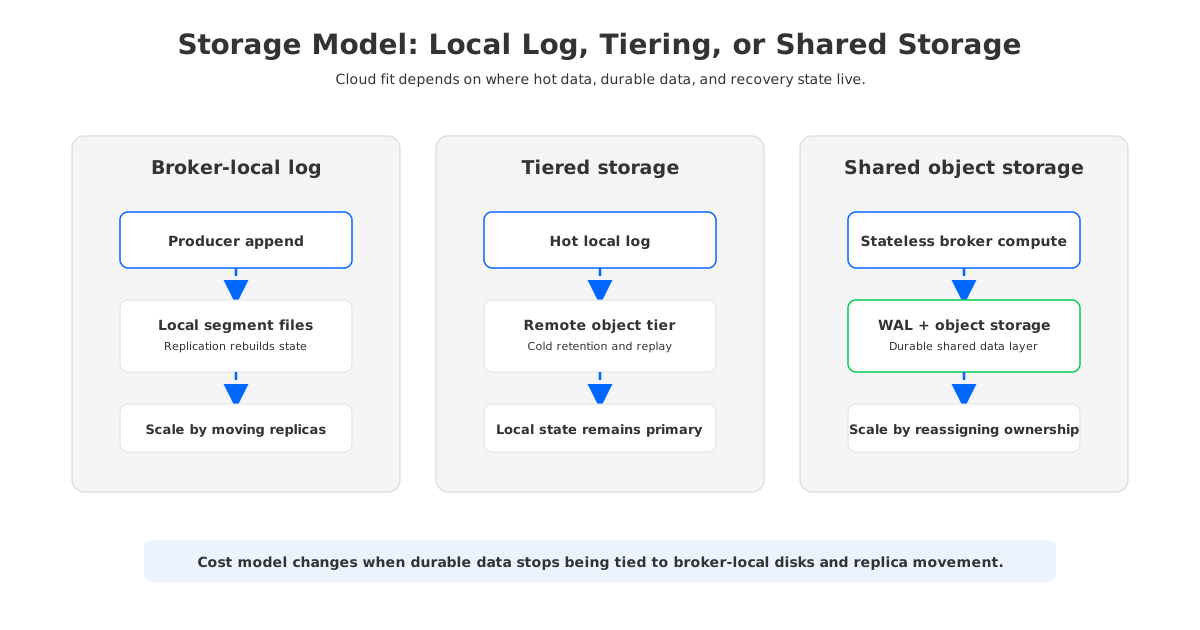
- Tiered storage is not the same as shared storage. Offloading cold segments can help with retention, but the primary hot path still depends on local storage behavior.
- Raft changes the replication mental model. Kafka operators reason about ISR, leaders, followers, and KRaft metadata; Redpanda operators reason about Redpanda's Raft groups and tooling.
- Compatibility does not remove runbook work. Your SRE team still needs dashboards, alerts, failure drills, upgrade plans, and support paths.
The architectural difference is not automatically good or bad. It changes where confidence has to be earned. Kafka's design is widely understood, deeply integrated, and sometimes operationally heavy. Redpanda's design can be easier to package and reason about in some environments, but it asks the team to trust a different engine beneath a familiar API.
4Storage and Replication: The Cloud Cost Pressure Point
Cost comparisons between Redpanda and Kafka often get flattened into node counts or benchmark claims. That misses the bigger cloud question: where does durable data live, and how much movement is required when the platform changes shape? In Kafka, retention and throughput sizing are tied to broker-local storage. Broker replacement, partition rebalancing, or storage expansion often implies moving or rebuilding replica data.
Redpanda changes implementation details, but it does not make hot data broker-independent in the same way a shared-storage design does. Its Tiered Storage can offload log segments to object storage, yet keeps a primary local tier. That distinction matters when the workload's pain is elasticity: adding capacity, recovering a node, or rebalancing partitions without turning data movement into the main event.
A practical cost model should include these inputs before procurement gets attached to a simple headline:
- Compute sized for peak throughput, partition count, compression, and consumer fan-out.
- Local disk or cloud volume capacity, IOPS, retention headroom, and replacement behavior.
- Cross-zone replication and client traffic patterns, especially where producers, brokers, consumers, and object storage endpoints sit in different zones or networks.
- Object storage capacity, request volume, retrieval behavior, lifecycle rules, and replay patterns if tiered storage or shared storage is used.
- Operator time for upgrades, incidents, partition balancing, capacity planning, security reviews, and migration testing.
This is also where Apache Kafka remains a strong baseline. If the current workload has strict low-latency requirements, stable traffic, clear retention windows, and an experienced Kafka operations team, a well-run Kafka cluster may be a better choice than an unnecessary platform change. The strongest Redpanda evaluation is not "can it be faster in a benchmark?" but "does it reduce the specific operational and cost pressure we actually have?"
5Ecosystem Compatibility: The Hidden Migration Cost
The most visible migration test is a producer sending records and a consumer reading them back. That test is necessary, but insufficient. Kafka estates accumulate small dependencies over time: admin scripts, connector error handling, stream processing jobs, monitoring rules, and security policies tied to ACL or SASL behavior.
Redpanda's Kafka compatibility documentation is useful precisely because it treats compatibility as something to validate rather than assume. Platform teams should turn that into a checklist:
- Application clients: language libraries, protocol versions, retries, batching, idempotence, transactions, and timeouts.
- Data integration: Kafka Connect deployments, Redpanda Connect if considered, schema registry behavior, and connector compatibility.
- Stream processing: Kafka Streams applications, Flink jobs, transactional processing, offset management, and replay behavior.
- Administration: topic creation, partition expansion, configuration changes, ACLs, quotas, CLI tools, automation, and Terraform providers.
- Observability: broker metrics, consumer lag, request latency, storage metrics, logs, alerts, dashboards, and incident runbooks.
The deeper the Kafka estate, the less useful "drop-in replacement" language becomes. A small application team may care mostly about producers and consumers. A central platform team has to protect the whole operating contract. That contract includes the behavior people only notice during incidents.
6Cloud Fit: Self-Managed, Managed, and BYOC Questions
The Redpanda vs Kafka decision often arrives as part of a larger cloud platform decision. Should the team run self-managed clusters? Use a managed Kafka service? Adopt Redpanda Cloud? Keep infrastructure inside a customer-owned cloud account? The answer depends on governance as much as engineering.
For Apache Kafka, cloud fit is shaped by the managed-service boundary. Amazon MSK, Confluent Cloud, self-managed Kafka on Kubernetes, and private Kafka deployments keep the Kafka API but distribute responsibility differently. The architecture is familiar, but the service surface can still constrain upgrades, quotas, networking, observability, and cost visibility.
For Redpanda, cloud fit depends on whether the team wants Redpanda's Kafka-compatible platform as a self-managed deployment or as Redpanda Cloud. Redpanda can reduce some packaging work compared with running the full Kafka ecosystem yourself, yet buyers still need to inspect data residency, networking, support boundaries, cluster sizing, tiered storage, and SRE fit.
There is a third path when the real goal is not to leave the Kafka API but to leave broker-local storage economics. AutoMQ is a cloud-native, Kafka-compatible streaming platform that keeps Kafka protocol and semantics while replacing Kafka's local log storage with S3Stream shared storage. In AutoMQ's architecture, brokers are stateless compute nodes, durable data is stored through WAL storage and shared object storage, and scaling or partition reassignment becomes more about ownership and metadata than copying large local log replicas.
That is a different answer from both "stay on Apache Kafka" and "move to a different Kafka-compatible engine." It fits teams that want Kafka ecosystem continuity while changing the storage layer that drives cloud cost and elasticity problems. Shared object storage still needs validation around WAL choice, object store performance, request cost, cache behavior, and deployment responsibility.
7Decision Guidance
Choose Apache Kafka when ecosystem depth, operational familiarity, and reference implementation behavior matter most. This is especially reasonable when your team already operates Kafka well, latency targets are tight, workloads are stable, and migration costs more than improving the existing cluster. Kafka's maturity shows up in tools, docs, community knowledge, vendor support, and edge cases other teams have already hit.
Evaluate Redpanda when you want Kafka API compatibility with a different implementation model and are willing to validate the platform as its own system. Redpanda can be compelling for teams looking for a Kafka-compatible platform with single-binary architecture, Raft-based replication, Redpanda tooling, and Redpanda Cloud or self-managed deployment options. The proof should include compatibility checks, failure drills, tiered storage tests, upgrade rehearsals, and real workload replays.
Evaluate AutoMQ when the pressure point is broker-local storage, cloud elasticity, or long-retention economics, and you still want Kafka protocol and semantics. It is most relevant when a team wants to preserve Kafka clients while adopting shared object storage and stateless brokers. Compare Kafka, Redpanda, and AutoMQ against the same traffic shape, retention policy, failure scenarios, governance requirements, and cloud bill model.
The cleanest decision memo has one page for the API surface and one page for the storage architecture. If the API surface is the hard part, stay close to Kafka's ecosystem baseline until testing proves otherwise. If storage architecture is the hard part, include shared-storage Kafka-compatible options in the proof. Redpanda vs Kafka is a useful comparison, but the stronger question is what layer you are actually trying to change.
For teams that want to test the shared-storage path while keeping Kafka semantics, start with the AutoMQ architecture overview and run a proof with your own producers, consumers, retention settings, and failure drills.
8FAQ
8.1Is Redpanda the same as Apache Kafka?
No. Redpanda is a Kafka API-compatible streaming platform. It is not an Apache Kafka distribution. It reimplements the engine and uses the Kafka API compatibility surface so many Kafka clients can connect, but platform teams should validate the specific clients, APIs, operational tools, and ecosystem components they use.
8.2Is Redpanda compatible with Kafka clients?
Redpanda's documentation says Kafka clients version 0.11 or later are compatible, with validations and exceptions documented by Redpanda. Treat that as a strong starting point, not a replacement for testing. Client behavior depends on protocol features, transactions, idempotence, admin operations, security, and library assumptions.
8.3Is Kafka better than Redpanda?
It depends on the layer you care about. Kafka is the reference implementation with the broadest ecosystem gravity. Redpanda is a Kafka API-compatible platform with a different implementation model. Kafka may be better when ecosystem depth matters most; Redpanda may fit when the team wants a different Kafka-compatible engine and has validated workload behavior.
8.4Does Redpanda use ZooKeeper?
Redpanda does not use ZooKeeper in the way older Kafka deployments did. Its architecture uses Raft for replication and coordination. Current Apache Kafka versions also use KRaft for metadata rather than ZooKeeper, so this comparison should not be reduced to "ZooKeeper vs no ZooKeeper."
8.5Is tiered storage the same as shared storage?
No. Tiered storage offloads data, usually older log segments, to object storage while keeping a primary local storage tier for the hot path. Shared storage makes object storage part of the primary durable data layer and can make brokers more stateless. That difference affects scaling, recovery, and cost modeling.
8.6Where does AutoMQ fit in a Redpanda vs Kafka evaluation?
AutoMQ fits when the team wants to keep Kafka protocol and semantics but change the storage architecture. It uses S3Stream shared storage, WAL storage, and stateless brokers to reduce the coupling between durable data and broker-local disks. It should be evaluated alongside Kafka and Redpanda when the main problem is cloud elasticity, retention cost, or broker state movement.
9References
- Apache Kafka documentation: Kafka 4.3 documentation
- Apache Kafka documentation: Kafka design and replication
- Apache Kafka documentation: KRaft operations
- Apache Kafka documentation: Kafka Connect
- Redpanda documentation: Kafka Compatibility
- Redpanda documentation: How Redpanda Works
- Redpanda documentation: Tiered Storage
- AutoMQ documentation: Architecture overview
- AutoMQ documentation: S3Stream shared streaming storage
- AutoMQ GitHub: AutoMQ/automq


