
Table of Contents
Table of Contents
A Redpanda vs Kafka cost comparison often starts with a tempting shortcut: count the nodes, compare the instance sizes, and assume the smaller cluster wins. That shortcut feels practical because compute is visible in Terraform, Kubernetes node pools, cloud bills, and procurement spreadsheets. Yet the largest cost surprises rarely come from broker count alone. They come from what those brokers are responsible for: storing retained data, replicating it, serving read fanout, recovering from failure, and moving partitions during routine operations.
That is why a Redpanda vs Kafka cost discussion needs an architecture model before it needs a calculator. Apache Kafka and Redpanda both keep the hot write path close to broker-local resources, but they differ in runtime design, operational tooling, managed-service packaging, and feature implementation. A comparison that ignores these boundaries can produce a precise spreadsheet that answers the wrong question.
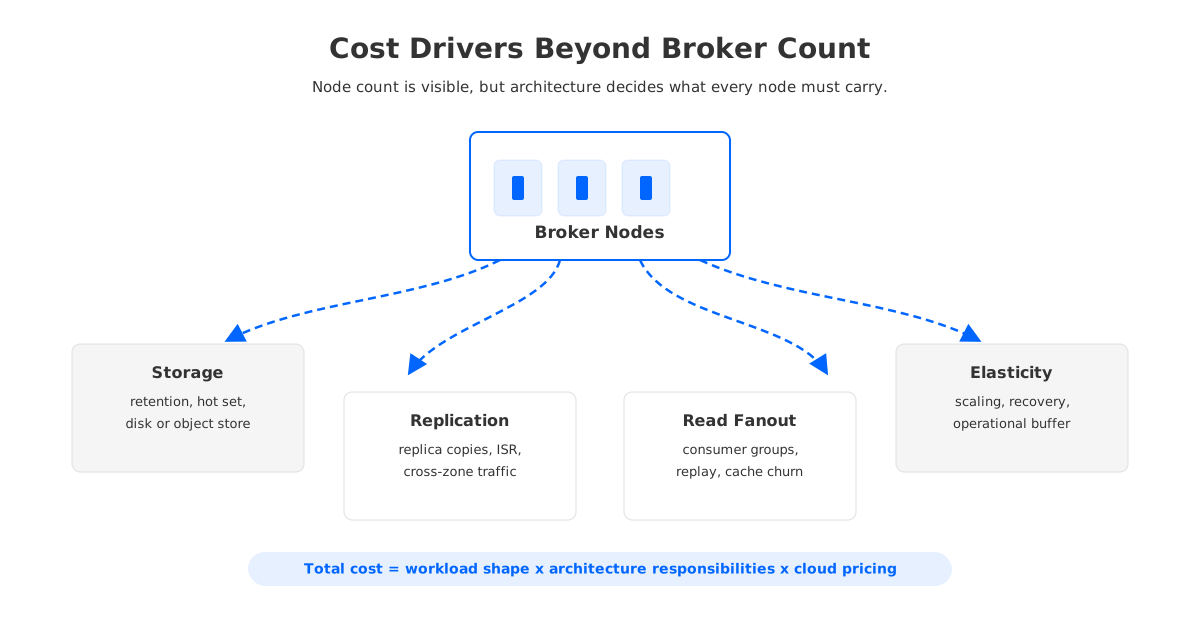
The honest question is not "Which platform uses fewer nodes?" It is "Which architecture makes the expensive parts of my workload smaller, more elastic, or easier to operate?" For long retention, high replay, bursty traffic, multi-AZ replication, or frequent scaling, storage and recovery may dominate the bill. Node count is an input. Architecture decides how many other costs each node pulls behind it.
1Why Node-Count Comparisons Mislead
The broker is not a neutral unit of cost. In Kafka, a broker usually carries request handling, partition leadership, local log storage, replica fetch, page cache, disk throughput, and risk during reassignment or recovery. Redpanda exposes Kafka-compatible APIs through a different broker implementation, but the same cost principle applies: the node is not only compute. It is part of the storage and durability system.
Streaming workloads are rarely balanced across a single dimension. A team may size brokers for peak write throughput while paying for storage sized to retention. Another team may size for consumer replay while idle most of the day. A third may add nodes because partition movement is painful, even when average CPU looks comfortable.
| Cost question | Why node count is not enough | What to inspect instead |
|---|---|---|
| Compute | Fewer brokers can still run hot if compression, fetch fanout, or compaction is heavy. | CPU saturation, request queues, p99 latency, partition leadership balance |
| Storage | Broker count does not reveal retained bytes, replica copies, disk class, or tiered storage policy. | Retention, replication factor, local vs remote storage, hot set size |
| Network | A cluster with stable CPU can still pay heavily for replication and reads across zones. | Inter-AZ traffic, replica fetch paths, client placement, consumer fanout |
| Scaling | Adding brokers may trigger data movement or operational throttling. | Reassignment behavior, rebalance duration, recovery path, automation maturity |
| Operations | A smaller fleet can still require more human effort if failures are tense. | Upgrade process, replacement workflow, observability, failure drills |
Kafka's documentation describes replication as a core durability mechanism: partitions have leaders and followers, and replicas keep copies of the log. That model is powerful because it is explicit and mature. It also means durability is implemented inside the streaming cluster, so storage and network cost follow topic configuration.
Redpanda changes implementation details, not the need to model the workload. Its documentation emphasizes Kafka API compatibility for clients, and its tiered storage documentation describes offloading data from local storage to cloud object storage. Those features affect cost, but they do not make pricing reducible to broker count.
2The Cost Drivers That Actually Matter
The first durable cost driver is write amplification. A logical byte written by a producer is not the same as the physical work done by the platform. Replication can multiply writes across brokers, while compression can reduce physical bytes according to workload shape. If the comparison starts from "daily ingress" and stops there, it misses how architecture turns ingress into storage IO and network traffic.
The second driver is retained data. Teams increase retention for replay, audit, ML feature rebuilds, CDC safety, or downstream recovery. Once retention grows, the difference between hot local storage, block storage, object storage, and tiered storage becomes material.
The third driver is read fanout. A topic with one consumer group and a topic with many independent consumer groups can have the same write volume but very different read cost. Fanout burns broker CPU, network, cache, and sometimes cross-zone transfer.
The fourth driver is elasticity. In a local-disk architecture, scaling is not only adding compute. It often means deciding how partitions move, how much data moves, and how long the cluster runs in an imbalanced state.
3Kafka and Redpanda Cost Models in Practice
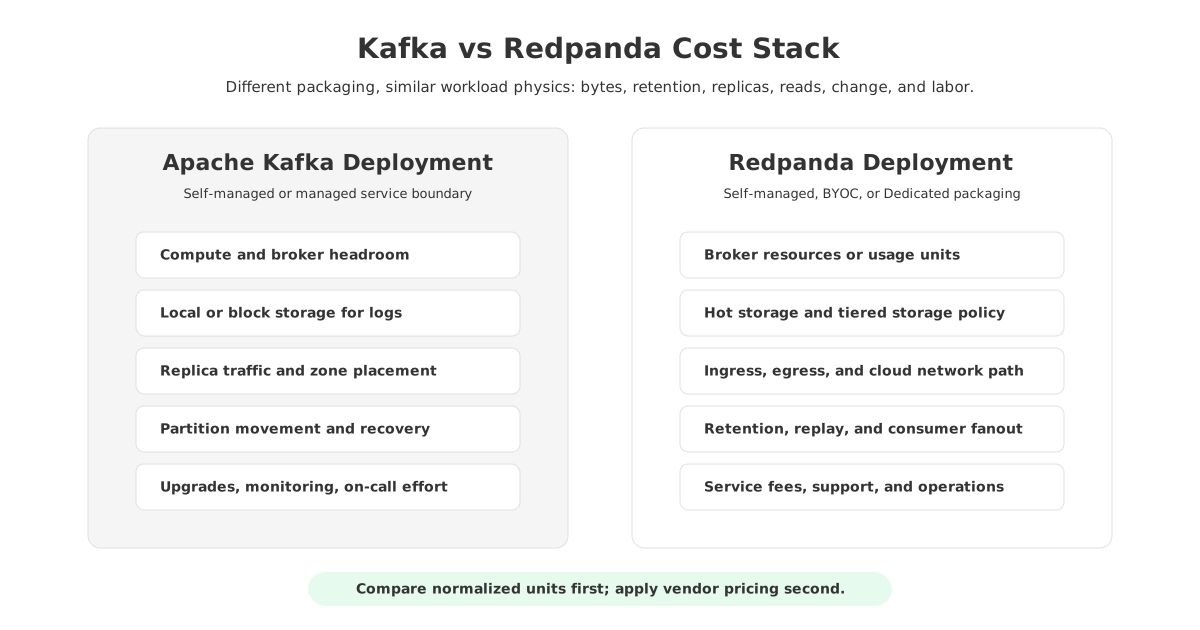
Self-managed Kafka cost typically comes from infrastructure first: compute instances, disks or cloud block volumes, network transfer, load balancers, monitoring, backups, and engineering time. Managed Kafka services move some labor and platform risk into a service bill, but storage, throughput, partitions, availability zones, and networking remain part of the economic model.
Redpanda has the same boundary problem: self-managed Redpanda, Redpanda Cloud BYOC, and Redpanda Cloud Dedicated are not the same cost object. Redpanda's billing documentation describes usage dimensions such as ingress, egress, storage, uptime, and Redpanda Processing Units depending on the deployment model. Its public pricing and estimator pages are the right place to check current commercial packaging because rates and included resources can change.
That distinction matters for FinOps teams. A self-managed comparison may make Redpanda and Kafka look like instance-plus-disk choices. A managed-service comparison may expose throughput units, storage units, support commitments, minimum spend, networking assumptions, or cloud-provider pass-through costs.
A useful cost model separates workload physics from vendor packaging. Workload physics includes bytes, retention, replicas, reads, recovery, and peak-to-average ratio. Vendor packaging decides how those physics appear on an invoice.
This is also where "Kafka" needs careful wording. Apache Kafka is open source software, not a single commercial SKU. It can run on local disks, cloud block storage, Kubernetes persistent volumes, managed service brokers, or newer shared-storage implementations. Comparing Redpanda to "Kafka cost" therefore requires naming the Kafka deployment model.
4Tiered Storage Helps, But It Is Not the Same as Shared Storage
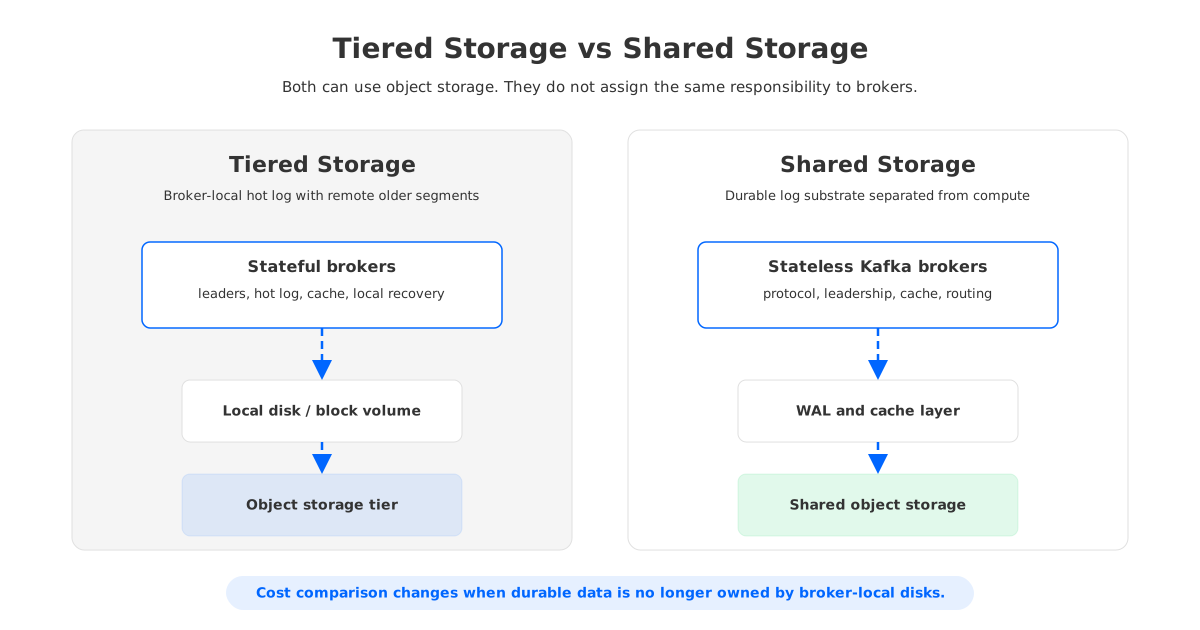
Tiered storage is often the next shortcut. If both Kafka and Redpanda can use object storage for older data, why not assume retention cost becomes similar? Because tiered storage and shared storage solve different problems. Tiered storage usually keeps the broker-local log as the hot operational path and moves older segments to remote object storage. That can reduce long-retention pressure, but brokers still matter for writes, hot reads, metadata, cache behavior, and local failure handling.
Apache Kafka's tiered storage work is designed around remote log storage while preserving Kafka's log abstraction. Redpanda's tiered storage similarly uses object storage to extend retention beyond local disk. These capabilities do not automatically make brokers stateless, and they do not remove the need to size the hot set, replay path, or operational recovery process.
Shared storage changes the starting assumption. Instead of treating object storage as a colder extension of broker-local disks, the architecture makes shared storage the durable substrate and keeps brokers focused on compute, protocol handling, caching, and coordination. That alters cost drivers in three ways:
- Persistent storage is no longer multiplied primarily by broker-local ownership. The platform can use object storage economics for durable data while keeping a smaller hot path for latency.
- Scaling compute is less tied to copying retained log data. Broker replacement, traffic shifts, and partition ownership changes can become metadata and cache-warming events rather than large storage migrations.
- Recovery targets can focus on restoring service capacity and metadata ownership. Durable bytes remain in shared storage, so the platform does not need to rebuild all retained data from peer brokers before it can serve useful traffic.
The tradeoff is not magic. Shared-storage systems must manage write latency, object layout, metadata scale, cache efficiency, and object-store request behavior. Buyers should test those behaviors with production-like traffic. The cost model moves from stateful broker capacity to the separation of durable storage, hot cache, compute, and operations.
5Where AutoMQ Changes the Cost Discussion
Once the evaluation reaches that architecture question, AutoMQ becomes relevant as a Kafka-compatible shared-storage option rather than as a generic "Kafka alternative." AutoMQ keeps Kafka protocol compatibility while moving durable streaming storage into S3-compatible object storage. Its brokers are designed to be stateless with respect to long-lived log ownership.
That matters for cost because AutoMQ targets the parts of Kafka economics that are difficult to improve with tuning alone. If retained data lives primarily in shared object storage, long retention is no longer sized like a fleet of broker-owned disks. If brokers are stateless, scaling compute for peak traffic does not have to imply moving large amounts of historical data.
The practical value is not that every workload becomes lower cost by default. The value is that the worksheet changes from "How many brokers and disks do we need?" to more useful questions: how much durable data should live in object storage, how much hot capacity should be cached near brokers, and how quickly should compute scale?
This keeps the Redpanda comparison fair. Redpanda's local hot path can be attractive when the workload prioritizes low latency and operational simplicity within its design envelope. Kafka's maturity and ecosystem depth can be attractive when teams already have deep Kafka expertise and tooling. AutoMQ is strongest where Kafka compatibility matters, but the team wants shared storage, stateless brokers, elastic scaling, and BYOC control.
6A Cost Worksheet That Avoids False Precision
A good worksheet does not need made-up prices. It needs the right units, official price sources, and a place to record assumptions. Cloud rates vary by provider, region, storage class, commitment, and contract. Redpanda and managed Kafka packaging can also change.
| Worksheet row | Unit to capture | Why it changes the answer |
|---|---|---|
| Producer ingress | compressed and uncompressed GiB/day | Determines broker load, replicated bytes, and billable throughput units in some services |
| Replication | replication factor and AZ placement | Multiplies storage and may create cross-zone traffic |
| Retention | hours or days per topic class | Separates hot operational data from long replay or audit data |
| Read fanout | consumer groups and replay frequency | Drives egress, broker CPU, cache pressure, and historical read behavior |
| Storage class | local disk, block volume, object storage, tiered storage | Changes cost per retained GiB and performance constraints |
| Peak ratio | peak throughput divided by average throughput | Determines over-provisioning and elasticity value |
| Recovery target | RTO, rebuild time, replacement process | Converts architecture into operational buffer and labor cost |
| Operations | upgrades, balancing, monitoring, incident response | Captures the human cost that infrastructure-only models hide |
Use official pricing pages for rows that need rates: cloud compute, cloud block storage, object storage, and data transfer. For Redpanda Cloud, use Redpanda's current pricing, estimator, and billing documentation. For Kafka, state whether the target is self-managed Apache Kafka, a managed Kafka service, or a Kafka-compatible architecture.
Add sensitivity checks. Change retention from a short buffer to long replay. Change consumer fanout from one group to many. Change traffic from steady to spiky. A platform that looks efficient under one row may look different when the workload becomes retention-heavy or replay-heavy.
7How To Compare Redpanda, Kafka, and AutoMQ Without Gaming the Result
Start with the workload, not the vendor. Capture topics, partitions, message sizes, compression ratio, consumer groups, retention by topic class, peak traffic, availability-zone layout, and recovery targets. Then run the same assumptions through each architecture. If one candidate requires premium local disks, another uses block volumes, and another uses object storage plus cache, make those rows visible.
Separate steady-state cost from change cost. Steady state covers ingestion, reads, retention, and baseline operations. Change cost covers scaling, broker replacement, partition movement, traffic spikes, upgrades, and failure drills. A lower steady-state bill can be offset by operational freezes, manual intervention, or excess buffer kept for fear of recovery.
Finally, test the two read paths separately. Tailing reads measure the live stream. Catch-up reads measure replay, backfill, consumer recovery, and analytics scans. Redpanda, Kafka, and shared-storage systems can behave differently across those paths because they stress cache, local disk, object storage, metadata, and network in different proportions.
8FAQ
8.1Is Redpanda lower cost than Kafka?
It depends on deployment model and workload shape. Redpanda may reduce some operational or runtime overhead for certain self-managed workloads, but Kafka cost is not a single number because Kafka can be self-managed, managed, tiered, or implemented through Kafka-compatible shared storage. Compare compute, storage, replication, network, retention, read fanout, recovery, and operations first.
8.2Does using fewer broker nodes always reduce streaming cost?
No. Fewer nodes can reduce compute spend, but they can also concentrate CPU, disk, network, and failure risk. If long retention, replica traffic, cross-zone reads, or recovery buffers dominate the bill, broker count alone will not predict total cost.
8.3Does tiered storage remove the storage cost problem?
Tiered storage can reduce local storage pressure by moving older data to object storage, but it usually preserves a broker-local hot path. You still need to size brokers, local storage, cache, replay behavior, and operational recovery. Shared storage goes further by making object storage the durable substrate rather than only a colder tier.
8.4Where does AutoMQ fit in a Redpanda vs Kafka cost evaluation?
AutoMQ fits when the team wants Kafka compatibility but is trying to change the cost drivers created by broker-owned storage. Its shared-storage architecture, stateless brokers, and BYOC deployment model are most relevant for retention-heavy, elastic, replay-sensitive, or operations-sensitive workloads.
8.5What should I verify before making a cost decision?
Verify current official pricing, real workload units, availability-zone traffic, storage class assumptions, support or service fees, and recovery behavior under failure. Then test tailing reads and catch-up reads with production-like clients.
The node-count shortcut is attractive because it makes a hard architecture choice look tidy. But streaming cost is shaped by where data lives, how many times it is copied, how often it is read, how quickly the platform changes shape, and how tense recovery becomes. If your current model keeps turning into a broker spreadsheet, try the architecture worksheet instead. To compare a Kafka-compatible shared-storage design with your own traffic, run the AutoMQ pricing calculator and bring the same workload assumptions you would use for Redpanda or Kafka.
9References
- Redpanda Docs, Kafka Client Compatibility
- Redpanda Docs, Tiered Storage
- Redpanda Docs, Cloud Billing
- Redpanda, Pricing
- Apache Kafka Documentation, Replication
- Apache Kafka Documentation, Tiered Storage
- AWS, Amazon EBS Pricing
- AWS, Amazon S3 Pricing
- AWS, Amazon EC2 On-Demand Pricing
- AutoMQ Docs, Architecture Overview
- AutoMQ, Pricing Calculator


