
Table of Contents
Table of Contents
Teams searching for Redpanda vs MSK usually already know why Kafka exists. They have producers, consumers, topics, offsets, schema dependencies, observability dashboards, and a set of services that expect Kafka-compatible behavior. The real decision is not whether streaming matters. It is which operating model should carry the workload on AWS.
Amazon MSK, Redpanda, and AutoMQ all sit near the same buying conversation, but they do not represent the same architectural bet. MSK is AWS-managed Apache Kafka, with provisioned and serverless options. Redpanda is a Kafka API-compatible streaming engine that replaces Kafka's JVM-based broker implementation with its own engine and storage model, including cloud options such as BYOC. AutoMQ is a Kafka-compatible shared-storage architecture that keeps the Kafka protocol surface while moving durable data away from broker-local disks.
That makes a three-way comparison more useful than a winner-takes-all scorecard. A low-latency operational topic, a long-retention analytics topic, and a bursty ingestion stream can all speak Kafka while needing different answers for storage, scaling, recovery, and cloud ownership.
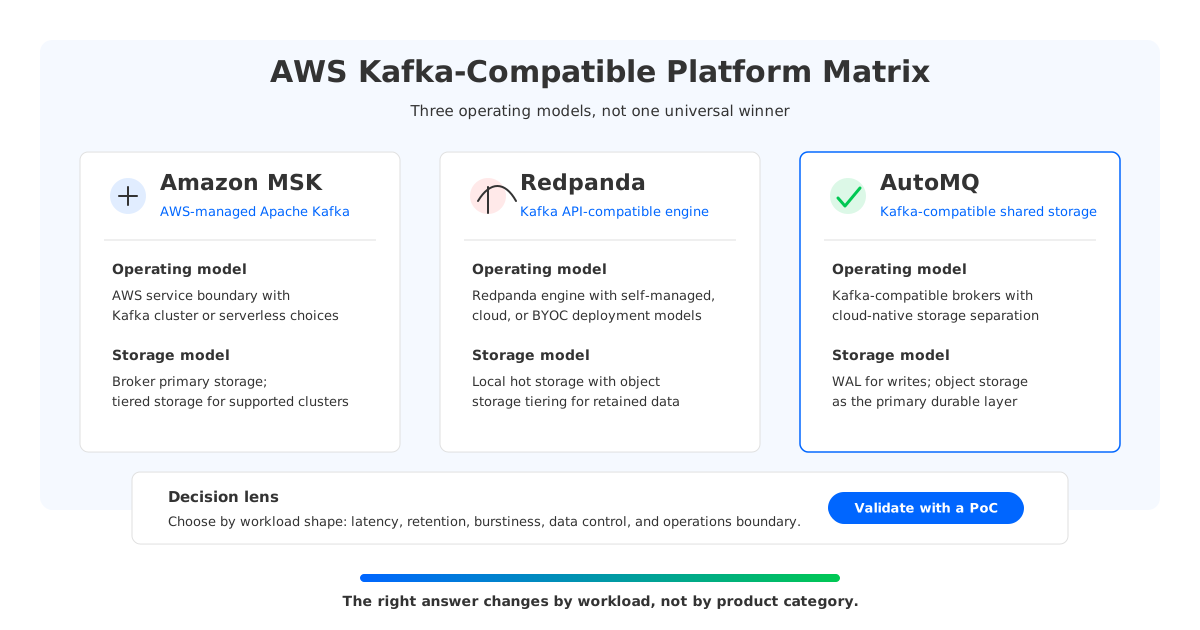
This is not a benchmark. Public vendor claims and lab results rarely transfer cleanly across instance families, partition counts, producer settings, consumer fan-out, retention, compaction, and AWS network topology. The safer comparison starts with architecture and cost mechanics, then validates latency and compatibility with your own workload.
1Quick Recommendation Table
If the shortlist is Redpanda vs Amazon MSK, add AutoMQ when the workload has cloud-storage economics or scaling pressure. The three options answer different questions:
| Decision dimension | Amazon MSK | Redpanda | AutoMQ |
|---|---|---|---|
| Best first fit | Teams that want AWS-managed Apache Kafka with familiar Kafka operations | Teams that want a Kafka API-compatible engine with Redpanda-managed or self-managed operations | Teams that want Kafka compatibility with shared-storage elasticity on cloud infrastructure |
| Storage model | Broker-attached primary storage, with tiered storage available for supported provisioned clusters | Local broker storage with Tiered Storage to object storage for cloud-backed retention | WAL for write acceleration and recovery, with object storage as primary shared storage |
| Scaling mental model | Scale broker capacity, storage, or serverless throughput within AWS service boundaries | Scale Redpanda brokers or cloud deployment capacity around the Redpanda engine | Scale stateless brokers because durable data is not bound to individual broker disks |
| Cost pressure to inspect | Broker hours, storage, provisioned throughput, tiered storage, data transfer, operations | Compute, local disks, cloud deployment fees, tiered storage, network paths, operations | Compute, WAL storage, object storage, managed service or license fees, network paths |
| Main validation work | Kafka version, quotas, storage mode, authentication, limits, upgrade and scaling operations | Kafka API compatibility, feature exceptions, tiered storage behavior, operational ownership | Kafka client behavior, WAL choice, object-storage behavior, migration and runbook fit |
MSK is often the cleanest default when the team wants AWS to own the managed Kafka service boundary. Redpanda is often attractive when the team wants Kafka API compatibility but does not want Apache Kafka's broker implementation. AutoMQ becomes interesting when the pain is not only "who manages Kafka" but the deeper issue that broker-local durable storage makes scaling, balancing, and long retention expensive to operate.
2Architecture and Storage Model
MSK preserves the Apache Kafka architecture most teams already understand. In provisioned mode, the team chooses broker type, broker count, storage, networking, authentication, monitoring, and Kafka configuration. AWS manages the service, but the workload still behaves like Kafka: partitions live on brokers, replicas move between brokers, and storage choices affect cost and recovery. MSK Serverless changes the capacity-management model by automatically provisioning and scaling capacity, but it still sits inside AWS-defined service limits and IAM-centered access control.
Redpanda changes a different layer. It is Kafka API-compatible, but it is not Apache Kafka under the hood. Its docs describe compatibility with Apache Kafka clients from version 0.11 onward, with documented exceptions and validated clients. Operationally, that means Redpanda can look familiar to Kafka applications while giving platform teams a different broker implementation to run, tune, and upgrade. With Tiered Storage, Redpanda can offload log segments to object storage while keeping local storage as the hot path.
AutoMQ changes the storage binding. Instead of treating object storage as a secondary tier for older data, AutoMQ uses shared storage as the primary durable data layer and uses WAL storage for low-latency persistence and fault recovery. That distinction matters. A tiered-storage system still has a primary broker-local storage tier; a shared-storage system is designed so durable data is no longer owned by a specific broker node.
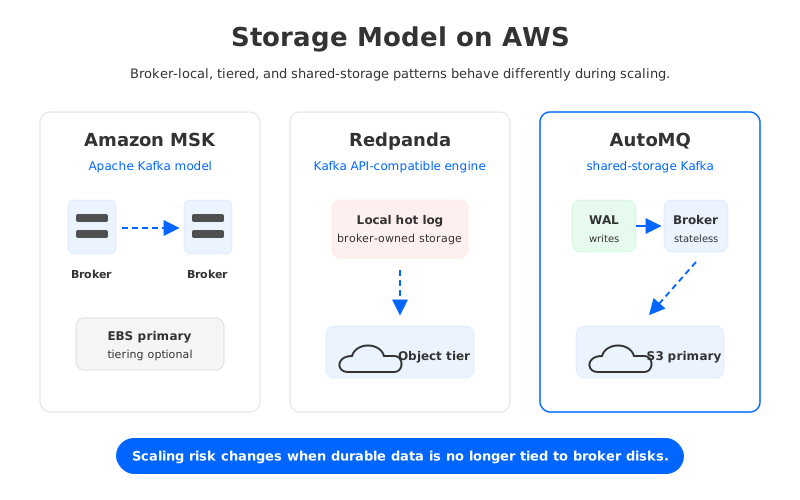
The operational consequence shows up during failure and scaling events. In a broker-local model, replacing or shrinking capacity can involve data movement, replica catch-up, and partition balancing. In a shared-storage model, the platform can move partition ownership without copying the full retained log between broker disks. That does not remove the need for careful engineering, but it changes the limiting resource from "move bytes between brokers" to "coordinate ownership over shared durable data."
3Cost Model on AWS
Cost comparisons go wrong when they reduce streaming to a single price line. AWS Kafka workloads pay for compute, storage, network movement, requests, managed service boundaries, support, and migration overlap. The labels differ by vendor, but the physics are the same: retained bytes must live somewhere, writes must be acknowledged somewhere, and reads must travel through a network path.
For MSK, the model starts with AWS pricing dimensions. Provisioned clusters can include broker instance hours, storage, provisioned storage throughput, data transfer, and optional features such as tiered storage. MSK Serverless uses a throughput-based model and charges for streamed and retained data according to AWS's current pricing. The service can reduce direct operational burden, but it does not make workload shape irrelevant. Retention, consumer fan-out, partition count, and cross-AZ traffic still matter.
For Redpanda, the model depends on deployment mode. A self-managed deployment puts more responsibility on your team. A Redpanda Cloud or BYOC deployment shifts more operational work to Redpanda while keeping the data plane in a cloud environment depending on the chosen model. The key AWS cost lines are compute, local storage, object storage for Tiered Storage, request volume, network paths, and commercial fees. Redpanda's local-storage-first design can be strong for latency-sensitive hot data, but long retention should be modeled with both local and object-storage behavior.
For AutoMQ, the worksheet should separate compute, WAL storage, object storage, network paths, and managed service or license fees. The architecture aims to reduce data movement tied to replication, reassignment, and broker replacement by moving durable data into shared storage. That can be especially relevant when the bill is driven by retained bytes and operational elasticity rather than only steady-state broker CPU.
Use a dated worksheet before procurement. As of May 21, 2026, AWS MSK, Redpanda, and AutoMQ all publish enough public material to model the cost categories, but exact prices and packaging can change. A serious comparison should include:
- Steady-state write and read throughput: producer ingress, consumer fan-out, compression ratio, and partition count shape the compute and network bill.
- Retention and replay behavior: hot retention, long retention, cold reads, and reprocessing determine whether local disk, tiered storage, or shared object storage dominates.
- Failure and scaling movement: broker replacement, partition reassignment, and cluster expansion can create temporary network and operational cost.
- Migration overlap: old and target clusters often run in parallel while replication, validation, rollback, and client cutover are tested.
- People cost and risk: managed services reduce some tasks, but incident response, quota planning, access control, and application compatibility remain owned by the platform team.
The first-pass conclusion is usually architectural. MSK makes sense when AWS-managed Kafka familiarity is worth the broker-storage model. Redpanda makes sense when the team wants Redpanda's Kafka-compatible engine and cloud operating model. AutoMQ makes sense when the workload needs Kafka compatibility and the economics of shared storage at the same time.
4Scaling and Failure Recovery
Scaling is where Kafka-compatible systems stop looking interchangeable. The Kafka API can stay stable while the storage layer changes the recovery path underneath it. That is why the same topic count and throughput can feel routine on one architecture and operationally heavy on another.
In MSK provisioned clusters, capacity planning still involves broker count, broker type, storage throughput, partition placement, and cluster operations. Tiered storage helps with long retention by moving closed segments to a lower-cost tier, but AWS documents constraints such as provisioned-mode availability, topic and broker limitations, and feature-specific behavior. MSK Serverless removes more capacity planning from the user, but it also introduces a different set of quotas and service boundaries.
Redpanda scaling depends on the Redpanda deployment and its local-storage model. Because it is a different engine, teams should test broker sizing, partition leadership, compaction, tiered storage, rolling upgrades, and cloud operations with Redpanda-specific runbooks rather than assuming Apache Kafka behavior maps one-for-one. The benefit is a Kafka API-compatible engine designed around Redpanda's implementation choices; the tradeoff is that those choices must be validated against the exact workload.
AutoMQ's scaling argument is tied to stateless brokers. Its documentation describes storage-compute separation, WAL-backed persistence, and object storage as the durable data location. When retained data is not bound to a broker disk, broker replacement and partition reassignment can avoid full log copying between nodes. For bursty workloads, that is the key architectural question: can the platform add and remove compute without dragging the durable log around the cluster?
5Migration and Ecosystem Compatibility
"Kafka-compatible" is a useful starting point, not a migration plan. It usually means existing Kafka clients can speak to the platform, but production workloads also depend on security, metadata behavior, admin APIs, transactions, idempotent producers, consumer group behavior, quotas, connectors, schema registries, monitoring, and failure semantics.
MSK has the strongest familiarity signal because it is Apache Kafka managed by AWS. That does not make migrations automatic. Teams still need to verify Kafka version support, IAM or SASL/SCRAM choices, TLS, ACL behavior, Connect dependencies, topic configuration, tiered storage constraints, quotas, and monitoring integrations.
Redpanda's compatibility needs a careful read of the current docs. Its Kafka API compatibility is one of its central promises, but the official compatibility page also documents specific exceptions and validated clients. That is the right posture for an evaluator: treat compatibility as a test matrix, not a slogan. Include your real producers, consumers, admin tooling, stream processors, Connect jobs, and failure scenarios.
AutoMQ should be evaluated the same way. Its value proposition depends on Kafka compatibility plus a different storage architecture, so the proof of concept should cover both surfaces. A migration test should verify bootstrap changes, offsets, ACLs, quotas, topic configs, client versions, observability, lag behavior, cutover, rollback, and the runbooks for broker failure or capacity changes.
6Scenario-Based Recommendations
The cleanest way to choose is to classify workloads instead of choosing one platform for the whole estate. A compacted control-plane topic, an observability pipeline, and a customer-facing event stream have different tolerance for latency, retention cost, compatibility risk, and operational ownership.
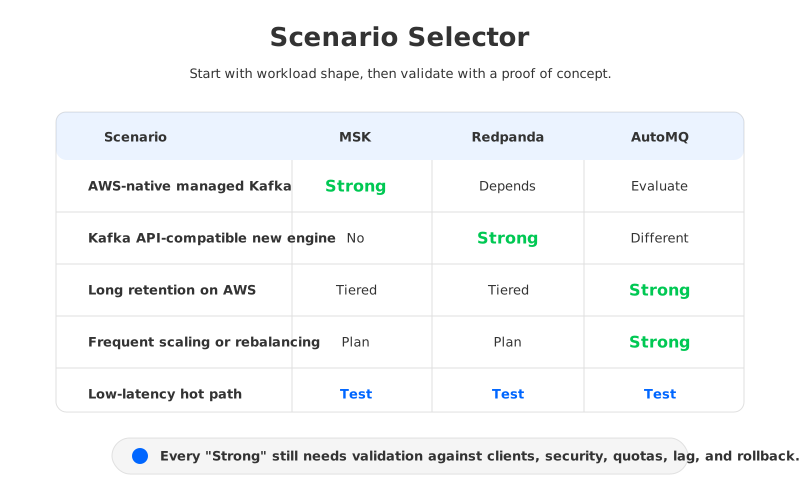
Use MSK as the baseline when the team wants AWS-native managed Kafka, strong familiarity with Apache Kafka semantics, and close integration with AWS networking and security patterns. This is especially reasonable when the workload is already tuned for Kafka, the team values service familiarity, and the storage and scaling profile is predictable enough to operate within MSK's boundaries.
Use Redpanda when the team wants a Kafka API-compatible alternative engine and is willing to validate Redpanda-specific behavior. It can be a strong fit when low-latency hot data, operational simplicity, and Redpanda's cloud or BYOC model match the team's priorities. The evaluation should pay close attention to feature compatibility, tiered storage behavior, and the operational boundary between your team, Redpanda, and AWS.
Use AutoMQ when the main tension is between Kafka compatibility and cloud-native elasticity. Long retention, bursty throughput, frequent scaling, or expensive data movement are signals that broker-local durable storage may be the wrong center of gravity. AutoMQ is not a shortcut around testing, but it gives architects a third pattern: Kafka-compatible brokers over shared storage rather than AWS-managed traditional Kafka or a different Kafka-compatible engine.
7Sources
- Amazon MSK developer guide: What is Amazon MSK?
- Amazon MSK Serverless
- Amazon MSK tiered storage
- Amazon MSK pricing
- Redpanda Kafka compatibility
- Redpanda Tiered Storage
- Redpanda BYOC
- AutoMQ compatibility with Apache Kafka
- AutoMQ stateless broker
- AutoMQ S3Stream overview
- AutoMQ WAL storage
- AutoMQ pricing
8FAQ
8.1Is Redpanda the same as Amazon MSK?
No. Amazon MSK is AWS's managed Apache Kafka service. Redpanda is a Kafka API-compatible streaming platform with its own broker implementation and cloud deployment options. They can serve similar application needs, but the engine, operating boundary, and storage behavior differ.
8.2Is Redpanda fully compatible with Kafka clients?
Redpanda documents compatibility with Apache Kafka clients from version 0.11 onward, with specific exceptions and a list of validated clients. Treat that as a compatibility matrix to test against your real applications, not as a reason to skip migration validation.
8.3When should I choose MSK over Redpanda?
Choose MSK when AWS-managed Apache Kafka familiarity is the main requirement and your workload fits MSK's cluster type, quota, storage, and security model. It is often the lower-change option for teams already operating Kafka on AWS.
8.4When should AutoMQ be in the Redpanda vs MSK shortlist?
Add AutoMQ when long retention, scaling, broker replacement, or data movement are central concerns. It is especially relevant when the team wants Kafka compatibility but does not want durable data tied to broker-local disks.
8.5Does MSK tiered storage solve the same problem as AutoMQ shared storage?
Not exactly. MSK tiered storage offloads older closed segments to a lower-cost tier while primary storage remains part of the broker-local Kafka model. AutoMQ uses object storage as primary shared storage with WAL for write acceleration and recovery, so the scaling and reassignment mechanics are different.
8.6Can I migrate from MSK or Redpanda to AutoMQ without rewriting applications?
Often the application code can remain Kafka-client based, but the migration still needs testing. Verify client versions, security settings, topic configuration, offsets, consumer groups, admin operations, monitoring, cutover, and rollback before treating the change as only a bootstrap-server update.


