
Table of Contents
Table of Contents
Redpanda vs WarpStream is not a normal feature checklist. It is a choice between two answers to the same cloud question: should a Kafka-compatible platform keep the hot log close to a performance-oriented broker, or move durable data into object storage and make the serving layer mostly stateless? Both answers can be reasonable. They optimize for different failure modes, latency budgets, and cloud bills.
Redpanda starts from the broker engine. Its documentation describes Kafka client compatibility for clients developed for Apache Kafka 0.11 or later, with documented exceptions, and Tiered Storage for offloading log segments to cloud storage. WarpStream starts from object storage: its architecture documentation describes stateless Agents that speak the Apache Kafka protocol, write data to object storage, and coordinate metadata through WarpStream cloud services.
The phrase "Kafka-compatible cloud streaming" hides the design decision that matters most. Object storage can be a cold tier, a primary log substrate, a batch file store, or a shared storage layer behind Kafka-compatible brokers. Those choices create different answers for write acknowledgement, p99 latency, replay throughput, recovery behavior, and data control.
1The Architecture Split
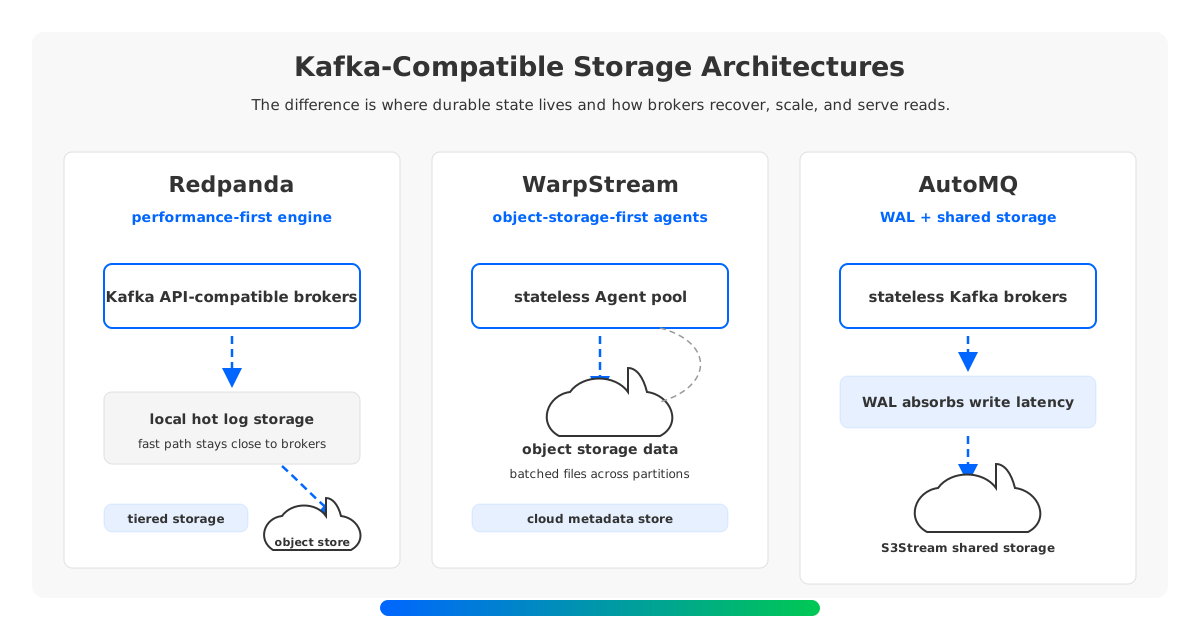
Redpanda is best understood as a performance-first streaming engine with Kafka API compatibility. It is not Apache Kafka internally, but it is designed so Kafka clients and many Kafka ecosystem assumptions still apply. The appeal is direct: keep the hot path close to the broker, reduce moving parts, and use tiered storage when retention economics become painful.
WarpStream is best understood as an object-storage-first Kafka-compatible system. Its Agent is stateless, and its documentation emphasizes that any Agent can act for any topic or consumer group because durable data and metadata are separated from the Agent process. The trade-off is a different performance model: data is batched into object storage files, metadata maps those files to topic-partition offset ranges, and control-plane behavior becomes part of the end-to-end design.
AutoMQ belongs in the same conversation as a third point in the design space: Kafka-compatible shared storage with stateless brokers and a WAL layer in front of object storage. AutoMQ documentation describes replacing Kafka's native log storage with S3Stream, storing data into object storage near real time, and using WAL storage to absorb object storage latency and IOPS limits. That makes AutoMQ a useful reference when the buyer is really asking how to combine Kafka compatibility, shared storage, and BYOC-style control.
| Dimension | Redpanda | WarpStream | AutoMQ |
|---|---|---|---|
| Primary architectural center | Performance-oriented broker engine | Stateless Agents plus object storage | Stateless Kafka-compatible brokers plus WAL and object storage |
| Object storage role | Tiered storage for offloaded segments | Primary durable data store | Primary shared storage through S3Stream |
| Kafka compatibility posture | Kafka clients 0.11+ documented as compatible, with exceptions | Kafka protocol support for core produce, consume, topics, groups, transactions, and more | Kafka protocol and ecosystem compatibility as a design goal |
| Latency model | Hot path stays close to broker-local storage | Batching, object storage, cluster tier, and optional low-latency modes shape p99 | WAL absorbs write latency before shared object storage persistence |
| Operational model | Broker-centric cluster operations | Agent pool in customer VPC plus managed cloud metadata/control plane | Stateless broker operations with shared storage and BYOC options |
The table is not a benchmark. It is a map of where to look: Redpanda broker CPU, disk, tiered storage, and partition movement; WarpStream batch timeout, object operation rate, control-plane tier, cache, and supported APIs; AutoMQ WAL behavior, S3Stream persistence, broker replacement, and client compatibility.
2Storage Architecture Is The Real Comparison
Kafka's original storage model binds partitions, local logs, and broker ownership tightly together. That model is familiar and fast when disks and traffic are stable. In public cloud environments, it can turn every capacity decision into a storage decision: more local state to balance, more attached storage for retention, and more replication traffic for availability.
Redpanda changes the Kafka implementation, but it does not turn every broker into a stateless proxy. Its Tiered Storage feature is valuable because long retention is expensive when every byte must remain on primary broker storage. Offloading older segments to object storage can improve retention economics and support recovery workflows, but fresh writes still depend on the broker hot path.
WarpStream takes the opposite bet. Its architecture page distinguishes it from tiered storage: Agents do not require local disks, and data streams to object storage instead of being replicated across broker disks. That changes cost and scaling, but it makes batching, small file compaction, object request cost, and metadata coordination first-class concerns. WarpStream's own documentation says a naive S3-based Kafka-compatible system can end up with either high latency or high S3 API operation cost.
AutoMQ's shared-storage architecture sits between those mental models. It accepts that object storage is attractive as a primary data repository, but it does not pretend object storage latency disappears. The WAL layer exists because object storage has higher latency and lower IOPS characteristics than local or block storage. Shared storage changes broker state and cloud cost, while WAL keeps the write path from becoming a direct object-store latency bet.
3Kafka Compatibility: Same Word, Different Surface Area
"Kafka-compatible" can mean several things. Clients can connect and produce or consume records, but consumer groups, offsets, idempotent producers, transactions, ACLs, topic configuration, schema registry behavior, Kafka Connect, Kafka Streams, and admin tooling also need validation. A platform can be excellent for core produce/consume workloads and still need testing for the rest of the estate.
Redpanda's Kafka compatibility page states that clients developed for Kafka 0.11 or later are compatible, while listing unsupported features and caveats. That gives platform teams a concrete page to compare against their actual clients. Standard producers, consumers, consumer groups, and common clients may fit naturally; less common protocol messages, quotas, admin workflows, or tooling assumptions need closer review.
WarpStream's protocol and feature support page is similarly concrete. It lists supported Kafka messages, including produce, fetch, metadata, consumer group coordination, topic operations, ACL operations, and transaction-related requests. It also explains that some Kafka broker operations have no meaning because Agents are stateless and durability is managed by object storage. Compatibility here is not "Kafka broker behavior with a different disk." It is Kafka protocol compatibility mapped onto a different control and storage model.
For AutoMQ, the compatibility promise comes from a different implementation strategy: preserve the Kafka compute and protocol surface while replacing the storage layer with S3Stream. If the migration goal is to keep Kafka clients and ecosystem tools while changing broker state, storage economics, and BYOC control, AutoMQ should be tested alongside the two endpoints rather than treated as a generic alternative.
4Latency And Cost Are The Same Trade-Off
Latency and cost should not be evaluated as separate spreadsheets. In cloud streaming, knobs that reduce p99 often increase compute, storage operations, premium storage usage, or networking. Knobs that reduce cost often increase batching, cache dependence, or replay complexity.
Redpanda's advantage is intuitive: a performance-oriented local hot path can fit workloads that care about low p99 for fresh reads and writes. Cost then depends on provisioned capacity, storage, retention, replication, deployment model, and service contract. Redpanda's public pricing entry point currently routes buyers into a get-started or contact flow, so teams should model cost from the actual quote, cloud resources, support terms, and retention profile.
WarpStream's advantage is the cloud cost structure it is designed around. Its pricing and billing documentation describe consumption-based billing for BYOC and Serverless clusters, with dimensions such as cluster-minutes, uncompressed GiB written, uncompressed GiB stored, and, for Serverless, compressed ingress and egress. That is attractive for high-retention or bursty workloads, but the low-latency documentation shows the other side of the bargain.
WarpStream's low-latency guide states that the default setup is tuned for throughput and minimal costs at the expense of higher latency. It shows a default profile with 25 ms client linger, 250 ms Agent batch timeout, S3 Standard, and Fundamental cluster tier at p50 250 ms and p99 500 ms produce latency. Lower-latency profiles use reduced batch timeout, S3 Express, higher cluster tiers, or lightning topics, but the same page ties those choices to higher PUT costs or relaxed consistency caveats.
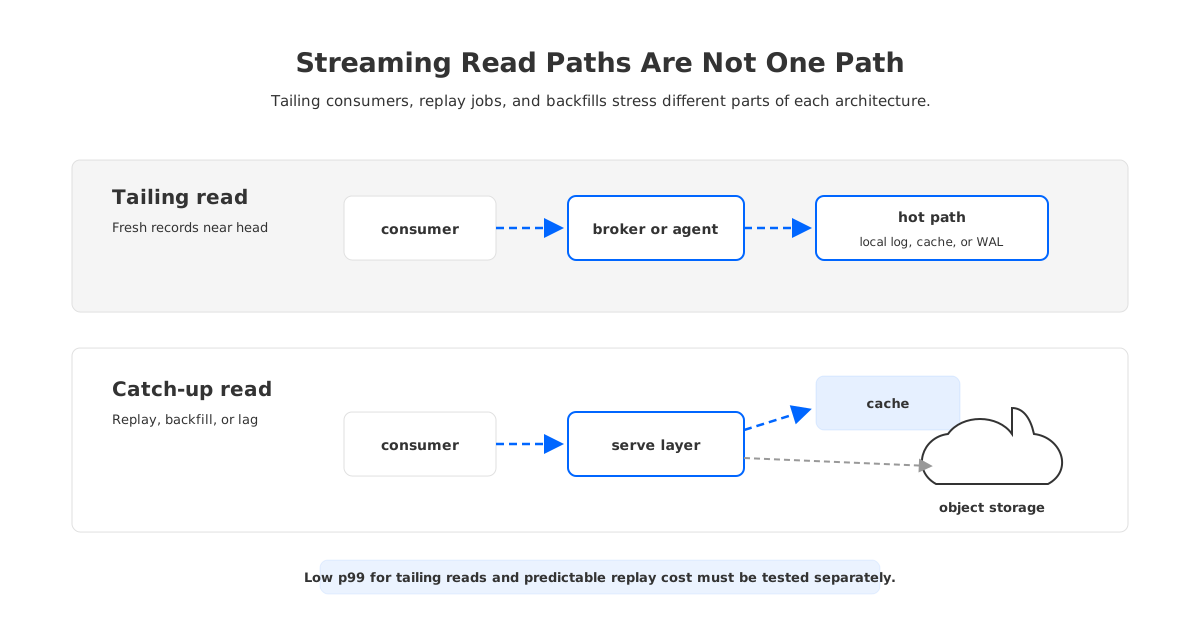
Those details should change the PoC. A single "produce latency" number is not enough. Test a throughput-oriented profile, a low-latency profile, and a production-like profile with your expected retention, partitions, fan-out, failures, and cloud placement. Apply the same discipline to Redpanda and AutoMQ.
5BYOC And Data Boundary
BYOC is not a single security model. It only tells you that some part of the data plane runs in the customer's cloud account or VPC. The real question is which data, metadata, credentials, telemetry, and control operations cross the boundary.
WarpStream's architecture page says the Agent pool runs inside the customer's VPC and customer data is never sent outside that VPC; metadata about which files belong to a virtual cluster is transferred to WarpStream Cloud. That is a strong data-plane boundary for teams comfortable with managed metadata and control-plane dependency. Buyers should still review what metadata contains, where it is stored, how control-plane regions are chosen, and what happens during control-plane impairment.
Redpanda Cloud includes deployment models that can place data-plane infrastructure in the customer's environment, including BYOC architecture documented by Redpanda. That can satisfy teams that want a provider-managed experience while retaining more cloud-account control than pure SaaS. Review cloud IAM roles, network connectivity, upgrade authority, support access, diagnostic bundles, and chargeback fit.
AutoMQ also fits naturally into this boundary discussion because BYOC and private deployment are part of its positioning. When durable data is in the customer's object storage and brokers are stateless, the platform team can separate data ownership from broker lifecycle in a different way than broker-local storage systems. That still requires review around control-plane access, telemetry, keys, and operational support.
6Workload Fit
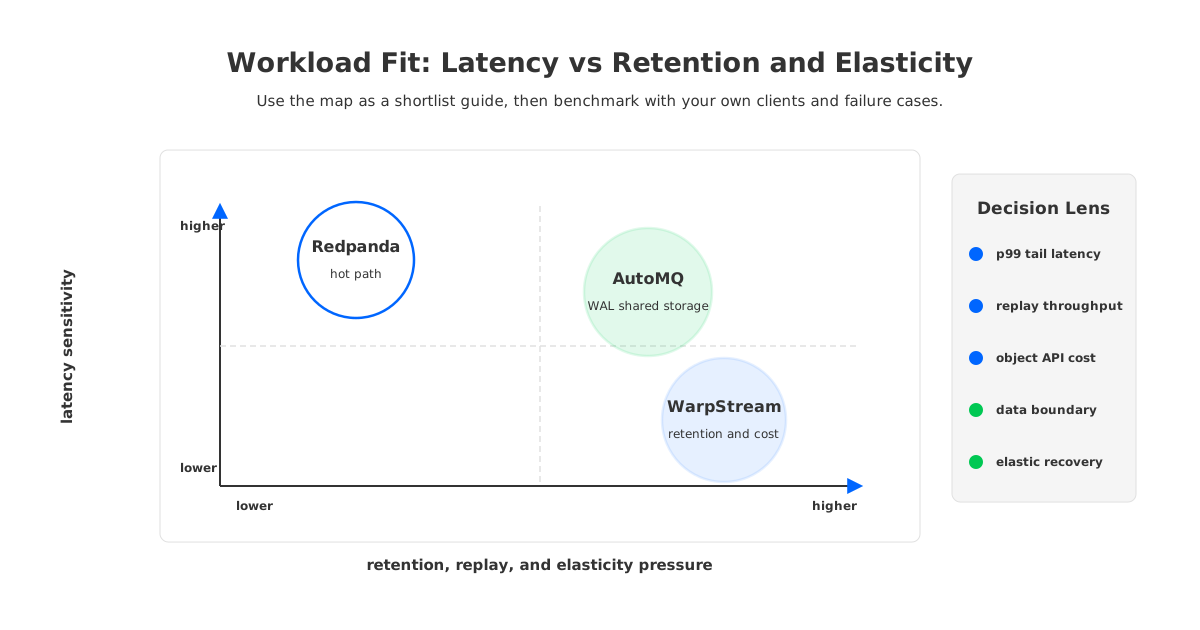
There is no universal answer because the products are not optimizing for the same center of gravity. Redpanda is a strong candidate when the workload is latency-sensitive, retention is manageable, and broker-centric operations fit the organization. WarpStream is a strong candidate when storage cost, cross-zone replication cost, bursty capacity, or long retention dominate the problem. AutoMQ is a strong candidate when the buyer wants Kafka-compatible shared storage with stateless broker behavior, WAL-assisted writes, and BYOC control.
Map workload pressure instead of vendor names:
| Workload pattern | Redpanda fit | WarpStream fit | AutoMQ fit |
|---|---|---|---|
| Ultra-low-latency hot stream | Strong candidate if local hot path economics work | Requires low-latency configuration and trade-off review | Candidate when WAL and target cloud meet p99 goals |
| Long retention with replay | Tiered storage can help; test remote reads | Strong candidate; object storage is central | Strong candidate; object storage is primary shared storage |
| Bursty ingest with scale-down periods | Depends on deployment and reserved capacity | Strong candidate if cluster-minute and object costs align | Strong candidate if stateless scaling is the goal |
| Kafka ecosystem-heavy estate | Validate documented exceptions | Validate supported protocol/API surface | Validate clients, Connect, Streams, and migration tooling |
| Strict data boundary / BYOC | Review Redpanda BYOC model | Review customer VPC Agents plus cloud metadata | Review customer-cloud storage, broker, and control-plane model |
The mistake is to pick from a quadrant chart and skip the experiment. Redpanda may still be dominated by retention and recovery. WarpStream may have p99 or consistency requirements that push it into higher-cost modes. AutoMQ still needs a WAL, object storage, and compatibility test.
7A Practical Evaluation Plan
Start with the workload inventory: partitions, message sizes, throughput, read fan-out, retention, compaction, lag recovery targets, transactions or idempotence, and zone-aware clients. Then list operational events that hurt today: broker replacement, scale-out, scale-in, backfill, hot partitions, retention expansion, or cloud bill spikes. The right benchmark reproduces those events.
Next, define compatibility gates. For Redpanda, compare usage against its Kafka compatibility page. For WarpStream, compare usage against its protocol and feature support page, including broker-centric operations that are intentionally irrelevant. For AutoMQ, validate Kafka clients, Kafka Connect, Kafka Streams, schema workflows, migration tooling, and deployment model.
Then model cost from components rather than slogans: compute, storage, network, and operations. Finally, run failure tests. Kill a broker or Agent, add capacity, induce consumer lag, trigger replay, and observe whether the system fails in a way your team can understand.
8How To Choose
Choose Redpanda when the workload is latency-sensitive, the storage footprint is controlled, and the team wants a Kafka API-compatible platform whose hot path stays close to a performance-oriented broker. The procurement question is whether the deployment and pricing model match your cloud operating model.
Choose WarpStream when long retention, cross-AZ traffic avoidance, bursty capacity, and object-storage economics are the main problem. Its architecture is deliberately not tiered Kafka, and that difference is the point. The evaluation question is whether the latency, consistency, metadata boundary, and object operation cost profile fit the production workload after you tune it for your required p99.
Choose AutoMQ when the desired target is Kafka-compatible shared storage with stateless broker behavior, WAL-assisted writes, and customer-cloud deployment control. The hypothesis is specific: existing Kafka applications can keep their protocol and ecosystem assumptions while durable state moves into shared object storage and broker operations become lighter-weight.
The Redpanda vs WarpStream decision starts with a vendor comparison, but it should end with an architecture test. If your team is evaluating shared-storage Kafka and wants to compare a WAL-based stateless broker model alongside Redpanda and WarpStream, evaluate AutoMQ with your own topics, clients, retention, and failure drills. The right answer is the one whose trade-offs remain acceptable under pressure.
9FAQ
9.1Is Redpanda the same type of architecture as WarpStream?
No. Redpanda is centered on a performance-oriented broker engine, with Tiered Storage available to offload log segments. WarpStream is built around stateless Agents that write data to object storage and coordinate metadata through WarpStream cloud services.
9.2Is WarpStream fully Kafka-compatible?
WarpStream speaks the Apache Kafka protocol and documents support for core produce, fetch, topics, consumer groups, ACLs, and transaction-related requests. Its documentation also lists known incompatibilities and broker-centric messages that do not apply because Agents are stateless.
9.3Which is lower latency, Redpanda or WarpStream?
There is no honest answer without workload context. Redpanda's local hot path is attractive for low-latency workloads. WarpStream can be tuned with client linger, Agent batch timeout, cluster tier, S3 Express, and lightning topics, but its documentation ties those choices to cost or consistency trade-offs.
9.4Where does AutoMQ fit compared with Redpanda and WarpStream?
AutoMQ fits as a Kafka-compatible shared-storage option with stateless brokers, S3Stream, and a WAL layer in front of object storage. It is relevant when the goal is to reduce broker-local state while preserving Kafka protocol and ecosystem compatibility.
9.5What should a Redpanda vs WarpStream PoC measure?
Measure p50, p95, and p99 latency; replay throughput; object operation rate; storage and network cost; lag recovery; broker or Agent failure behavior; compatibility; and the exact BYOC or managed data boundary.
10References
- Redpanda Docs: Kafka Compatibility
- Redpanda Docs: Use Tiered Storage
- Redpanda Docs: BYOC Architecture
- Redpanda: Get started / pricing contact flow
- WarpStream Docs: Introduction
- WarpStream Docs: Architecture
- WarpStream Docs: Protocol and Feature Support
- WarpStream Docs: Low Latency Clusters
- WarpStream Docs: Billing
- WarpStream: Pricing
- Apache Kafka: Official Documentation
- AutoMQ Docs: What Is AutoMQ
- AutoMQ Docs: Architecture Overview
- AutoMQ: Pricing Calculator
- AutoMQ GitHub: AutoMQ/automq


