
Table of Contents
Table of Contents
Someone searching reduce kafka brokers is rarely asking a cosmetic question. They are usually staring at a cluster where the broker count has become a proxy for too many other problems: compute spend, disk growth, partition movement, maintenance windows, governance boundaries, and the unpleasant gap between average traffic and peak traffic. Reducing brokers sounds like the clean fix because it gives the team one visible number to attack. The trouble is that Kafka capacity is not one number.
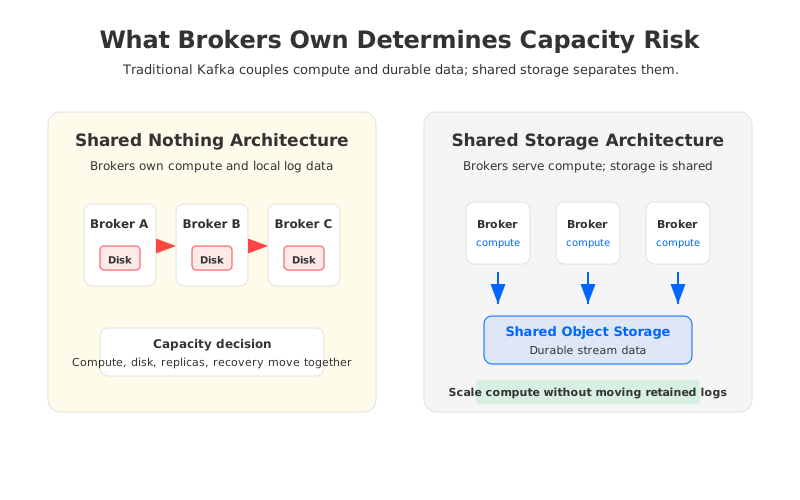
In production Kafka, a broker is not only a compute process. In a traditional Shared Nothing architecture, it is also a storage owner, a replication participant, a network endpoint, a failure-domain member, and part of the operational contract for every Topic and Partition it hosts. Removing brokers can reduce one line item while increasing risk somewhere else. If the remaining brokers inherit more partitions, more retained bytes, more leader traffic, and less maintenance headroom, the cluster may look leaner right before it becomes harder to operate.
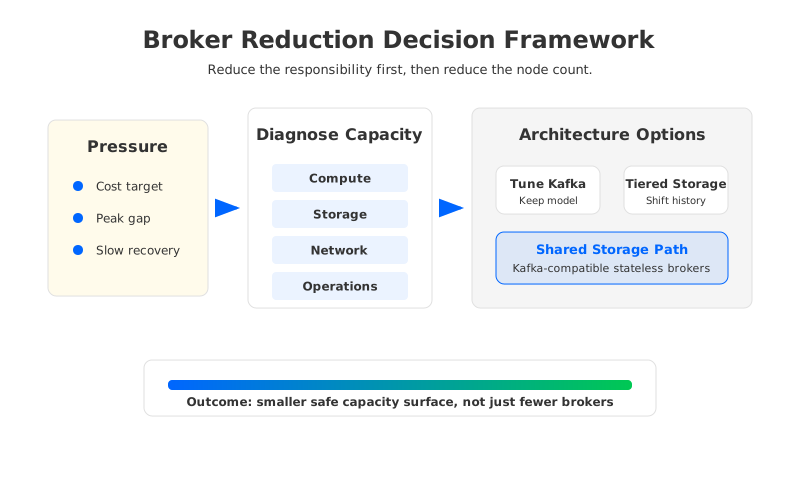
The better question is not "How do we reduce broker count?" It is "Which capacity responsibility should brokers still own?" That framing gives platform teams room to compare tuning, consolidation, managed service changes, Tiered Storage, and Kafka-compatible Shared Storage architecture without turning the exercise into a blind cost cut.
1Why reduce kafka brokers matters now
Broker reduction has become a common FinOps and platform-engineering search because Kafka clusters often grow by accumulation. An additional product line adds more partitions. A compliance requirement extends retention. A data science team starts replaying historical streams. A cloud migration moves the same replication pattern into an environment where storage, network, and availability zones are priced differently. Each change is reasonable by itself, but the combined effect is a cluster sized for the worst week of the quarter and paid for every hour.
This is why the first broker-reduction review should separate capacity pressure into four buckets:
- Compute pressure. CPU, memory, request handling, compression, TLS, and network interrupts define whether brokers can serve live traffic with acceptable latency.
- Storage pressure. Retention, segment size, compaction, local disk throughput, and disk failure behavior define how much durable data each broker must carry.
- Network pressure. Producer writes, consumer reads, replication traffic, and cross-Availability-Zone transfer define how much data moves through the broker fleet.
- Operational pressure. Rebalancing, broker replacement, upgrades, partition reassignment, and incident recovery define how much human and automation effort the model requires.
Those buckets often move in different directions. A team might reduce brokers and still pay the same storage bill because retained data did not shrink. Another team might use larger instances and reduce broker count, only to create larger failure domains and slower maintenance events. A third team might find that the expensive part is not brokers at all, but cross-zone replication traffic created by the architecture.
The AWS documentation for data transfer pricing makes the point in cloud terms: traffic crossing Availability Zones can be charged differently from traffic staying inside a zone or using service-specific paths. Kafka's replication and client-routing patterns therefore matter to the bill, not only the number of nodes. A broker-count KPI cannot see that.
2The production constraints behind the search
Traditional Kafka was designed around local log ownership. Each broker stores partitions on local or attached disks, and Kafka maintains durability through replica placement and ISR (In-Sync Replicas). This model is proven and well understood, but it couples several capacity decisions that cloud teams would rather scale separately. If you add brokers, you may need partition reassignment. If you remove brokers, you need to drain data safely. If retention grows, broker-local storage grows with it. If a broker fails, the cluster must restore both serving capacity and replica health.
That coupling is why reducing brokers can backfire. A smaller cluster has fewer places to put leaders, fewer disks to absorb retained data, and less spare capacity during failover. It may also concentrate noisy Topics onto fewer machines. Kafka gives operators many tools to manage this, including partition-level configuration, quotas, rebalancing, KRaft-based metadata management, and Tiered Storage in current Apache Kafka documentation. Those tools are valuable, but they do not erase the basic question of what durable data is attached to.
The constraint is not that Kafka cannot be optimized. It can. The constraint is that optimization inside the same broker-local storage model has a ceiling. At some point the team is deciding how much risk to accept in exchange for fewer brokers, not whether a spreadsheet can show a smaller node count.
3Architecture patterns teams usually compare
When a platform team tries to reduce Kafka brokers responsibly, the options usually fall into a few patterns. They are not mutually exclusive, but they answer different questions.
| Pattern | What it optimizes | What it does not solve by itself |
|---|---|---|
| Tune existing Kafka | Partition placement, topic count, retention, compression, quotas, instance sizing | Broker-local ownership and data movement remain part of operations |
| Consolidate clusters | Fewer operational surfaces and better shared utilization | Multi-tenant isolation, blast radius, and governance become harder |
| Use larger brokers | Lower node count and simpler inventory | Larger failure domains and potentially heavier recovery events |
| Add Tiered Storage | Lower pressure from historical retention on local disks | Hot path and broker-local responsibilities still matter |
| Move to shared-storage Kafka | Separates durable storage from broker compute | Requires validation of compatibility, write path, object storage, and migration |
The table is deliberately neutral. For some teams, tuning existing Kafka is enough. If the cluster has excessive partitions, unbounded retention, poor compression, or stale Topics, architecture change is premature. For others, the root problem is not waste but elasticity: traffic is bursty, retention is long, and every broker lifecycle event is dominated by data movement. In that case, broker reduction becomes a symptom of a deeper architectural mismatch.
Tiered Storage deserves special care in this discussion because it is often confused with stateless brokers. Tiered Storage moves older log segments to remote storage while keeping the active write path and recent data on broker-local storage. That can be a strong fit for long retention and replay-heavy workloads, especially when the team wants to preserve the operational model of Apache Kafka while reducing local disk pressure. It does not make brokers fully replaceable compute nodes. A broker still owns active partitions and still participates in local write, cache, and leader behavior.
Shared Storage architecture changes the ownership model more directly. Durable stream data lives in shared object storage, while brokers focus on Kafka protocol handling, caching, coordination, and serving traffic. That shifts the broker-reduction question from "How much data can each broker safely hold?" to "How much compute do we need to serve this workload?"
4Evaluation checklist for platform teams
The practical evaluation starts with evidence, not product categories. Before removing brokers or changing architecture, measure the actual drivers that force the current fleet size. A week of clean metrics is useful; a month that includes batch peaks, replay events, deployments, and maintenance is better.
Use this checklist as a capacity review, not a procurement script:
- Traffic shape. Compare average throughput, peak throughput, tailing reads, catch-up reads, and replay behavior. A cluster with predictable write traffic but bursty historical reads needs a different plan from a cluster that is write-saturated all day.
- Storage growth. Separate hot data, retained historical data, compacted Topics, and compliance retention. Storage pressure caused by long retention should not be solved only by adding compute.
- Failure headroom. Model what happens when one broker or one Availability Zone is unavailable. A smaller cluster must still have enough capacity to absorb leadership changes and client traffic.
- Network locality. Identify replication paths, cross-zone traffic, client placement, and connector placement. The bill often reflects data paths that the broker-count dashboard hides.
- Governance boundaries. Decide whether environments, tenants, Topics, and teams can safely share fewer clusters. Consolidation without access, quota, and ownership controls only moves the problem.
- Migration and rollback. Treat client compatibility, offset continuity, ACLs, Connectors, Schema Registry dependencies, and rollback as part of capacity planning. A lower steady-state cost is not useful if cutover risk is uncontrolled.
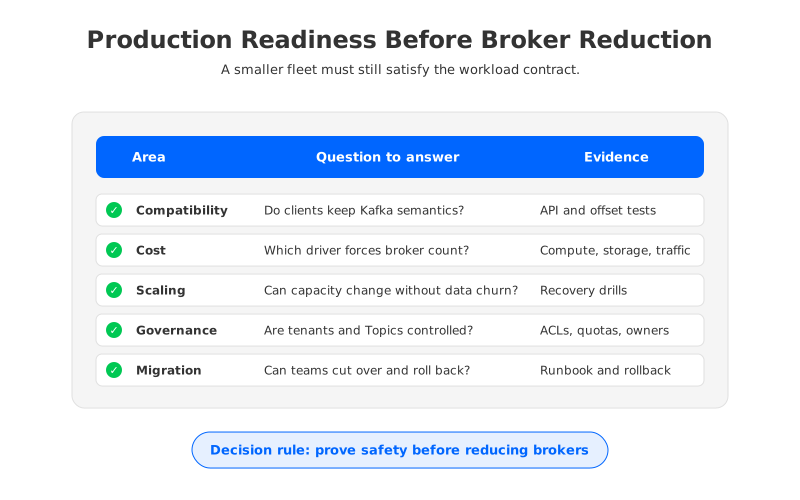
The most important output of the checklist is a classification. If brokers are high because Topics are unmanaged, fix governance. If brokers are high because retention is long, evaluate retention architecture. If brokers are high because failover requires large spare capacity, evaluate the recovery model. If brokers are high because the cluster uses broker-local disks as the long-term storage layer, then a different architecture may be the cleanest way to reduce capacity waste.
5Where AutoMQ changes the operating model
Once the problem is framed as broker responsibility, AutoMQ enters the evaluation naturally. AutoMQ is a Kafka-compatible cloud-native streaming platform that keeps the Kafka protocol and ecosystem while changing the storage layer underneath. Instead of binding retained Kafka data to broker-local disks, AutoMQ uses a Shared Storage architecture built around S3-compatible object storage, S3Stream, WAL storage, data caching, and stateless brokers.
The important point is not that every team should replace Kafka to reduce node count. The point is that a shared-storage design attacks a different part of the capacity equation. Brokers no longer need to be sized as permanent owners of retained data. They can be treated more like compute nodes that serve protocol traffic, cache hot data, coordinate leadership, and recover service ownership without waiting for large retained-log copies to move between disks.
That changes several operating assumptions:
- Scaling is less tied to data migration. Adding or replacing compute capacity does not require the same retained-data movement that dominates many traditional broker operations.
- Storage grows with object storage economics. Durable data sits in S3-compatible object storage rather than being provisioned as broker-local disk for every retained byte.
- Failure recovery focuses on service ownership. A failed broker is primarily a compute-capacity event because durable data remains in shared storage.
- Deployment control can remain in the customer environment. AutoMQ BYOC runs control plane and data plane components in the customer's cloud account, while AutoMQ Software supports private data center deployments.
There are still tradeoffs to validate. Object storage has different latency and request behavior than local disks. A serious architecture must define the acknowledgment path, WAL type, cache behavior, metadata consistency, compaction, and observability model. AutoMQ documentation describes WAL options such as S3 WAL, Regional EBS WAL, and NFS WAL for different deployment needs; the right choice depends on latency, durability, cloud environment, and operational constraints. That is why a proof of concept should test the full workload, not only a benchmark that writes a neat stream of records for a short time.
AutoMQ is most relevant when the team wants Kafka compatibility but wants the infrastructure to behave more like cloud-native compute plus shared durable storage. It is less relevant if the current pain is only messy Topic ownership, stale data, or misconfigured client behavior. Architecture helps when the architecture is the bottleneck.
6Decision table and FAQ
The final broker decision should be written as a table because it forces tradeoffs into the open. A good outcome might be "do not reduce brokers yet," and that is not a failure. It means the team found a risk before production found it.
| If your evidence shows... | Better next move |
|---|---|
| Low utilization, unmanaged Topics, and stale retention | Clean Topic ownership, retention policy, quotas, and partition strategy first |
| Long retention dominates disk sizing | Evaluate Tiered Storage or shared-storage Kafka depending on hot-path requirements |
| Broker replacement and scaling are slow because data moves with brokers | Evaluate Kafka-compatible Shared Storage architecture and stateless brokers |
| Cross-zone traffic is a major cost driver | Model data paths, client placement, replication behavior, and architectures designed for Zero cross-AZ traffic |
| Governance blocks consolidation | Strengthen tenant isolation, ACLs, quotas, observability, and ownership before merging clusters |
| Client rewrite risk is unacceptable | Favor Kafka-compatible options and validate protocol behavior, offsets, transactions, and Connectors |
Returning to the original search, reducing Kafka brokers is a useful goal only after the team knows which capacity responsibility is being removed. A smaller fleet that still carries the same storage, replication, and recovery burden is not simpler; it is denser. If your real goal is to keep Kafka semantics while reducing the operational coupling between brokers and durable data, evaluate a shared-storage design alongside conventional tuning. AutoMQ is worth testing in that branch of the decision tree, especially for teams that want Kafka-compatible streaming with stateless brokers, BYOC or private deployment boundaries, and object-storage-backed durability.
7References
- Apache Kafka Documentation
- Apache Kafka Tiered Storage Documentation
- AWS EC2 Data Transfer Pricing
- Amazon S3 Data Resiliency
- AutoMQ Architecture Overview
- AutoMQ S3Stream Shared Streaming Storage
- AutoMQ WAL Storage
8FAQ
8.1Should we reduce Kafka brokers if average utilization is low?
Not immediately. Low average utilization may hide peak traffic, replay workloads, maintenance headroom, or failure capacity. First separate compute, storage, network, and operational drivers. If the cluster is over-provisioned because of stale Topics or retention policy drift, governance cleanup may reduce pressure without architectural change.
8.2Is Tiered Storage the same as stateless Kafka brokers?
No. Tiered Storage offloads older log segments to remote storage while the active path still depends on broker-local responsibilities. Stateless brokers in a Shared Storage architecture move durable storage responsibility out of broker-local disks more completely, so broker replacement and scaling are less tied to retained-data movement.
8.3How does broker reduction affect reliability?
Reducing brokers can increase the load carried by each remaining broker and reduce failure headroom. The reliability impact depends on leader placement, partition count, replication behavior, disk capacity, network paths, and whether the architecture requires data movement during recovery.
8.4Where does AutoMQ fit in a broker-reduction strategy?
AutoMQ fits when the goal is not only fewer nodes, but a different capacity model: Kafka-compatible APIs, stateless brokers, Shared Storage architecture, and customer-controlled deployment through AutoMQ BYOC or AutoMQ Software. It should be evaluated with real workload tests covering compatibility, latency, recovery, migration, and rollback.


