
Table of Contents
Table of Contents
Searches for broker over provisioning kafka usually come from a specific moment: the Kafka cluster is healthy, the bill is not. CPU graphs sit below the alert threshold, yet the platform team cannot remove brokers because storage, partition placement, replica recovery, and peak traffic are tied together. Finance sees idle capacity. SRE sees risk. Application teams see a shared service that must not fall behind.
That tension is the real problem. Broker over-provisioning is not only a bad sizing decision; it is often a symptom of an architecture where durable state lives on the same machines that serve traffic. Traditional Apache Kafka gives teams strong ordering, offsets, Consumer group coordination, transactions, Kafka Connect integration, and a mature ecosystem. The trade-off is that each Broker also owns local log segments and replica responsibilities, so capacity planning becomes a bundle of compute, disk, network, and failure headroom. Reducing over-provisioning safely means unbundling those drivers before deleting a single broker.
1Why teams search for broker over provisioning kafka
A platform owner asking this question is usually trying to learn whether the cluster is oversized, whether it can be resized without disruptive data movement, and whether a different Kafka-compatible architecture could lower the long-term cost curve. In production, the concern starts with a concrete mismatch between what the workload needs and what the cluster must keep provisioned.
Common signals look like this:
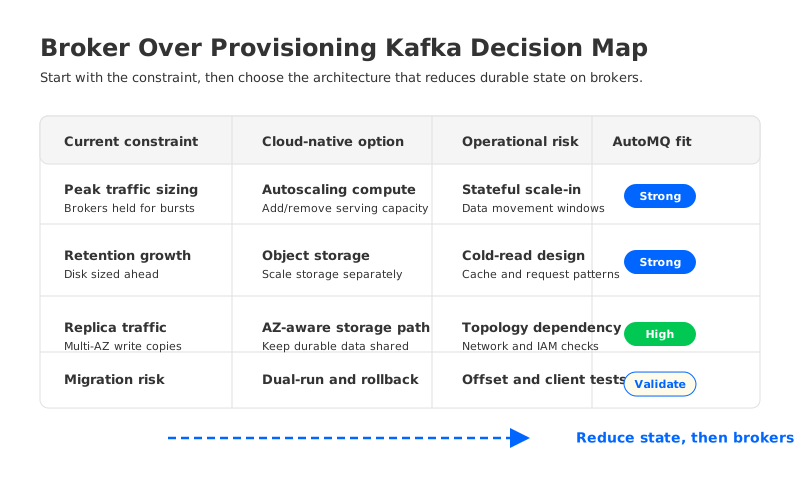
- Peak-to-average gap. The cluster is sized for bursts, replays, or backfills, while normal traffic uses a fraction of the brokers.
- Retention-driven broker count. Brokers stay alive for disk capacity or local segment distribution, not live traffic.
- Slow reassignment. The team avoids scale-in because moving Partition data can take long maintenance windows.
- Replica and cross-zone cost. Multi-AZ Kafka deployments replicate data between Brokers for availability, adding storage and network charges.
- Operational insurance. Extra brokers substitute for confidence in recovery, rollback, rebalancing, and observability.
None of these signals automatically means the cluster should shrink. Low average CPU can hide leader skew, network saturation, hot partitions, slow disks, consumer replay, or recovery capacity. The better first question is not "how many brokers can we remove?" It is "which part of the workload forced us to keep these brokers?"
2The production constraint behind the problem
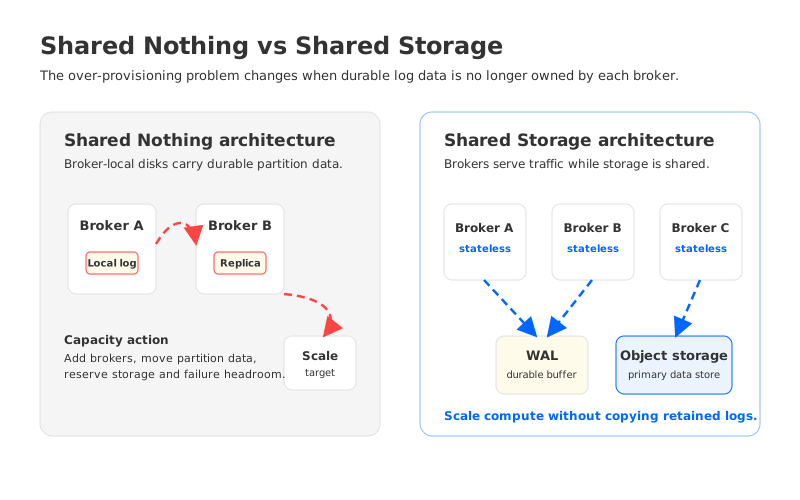
Traditional Kafka's Shared Nothing architecture was built around Broker-owned local storage. A Topic is split into Partitions, each Partition has a leader, followers replicate data, and clients use offsets to read ordered records from each Partition. This model is understandable and battle-tested. It also means the Broker is both a serving node and a durable storage owner.
That dual role creates a conservative sizing habit. If retained data grows faster than live throughput, you may add broker capacity for storage runway. If a Broker failure causes recovery traffic and leader movement, you may keep spare capacity for the failure case. If consumers replay historical data, you may size for both fresh writes and catch-up reads. Reducing brokers later means accounting for Partition reassignment, replica movement, leader balance, controller behavior, client metadata refreshes, and monitoring noise.
The same coupling affects cloud cost modeling. A three-AZ deployment can be the right availability posture, but the bill spans broker instances, attached storage, object storage if Tiered Storage is enabled, inter-AZ data transfer, private connectivity, monitoring, support, and engineering time. A narrow instance-count comparison misses the reason over-provisioning persists. The waste may sit in broker-local disk allocated ahead of retention growth, replica traffic, or the operational cost of being afraid to resize.
Tiered Storage helps one part of the problem by moving older log segments to remote storage while retaining recent data on brokers. For teams whose main pain is long retention of cold data, that can be a good fit. It is less complete when the goal is to make Brokers behave like elastic compute, because the local hot tier, leader placement, and operational movement of broker-owned state still matter. The distinction is important: reducing retained disk pressure is not the same as making the Broker fleet stateless.
3Architecture options and trade-offs
Before changing platforms, teams should classify the over-provisioning driver. The wrong classification leads to expensive migrations that solve the visible symptom while leaving the constraint intact. Stale Topics need governance cleanup. Retention and data movement may require a storage architecture change. Unpredictable demand may need better elasticity, quota management, or a different managed service model.
Use the following frame to separate options:
| Option | Best fit | What it does not automatically solve |
|---|---|---|
| Tune current Kafka | Stale Topics, bad retention defaults, leader skew, oversized instances | Structural coupling of Broker compute and durable local state |
| Add Tiered Storage | Long retention where older data is read less often | Stateful Broker operations, local hot-tier sizing, and scale-in friction |
| Use fully managed Kafka | Teams that want less operational ownership | Workload-specific billing, data-plane control, and architectural coupling may still matter |
| Move to shared storage | Retention-heavy, bursty, or cloud-cost-sensitive workloads needing Kafka compatibility | PoC work, object storage behavior, WAL design, and migration validation |
Architecture is more useful here than a vendor list. Kafka compatibility matters because most organizations are not trying to rewrite producers, consumers, Kafka Streams applications, Connect workers, ACL models, schemas, or offset-based recovery procedures. They want to keep the application contract while reducing broker-local storage growth, repeated data movement, and permanent headroom for rare events.
A serious evaluation should test several dimensions at once. Compatibility covers client versions, transactions, idempotent producers, Consumer group behavior, offset continuity, Connect integrations, and security settings. Cost covers compute, storage, requests, network paths, support, and people. Elasticity covers scale-out and scale-in under normal, failure, and replay traffic. Governance covers VPC boundaries, Identity and Access Management, encryption, audit, data residency, and control-plane access. Recovery covers Broker loss, zone impairment, object storage behavior, rollback, and observability.
4Evaluation checklist for platform teams
The safest way to reduce broker over-provisioning is to turn "we think we are oversized" into evidence. Start with a workload inventory: Topic count, Partition count, replication factor, retention, daily write volume, peak write rate, read fanout, replay frequency, consumer lag patterns, and the top 10 Topics by storage and traffic. Then map each overloaded dimension to the cluster resource it consumes. If storage dominates, compute-only autoscaling will not fix the root cause. If replay dominates, deleting brokers may increase risk even when producer traffic is modest.
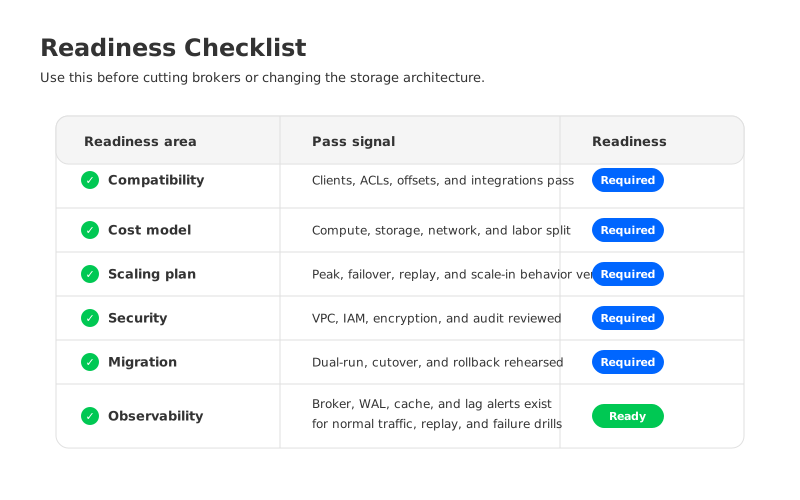
After the inventory, run a readiness review with the teams that own cost, reliability, security, and application dependencies. The review should be practical rather than ceremonial:
- Compatibility: Can existing clients, serializers, Connectors, transactions, Consumer groups, and offset management run without application rewrites?
- Cost model: Can you separate broker compute, attached storage, object storage, cross-AZ transfer, private connectivity, support, and operational labor?
- Scaling behavior: What happens during scale-out, scale-in, Broker failure, zone failure, and replay while fresh writes continue?
- Security and governance: Where do customer data, metadata, logs, metrics, credentials, and administrative actions live?
- Migration and rollback: Can you dual-run, preserve consumption progress, cut over producers safely, and return to the source cluster if a validation fails?
- Observability: Do dashboards show Broker load, consumer lag, storage path health, cache behavior, object storage latency, and recovery state?
The output should be a decision record, not a vague "optimize Kafka" project. A good record says which cost driver is being attacked, what safety checks block broker reduction, what architecture is being tested, and what evidence will end the evaluation. That discipline prevents shrinking too early or migrating too broadly.
5How AutoMQ changes the operating model
Once the evaluation points to broker-local state as the constraint, AutoMQ belongs in the architecture review as a Kafka-compatible, cloud-native streaming platform built around Shared Storage architecture. The key shift is not a cosmetic change to broker sizing. AutoMQ keeps Kafka protocol semantics while replacing Kafka's local log storage layer with S3Stream, which uses WAL (Write-Ahead Log) storage, data caching, object metadata, and S3-compatible object storage.
That changes the over-provisioning conversation in three ways. First, retained data can live in shared object storage instead of being permanently attached to Broker disks. Brokers still process Kafka requests, own Partition leadership, and serve reads and writes, but they do not carry long-term durable log ownership in the same way. Second, stateless brokers make scaling and replacement less dependent on moving retained Partition data between machines. A capacity change becomes more about traffic ownership, metadata, cache warm-up, and WAL safety than copying a large local log estate. Third, AutoMQ's zero cross-AZ traffic design can reduce the cost pattern created by traditional multi-AZ replica traffic, while still requiring teams to validate topology, storage configuration, and deployment boundaries.
The WAL layer deserves a careful reading because it is where many Shared Storage architecture designs succeed or fail. Object storage is durable and elastic, but it has different latency and request characteristics from local disks. AutoMQ uses WAL storage as the durable write buffer and recovery path, then uploads data to object storage. AutoMQ Open Source uses S3 WAL with S3-compatible storage, while AutoMQ commercial editions can support additional WAL storage options for different latency and deployment requirements. That means a proof of concept should state the WAL type, cloud provider, workload profile, and read pattern rather than treating all object-storage-backed Kafka designs as interchangeable.
AutoMQ also changes the governance boundary. In AutoMQ BYOC, the control plane and data plane run in the customer's cloud account and VPC; in AutoMQ Software, they run in the customer's private environment. That matters when reducing Kafka cost cannot come at the expense of data-plane control. Architecture teams should still verify where records are stored, where credentials live, which operators can act on the cluster, and how telemetry is handled.
This is not a reason to skip measurement. It is a reason to measure the right things. Keep Kafka clients and workload assumptions as constant as possible, then compare how quickly the platform can add or remove serving capacity, how much data movement is required, how retained data cost grows, how replay behaves, and whether observability gives SRE enough confidence to stop using permanent spare brokers as insurance.
6A practical migration path
Migration should start smaller than the cost spreadsheet suggests. Pick one workload family with enough pain and enough isolation to test safely: observability pipelines, data lake ingestion, internal analytics streams, CDC fanout, or another domain where retention, replay, or burst headroom drives capacity.
A clean path has four phases:
- Baseline the source cluster. Capture traffic, retention, lag, Broker utilization, storage growth, network cost, reassignment behavior, and incident history.
- Build an architecture-equivalent target. Match Kafka-facing behavior first: Topic configs, ACLs, clients, Connectors, Consumer groups, transaction requirements, and monitoring expectations.
- Dual-run and compare. Replicate data, verify offsets and read behavior, run replay tests, exercise Broker failure, and compare cost drivers under the same workload window.
- Cut over with rollback criteria. Define what blocks cutover, what triggers rollback, and what evidence allows the team to reduce source capacity after the target is stable.
This sequence keeps migration tied to the original question. If the goal is reducing broker over-provisioning, success is not only "the target cluster works." Success means the team can explain why fewer brokers, less local storage, less data movement, or less permanent headroom is safe under the same reliability objectives.
7FAQ
7.1Is broker over-provisioning always bad?
No. Some spare capacity is production discipline, especially for failure recovery, replay, and traffic spikes. It becomes a problem when unused capacity is permanent, poorly explained, and caused by architectural coupling rather than explicit reliability targets.
7.2Can I reduce Kafka brokers by looking at CPU utilization?
CPU is only one signal. Check network throughput, disk utilization, Partition leadership, controller load, consumer lag, replay behavior, failure headroom, and reassignment risk before reducing broker count.
7.3Does Tiered Storage eliminate broker over-provisioning?
Tiered Storage can reduce pressure from long retention by moving older data to remote storage. It does not automatically make Brokers stateless, and it does not remove every scale-in, hot-tier, or data movement concern.
7.4When should a team evaluate AutoMQ?
Evaluate AutoMQ when the team wants Kafka compatibility but the cost or operational problem is tied to broker-local storage, slow capacity changes, retained-data growth, cross-AZ traffic exposure, or strict BYOC/private deployment boundaries.
7.5What should the first proof of concept measure?
Measure compatibility, write latency, tailing reads, catch-up reads, failure recovery, scale-out, scale-in, object storage behavior, WAL health, consumer lag, and the full cost model. The PoC should prove the operating model, not only run a benchmark.
8Closing thought
The original search was about broker over provisioning kafka, but the durable answer is broader than broker count. If the cluster is oversized because the Broker carries compute, storage, replication, and recovery risk at the same time, trimming instances treats the symptom. Changing the storage and operating model may be the more durable fix. To test that path, start with the workload inventory and run an architecture-aware PoC with AutoMQ.
9References
- Apache Kafka Documentation
- Apache Kafka KRaft Documentation
- Apache Kafka Tiered Storage Documentation
- Apache Kafka Transactions Documentation
- Apache Kafka Connect Documentation
- AutoMQ Shared Storage Architecture
- AutoMQ S3Stream Shared Streaming Storage
- AutoMQ WAL Storage
- AutoMQ Compatibility with Apache Kafka
- AutoMQ Zero Cross-AZ Traffic Overview
- AWS Data Transfer Pricing
- AWS S3 Pricing


