
Table of Contents
Table of Contents
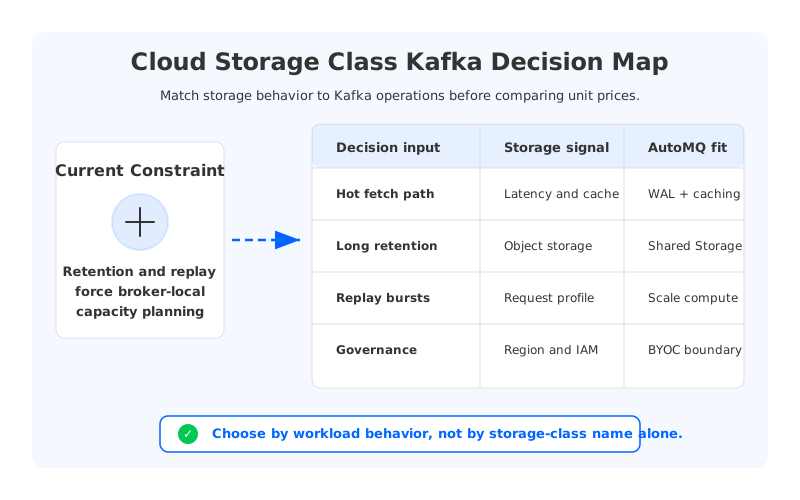
Teams usually search for cloud storage class kafka when a storage bill has stopped looking like a storage bill. The question sounds narrow: which cloud storage class should support Kafka retention, replay, or archive data? The real pressure is broader. Kafka platform owners are trying to separate hot reads from replay, retention from broker sizing, durability from replication traffic, and governance from the storage choice made during the first deployment.
That is why storage-class selection becomes uncomfortable in production. Cloud providers expose many storage options because data does not have one access pattern. Kafka turns storage into a live part of the streaming system: producers write continuously, consumers fetch at different speeds, offsets define recovery points, and replay can turn old data hot. A storage class that looks cost-efficient for static objects may fit poorly when the workload expects low-latency fetches, predictable requests, and fast recovery. The useful question is not “Which storage class is lowest cost?” It is “Which architecture lets each class of Kafka data live in the right place without forcing brokers to become the long-term storage plan?”
1Why Teams Search for cloud storage class kafka
The search often starts with a practical mismatch. Apache Kafka was designed around a commit log model where records are written to partitions, consumers track offsets, and consumer groups process the same topics independently. That model lets teams move at different speeds. It also means the infrastructure must preserve ordering and recovery while serving current traffic and historical reads.
Cloud storage classes introduce another axis. Object storage services separate access patterns into classes such as frequent access, infrequent access, archive, and automated tiering. Names differ by provider, but the trade-off is consistent: storage cost, retrieval cost, request cost, latency, durability, region placement, and operational constraints move together. For Kafka, that menu is dangerous when treated as a direct replacement for broker-local log storage.
The same topic can have several access patterns at once:
- Tailing reads serve applications that follow current records with low lag. These reads care about latency, cache behavior, and broker placement.
- Catch-up reads serve consumers that fell behind or replay a bounded window. These reads care about throughput, request efficiency, and not starving the hot path.
- Retention reads serve audit, compliance, machine learning, or incident analysis. These reads may be rare, but teams still expect availability without a restoration project.
- Migration reads serve platform changes, cluster replacement, or disaster recovery. These reads stress both correctness and operational timing because offsets, consumers, and rollback criteria matter.
Once those patterns share one Kafka cluster, storage-class selection stops being procurement work. It becomes an operating-model question. A platform team has to decide whether storage classes are lower-cost places for older bytes, or whether the architecture can use cloud storage without making Kafka recovery and scaling harder.
2The Production Constraint Behind the Problem
Traditional Kafka uses a Shared Nothing architecture: each broker owns local storage for its partitions, and durability comes from replication between leader and follower replicas. This design is proven and still appropriate for many deployments. Its cloud cost problem comes from coupling. The broker is not only a compute process for the Kafka protocol; it also owns durable local data, participates in replication, defines recovery scope, and must be resized when retention grows.
Storage classes do not remove that coupling by themselves. If a team extends retention on broker-local disks, brokers need enough block storage to hold it. If older segments move to remote storage through Tiered Storage, the local broker still owns the hot path, and the system still manages reads, metadata, cache behavior, and failure around that split. Apache Kafka’s Tiered Storage is valuable, but it is not a fully shared storage model where brokers stop being the primary durable-data boundary.
The cloud adds another accounting layer. Storage is not one billable dimension. AWS S3 separates storage classes from request, retrieval, data transfer, and management dimensions. VPC networking and cross-zone transfer have their own pricing behavior. A Kafka decision that looks like storage optimization can later appear as network cost, broker overprovisioning, slower partition reassignment, or recovery risk.
That is the root constraint: Kafka data is not passive. It is written, fetched, retained, replayed, replicated, compacted, governed, and migrated. A storage class can optimize one part of that lifecycle, but the architecture decides whether the gain helps the system or shifts cost elsewhere.
3Architecture Options and Trade-offs
The conservative option is to keep broker-local storage and make capacity planning more disciplined. This can work when retention is short, replay is rare, consumers are close to brokers, and the platform team has strong automation for quotas, partition sizing, reassignment, and storage expansion. The benefit is familiarity. The trade-off is that broker compute, durable storage, and recovery exposure remain tied together.
Tiered Storage helps teams with longer retention. It moves older log segments to remote storage while keeping the recent log local for active reads. This reduces the need to size broker disks for every retained byte, especially when historical reads are occasional. The broker-local model still exists, so hot traffic, leader placement, local disks, cache behavior, and recovery workflows still need planning.
A Kafka-compatible Shared Storage architecture changes the premise. Brokers handle protocol processing, leadership, caching, and traffic, while durable data is stored through a shared layer backed by object storage. This does not mean every read goes directly to a cold storage class, or that latency becomes irrelevant. It means storage and compute can scale and recover separately when the platform has a WAL (Write-Ahead Log), data caching, metadata management, and object compaction built for streaming.
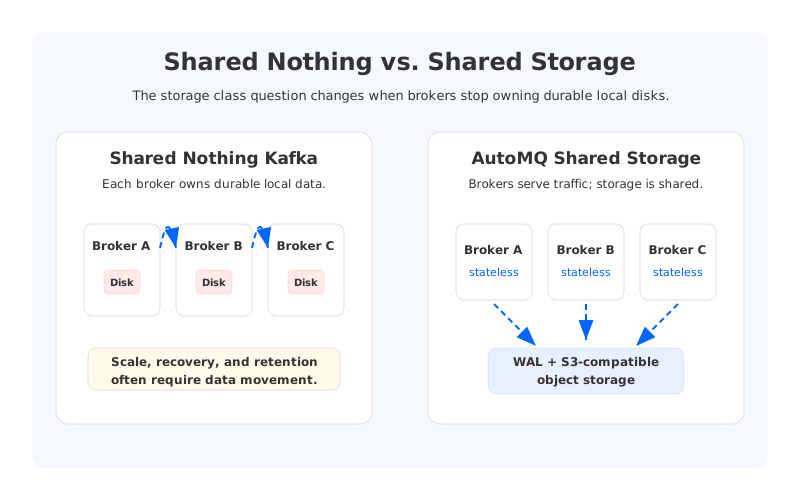
The differences are clearer when you compare failure and scaling behavior rather than storage names:
| Architecture choice | What it optimizes | What remains hard |
|---|---|---|
| Broker-local Kafka storage | Predictable hot-path behavior and operational familiarity. | Retention growth, broker replacement, partition movement, and multi-AZ replication cost can stay coupled to local disks. |
| Kafka Tiered Storage | Longer retention without keeping all historical segments on local broker disks. | Hot reads, active partition ownership, cache behavior, and recovery planning still depend on the broker-local operating model. |
| Kafka-compatible Shared Storage architecture | Independent compute/storage scaling, object-storage-backed durability, and faster broker replacement. | Requires a streaming-aware WAL, cache layer, compatibility validation, and clear deployment boundaries. |
This is where many storage-class discussions go wrong. They compare Standard, infrequent access, archive, or intelligent tiering classes as if Kafka were only writing files. Kafka is a live protocol system, so storage class selection has to follow the access pattern and architecture.
4Evaluation Checklist for Platform Teams
A useful evaluation starts with evidence, not vendor categories. Before changing storage classes, enabling Tiered Storage, or evaluating an alternative Kafka-compatible platform, build a workload inventory that explains how records move through production. The goal is to expose costs caused by storage, reads, network placement, and operational coupling.
Use these questions as the first pass:
- Compatibility: Which Kafka client versions, transactional producers, consumer group behaviors, Kafka Connect jobs, schema tools, and monitoring integrations must keep working? Lower storage cost is irrelevant if migration breaks offsets or connectors.
- Access pattern: What percentage of reads are tailing reads, catch-up reads, replay jobs, and audit exports? Archive-like storage only helps when historical reads tolerate its access behavior.
- Cost attribution: Can the team separate block storage, object storage, requests, retrieval, inter-zone transfer, endpoints, and broker compute? A blended monthly number hides the cause.
- Scaling path: Can the platform add read-serving or write-serving capacity without bulk data movement? If every resize becomes partition relocation, storage-class tuning will not fix elasticity.
- Governance boundary: Where do data, metadata, logs, encryption keys, IAM policies, and audit trails live? Storage selection has to respect region, VPC, compliance, and ownership.
- Rollback: If the storage model changes, how does the team reverse the decision? A production migration needs dual-run criteria, validation windows, and a clear point where rollback stops being safe.
This checklist keeps platform engineering, SRE, FinOps, and procurement in the same conversation. FinOps may focus on storage unit cost. SRE may focus on recovery and lag. Security may focus on data boundaries. Procurement may focus on service ownership. Kafka sits between application correctness and infrastructure economics, so the architecture has to satisfy all of them.
5How AutoMQ Changes the Operating Model
Once the neutral evaluation is in place, AutoMQ is easier to evaluate on architectural terms. AutoMQ is a Kafka-compatible, cloud-native streaming platform that keeps the Kafka API and ecosystem model while replacing broker-local log storage with a Shared Storage architecture. It uses S3Stream, WAL storage, data caching, and S3-compatible object storage so AutoMQ Brokers operate as stateless brokers rather than durable disk owners.
That shift changes storage-class selection. Instead of asking every broker to carry long-term retention, the platform can place durable data in object storage while using a WAL and cache layer for streaming behavior. Compute can scale for traffic. Storage can scale for retention. Broker replacement no longer starts from the assumption that a local disk is the recovery source of truth. Partition reassignment can focus more on traffic ownership and less on copying retained data.
AutoMQ’s documented architecture also matters for cloud governance. AutoMQ BYOC runs the control plane and data plane in the customer’s cloud account and VPC, while AutoMQ Software supports customer-operated private environments. For teams evaluating cloud storage classes, that boundary affects IAM design, network routing, audit review, object storage ownership, and security approval.
The cost implication should be stated carefully. Shared Storage architecture does not make Kafka reads free, and object storage is not a universal low-latency substitute for local disks. The advantage is architectural: it separates retention from broker-local capacity, reduces the need for cross-AZ replication traffic in the data path when designed around shared object storage, and lets teams evaluate compute and storage independently.
6A Practical Readiness Scorecard
The readiness scorecard should be simple enough for a design review and strict enough to block wishful thinking. Give each area a green, yellow, or red rating, and require evidence for every green box.
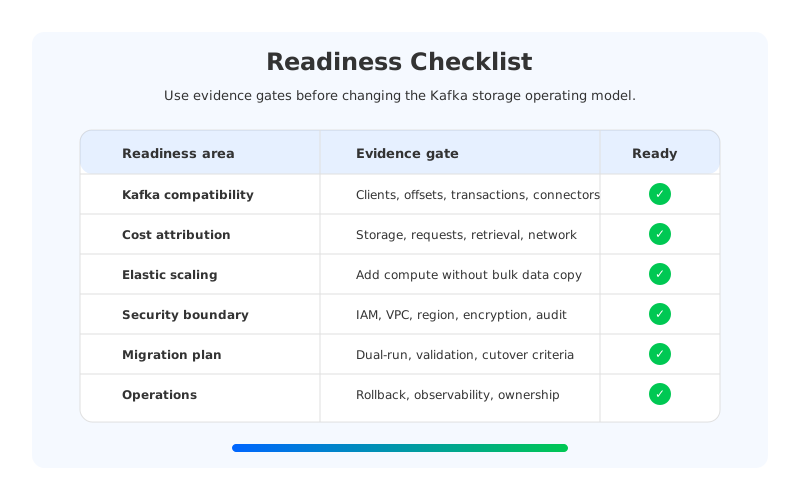
| Area | Green signal | Yellow or red signal |
|---|---|---|
| Compatibility | Existing clients, offsets, transactions, connectors, and observability pass staged tests. | The migration plan assumes application changes that have not been scheduled or tested. |
| Cost model | Storage, request, retrieval, compute, and network costs are separated. | The business case relies on a single storage price comparison. |
| Access behavior | Hot, catch-up, replay, and archive reads are measured separately. | Historical reads are described as “rare” without evidence. |
| Scaling | Compute can be added without moving retained data in bulk. | Scaling depends on long partition reassignment windows. |
| Security | IAM, encryption, VPC routing, region control, and audit ownership are reviewed. | Security review starts after the architecture has already been selected. |
| Rollback | Dual-run, cutover, validation, and reverse path are documented. | Rollback depends on manual reconstruction of offsets or topic state. |
The scorecard prevents a storage-class discussion from ignoring runtime behavior, and it prevents an architecture discussion from ignoring cost ownership. A platform team does not need every box to be green before a proof of concept, but it should know which yellow boxes are technical tasks and which red boxes are business risks.
7FAQ
7.1What does cloud storage class kafka mean in practice?
It usually means a platform team is trying to decide how cloud storage options should support Kafka retention, replay, archive, or shared storage. Start by mapping Kafka access patterns before choosing a storage class.
7.2Can Kafka use object storage directly as its main storage layer?
Apache Kafka traditionally uses broker-local storage. Tiered Storage can offload older log segments to remote storage. A fully shared object-storage-backed model requires a Kafka-compatible platform designed with a WAL, cache, metadata, and recovery model built for streaming.
7.3Does Tiered Storage eliminate the need to plan broker disks?
No. Tiered Storage can reduce pressure from long retention, but brokers still handle the hot path and retain local data for active segments. Platform teams still need to plan broker capacity, cache behavior, reassignment, and failure recovery.
7.4Which cloud storage class is best for Kafka retention?
There is no universal answer. Frequent-access storage may fit active replay, infrequent-access storage may fit rarely read retention, and archive classes may fit compliance data with tolerant retrieval windows. The correct choice depends on latency, request rate, retrieval expectations, governance, and migration needs.
7.5When should teams evaluate a Shared Storage architecture?
Evaluate it when broker-local storage has become the bottleneck for retention growth, replay, cross-AZ traffic, broker replacement, or elastic scaling. The strongest signal is a workload where storage growth and compute growth need to move independently.
If your storage-class review keeps returning to the same argument over broker disks, replay windows, and cross-AZ paths, the storage menu is not the core problem. Test the operating model. Start with the AutoMQ Cloud Console or review the AutoMQ open source project against your own readiness scorecard.


