
Table of Contents
Table of Contents
Teams searching for cross region recovery drill kafka are usually past the question of whether disaster recovery is important. They are asking whether a regional recovery exercise can move real streaming workloads without corrupting offsets, surprising consumers, overloading the standby region, or creating a governance exception. A Kafka diagram can look resilient while the drill still depends on manual DNS changes, translated offsets, stale ACLs, under-sized brokers, and application owners who are not sure whether replay is safe.
That is why a recovery drill should be treated as an architecture test, not as a calendar exercise. The purpose is not to prove that a replication job can copy bytes. The purpose is to prove that the streaming platform can carry operational state across a regional boundary in a way application teams can trust. The risk in a Kafka recovery drill often comes from state coupling, and cloud-native Kafka architecture should be evaluated by how much of that coupling it removes or makes testable.
1Why teams search for cross region recovery drill kafka
The search phrase is awkward because the situation is awkward. A platform team may already have multi-AZ Kafka, a second region, backups, dashboards, and a runbook, yet still be unable to answer what happens when producers move and consumers resume. Kafka is rarely isolated. It feeds fraud checks, observability, feature stores, data lake ingestion, billing workflows, and operational analytics. If the recovery drill is wrong, the blast radius lands in every downstream system that interpreted a record, committed an offset, or relied on a retention window.
A useful drill begins by naming the state that must survive the move. Records are only one part of that state. Consumer group offsets, topic configuration, ACLs, credentials, schemas, quotas, connector positions, transaction behavior, private network routes, and observability context all become part of the recovery surface. Apache Kafka's documentation covers the primitives that matter here: consumer groups coordinate partition assignment and committed offsets, producers may use idempotence and transactions, Kafka Connect runs source and sink workloads, and KRaft removes ZooKeeper from Kafka metadata management. None of those primitives become less important during recovery. They become more visible.
The common mistake is to test the clean switch and ignore the messy middle. Primary region healthy and primary region gone are easy states to reason about. Partial degradation is where mistakes happen. Replication lag grows, private connectivity flaps, one consumer group is already behind, a producer retries through stale bootstrap metadata, and someone suggests writing to both clusters "for a few minutes." A good drill exists to make that moment boring.
2The production constraint behind the problem
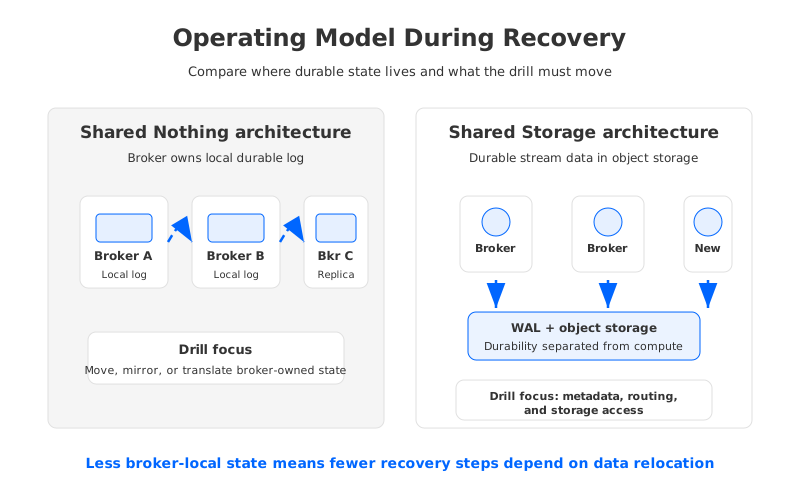
Traditional Kafka uses a Shared Nothing architecture. Brokers own local log storage, partitions have leaders and followers, and durability is achieved through replicas across brokers. The model is mature and powerful, but it binds compute, partition ownership, and durable local storage into the same operational unit. In one region, operators can manage that coupling with replication factor, rack awareness, ISR health, capacity planning, and partition reassignment. Across regions, the coupling becomes harder because the recovery target is not another broker in the same cluster. It is another cluster with its own metadata, client endpoints, security state, and capacity envelope.
This constraint changes what a cross-region drill must prove. If data is copied asynchronously, the team must know the recovery point objective in workload terms, not only in lag metrics. If offsets are translated or synchronized, the team must verify where each consumer group resumes and whether downstream sinks tolerate replay. If topic names or configurations differ, the cutover is no longer a routing step; it is a compatibility exercise. If standby brokers are intentionally under-provisioned, the drill has to expose whether they can scale before client retries create a second incident.
The cloud adds one more constraint: recovery paths have a cost profile. Cross-region transfer, inter-AZ data movement, private connectivity, standby compute, object storage requests, and observability pipelines all show up somewhere. A recovery design that cannot be afforded, monitored, and rehearsed during normal operation will decay.
3Architecture options and trade-offs
There are several defensible ways to design Kafka recovery, but each one moves risk to a different place. Backup and restore is operationally simple for low-RTO workloads, but it does not preserve live consumer progress, client routing, connector state, or downstream idempotency by itself. Asynchronous replication keeps cross-region latency out of the write path, but it forces the drill to validate lag, offset handling, failover order, and duplicate behavior. Application dual-write can reduce replication delay for selected workloads, but it pushes ordering and conflict handling into the application. Active-active designs work when data ownership is partitioned by tenant or geography, but they are fragile when the same keys can be written from more than one region.
The right comparison is not "which pattern sounds more resilient." It is "which state does this pattern require us to move, translate, reserve, or govern during the drill?"
| Architecture pattern | What it is good at | Drill risk to validate |
|---|---|---|
| Backup and restore | Compliance retention, last-resort recovery, low-frequency workloads | Restore time, client reconfiguration, missing live offsets, and stale governance state |
| Asynchronous replication | Lower write-path latency than synchronous cross-region writes | Replication lag, offset continuity, topic drift, duplicate records, and promotion order |
| Application dual-write | Workload-specific low-lag replication | Partial writes, ordering differences, idempotency, and application-owned rollback |
| Active-active | Regional locality when ownership boundaries are clean | Conflict handling, key ownership, routing rules, and split-brain prevention |
| Kafka-compatible shared storage | Reduced dependence on broker-local durable data movement | Object storage placement, metadata recovery, WAL behavior, client compatibility, and region policy |
No architecture eliminates the need for a drill. A better architecture reduces unsafe assumptions. If the riskiest step is offset translation, focus on offset continuity. If the riskiest step is moving broker-local data, question whether broker-local durable storage should remain the center of the operating model. If the riskiest step is governance drift, a faster failover mechanism will not save the drill until security state is reproducible.
4Evaluation checklist for platform teams
Before evaluating any Kafka-compatible target or recovery pattern, define the drill as observable claims. "Fail over Region A to Region B" is too broad. A stronger objective is: "Move producers for five critical topics, promote the target read/write path, resume two consumer groups from verified offsets, preserve schema compatibility, and document rollback conditions within the agreed recovery time objective." That gives SREs, application owners, and security reviewers the same criteria.
Use this checklist to keep the evaluation grounded:
- Compatibility: confirm client versions, authentication modes, topic configuration, compression, transactions, idempotent producers, Kafka Connect dependencies, and any admin APIs used by automation.
- Offset and replay behavior: verify how consumer group offsets are synchronized, translated, copied, or intentionally reset. Record whether downstream systems tolerate duplicates and whether replay creates side effects.
- Cost and capacity: measure standby compute, network transfer, private connectivity, object storage, observability, and scaling headroom under drill load instead of idle assumptions.
- Governance: reproduce ACLs, credentials, quotas, audit trails, data residency boundaries, schema rules, and approval authority before moving traffic.
- Rollback: define whether rollback is allowed after target writes begin, what evidence is required, and how split-brain writes are prevented.
- Observability: collect broker metrics, client errors, consumer lag, replication or linking lag, downstream sink health, and a human-readable incident timeline.
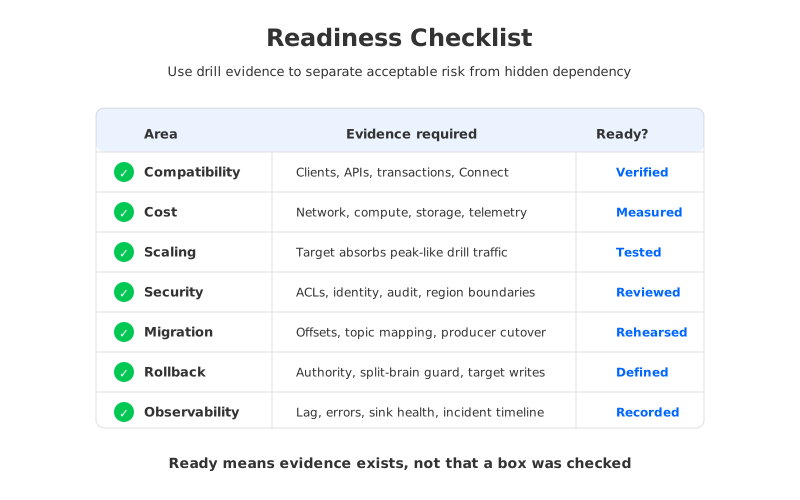
The output should be a risk register with owners, not a pass/fail badge. A drill that reveals "consumer offsets are safe, but standby capacity is under-modeled" is useful. A drill that says "all green" without workload names, regions, versions, offset ranges, and measured lag is theater.
5How AutoMQ changes the operating model
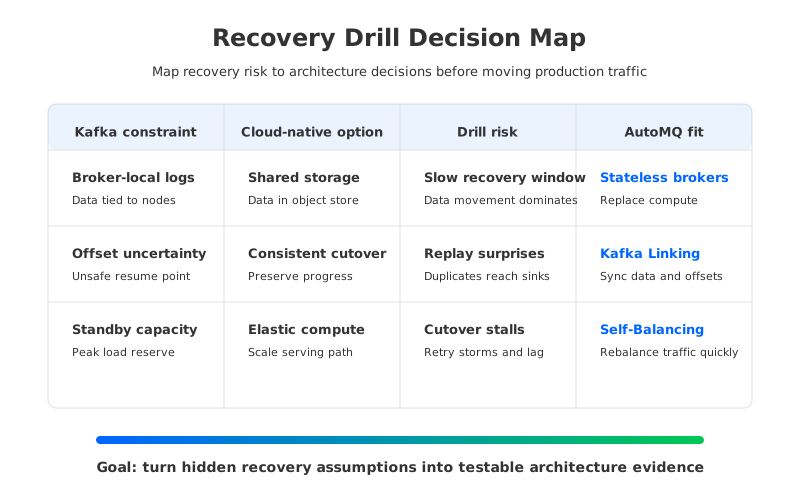
Only after that neutral framework does AutoMQ become relevant. AutoMQ is a Kafka-compatible cloud-native streaming platform that preserves the Kafka protocol surface while changing the storage model underneath. Instead of making brokers the owners of durable local log data, AutoMQ uses Shared Storage architecture: AutoMQ Brokers handle Kafka protocol traffic and scheduling, while S3Stream persists stream data through WAL (Write-Ahead Log) storage and S3-compatible object storage. The architecture is designed to make brokers stateless, so broker replacement, scaling, and reassignment are less tied to moving retained log data between machines.
That shift matters because it changes the dominant failure domain. In a traditional Kafka estate, a drill often has to reason about broker-local data, cluster-to-cluster replication, partition ownership, and enough standby capacity to make failover credible. In AutoMQ, the drill focuses more directly on shared storage access, WAL type, metadata, object storage placement, client routing, security boundaries, and application semantics. Those are still serious checks, but they are different checks.
AutoMQ also matters when the recovery exercise overlaps with migration. AutoMQ's Kafka Linking capability is designed for migration from Apache Kafka or other Kafka distributions to AutoMQ, with byte-level message synchronization and offset consistency. For a platform team, that does not remove the need to test producers, consumers, rollback, and governance. It does reduce one common source of drill anxiety: whether consumer progress will surprise stateful applications after cutover.
The deployment boundary is another part of the risk discussion. AutoMQ BYOC runs control plane and data plane components in the customer's cloud account and VPC, while AutoMQ Software runs in the customer's private environment. For teams reviewing data residency, network isolation, IAM, and audit evidence, this boundary is part of the architecture review.
AutoMQ should not be treated as a magic recovery switch. A cross-region plan still needs region-level object storage strategy, WAL selection, client routing, observability, runbook authority, and application-level idempotency. The difference is that Shared Storage architecture and stateless brokers give the team a different set of levers when broker-local storage movement, long reassignment windows, or standby capacity waste dominate the drill.
6A practical decision matrix for the next drill
The next drill should start small enough to control and real enough to be uncomfortable. Pick a workload with known owners, downstream effects, and meaningful traffic. Record source and target regions, Kafka versions, client versions, topic list, partition counts, retention settings, consumer groups, security rules, and rollback constraints. Then run the drill in stages: inventory, data synchronization, consumer resume, producer cutover, target write validation, rollback decision, and post-drill review.
When the results come back, use the matrix below to decide what the architecture is telling you.
| Drill finding | What it usually means | Architecture response |
|---|---|---|
| Records replicate, but consumers resume incorrectly | Consumer group state is not governed as first-class recovery state | Add offset reconciliation and test stateful consumers before any broad cutover |
| Target region is fresh, but cutover takes too long | Routing, approval, or client bootstrap behavior is the bottleneck | Automate routing changes and pre-approve runbook authority |
| Standby brokers cannot absorb load | Capacity planning is based on idle standby, not drill traffic | Reserve or automate capacity; evaluate elastic scaling assumptions |
| Recovery depends on large broker-local data movement | Storage ownership is shaping the recovery window | Compare Shared Storage architecture and stateless brokers against the current design |
| Duplicate records break downstream systems | Application semantics are not compatible with the recovery pattern | Add idempotency, workload-specific rules, or a stricter promotion sequence |
| Security state is missing in the target region | Governance was treated as documentation, not platform state | Automate ACL, identity, quota, and schema replication or recreation |
This is the point where many teams discover that the recovery problem is not "Kafka is hard" in the abstract. It is a specific coupling between state, routing, storage ownership, and team authority. Once the coupling is visible, the next architecture decision becomes much easier to defend.
7FAQ
7.1What should a cross region recovery drill Kafka plan validate first?
Start with workload state: topic coverage, offset continuity, consumer group behavior, producer routing, security state, and downstream idempotency. Record replication or linking lag, but do not let lag be the only success metric.
7.2Is asynchronous replication enough for Kafka disaster recovery?
It can be enough when the business accepts the measured recovery point objective and the drill proves consumer resume, routing, governance, and duplicate handling. It is not enough when the team has only verified that records are being copied.
7.3How does cloud-native Kafka architecture reduce recovery drill risk?
Cloud-native Kafka architecture can reduce risk when it separates compute from durable storage, supports elastic capacity, and keeps Kafka compatibility intact. The practical benefit is not that drills disappear. The benefit is that fewer drill steps depend on broker-local durable data movement.
7.4When should AutoMQ be evaluated for cross-region recovery drills?
Evaluate AutoMQ when broker-local storage, partition reassignment, standby capacity, migration windows, or offset continuity dominate the recovery risk. Its Shared Storage architecture, stateless brokers, and Kafka Linking capability are most relevant when the team needs a Kafka-compatible operating model with less dependence on broker-local state.
The next useful step is not another architecture diagram. Pick one workload, write down the state it needs to survive, and run the drill until the hidden dependency becomes visible. If the dependency points back to broker-local storage or migration continuity, evaluate AutoMQ with the same evidence standard you use for the drill: try a workload, measure the cutover, validate offsets, and review the governance boundary. For a hands-on evaluation, start from the AutoMQ Cloud Console.
8References
- Apache Kafka Documentation
- Apache Kafka Documentation: Geo-replication
- Apache Kafka Documentation: Consumer Configuration
- Apache Kafka Documentation: Transactions
- Apache Kafka Documentation: KRaft
- Apache Kafka Documentation: Tiered Storage
- AutoMQ Documentation: Architecture Overview
- AutoMQ Documentation: S3Stream Shared Streaming Storage
- AutoMQ Documentation: WAL Storage
- AutoMQ Documentation: Kafka Linking Overview
- AWS EC2 On-Demand Pricing: Data Transfer


