
Table of Contents
Table of Contents
Someone searching for schema migration sequencing kafka is usually looking at a production cutover where data format, Kafka cluster, consumer groups, and rollback plan all have to line up. A schema that is technically compatible can still break a migration if it reaches consumers in the wrong order, offsets no longer point to consumable records, or the target cluster cannot preserve the operational assumptions the old cluster quietly encoded.
That is the uncomfortable part of Kafka migration planning: the schema sequence is rarely isolated from the platform sequence. Producers serialize records, Brokers preserve partition order and offsets, and Consumers deserialize, commit progress, and write side effects into databases, caches, or lakehouse tables. When the platform changes underneath that path, schema migration sequencing becomes a reliability problem, not a metadata chore.
The useful question is not "which schema goes first?" It is "which irreversible step can be delayed until ordering, offsets, replay, and rollback behave the way applications expect?" That framing keeps the work grounded in production risk instead of a checklist that looks clean on paper and fails during the first consumer restart.
1Why Teams Search for schema migration sequencing kafka
Kafka teams usually reach this search query after they have agreed on a destination architecture. Application owners want minimal downtime. The platform team wants a repeatable runbook. Security wants the same governance boundary. Finance wants a cleaner cloud cost model. Schema owners want one thing above all else: no application should read a record it cannot understand.
That sounds straightforward until the sequence crosses team boundaries. A producer may ship a backward-compatible schema before the target cluster is ready. A consumer may support the next schema version while still reading from the old cluster. A replication job may copy records correctly while the schema registry, subject naming strategy, or downstream table evolution lags behind. The failure is not that Kafka cannot move bytes. The failure is treating "data copied" as "application-safe."
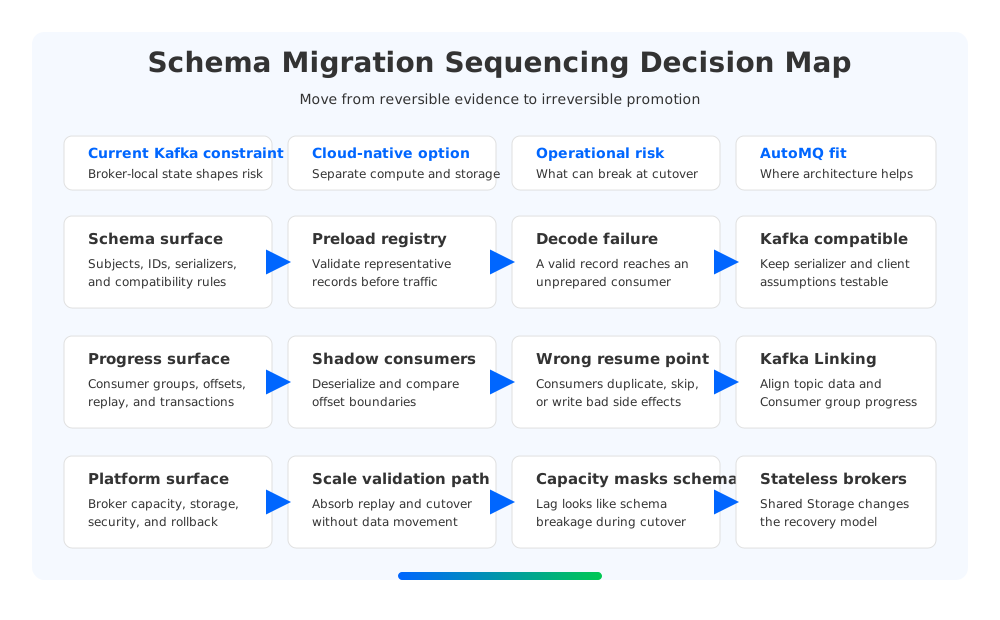
Schema migration sequencing in Kafka should start with four ordered surfaces:
- Schema surface: subject names, compatibility rules, serializer configuration, schema IDs, and the teams authorized to publish changes.
- Record surface: topic names, partition counts, ordering assumptions, headers, timestamps, keys, and retention windows.
- Progress surface: Consumer group offsets, replay boundaries, transactional markers, and idempotency state in downstream systems.
- Platform surface: broker compatibility, storage architecture, capacity, observability, security policies, and rollback entry points.
The sequence becomes safer when these surfaces are handled in that order conceptually, even if the execution overlaps. Schema compatibility is not enough without record continuity. Record continuity is not enough without offset continuity. Offset continuity is not enough if the platform cannot recover from a bad switch without forcing every consumer team to invent its own repair.
2The Production Constraint Behind the Problem
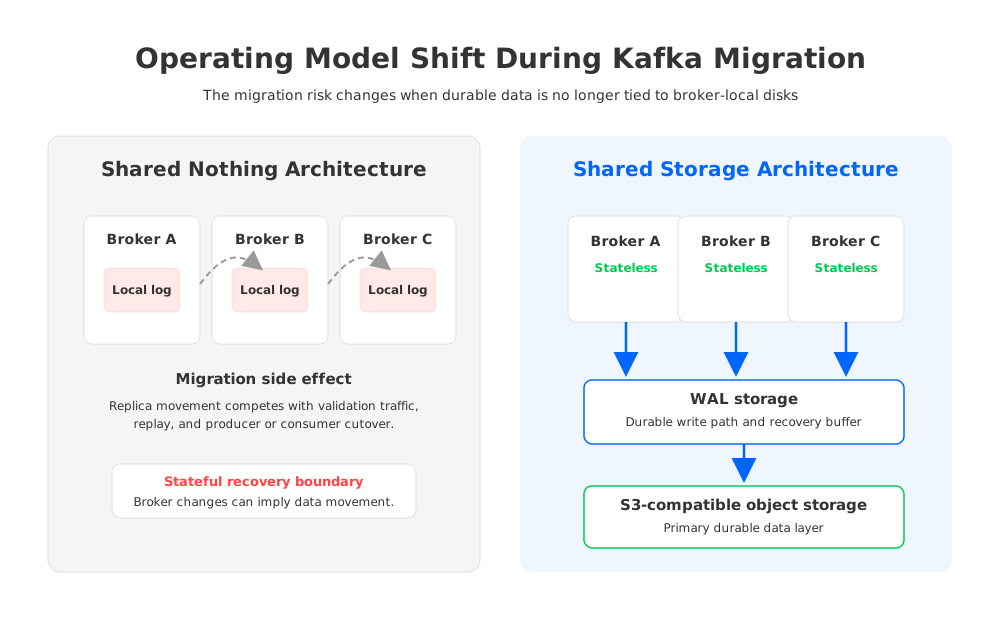
Traditional Kafka operations force schema work to share a risk budget with broker-local storage work. In the classic Shared Nothing architecture, each Broker owns local log data for its partition replicas. Reliability comes from replication across Brokers, and operational changes often involve moving data between machines. The design is well understood, but many cloud operations become data movement problems.
For a schema migration, that matters because safe sequencing often depends on delaying final cutover until enough evidence has accumulated. Teams want to run source and target paths in parallel, compare lag, validate deserialization, and prove that consumer offsets land inside the replicated range. Broker-local storage can make that evidence window expensive. Rebalancing, partition reassignment, broker replacement, and capacity changes compete with migration traffic for disk, network, and operator attention.
The risk pattern is predictable. The platform team adds capacity, the cluster starts moving replicas, and Cross-Availability Zone traffic increases because replication and client paths are not always local to the same zone. Consumers fall behind because the migration window changes the resource profile. Then the schema team is asked whether it is still safe to promote the next schema version. At that moment, schema sequencing is a capacity and recovery decision.
Tiered Storage can reduce pressure on long-retention data by offloading older segments to object storage. It does not remove the broker-local storage model for active data. Hot segments still need local storage, leaders still serve client traffic, and partition ownership changes still require care. For migration planning, Tiered Storage can change cost and retention, but it does not make Brokers stateless.
3Architecture Options and Trade-Offs
Before choosing a migration tool or target platform, map each architecture option to the failure mode it reduces and the one it introduces. A self-managed Kafka cluster gives maximum control, but the team still owns broker sizing, storage growth, partition reassignment, and schema-registry operations. A managed Kafka service reduces some burden, but deployment boundary, networking path, and migration mechanics can become harder to inspect. A Kafka-compatible cloud-native platform can change the storage and scaling model while preserving Kafka client behavior, but compatibility still needs verification.
The key trade-off is not "managed or self-managed." It is "stateful Brokers or stateless Brokers." Stateful Brokers make cluster topology part of data durability. Stateless Brokers move durable data ownership into shared storage, so compute nodes can be added, removed, or replaced with less coupling to retained log data. That matters when the target platform must absorb producer cutover traffic, consumer replay, validation jobs, and rollback monitoring in the same window.
Use this decision matrix before approving a cutover plan:
| Evaluation area | What to verify | Risk if skipped |
|---|---|---|
| Client compatibility | Producer, Consumer, Kafka Connect, transactional producer, and admin-client behavior match the source assumptions. | A passing data-copy test hides application-level incompatibility. |
| Schema governance | Subject naming, compatibility mode, schema publication rights, and registry backup paths are documented. | A valid schema version appears in a place the consumer does not check. |
| Offset continuity | Consumer group progress can be mapped to the target cluster and tested with replay. | Consumers restart from a wrong boundary or duplicate side effects. |
| Capacity elasticity | Target capacity can absorb replication, producer cutover, validation reads, and backlog drain. | The migration creates lag that looks like a schema failure. |
| Rollback boundary | Teams know which step makes source and target diverge and how offsets will be reset. | Rollback produces gaps, duplicates, or inconsistent downstream state. |
| Observability | Lag, event age, produce rate, deserialize errors, and schema-registration events are visible per topic. | The team cannot distinguish platform lag from schema breakage. |
This matrix keeps platform evaluation honest. A Kafka-compatible system still has to prove the exact paths your migration touches: offsets, transactions, Connect workers, Schema Registry behavior, security policies, and operational metrics. The right answer may differ between a logging pipeline, a payment stream, a CDC pipeline, and a lakehouse ingestion path.
4Evaluation Checklist for Platform Teams
A production runbook should sequence the migration in reversible stages. Start with a read-only inventory: schemas, subjects, topics, partitions, Consumer groups, producers, serializers, Connectors, and downstream systems. Then classify schemas by compatibility direction. Backward-compatible additions can often be introduced before cutover. Breaking changes should wait until the target path has proven record and offset continuity. Schema deletion and subject renaming belong near the end because they weaken replay safety.
The next stage is shadow validation. Create target topics, register or import required schemas, and run replication or linking before application cutover. Do not declare the stage complete because bytes are arriving. Declare it complete when the target can deserialize representative records, consumers can restart from expected offsets, and observability can explain the difference between source lag and target lag. If a record cannot be decoded, the failure should point to a schema, subject, serializer, or registry permission issue.
Producer cutover should happen before consumer cutover in most Kafka migrations because it controls the creation point for post-cutover records. The source path can keep serving consumers while producers move to the target or proxy through a migration layer. That sequence gives the team a clearer rollback path: producer configuration can move back while consumers continue to process from the source. Consumer cutover is harder because it combines deserialization, offset continuity, downstream idempotency, and freshness.
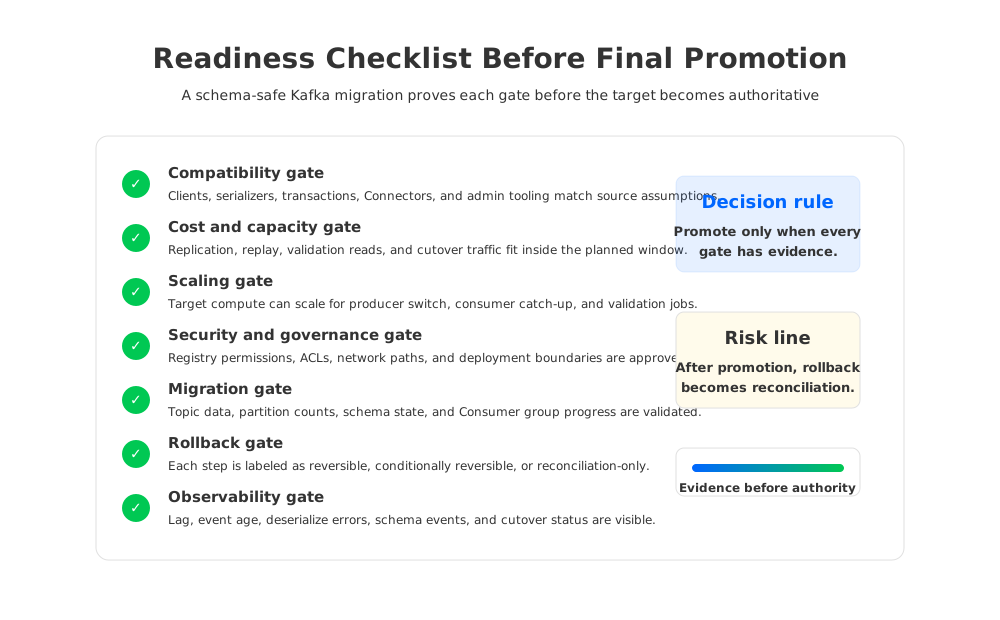
Treat final promotion as a separate decision, not the natural end of a deployment window. Promotion means the target path becomes authoritative. After that point, rollback may require offset resets, duplicate handling, and downstream reconciliation. A good checklist asks what happens to a consumer that was offline during the switch, a producer that still uses the old serializer, and a replay job that reads records written before the first schema version in the target registry.
5How Cloud-Native Kafka Changes the Operating Model
After the neutral evaluation work is done, AutoMQ becomes relevant because it changes the operating model behind the migration. AutoMQ is a Kafka-compatible streaming platform that keeps Kafka protocol and compute semantics while replacing broker-local log storage with Shared Storage architecture. Persistent data is stored through S3Stream using WAL (Write-Ahead Log) storage and S3-compatible object storage, which makes AutoMQ Brokers stateless.
For schema migration sequencing, capacity and recovery decisions become less tied to retained data movement. If the target cluster needs more compute during validation, producer cutover, or consumer catch-up, stateless Brokers can scale with less concern that each node change triggers a large data migration. If a Broker fails during the migration window, recovery focuses on ownership, metadata, WAL recovery, and shared storage access rather than reconstructing local log state from peer Brokers.
AutoMQ Kafka Linking is especially relevant when the migration needs offset consistency. It is designed to replicate topic data while keeping partition counts and offsets aligned, synchronize Consumer group progress, and provide a producer proxy path during cutover. It does not eliminate schema planning, but it lets the platform team treat schema validation, producer switching, consumer switching, and mirror-topic promotion as separate gates.
This architecture also changes rollback design. Before final promotion, producer configuration can be rolled back while consumers continue to rely on the source path. During consumer cutover, the readiness gate should verify that each Consumer group's committed offset is within the synchronized range on the target. After promotion, rollback is a data-consistency problem, so the runbook needs explicit approval and offset-reset planning. The value is that the runbook can isolate which state changed and which stayed stable.
AutoMQ BYOC and AutoMQ Software also matter for governance. In BYOC, the control plane and data plane run inside the customer's cloud account and VPC, helping platform and security teams keep Kafka workloads inside their deployment boundary. For lakehouse workflows, AutoMQ Table Topic adds a path for streaming data into Apache Iceberg tables with schema-aware table creation and evolution. That is not a replacement for migration governance, but it can reduce external moving parts after the platform lands.
6A Practical Sequencing Pattern
The safest sequencing pattern is boring by design. First, freeze the schema contract for the migration scope. Second, create target platform resources and registry state while the source remains authoritative. Third, replicate or link records and Consumer group progress, then run validation consumers that deserialize data without writing side effects. Fourth, move producers in batches and keep a rollback path open. Fifth, move consumers only after offset and replay checks pass. Sixth, promote the target path and keep the source retained long enough to support post-cutover investigation.
This pattern creates a clean separation between reversible and irreversible steps. Schema registration is reversible if old records can still be read. Producer cutover is reversible if the source can still accept writes or the migration layer can proxy correctly. Consumer cutover is reversible only when the team understands offset state on both sides. Target promotion is the line where rollback becomes reconciliation.
For platform teams, the win is a runbook that application owners can reason about. Each gate answers a concrete question: Can the target read the records? Can consumers resume at the expected offsets? Can producers be moved back? Can downstream systems tolerate duplicate processing if rollback is required? Can observability identify schema errors separately from platform lag? When those answers are explicit, schema migration sequencing stops depending on hope and starts depending on evidence.
If your migration plan has to preserve schema readability, offset continuity, and rollback control while changing the Kafka operating model, review the AutoMQ BYOC path with the team that owns your platform boundary: talk to AutoMQ.
7FAQ
7.1What is schema migration sequencing in Kafka?
It is the ordered plan for changing schemas, records, offsets, producer paths, consumer paths, and platform state during a Kafka migration. The goal is to keep records readable and rollback paths clear while the authoritative cluster changes.
7.2Should producers or consumers move first during a Kafka migration?
In most production migrations, producers move before consumers because that controls where post-cutover records are written. Consumers usually move after data synchronization, schema validation, and offset continuity checks have passed.
7.3Does Kafka Tiered Storage make schema migration sequencing easier?
Tiered Storage can help with long-retention storage economics, but it does not make active Brokers stateless. Migration teams still need to plan producer cutover, consumer offsets, schema registry state, and rollback boundaries.
7.4How does AutoMQ help with schema migration sequencing?
AutoMQ preserves Kafka compatibility while using Shared Storage architecture and stateless Brokers. AutoMQ Kafka Linking can replicate data with offset alignment, synchronize Consumer group progress, and support staged producer and consumer cutover.
7.5What should be checked before final promotion?
Check schema compatibility, representative deserialization, topic and partition mapping, Consumer group offsets, producer traffic routing, lag and event-age metrics, rollback instructions, and ownership of post-cutover incidents.
8References
- Apache Kafka documentation
- Apache Kafka consumer groups
- Apache Kafka message delivery semantics
- Apache Kafka KRaft mode
- Apache Kafka Tiered Storage
- Apache Kafka Connect
- AutoMQ architecture overview
- AutoMQ compatibility with Apache Kafka
- AutoMQ S3Stream shared streaming storage
- AutoMQ WAL storage
- AutoMQ Kafka Linking overview
- AutoMQ migration execution guide
- AutoMQ Table Topic overview


