
Table of Contents
Table of Contents
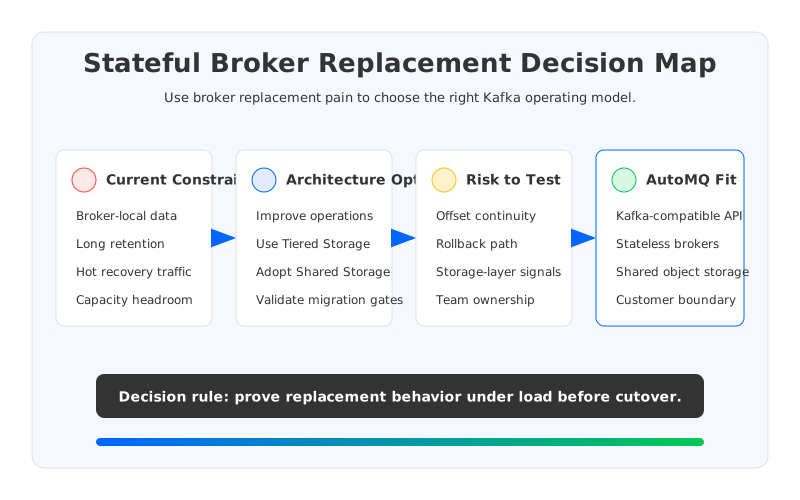
Teams search for stateful broker replacement kafka when a broker lifecycle event has become larger than the failed machine. A disk fills, a node is drained, a patch window expands, or a migration plan reveals that every replacement also touches retained data. Kafka may keep serving traffic, but the platform team still has to prove that replica placement, offsets, latency, consumer lag, and rollback paths remain under control.
Stateful broker replacement is therefore not only an operations task. It is an architecture test. If durable data is bound to broker-local storage, replacing compute often means restoring data ownership, moving partition replicas, throttling recovery traffic, and watching live workloads while the cluster heals. If the storage model changes, the same event can become a smaller coordination problem around metadata, leadership, cache warmup, and storage-layer health.
1Why Teams Search for stateful broker replacement kafka
The phrase usually appears when an organization is weighing a familiar Kafka estate against a Kafka-compatible platform with a different operating model. Staying put keeps client behavior, topic semantics, and operational knowledge stable. Moving can reduce long-running pain, but it raises practical questions: Will producers need changes? Can consumers keep offset continuity? What happens to Kafka Connect jobs, transactions, ACLs, quotas, observability, and rollback if the migration stalls halfway through?
Broker replacement concentrates those questions because it sits at the boundary between reliability and migration. In Apache Kafka, the broker participates in request handling, partition leadership, local log storage, replication, and recovery coordination. Kafka documentation covers core concepts such as consumer groups, offsets, transactions, KRaft metadata, Kafka Connect, and Tiered Storage, but the operational impact depends on deployment shape. A replacement in a small dev cluster is routine. A replacement in a multi-Availability Zone (AZ) production estate with long retention and hot consumers is a different exercise.
The useful distinction is between Kafka semantics and storage ownership. A migration can preserve Kafka protocol behavior while changing how broker state is owned, recovered, and scaled. That is where the risk review should begin.
2The Production Constraint Behind the Problem
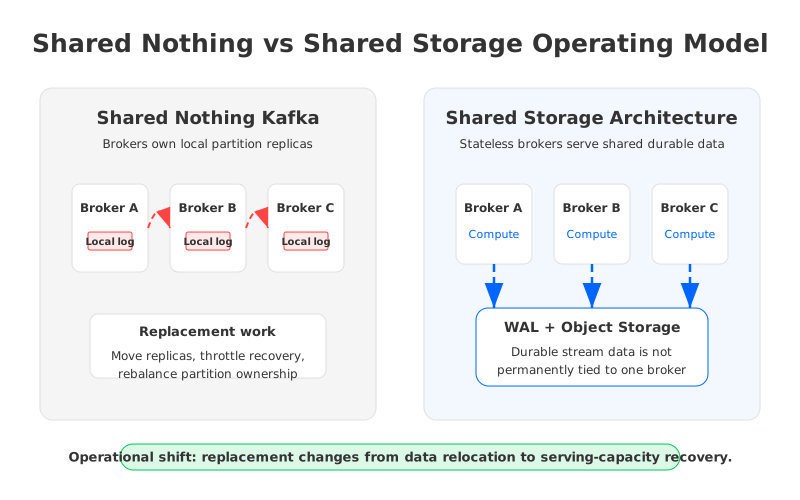
Traditional Kafka uses a Shared Nothing architecture. Each broker manages local or attached storage, and durability is achieved by keeping replicas across brokers through ISR (In-Sync Replicas). This design is proven and familiar. It also makes retained data part of the broker lifecycle. When a broker is replaced, the cluster may need to rebuild replicas, rebalance partition load, and move data until the desired placement is restored.
The issue is not that Kafka cannot survive a broker failure. A well-configured cluster can elect leaders from healthy replicas and keep serving requests. The issue is how much production work must continue while the cluster repairs itself. Recovery traffic competes with live produce and consume traffic, disk pressure changes throttling decisions, and long retention makes every reassignment heavier.
That coupling shows up in four repeatable ways:
- Capacity is sized around recovery. Normal throughput is not enough if the cluster must rebuild replicas, serve catch-up reads, and absorb a traffic spike at the same time.
- Replacement windows inherit retention policy. The more local data a broker owns, the more carefully the team must plan movement and degraded-state duration.
- Cloud placement becomes operational risk. Multi-AZ replication and reassignment can produce network traffic across failure domains.
- Governance reviews need evidence. Security teams want proof that access, data location, audit logs, and rollback behavior remain valid during replacement.
If the replacement model is unclear, the migration plan is still incomplete.
3Architecture Options and Trade-Offs
One option is to keep the existing Shared Nothing architecture and improve operational discipline. That can be right when traffic is stable, retention is moderate, and the team already has mature reassignment, rack awareness, throttling, and failure-drill practices. The trade-off is that broker-local data remains part of scaling and replacement.
Another option is Tiered Storage. Apache Kafka Tiered Storage moves older closed log segments to remote storage while brokers keep the active local log. It can reduce local storage pressure for retention-heavy workloads, but it does not automatically make brokers stateless. The active log, local recovery path, remote log metadata, and cache strategy still matter.
A third option is a Kafka-compatible Shared Storage architecture. The platform keeps Kafka protocol and ecosystem compatibility while moving durable stream data away from broker-local disks into shared object storage. Brokers still handle Kafka requests, leadership, caching, and coordination, but they are no longer permanent owners of retained partition data. The main questions shift toward WAL (Write-Ahead Log) storage, object storage availability, metadata correctness, cache behavior, and observability.
| Evaluation area | Shared Nothing Kafka | Tiered Storage Kafka | Shared Storage Kafka-compatible platform |
|---|---|---|---|
| Broker replacement | Often tied to local replica recovery and reassignment | Historical pressure is reduced, but active local state remains | More focused on metadata, leadership, WAL recovery, and cache warmup |
| Retention growth | Broker storage and recovery windows grow together | Older segments move remotely | Durable history is designed around shared object storage |
| Migration risk | Lowest architecture change, higher operational carryover | Moderate architecture change | Higher architecture change, lower broker-local data coupling |
| Best fit | Stable clusters with mature operations | Long retention with familiar Kafka operations | Elastic cloud operations, frequent replacement, and storage decoupling |
The table is about operating behavior, not feature count. A replacement architecture can pass every API checkbox and still fail the production test if it cannot explain where data lives, which component owns recovery, and how rollback works.
4Evaluation Checklist for Platform Teams
Before comparing platforms, turn the migration into tests. A stateful broker replacement assessment should prove that the target platform preserves application semantics and reduces the operational coupling the team is trying to escape.
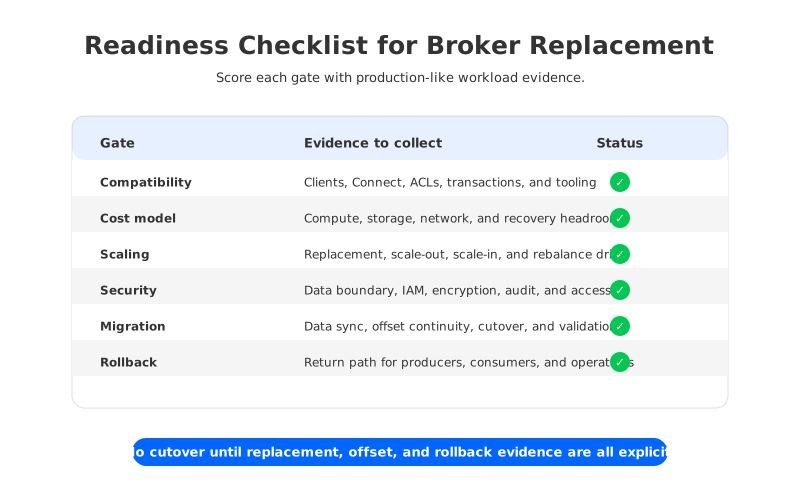
Start with compatibility because it decides whether the rest of the migration is practical. Validate producers, consumers, admin clients, Kafka Connect, stream processors, authentication, authorization, and observability tools against the target endpoint. Include consumer group behavior and offset continuity. Offset handling is often where a migration that looked clean at the protocol layer becomes risky at the application layer.
Then test replacement under load. A useful rehearsal does not stop at "kill a broker and see whether the cluster stays up." It measures produce latency, consumer lag, rebalance duration, storage pressure, controller behavior, and alert quality while replacement is happening. The goal is to understand whether the platform can keep the workload inside its service objectives while it repairs or reassigns capacity.
The readiness review should answer these questions:
- What state is attached to a broker? Separate durable log data, WAL data, cache, metadata, leadership, local configuration, and credentials.
- What must move during replacement? Identify retained data copy, metadata reassignment, cache rebuild, leader movement, or compute-only changes.
- How are offsets protected? Test committed offsets, replay, pause/resume, and rollback behavior with real applications.
- What happens when storage is slow? Test throttling, retries, backlog, cold reads, object storage errors, and WAL pressure.
- Who owns each failure mode? Map responsibilities across platform engineering, applications, security, networking, and support.
- How does rollback work? Define when producers, consumers, and operations can return to the source cluster without offset confusion.
This checklist exposes the real decision: the team is not replacing a broker. It is replacing an operating model.
5How AutoMQ Changes the Operating Model
After the neutral evaluation framework, AutoMQ fits a specific architecture category: a Kafka-compatible cloud-native streaming platform built around Shared Storage architecture. It keeps Kafka protocol compatibility while replacing Kafka's broker-local log storage layer with S3Stream. Persistent stream data is stored in S3-compatible object storage, while AutoMQ Brokers handle Kafka protocol work, leadership, caching, and request processing as stateless brokers.
The practical change is that broker replacement is less dominated by retained-data movement. A replacement broker does not need to become the permanent owner of a large local log before it can be useful. The system still has work to do: Controller metadata must be correct, WAL storage must protect acknowledged writes waiting for upload, cache must warm predictably, and object storage must remain observable. But the center of gravity shifts from "move the broker's data" to "restore serving capacity and ownership over data already in shared storage."
WAL choice matters. AutoMQ Open Source uses S3 WAL. AutoMQ commercial editions can use other WAL storage options, such as Regional EBS WAL or NFS WAL, depending on latency targets and deployment constraints. That distinction belongs in the evaluation because WAL choice changes write-path behavior, infrastructure dependencies, and failure-domain assumptions.
Migration is where architecture and semantics meet. AutoMQ supports Kafka Linking for migration scenarios in AutoMQ commercial editions, while open-source users can evaluate migration with standard Kafka ecosystem tools such as MirrorMaker2. The important contract is data synchronization where applicable, offset consistency, clear cutover gates, and rollback that operators can rehearse before the business depends on it.
AutoMQ is not the automatic answer to every Kafka replacement project. If a platform has stable traffic, short retention, rare broker lifecycle events, and a team comfortable with the existing Shared Nothing model, improving automation may be enough. AutoMQ becomes more relevant when broker replacement is a recurring symptom of a larger architecture mismatch: compute and durable storage scale together, long retention makes every operation heavier, and cloud infrastructure wants stateless capacity while Kafka brokers still behave like stateful data owners.
6A Practical Migration Scorecard
A scorecard keeps the decision honest. Give each category a rating from one to five, where one means "not proven" and five means "tested under workload conditions." Do not average the scores too early. A low rollback score can block a migration even if compatibility looks strong.
| Category | What to prove | Blocking signal |
|---|---|---|
| Client compatibility | Producers, consumers, admin tools, Kafka Connect, and stream processors work without redesign | Unsupported client behavior or unclear transaction semantics |
| Offset continuity | Consumer groups can pause, resume, replay, and roll back with predictable committed offsets | Cutover creates duplicate processing or skipped records the team cannot bound |
| Replacement behavior | Broker replacement under load stays within latency, lag, and recovery objectives | Recovery requires large retained-data movement during a hot period |
| Storage resilience | WAL, object storage, metadata, cache, and cold-read behavior are observable and tested | Storage-layer errors turn into opaque Kafka symptoms |
| Governance boundary | Data location, credentials, encryption, audit, and access are documented | Security review cannot identify who can access what during an incident |
| Operational ownership | Alerts, runbooks, escalation, and rollback are assigned across teams | The migration relies on one engineer's tribal knowledge |
The scorecard is useful when the answer is "not yet." A platform team may discover that client compatibility is ready, but rollback is weak. Or the architecture may look promising, but observability does not expose the storage-layer signals needed for production. Those are gates to fix before cutover.
7FAQ
7.1What does stateful broker replacement mean in Kafka?
It means replacing a broker that owns or participates in durable local state, such as partition log replicas, local recovery data, cache, configuration, and leadership responsibilities. In traditional Kafka, durable partition data is commonly tied to broker-local or attached storage, so replacement can involve replica rebuild, reassignment, and recovery traffic.
7.2Is KRaft enough to reduce broker replacement risk?
KRaft changes Kafka metadata management by replacing ZooKeeper with a Kafka-based quorum. It does not by itself move durable log data away from broker-local storage. If the pain is metadata migration, KRaft may be the right focus. If the pain is retained-data movement during replacement and scaling, storage architecture still needs evaluation.
7.3Does Tiered Storage make Kafka brokers stateless?
No. Tiered Storage can move older log segments to remote storage, but the active local log and broker recovery path still matter. It is different from a Shared Storage architecture where durable stream data is designed around shared object storage.
7.4How should a team test offset continuity during migration?
Use real consumer groups and production-like traffic. Pause consumers, mirror or link data, cut over a bounded topic set, resume consumption, verify committed offsets, test replay from known offsets, and rehearse rollback. Measure application behavior, not only replication progress.
7.5When should AutoMQ be evaluated?
Evaluate AutoMQ when Kafka compatibility must be preserved but broker-local storage is making replacement, scaling, long retention, cross-AZ traffic, or governance harder than the team can defend. Include client compatibility, WAL choice, object storage behavior, observability, deployment boundary, migration tooling, and rollback in the review.
If your Kafka roadmap includes frequent broker replacement, elastic capacity, or long-retention workloads, test the replacement model as an architecture requirement. AutoMQ's GitHub project is a practical place to start that evaluation.


