
Table of Contents
Table of Contents
Teams search for streaming platform chargeback kafka when the Kafka bill has become too important to hide inside a platform budget. FinOps wants usage tied to cost centers. Application owners want to know why a topic with modest write volume still carries a large allocation. Platform engineers want the model to reflect the realities of retention, replication, replay, and production safety rather than a spreadsheet split by team name.
The uncomfortable part is that Kafka chargeback is rarely an accounting problem first. It is an architecture problem that shows up in accounting language. Traditional Kafka couples compute, local durable storage, replication traffic, and operational headroom inside the broker fleet, so a workload decision made by one team can create shared cost in places that are hard to attribute cleanly.
Chargeback can still be useful, but only if it explains the system instead of disguising it. A good model tells an application team which choices they control, tells the platform team which costs are shared reliability policy, and tells leadership when the platform architecture is multiplying valid workload requirements.
1Why Teams Search for streaming platform chargeback kafka
The search usually begins after a budget review, but the pressure starts earlier. A central Kafka platform grows from one shared cluster into a fleet of production clusters, each serving product events, CDC, fraud signals, telemetry, data lake ingestion, customer notifications, and operational logs. Those workloads do not behave alike, and they should not receive the same internal bill.
The simplest chargeback model allocates by broker count, cluster count, or topic count. That can work for a small platform with a few teams and similar workloads. It breaks down when one team keeps 90 days of retained history, another runs frequent backfills, and a third creates heavy fanout through many consumer groups. The resources consumed by those teams are different, even if they share the same brokers.
A more useful model starts with the workload behaviors that actually drive streaming cost:
- Write volume and peak rate. Produce traffic determines how much data must be accepted, replicated or durably written, cached, indexed, monitored, and eventually retained.
- Retention and replay. Long-lived history creates storage pressure, while catch-up reads and backfills stress paths that ordinary tailing consumers may not touch.
- Consumer fanout. The same record can be read by many groups, and each group creates broker work, egress, lag tracking, and operational responsibility.
- Availability policy. Multi-AZ placement, replication factor, controller quorum, spare capacity, and failure drills are shared reliability decisions, not simple tenant usage.
- Change activity. Expansion, reassignment, migration, upgrades, and rollback plans consume engineering time and may move large amounts of data.
That list gives FinOps something better than a bill. It gives them a technical ledger. The ledger does not solve chargeback by itself, but it stops the team from debating invoice lines before they understand what the platform is doing.
2The Production Constraint Behind the Problem
Apache Kafka was designed around a log abstraction where partitions are stored on brokers and replicated for durability. That model is clear and powerful: producers write to partition leaders, consumers track offsets, consumer groups divide partition ownership, and the broker fleet maintains the durable log. Kafka's ecosystem depends on those semantics, so any platform decision has to preserve client behavior, offsets, transactions, Connect integrations, and operational observability.
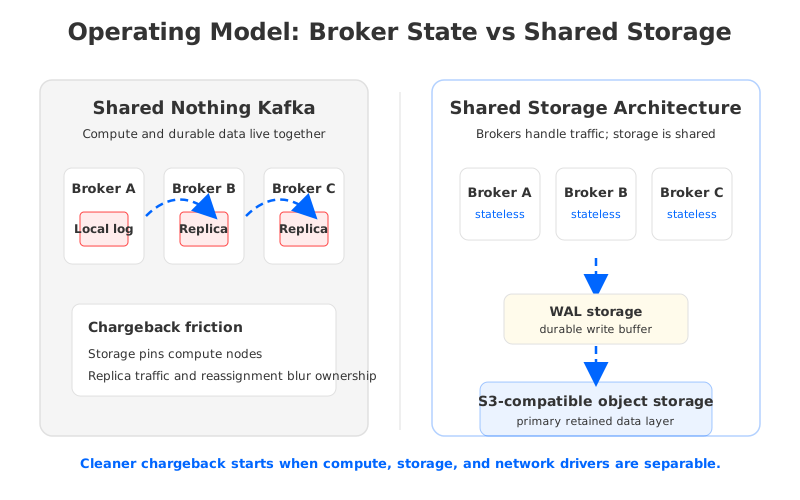
The cost tension comes from where the durable log lives. In a Shared Nothing architecture, each broker manages its own local log segments. When the platform retains more data, that data is attached to brokers. When the cluster needs availability across failure domains, data is replicated between brokers. When the platform reassigns partitions or reshapes capacity, state movement becomes part of the operational cost.
This coupling makes chargeback messy. A team may ask for longer retention, but the resulting cost may appear as larger disks, more conservative broker sizing, slower scale-in, cross-zone traffic, longer maintenance windows, and more careful recovery planning. Those line items benefit multiple tenants and protect the whole platform, so assigning them to one team can feel arbitrary.
Tiered Storage changes part of this picture by moving older log segments to remote storage while keeping Kafka semantics intact. It can reduce pressure on local disks for historical data and is worth evaluating for retention-heavy workloads. It does not automatically make brokers stateless, remove the local active tier, or eliminate the operational questions around placement, reassignment, and failure recovery. For chargeback, that distinction matters because the goal is not only lower storage spend; the goal is clearer ownership of compute, storage, network, and operational risk.
3Architecture Options and Trade-Offs
The right architecture depends on which cost driver is dominant. If the platform has abandoned topics, poor owner tagging, excessive retention defaults, or consumer jobs that replay whole topics out of habit, the first move is governance cleanup. Changing platforms before cleaning up usage usually transfers waste into a replacement bill.
Once usage is measurable, the team can compare operating models. The table below is not a vendor scorecard; it is a way to ask whether the architecture gives chargeback a clean shape.
| Architecture pattern | What chargeback can see clearly | What remains difficult |
|---|---|---|
| Broker-local Kafka | Broker fleet, attached storage, cluster-level network, and platform labor | Tenant-level attribution for shared headroom, replica traffic, reassignment work, and retained data pinned to compute |
| Kafka with remote tiers | Historical storage footprint, retention classes, and local-vs-remote read behavior | Active local tier sizing, stateful broker lifecycle, tier management, and platform-specific operational overhead |
| Fully managed Kafka service | Provider invoice, contracted service terms, and reduced infrastructure operations | Workload-level transparency, cloud-account chargeback fit, private networking cost, and data boundary review |
| Kafka-compatible shared storage | Compute, retained data, WAL requirements, cache pressure, and object storage usage as separate categories | Migration planning, workload validation, operational model change, and careful compatibility testing |
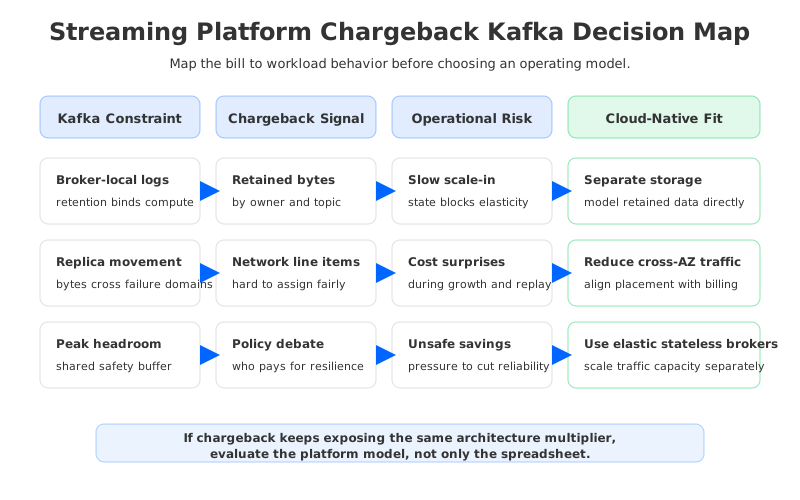
This comparison reframes the buying question. A lower platform bill is useful, but a chargeback-friendly architecture must also make the bill explainable. When compute and storage scale independently, retained bytes can be discussed as a storage policy. When brokers are less tied to durable state, traffic capacity can be discussed as a compute policy. When cross-AZ replica movement is reduced, network cost can be discussed as a placement and routing policy rather than an unavoidable side effect.
That is why the platform team should evaluate architecture with the same rigor it uses for availability. Chargeback is not only a financial control; it is a feedback loop. If the feedback loop points to a valid workload requirement that the current platform turns into disproportionate shared cost, the architecture is part of the decision.
4Evaluation Checklist for Platform Teams
A chargeback review should produce an action, not a larger spreadsheet. The action may be cleanup, right-sizing, policy change, managed service review, or architecture migration. The way to keep the conversation grounded is to use the same checklist for every option.
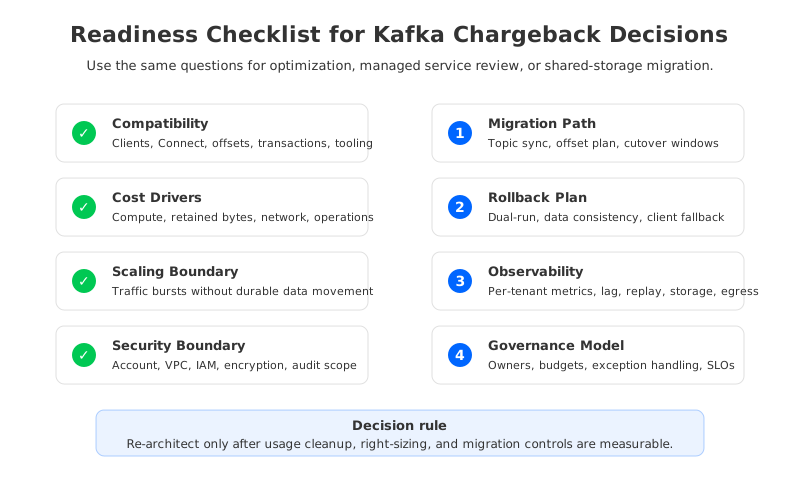
Start with compatibility. Kafka applications depend on more than produce and consume APIs. Consumer group behavior, offset commits, idempotent and transactional producers, Kafka Connect, Schema Registry integrations, stream processors, security mechanisms, client versions, monitoring, and operational tooling all need to be mapped. A platform that weakens the application contract can create migration cost that overwhelms infrastructure savings.
Then separate cost into components that different owners can influence:
- Workload-attributable cost: produced bytes, retained bytes, consumed bytes, replay volume, partition footprint, and tenant-specific support work.
- Shared reliability cost: spare capacity, controller quorum, baseline monitoring, security posture, incident readiness, and upgrade safety.
- Architecture-driven cost: broker-local state, replica movement, cross-zone traffic, slow reassignment, storage tiers, migration tooling, and rollback infrastructure.
The third category is where re-architecture becomes relevant. If the platform can reduce the first category through ownership cleanup, do that first. If the platform can reduce the second category without weakening reliability, do that next. If the third category remains the dominant source of cost pressure, the team has evidence that the operating model itself needs review.
Security and governance need the same treatment. For some organizations, a fully managed service is attractive because it removes infrastructure operations from the internal team. For others, data residency, cloud commitment usage, private networking, IAM review, auditability, or internal chargeback rules make customer-controlled deployment boundaries more important. Neither answer is universal. The point is to make the boundary explicit before the procurement process narrows the options.
5How AutoMQ Changes the Operating Model
At this point, a shared-storage Kafka-compatible architecture becomes a practical option rather than a slogan. AutoMQ is a cloud-native streaming platform that keeps Kafka protocol compatibility while replacing broker-local durable log storage with a Shared Storage architecture. Brokers handle Kafka requests, partition leadership, caching, and coordination, while S3Stream uses WAL storage and S3-compatible object storage for durable stream data.
For chargeback, the important change is not that one line item becomes smaller. The important change is that the line items become easier to reason about. Retained data is no longer primarily a reason to keep compute nodes carrying large local logs. Broker capacity can follow traffic more closely. Partition reassignment does not require the same kind of large durable data movement because the retained data is already in shared storage. Multi-AZ cost analysis can focus on routing and storage boundaries rather than treating inter-broker replica traffic as a permanent tax.
AutoMQ also changes the governance boundary. AutoMQ BYOC runs the control plane and data plane in the customer's cloud account and VPC, while AutoMQ Software runs in a customer-managed private environment. That matters for teams whose chargeback process depends on cloud-account visibility, internal tags, committed spend, private network design, or audit scope. In those environments, platform evaluation is not only about Kafka compatibility; it is also about whether the cost and control boundaries match how the organization already operates.
There are still real evaluation tasks. A team should validate client compatibility, WAL type, object storage behavior, security controls, observability, migration steps, rollback plan, and workload-specific read patterns. Shared storage is not a reason to skip engineering diligence. It is a reason to test whether the architecture removes the coupling that made chargeback painful in the first place.
6A Practical Decision Path
A reliable decision path has three stages. First, build a workload ledger from real metrics: write rate, retained bytes, consumer groups, replay traffic, partition footprint, cross-zone paths, and operational effort. Second, run cleanup and right-sizing before changing architecture. Third, compare operating models against the cleaned workload, not against a messy platform that nobody fully owns.
The decision rule is straightforward. Keep optimizing the current platform when cost comes from poor ownership, stale data, weak retention hygiene, or oversized capacity policy. Review managed services when the organization values provider operations more than cloud-account control and can accept the provider's billing and networking model. Evaluate a Kafka-compatible shared-storage architecture when valid production requirements keep turning into shared cost because brokers carry durable state and data movement.
This avoids two common mistakes. The first is treating chargeback as punishment, which makes application teams hide usage rather than improve it. The second is treating re-architecture as a shortcut around governance, which carries the same waste into another platform. Chargeback should create better technical choices, not only cleaner invoices.
If your Kafka platform has reached that stage, start with the ledger. Then ask whether each cost line is caused by workload behavior, reliability policy, or architecture coupling. That classification will tell you whether to tune, reallocate, or re-architect.
For teams evaluating a Kafka-compatible shared-storage model, the next step is to compare your current workload ledger with AutoMQ's operating model and deployment boundaries. You can explore the project on GitHub or review deployment options through AutoMQ Cloud.
7FAQ
7.1What does streaming platform chargeback mean for Kafka?
Streaming platform chargeback means assigning Kafka platform cost to teams, applications, tenants, or business units based on measured usage and agreed reliability policy. For Kafka, the model should include write volume, retained bytes, consumer fanout, replay traffic, partition footprint, shared operational headroom, and architecture-driven multipliers such as replication and data movement.
7.2Why is Kafka chargeback harder than ordinary cloud cost allocation?
Kafka cost is created by both workload behavior and platform topology. In traditional Kafka, brokers own local durable logs, so compute, storage, replication, and recovery are tightly connected. A team may control retention or replay behavior, but the resulting infrastructure cost can appear as shared broker capacity, network traffic, or operational work.
7.3Does Tiered Storage solve Kafka chargeback?
Tiered Storage can help by moving older segments to remote storage and making retention classes easier to reason about. It does not automatically make brokers stateless or remove every local-tier, reassignment, or failure-domain concern. Platform teams should compare Tiered Storage against the specific cost drivers in their workload ledger.
7.4When should a team evaluate AutoMQ?
Evaluate AutoMQ when valid Kafka workloads keep creating high shared cost because durable data is tied to broker-local storage, cross-AZ replica traffic is difficult to attribute, or stateful brokers make scaling and reassignment expensive. Validate compatibility, security, observability, migration, and rollback with your own workload before production migration.
7.5What should be measured before changing Kafka architecture?
Measure produced bytes, retained bytes, retention policy, consumer group count, consumed bytes, replay frequency, partition count, leader distribution, placement policy, cross-zone traffic paths, incident history, reassignment time, and upgrade effort. Those measurements let you compare architecture options fairly.
7.6Is chargeback always the right goal?
Not always. Some organizations prefer showback, where usage is visible but not billed back directly. The same technical model still helps because it shows which teams create which workload drivers and which costs protect the whole platform.


