
Table of Contents
Table of Contents
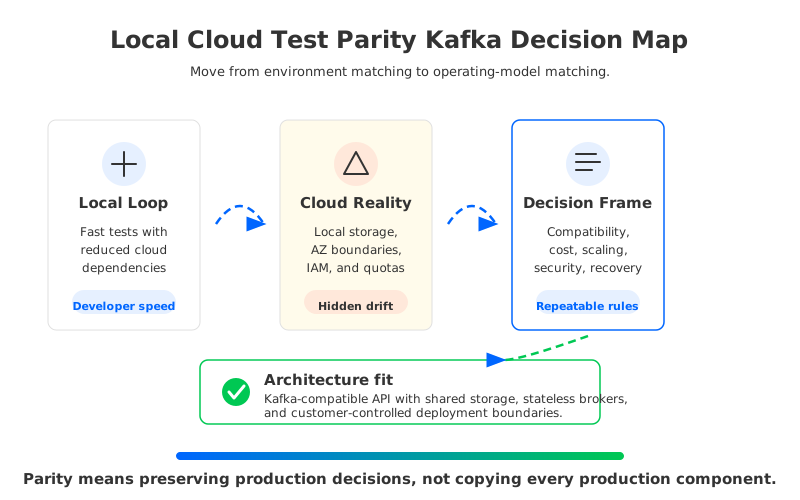
Searches for local cloud test parity kafka usually start after a painful mismatch, not during greenfield planning. A service passed every local integration test, the staging cluster looked quiet, and the production deployment still exposed a Kafka behavior the team did not rehearse: a Consumer group rebalance took longer than expected, an offset reset path behaved differently, a cloud network rule blocked a Connector, or a broker replacement turned into a storage event. The question is rarely whether developers can run Kafka locally. They can. The harder question is which production constraints deserve to be mirrored, simulated, or deliberately excluded from the local loop.
That distinction matters because Kafka parity is not a single environment target. It is a set of decisions about protocol behavior, state ownership, failure recovery, security boundaries, and cost exposure. Local tests are good at catching application bugs around serialization, topic names, transactions, idempotent Producer settings, and Consumer group behavior. They are weak at representing the way a production cluster pays for storage, moves data during scaling, handles Availability Zone boundaries, and recovers from a broker failure. Treating local parity as "make my laptop look like production" creates toil because the local environment becomes too heavy for developers while still missing the cloud behaviors that create operational risk.
The more useful goal is operating-model parity. Keep the local loop fast, but make every team agree on which Kafka behaviors must be verified locally, which must be validated in an ephemeral cloud environment, and which must be controlled by platform automation. That is where cloud-native Kafka operations change the conversation: they reduce the number of production behaviors that depend on broker-local storage and manual data movement, which makes the test plan easier to reason about.
1Why teams search for local cloud test parity kafka
A typical platform team has three constituencies pulling in different directions. Application developers want a local Kafka environment that starts quickly and behaves predictably. SREs want the test path to surface the failure modes they will be paged for. Security and governance teams want cloud identity, network segmentation, audit trails, and data residency rules to stay visible before production. Each group is right, but they are optimizing different feedback loops.
The mistake is to collapse those loops into one environment. A laptop cluster can validate that a service commits offsets correctly after a retry, but it should not be expected to reproduce cloud IAM, object storage permissions, PrivateLink routing, cross-zone behavior, and production-size retention. A shared staging cluster can validate more infrastructure, but it often becomes too expensive and too slow to use for every pull request. A full production clone gives the strongest signal, yet it is usually the least reusable option because capacity, data governance, and blast radius become blockers.
The practical answer is a tiered test strategy:
- Local tests validate Kafka semantics close to the application. This includes Producer retries, serializers, schemas, topic configuration assumptions, transactions, Consumer group offset handling, and idempotency.
- Ephemeral cloud tests validate infrastructure contracts. This includes listener configuration, TLS, ACLs, network routes, object storage access, Connector deployment, Terraform outputs, and observability wiring.
- Production readiness tests validate operating behavior. This includes broker replacement, partition reassignment, hot partition handling, backup and recovery workflows, scaling, alert routing, and rollback paths.
Once the tiers are explicit, "parity" stops meaning "identical environments." It means that every production risk has a named verification point. That is a smaller target and a better one.
2The production constraint behind the problem
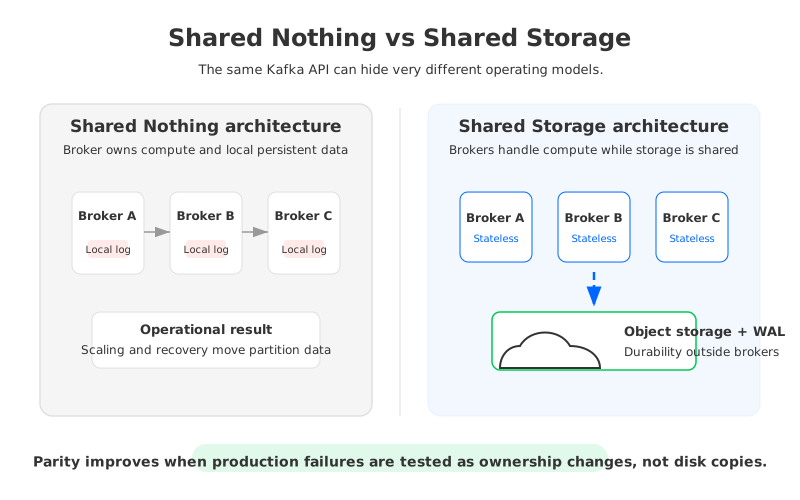
Traditional Kafka clusters run on a Shared Nothing architecture: each broker owns local persistent data, and reliability comes from replication between brokers. This model fits Kafka's original design well because each broker can append to its local log and followers can replicate data from the leader. The same model becomes more complicated in cloud operations because the broker is no longer only a compute node. It is also a storage owner, a recovery unit, a scaling constraint, and often a source of network transfer.
That storage ownership leaks into test parity. If production scaling requires partition reassignment and data movement, the test plan needs to cover reassignment behavior. If broker replacement depends on local disk recovery, the test plan needs to cover failure and catch-up behavior. If replication spans Availability Zones, the cost model and network paths need to be understood before the architecture is declared production-ready. None of these issues are visible when developers run a tiny local Kafka cluster with short retention and no meaningful failure domain.
Apache Kafka's own documentation makes the core semantics clear: topics are split into partitions, records have offsets, Consumers coordinate through Consumer groups, and transactions and idempotent Producers define application-level guarantees. Those semantics should be tested early because application teams control them. Storage topology, capacity planning, and failure recovery belong to a different layer. They should still be tested, but not by forcing every developer to carry production infrastructure on their machine.
Tiered Storage can reduce the amount of historical data kept on local disks, and it is a useful Kafka feature for many retention-heavy workloads. It does not make brokers stateless. Recent data, leadership, recovery behavior, and broker-local responsibilities still matter. For local-to-cloud parity, that means tiering can reduce one storage pressure while leaving the operating model largely intact. Teams evaluating cloud-native Kafka should separate "where old data lives" from "whether brokers own durable state."
3Architecture options and trade-offs
The evaluation should start without a vendor preference. A platform team choosing a Kafka-compatible streaming platform needs to understand what it is optimizing for: developer velocity, production fidelity, operating cost, data governance, or migration safety. These goals overlap, but they do not collapse into a single product requirement.
| Option | What it gives you | Where parity becomes hard |
|---|---|---|
| Local containers | Fast feedback for application logic and Kafka client behavior | Weak signal for cloud identity, network, scaling, and production recovery |
| Shared staging Kafka | Better infrastructure realism and team-wide reuse | Queueing, noisy neighbors, and expensive always-on capacity |
| Ephemeral cloud clusters | Stronger contract tests for infrastructure and automation | Requires disciplined provisioning, teardown, and data controls |
| Managed or cloud-native Kafka-compatible platform | Less platform toil around lifecycle operations | Requires careful validation of compatibility, migration, and governance boundaries |
The table is intentionally boring. Most failed parity programs are not caused by a missing local tool; they are caused by unclear ownership. Developers need to know which assumptions they must test before merging code. Platform teams need to know which behaviors are guaranteed by automation. SREs need to know which failure modes are covered by runbooks and alerts. Finance teams need to know which tests create persistent cloud cost.
A useful rule is to test the lowest-friction layer that can faithfully expose the risk. Serialization bugs belong in local tests. IAM and network bugs belong in ephemeral cloud tests. Broker replacement and scaling behavior belong in production-like readiness tests. The more your architecture reduces data movement during lifecycle events, the less often you need heavyweight environments to prove ordinary operations.
4Evaluation checklist for platform teams
Before choosing an operating model, write down the behaviors you expect each environment to prove. This checklist is more effective than debating whether local Kafka is "real enough" because it turns parity into a set of testable contracts.
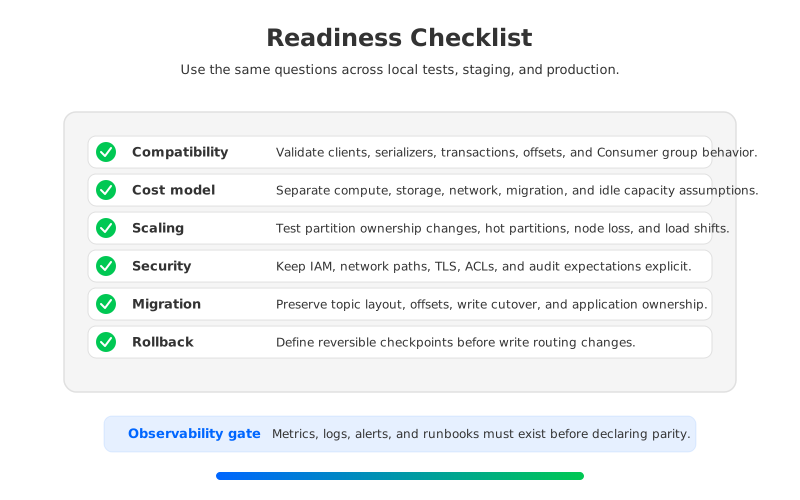
Start with compatibility. Kafka-compatible should mean more than accepting produce and fetch requests. Check the client versions you use, the authentication mechanisms you require, idempotent and transactional Producer behavior where applicable, Consumer group offset handling, Kafka Connect integrations, stream processing jobs, Schema Registry dependencies, and operational tools. If a platform requires application code changes, document that as migration scope rather than treating it as a test surprise.
Then separate the cost model. Kafka cost is not only broker instances. It includes persistent storage, retained data, cross-zone or inter-zone transfer, observability volume, migration overlap, idle staging capacity, and the people time spent keeping environments aligned. Local tests lower compute cost, but they can hide architecture decisions that create production cost. Ephemeral cloud tests cost more per run, but they can be the lower-cost option when they prevent weeks of debugging environment drift.
Security and governance deserve their own pass. A local cluster can test ACL intent, but it cannot fully represent cloud IAM, VPC routing, customer-owned buckets, audit requirements, or regional deployment boundaries. Treat those as platform contracts. The test should prove that Terraform, the console workflow, and the runtime permissions create the same boundary that production expects.
The final checklist item is rollback. Teams often test migration into a target cluster more carefully than they test the point at which writes are switched, offsets are trusted, and the old path stops being the recovery baseline. A good parity plan defines reversible checkpoints before the cutover. It also defines the metric that tells the team when rollback is safer than continuing.
5How AutoMQ changes the operating model
Once the evaluation frame is clear, the architectural requirement becomes sharper: keep Kafka protocol behavior familiar while reducing the production behaviors tied to broker-local storage. AutoMQ is a Kafka-compatible cloud-native streaming platform built around that requirement. It keeps the Kafka API and ecosystem surface familiar, while its Shared Storage architecture moves durable data to S3-compatible object storage and makes brokers stateless.
The important shift is not cosmetic. In a Shared Nothing architecture, replacing or scaling brokers often means reasoning about where partition data lives and how much data must move. In AutoMQ's Shared Storage architecture, brokers handle Kafka protocol processing, request routing, caching, and leadership work, while S3Stream persists data through WAL storage and object storage. WAL absorbs low-latency durable writes and recovery buffering; object storage becomes the shared durable layer. The result is an operating model where many lifecycle actions are closer to metadata, ownership, and traffic changes than bulk data migration.
That changes local-to-cloud parity in three concrete ways. First, application teams can keep using familiar Kafka clients and focus local tests on protocol-level behavior. Second, platform teams can validate cloud contracts through automation instead of hand-maintaining long-lived staging clusters. Third, SREs can test broker replacement, Self-Balancing, Self-healing, and observability as operational workflows rather than treating every node event as a storage migration.
AutoMQ BYOC also matters for governance. In that deployment model, the control plane and data plane run inside the customer's cloud account or VPC, and customer data stays within customer-controlled infrastructure. That boundary helps platform teams run realistic cloud tests without turning parity into a data custody exception. AutoMQ Console and Terraform support then become part of the verification surface: the question is not only whether the Kafka workload runs, but whether the environment can be created, observed, scaled, and rolled back through repeatable controls.
Migration planning is where parity often gets exposed. A target platform can pass client compatibility checks and still create risk if offsets, write routing, or Consumer progress are handled loosely. AutoMQ's Kafka Linking is designed for migrations that need byte-for-byte message synchronization, offset consistency, and controlled cutover behavior. That does not remove the need for a migration plan, but it gives teams a clearer set of artifacts to test: source access, target topics, synchronized consumption progress, write switching, promotion, and fallback criteria.
For teams building a practical readiness score, assign each category a simple status: local validated, cloud validated, production-readiness validated, or not covered. Compatibility and application semantics should reach local validated early. Security, Terraform, networking, and observability should reach cloud validated before a service depends on the platform. Scaling, broker loss, migration cutover, and rollback should reach production-readiness validated before business-critical traffic moves. This is a more honest score than a single "parity achieved" checkbox.
The point of cloud-native Kafka operations is not to make every test environment identical. It is to make the production operating model simpler enough that fewer behaviors need heavyweight rehearsal. When durable data is not trapped on broker disks, the gap between a small validation environment and a production cluster becomes easier to reason about. Teams still need discipline, but they spend less of it on data movement mechanics and more of it on the application and governance contracts that actually decide release safety.
6FAQ
6.1What does local cloud test parity Kafka mean?
It means deciding which Kafka behaviors must be consistent between local tests, cloud validation, and production. Good parity does not require identical environments. It requires explicit coverage for client semantics, infrastructure contracts, scaling behavior, security boundaries, observability, and rollback.
6.2Should every Kafka integration test run against a cloud cluster?
No. Local tests are the right place for fast feedback on serializers, topic assumptions, transactions, idempotent Producer configuration, and Consumer group logic. Cloud tests should cover infrastructure behavior that local environments cannot represent, such as IAM, VPC routing, object storage access, Terraform, Connector deployment, and production observability.
6.3Does Tiered Storage solve local-to-cloud parity?
Tiered Storage can help with retained historical data, but it does not automatically make brokers stateless. If recent data and recovery still depend on broker-local storage, scaling and failure testing remain part of the production readiness plan.
6.4Where should AutoMQ appear in a parity evaluation?
After the neutral requirements are clear. First define the compatibility, cost, scaling, security, migration, rollback, and observability questions. Then evaluate whether AutoMQ's Kafka-compatible API, Shared Storage architecture, stateless brokers, Console, Terraform support, Self-Balancing, Self-healing, and migration tooling reduce the operational gaps that matter to your team.
6.5What is the first practical step?
Create a one-page readiness scorecard with three columns: local validated, cloud validated, and production-readiness validated. Put every major Kafka assumption into one of those columns. The empty cells will show where toil and release risk are hiding.
If your team is evaluating whether a Kafka-compatible, shared-storage operating model can reduce local-to-cloud test parity toil, start with an AutoMQ BYOC environment and validate the scorecard against your own clients, network boundaries, and migration path: Explore AutoMQ.


