
Table of Contents
Table of Contents
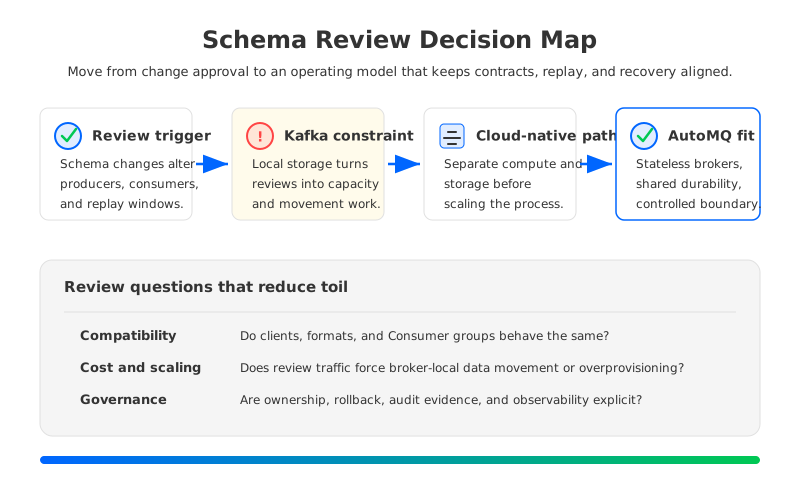
Teams search for schema evolution review kafka when a schema change has stopped being a library concern and has become a production coordination problem. A producer wants to add a field, rename an event, change a key, or adjust a connector output. The code diff may be small, but the review has to answer whether old consumers still read the stream, whether replayed records still deserialize, whether Consumer group offsets remain meaningful, whether downstream tables can absorb the change, and whether rollback is possible after new records enter the log.
That is why the review often feels heavier than the change. Kafka stores durable event history, and that history is shared across teams that do not deploy together. A compatibility rule can reject a bad schema, but it cannot decide whether the platform has enough retained data for a backfill, whether a lagging consumer will wake up on an older version, or whether a broker replacement will collide with a high-volume replay. The useful question is not "Do we have a schema registry?" It is "Can our Kafka operating model make schema evolution boring under production load?"
1Why teams search for schema evolution review kafka
Schema evolution reviews usually start with application safety, but they end up exposing platform boundaries. Application teams care about event contracts: field names, optionality, enums, keys, headers, and serialization formats. Data teams care about sinks, table schemas, compaction, and historical replay. SREs care about partitions, lag, broker health, storage growth, and incident recovery. Security and governance teams care about access, audit evidence, and data residency.
The friction appears when those concerns are reviewed in different places. A pull request may show the schema diff. A registry may show compatibility mode. A connector dashboard may show task status. A Kafka dashboard may show lag and broker storage. A cloud bill may show storage and network growth after a replay. None of those views is wrong, but the reviewer has to assemble the real risk by hand.
A production-ready schema review should make six decisions explicit:
- Contract compatibility. Which producers and consumers are expected to read each schema version, and which compatibility mode protects that expectation?
- Replay behavior. Which offsets, retained records, and historical schema versions are required if a consumer rebuilds state or a sink reprocesses data?
- Operational headroom. What happens when the change causes catch-up reads, connector retries, or downstream backfill traffic?
- Governance ownership. Who approves changes to event contracts, access policy, retention, and connector mappings?
- Failure recovery. What is the rollback path after new records are already written?
- Platform boundary. Which parts of the control plane, data plane, and storage layer are inside the team's cloud and security model?
Those decisions are not solved by one tool. They are solved by making schema review part of the streaming platform's operating model.
2The production constraint behind the problem
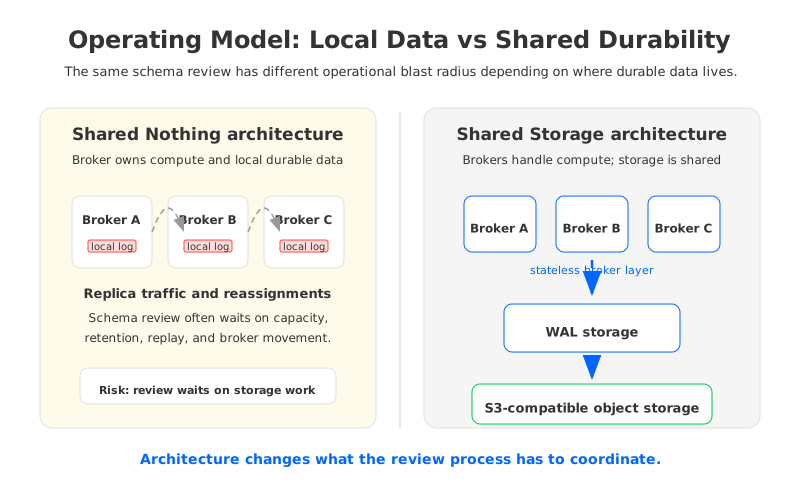
Traditional Kafka is built around a Shared Nothing architecture. Each broker owns local storage for the partitions it hosts, and Kafka uses leader/follower replication to keep partition data durable across brokers. This design is well understood and battle-tested, but it makes operational work closely tied to broker-local data placement. When partitions move, data moves. When retained data grows, broker storage grows. When a replay or backfill increases read pressure, the broker that owns the data feels it first.
Schema evolution brings these constraints into review meetings because it changes how data history is used. A harmless-looking field addition can trigger a sink connector redeploy. A corrected event contract can require a consumer to rewind. A downstream table change can need a backfill over retained records. A compatibility mistake may require quarantining invalid records and replaying from a known offset. At that point, the schema review is also a storage, scaling, and recovery review.
The cost side is equally practical. Kafka clusters running across Availability Zones (AZs) need durability and availability, so teams often replicate data across zones and read from multiple places. Cloud providers publish separate pricing for network data transfer and storage services, and the exact bill depends on region, traffic direction, and architecture. The review does not need to guess a universal cost number. It does need to ask whether the proposed change increases retained bytes, cross-zone movement, connector fan-out, or catch-up reads.
This is where review toil becomes predictable. The platform team is not resisting schema evolution; it is protecting the log that many teams depend on. If the underlying architecture couples compute, local disks, replication traffic, and partition movement, reviewers have to treat many schema changes as capacity events.
3Architecture options and trade-offs
A useful evaluation starts by separating schema governance from Kafka operations. Schema governance defines the contract: supported formats, compatibility rules, ownership, review workflow, and audit trail. Kafka operations define whether the platform can survive the consequences of that contract: long retention, lagging consumers, replay, connector retries, broker replacement, and migration. Weak governance breaks correctness. Weak operations make correct governance painful.
Most teams evaluate four architecture choices:
| Option | What it helps | What still needs review |
|---|---|---|
| Existing self-managed Kafka | Maximum control and familiar tools | Broker storage, reassignments, upgrades, replication traffic, and on-call ownership |
| Managed Kafka service | Less infrastructure management | Service boundaries, cost model, scaling limits, migration path, and operational visibility |
| Kafka with Tiered Storage | Lower pressure from historical data on local disks | Hot data, broker-local leadership, replay performance, and feature/version compatibility |
| Kafka-compatible cloud-native platform | A different storage and scaling model | API compatibility, deployment boundary, WAL choice, observability, and migration behavior |
The table is not a product ranking. It is a way to keep the review honest. Tiered Storage can be valuable when historical data is the main pressure, because Apache Kafka's KIP-405 moves older log segments to remote storage while retaining the Kafka log model. It does not make brokers stateless, and it does not remove every operational concern around hot partitions, leadership, failover, or compatibility. Managed services can reduce routine maintenance, but they may introduce boundaries around networking, support access, configuration, and price predictability. Self-managed Kafka gives control, but the team owns the full operational surface.
The harder question is whether the schema review process keeps paying for broker-local assumptions that the workload no longer needs. If the team approves more event contracts, extends retention, adds CDC feeds, or supports more backfills, the platform has to make historical data cheap to keep, safe to replay, and separate from broker lifecycle work. That requirement points toward an architecture where durable storage is shared and brokers are easier to replace.
4Evaluation checklist for platform teams
The cleanest schema review checklist is short enough to use during a design review and specific enough to catch production risk. It should not ask "Is the schema compatible?" and stop there. Compatibility is one input. The checklist should force the team to explain what happens when the change meets real traffic.
Start with compatibility. Verify the serialization format, compatibility mode, generated clients, nullability rules, default values, key behavior, and tombstone handling. If the stream uses Avro, Protobuf, or JSON Schema, confirm how schema IDs or references are resolved by producers, consumers, connectors, and stream processors. The review should also state whether old records remain readable by new consumers and whether new records remain readable by old consumers during deployment overlap.
Then move to runtime behavior. Identify the Consumer groups affected by the change and the offset policy for each one. Some consumers move forward only; others may replay during state rebuilds, data correction, or table backfills. Review the retention window against the longest expected rollback and replay path. If a connector or processor writes to a table system, include the table schema, catalog rules, and failed-record handling in the same review.
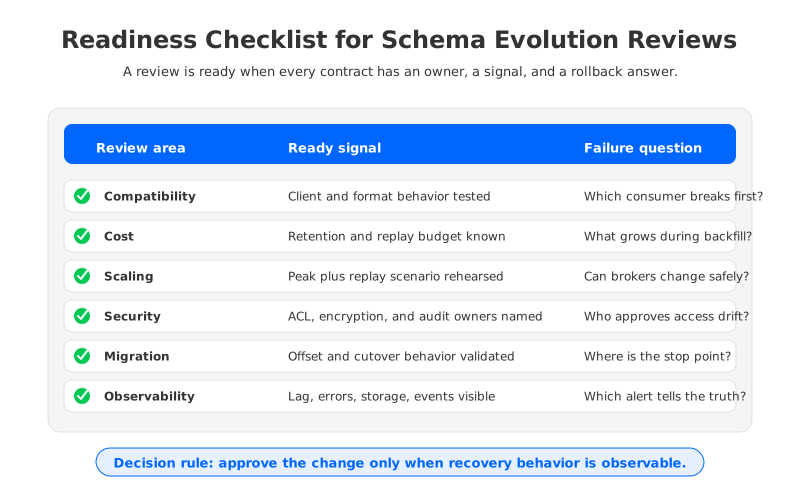
The operating checklist should include these gates:
- Compatibility gate: The schema rule is documented and tested against old and new clients.
- Replay gate: Required offsets, retained records, and historical schemas are available for the rollback window.
- Capacity gate: Peak write traffic plus expected catch-up reads and connector retries fit within the platform plan.
- Security gate: ACLs, encryption, audit ownership, and data boundary assumptions are unchanged or approved.
- Migration gate: If the platform is changing, offsets, client behavior, and cutover order are tested before production.
- Observability gate: Lag, serialization failures, connector errors, storage pressure, and broker health are visible in one incident workflow.
This checklist turns review from taste into evidence. A team can still decide to accept risk, but it becomes clear which risk is application-level and which risk is platform-level.
5How AutoMQ changes the operating model
Once the review framework separates contract safety from platform operations, AutoMQ becomes relevant as a Kafka-compatible streaming platform built around Shared Storage architecture. It keeps Kafka APIs and ecosystem expectations while replacing broker-local log storage with S3Stream, WAL (Write-Ahead Log) storage, data caching, and S3-compatible object storage. The key architectural shift is that AutoMQ Brokers are stateless brokers: durable data is not tied to the local disk of the broker that happens to serve a partition.
That shift does not approve schemas for you. It changes the amount of infrastructure work that surrounds the approval. When retained event history lives in shared object storage, broker replacement and partition reassignment are less dependent on copying broker-local data. When WAL storage absorbs writes before data is uploaded to object storage, the system can keep Kafka-compatible produce semantics while using object storage as the durable foundation. When data caching separates Tailing Read and Catch-up Read behavior, platform teams can reason about hot consumption and historical replay as different workload patterns rather than one undifferentiated broker disk problem.
For schema evolution reviews, the practical benefits show up in three places. First, replay and retention planning becomes less entangled with broker disk provisioning. Second, Self-Balancing and Self-healing reduce the routine coordination required when traffic shifts after a change. Third, AutoMQ BYOC and AutoMQ Software keep the control plane and data plane within the customer-controlled deployment boundary, which matters when schema changes touch regulated data or audit processes.
AutoMQ Console, Terraform support, monitoring integrations, Kafka Linking, and Kafka compatibility also matter because schema review is a workflow, not only a storage design. Console and monitoring make operational signals visible. Terraform helps standardize repeatable environments and resource changes. Kafka Linking can support migration planning by preserving topic data and Consumer group progress during cutover scenarios where teams need to validate compatibility and rollback before moving traffic. The architecture reduces one class of toil, while the surrounding operations surface helps teams keep review evidence in one place.
The fair evaluation is still workload-specific. Teams should test the clients, schema formats, Consumer group behavior, transactions if used, Kafka Connect paths, security rules, replay throughput, observability, and rollback procedure that their estate depends on. The difference is where the review energy goes. In a broker-local model, reviewers repeatedly ask whether the cluster can survive the data movement and storage side effects of change. In a shared-storage model, reviewers can spend more time on the contract itself: who owns it, who consumes it, how it fails, and how it recovers.
6FAQ
6.1Is schema evolution mainly a Schema Registry problem?
No. A Schema Registry is important because it stores schemas and enforces compatibility rules, but production schema evolution also depends on Consumer group behavior, offsets, retention, replay, connector recovery, table sinks, access control, and observability. Treat the registry as the contract gate, not the whole operating model.
6.2How does Kafka architecture affect schema review?
Architecture affects the consequences of a schema change. If a change requires replay, backfill, longer retention, or connector retries, the Kafka platform has to absorb that work. In a Shared Nothing architecture, that work is often tied to broker-local storage and partition placement. In Shared Storage architecture, durable data is shared, so broker lifecycle work can be separated from long-lived event history.
6.3Does Tiered Storage solve the same problem as Shared Storage architecture?
Not completely. Tiered Storage moves older log segments to remote storage, which can reduce pressure from historical data. Shared Storage architecture uses shared object storage as the primary durable storage layer and makes brokers stateless. Both can be useful, but they change different parts of the operating model.
6.4What should a migration readiness test include?
Test producer and consumer compatibility, schema formats, offset behavior, Consumer group progress, connector restart behavior, replay, security controls, monitoring, and rollback. Include at least one high-risk stream with real key distribution and message shape. A happy-path produce-and-consume test is not enough.
6.5Where should teams start?
Start with one event stream that has real downstream consumers and a known schema evolution pain point. Write down the owners, compatibility rule, replay window, rollback path, and operational signals. If the review uncovers recurring storage, scaling, or broker lifecycle work, evaluate whether a Kafka-compatible cloud-native platform can reduce that work.
If your schema review queue is spending more time on broker capacity and replay logistics than on event contracts, it is time to test a different operating model. Explore AutoMQ through the AutoMQ Cloud Console and validate one production-like schema evolution workflow end to end.


