
Table of Contents
Table of Contents
Someone usually searches for topic creation guardrails kafka after the first ad hoc topics have already escaped into production. One application asks for more partitions than it needs, another sets retention longer than budget allows, and a third creates a naming exception because the release is late. The trouble starts when every topic becomes a capacity, reliability, security, and ownership decision the platform team reviews by hand.
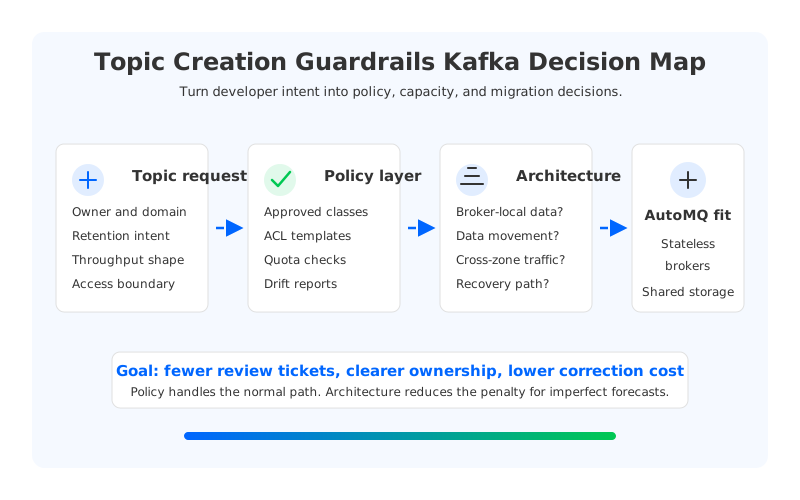
Topic creation guardrails are the operating contract between application teams and the Kafka platform. They define what a team can create without a ticket, which defaults are safe, when review is needed, and how the platform detects drift. The point is to keep developer speed from turning into hidden broker pressure, unclear ownership, and cleanup work.
Topic guardrails are not only a governance problem. They are a storage and operations problem wearing a governance label. If adding a topic changes disk placement, replica traffic, rebalancing plans, broker headroom, and failure recovery, every guardrail has to account for the cluster architecture.
1Why teams search for topic creation guardrails kafka
Kafka operators do not worry about topic creation because topics are conceptually difficult. A topic name, partition count, replication factor, cleanup policy, and retention period are straightforward fields. The operational weight comes from the fact that these fields map directly to resource consumption and recovery behavior.
The most common trigger is self-service. A platform team wants developers to create topics through a portal, Terraform module, GitOps workflow, or internal API instead of filing tickets. That is the right goal, but it exposes a design question: which decisions can be automated safely, and which still require review?
A good guardrail model usually covers five decisions:
- Naming and ownership. The topic name should encode team, environment, domain, and data classification well enough for billing, audit, and incident response.
- Partition count. The request should reflect expected throughput and consumer parallelism, not a guess copied from another service.
- Retention and cleanup. Time-based retention, size-based retention, log compaction, and delete policies should match the data contract and recovery requirement.
- Access control. Producers, consumers, and administrative roles need separate permissions, with machine identities mapped to the owning team.
- Change lifecycle. Topic creation is only the beginning. The same policy needs to cover partition increases, retention changes, ownership transfer, and deletion.
These rules sound like platform hygiene, and they are. Yet they also encode architectural assumptions. A high partition count matters because every partition has placement and metadata cost. Long retention is a budget concern because storage has a real price. Guardrails become noisy when the platform asks developers to reason about constraints the architecture itself could reduce.
2The production constraint behind the problem
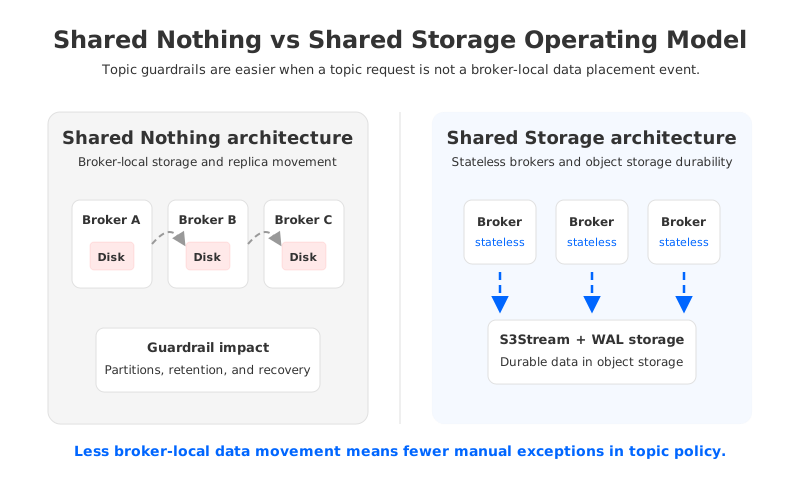
Traditional Kafka follows Shared Nothing architecture. Each broker owns local storage, each partition replica is placed on specific brokers, and leader and follower replicas keep data available. This gives operators a clear model: data is on brokers, brokers replicate data, and partition placement determines capacity.
That clarity creates toil in cloud operations. When a developer requests more partitions or longer retention, the platform team has to think about broker-local disk, replica placement, network paths between Availability Zones, and data that may move during reassignment. A guardrail such as "maximum 48 partitions by default" is a proxy for metadata load, background replication, recovery time, and correction cost.
Apache Kafka documents these concerns across several operational surfaces: topic-level configuration, quotas for shared clusters, KRaft metadata management, and consumer group behavior. Those are the right primitives for controlling a Kafka platform, but they do not erase the storage model. They give operators the knobs. They do not make every knob harmless.
The most expensive guardrail failures usually come from defaults that looked reasonable at request time. A topic starts with generous retention because the owner is unsure how far back consumers need replay. Another team requests extra partitions because it expects growth but has no current throughput data.
Once those choices are live, cleanup is slower than creation. Reducing partitions is not a normal Kafka operation. Moving partition replicas can compete with production traffic. Shrinking retention may conflict with downstream replay commitments. Even when the fix is technically clear, the platform team has to coordinate with application owners, SREs, security reviewers, and sometimes finance. That is why topic guardrails drift from a simple checklist into a standing operating burden.
3Architecture options and trade-offs
There are three broad ways to reduce topic creation toil. The first is stricter process: require approvals, limit topic templates, and reject requests outside a narrow default. The second is better automation: encode policies in Terraform, CI checks, admission controllers, or a self-service portal. The third is architectural: change the relationship between topics and broker-local storage so a topic request carries less operational blast radius.
Process is useful when risk is high and request volume is low. It fails when every application team needs Kafka as part of its normal delivery flow. Automation scales better, especially when the platform can evaluate a topic request against naming rules, allowed retention classes, partition budgets, and ownership metadata. But automation only enforces the policy you can express. It still inherits the cost model and recovery model of the underlying cluster.
The evaluation should start from neutral criteria, not from a product checklist:
| Evaluation area | Question to ask | Why it matters for topic guardrails |
|---|---|---|
| Compatibility | Do existing Kafka clients, tools, and admin workflows keep working? | Guardrails should not require application rewrites. |
| Storage model | Does topic growth bind data to broker-local disks? | Broker-local data makes bad defaults harder to correct. |
| Elasticity | Can the platform add capacity without large data movement? | Self-service topic creation needs room for imperfect forecasts. |
| Governance | Can ownership, ACLs, quotas, and retention classes be enforced as code? | Manual review does not scale with application count. |
| Recovery | What happens when a broker, zone, or disk fails? | Topic policies should not hide recovery risks. |
| Migration | Can existing topics and consumer progress move with low disruption? | Guardrails are easier to reset during platform migration. |
| Observability | Can teams see topic-level pressure and policy drift? | A policy without feedback becomes another document. |
The table separates two kinds of work. Governance defines who may create what. Architecture determines how painful it is when the forecast is wrong. Teams often invest heavily in governance and treat architecture as fixed, which is why self-service can produce more tickets instead of fewer.
4Evaluation checklist for platform teams
A practical topic creation model should give application teams enough freedom to ship while keeping the platform team out of routine approvals. Reduce the number of free-form decisions in the request. Instead of asking developers to choose every Kafka setting, offer a small set of policy-backed classes.
Start with a request schema that captures intent before configuration. A developer can usually answer "How long must consumers be able to replay?" more reliably than "What should retention.ms be?" The platform layer can translate intent into Kafka configuration and reject requests without an owner, data classification, or deletion plan.
Use this checklist as a working model:
- Define topic classes. For example: short-lived operational streams, compacted state streams, audit streams, and high-throughput event streams. Each class maps to allowed retention, cleanup, and review rules.
- Make ownership mandatory. Every topic should have a team, service, environment, escalation path, and cost center before creation.
- Set partition budgets by workload shape. Allow higher partition counts when the request includes throughput, consumer parallelism, and growth assumptions.
- Enforce ACLs with machine identities. Producer and consumer permissions should be explicit, reviewable, and revocable without changing application code.
- Record the rollback path. A topic request should state how the team will handle bad schema, accidental writes, excessive retention, or deletion.
- Measure drift. The platform should surface topics that exceed retention intent, have no active owner, show unusual lag, or sit idle for long periods.
This is where teams discover that a useful guardrail is not a stricter approval queue. It is a smaller gap between developer intent and the platform's operating model. When the request captures intent, automation handles the normal case and reserves review for real exceptions.
5How AutoMQ changes the operating model
Once the evaluation framework is clear, the architectural question becomes sharper: can a Kafka-compatible platform make topic creation less tied to broker-local storage decisions? AutoMQ is a Kafka-compatible, cloud-native streaming platform built around Shared Storage architecture. It keeps Kafka protocol semantics while moving durable storage into S3-compatible object storage and making brokers stateless.
That changes the daily work behind topic guardrails. In Shared Nothing architecture, a topic request is also a placement request. In AutoMQ, brokers handle compute, request routing, caching, and leadership, while persistent data lives in shared object storage through S3Stream and WAL storage. Partition reassignment is no longer equivalent to copying large amounts of broker-local data.
This does not remove the need for governance. You still need naming rules, ownership, ACLs, quotas, retention classes, and schema discipline. It does reduce how much infrastructure fear gets packed into each policy.
AutoMQ Console, Terraform-based management, observability, Self-Balancing, and Self-healing fit naturally into that model. Console gives teams an operational surface for lifecycle and monitoring. Terraform lets platform engineers encode topic and environment policy in versioned workflows. Self-Balancing and Self-healing reduce manual intervention as capacity and node health change.
For teams moving from an existing Kafka estate, migration deserves its own guardrail plan. Topic policies are often easiest to fix during migration because application teams are already reviewing ownership, access, retention, and consumer behavior. AutoMQ commercial editions provide Kafka Linking for migration scenarios that require byte-for-byte topic synchronization and consumer progress preservation. Teams that do not need that path can still use standard Kafka ecosystem tools, but the migration plan should explicitly cover write cutover, consumer offsets, ACL parity, and rollback.
The practical outcome is not "let every team create anything." The better outcome is a policy model where more requests can be approved automatically because the platform is less fragile when demand changes.
6A readiness scorecard
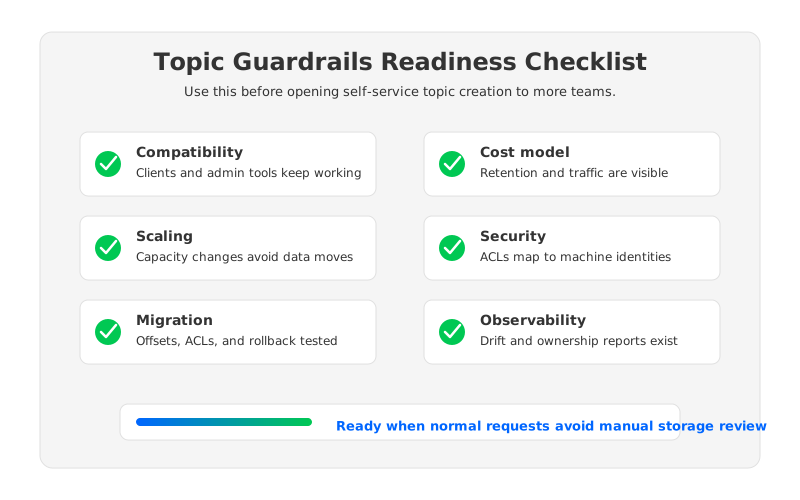
Before changing the platform or the workflow, score the current process with a few uncomfortable questions. Can a developer create a normal production topic without a ticket? Can the platform explain why a request was denied in terms of workload intent, not tribal knowledge? Can you identify topics with no owner in one report? Can you change capacity without planning a large data movement window? Can you recover from a bad topic default without turning it into a cross-team project?
If the answer is mostly no, the next step is not to write a longer policy document. Build a small operating contract:
| Readiness check | Low-friction target |
|---|---|
| Topic request | Intent-based form or code review with approved classes |
| Defaults | Retention, cleanup, and partition classes owned by the platform team |
| Ownership | Mandatory team, service, environment, and escalation metadata |
| Access | Producer and consumer ACLs tied to machine identities |
| Capacity | Elastic headroom and topic-level metrics reviewed continuously |
| Migration | Cutover, offsets, ACLs, and rollback tested before production move |
| Drift | Automated reports for idle, ownerless, oversized, or policy-breaking topics |
The scorecard is intentionally plain. Topic creation becomes painful when the platform asks developers to make infrastructure decisions indirectly. A good guardrail system translates application intent into safe defaults, keeps exceptions visible, and makes the cost of a topic understandable before it becomes production cleanup.
7FAQ
7.1What are topic creation guardrails in Kafka?
They are policies and automation that control how teams create and change Kafka topics. Common guardrails include naming rules, ownership metadata, allowed partition ranges, retention classes, cleanup policies, ACL requirements, quota checks, and deletion workflows.
7.2Should developers be allowed to create Kafka topics directly?
Usually yes, but through a controlled workflow. Direct broker-admin access makes auditing and drift detection harder. A self-service portal, Terraform workflow, or GitOps process can preserve developer speed while enforcing the same rules every time.
7.3How many partitions should a new topic have?
There is no universal default. The right number depends on expected throughput, consumer parallelism, ordering requirements, key distribution, and operational limits. A guardrail should ask for workload intent and map it to approved partition classes rather than asking every team to guess.
7.4Does Shared Storage architecture remove the need for topic governance?
No. It reduces the operational impact of some bad forecasts, especially around broker-local data placement and reassignment, but governance still matters. Teams still need ownership, access control, retention discipline, observability, and lifecycle management.
7.5Where should a team start?
Start with the normal case, not the exception path. Define two or three topic classes, make ownership mandatory, enforce ACLs through automation, and report drift weekly. Once the normal path works, add review rules for high-throughput, regulated, or long-retention topics.
8References
- Apache Kafka documentation: Topic-level configurations
- Apache Kafka documentation: Multi-tenancy
- Apache Kafka documentation: KRaft
- AWS EC2 On-Demand pricing: Data Transfer
- AutoMQ documentation: Architecture overview
- AutoMQ documentation: Compatibility with Apache Kafka
Topic creation guardrails should make the common path boring: clear intent, safe defaults, fast approval, and visible drift. If your Kafka operating model still turns every topic request into a storage review, evaluate whether a cloud-native Kafka-compatible architecture belongs in the next platform cycle. To discuss an AutoMQ BYOC or Software deployment path, use the AutoMQ Console entry point.


