
Table of Contents
Table of Contents
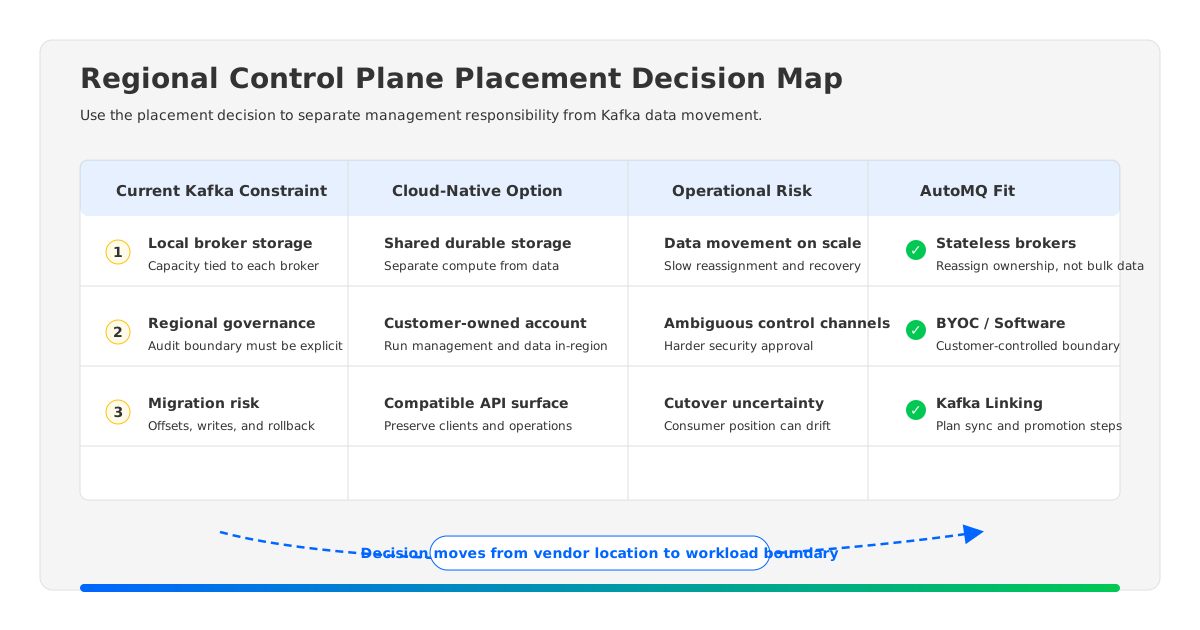
When teams search for regional control plane placement kafka, they are usually past the abstract question of whether Kafka should be managed, self-operated, or replaced. The harder question is where the management system should live, which environment owns the Kafka data path, and how much authority a vendor or platform team needs inside a production region. That question reaches platform engineering, security, procurement, and architecture at the same time because it defines the boundary for audit, incident response, network exposure, cloud cost, and migration risk.
Kafka does not make this boundary clean by default. A Kafka cluster is a data service, a storage system, a metadata system, and an operational surface. If brokers, controllers, monitoring agents, provisioning workflows, and management APIs span regions or accounts in a way nobody can explain, the buying process slows down. The useful question is concrete: which parts manage the platform, which parts carry business records, and which parts must stay inside the customer-controlled environment?
1Why teams search for regional control plane placement kafka
The search usually starts after a production constraint appears. A security reviewer asks whether customer data leaves a regulated region. A platform owner wants managed operations but cannot grant broad access to production networking. A procurement team compares a hosted service with a Bring Your Own Cloud model and discovers that "control plane" and "data plane" mean different things across vendors, cloud providers, and company teams.
For Kafka buyers, the control plane is the management layer: provisioning, upgrades, configuration, observability, identity integration, lifecycle automation, and sometimes connectors or schema services. The data plane is the workload layer: brokers, client connections, records, partitions, offsets, and storage. Apache Kafka also has a Controller role in KRaft mode, but that is cluster metadata coordination, not the product management layer a buyer evaluates during security review.
That distinction matters because regional placement is a trust boundary. A platform can be acceptable in one of several patterns:
- The control plane and data plane both run in a customer cloud account and selected region. This is common for BYOC models when security teams want operational automation without moving workload infrastructure into a vendor account.
- The control plane runs outside the customer account while the data plane runs inside it. This can work if the control channel is narrow, auditable, and clearly separated from business records.
- Both planes run in a provider account. This may reduce operational burden, but it can introduce procurement, data residency, network, and incident-response questions.
- Both planes run in a private data center. This is relevant when cloud regions are not the right boundary for policy, latency, or sovereignty reasons.
None is automatically correct. The weak answer is the one where the deployment diagram cannot explain who owns credentials, where records are stored, how management commands reach the cluster, and what happens when a region or network path fails.
2The Production Constraint Behind the Problem
Regional control plane placement becomes painful because Kafka's operating model grew around broker-local storage. In traditional Kafka, each broker stores partition data on local disks or attached block volumes. Replication across brokers protects availability, and reassignment moves partitions when capacity or leadership changes. That model is durable and well understood, but it couples compute, storage, and placement in a way that clouds make visible.
The coupling creates several production constraints. Broker capacity planning becomes storage planning: if a topic needs more retention, the buyer may need larger disks or more brokers even when compute is not the bottleneck. Scaling and recovery involve data movement, not only metadata changes. Cross-zone replication and client routing can become cost lines that are hard to forecast because network pricing varies by region, service, and path.
A regional placement discussion often becomes a storage architecture discussion. If the platform keeps Kafka's Shared Nothing architecture, the buyer must evaluate where broker-local copies are placed, how many zones carry replication traffic, and what happens during failover. If the platform moves toward Shared Storage architecture, the buyer must evaluate the object storage boundary, write path, cache design, and durability model. The control plane decision sits on top of these questions.
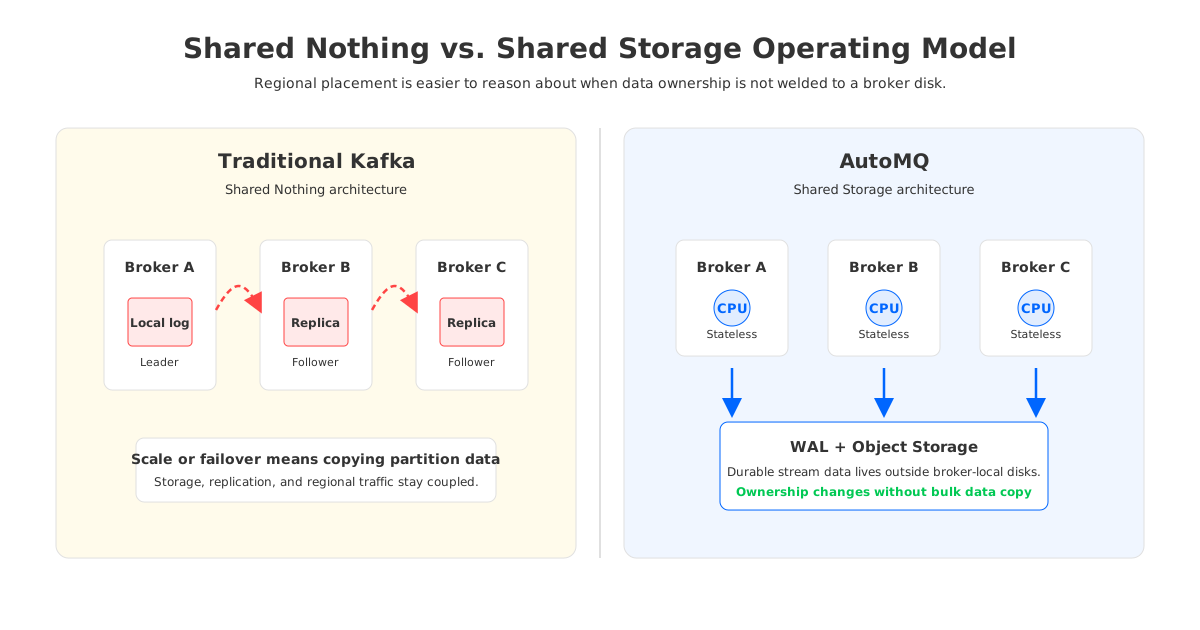
Broker-local storage is not broken. Many teams operate it successfully. The point is that regional placement decisions become harder when data ownership is tied to broker placement. If the buyer wants a control plane in one region, a data plane in another account, and strict limits on cross-zone movement, the storage model either supports that boundary or fights it during every scaling event.
3Architecture Options and Trade-Offs
A useful evaluation starts with the operating promises the platform must keep. For Kafka-compatible streaming, the promises are concrete: clients should keep using Kafka APIs, Consumer groups should preserve consumption semantics, offsets should remain meaningful, transactions and idempotent producers should behave as expected, Kafka Connect should have a clear migration path, and KRaft metadata should be handled without adding another coordination system.
The architecture options usually fall into three groups:
| Option | What It Optimizes For | What Buyers Must Inspect |
|---|---|---|
| Self-operated Kafka in customer account | Maximum direct control over infrastructure and placement | Operational burden, scaling time, storage growth, cross-zone traffic, upgrade discipline |
| Hosted managed Kafka | Lower day-to-day operations and a familiar service model | Data residency, network paths, PrivateLink design, regional availability, commercial lock-in risk |
| Customer-owned deployment with managed control | A managed experience inside the buyer's cloud or private environment | Control channel scope, IAM permissions, data path isolation, upgrade and rollback process |
The third option is where regional control plane placement gets interesting. A BYOC Kafka model can give platform teams automation without moving the workload into a provider-owned data plane. But a BYOC label is not enough. Security teams still need to know whether the control plane runs inside the customer VPC, whether it stores sensitive metadata, whether it can read records, whether it can initiate changes without approval, and how access is audited.
Procurement teams should treat cost as an architecture property, not a line-item comparison. Kafka cost is shaped by storage, compute, network, operations, and migration. Object storage may improve retention economics, but the buyer still needs to understand request charges, retrieval behavior, and private connectivity cost. Broker-local storage may be predictable for small clusters, but inefficient when retention grows faster than throughput.
4Evaluation Checklist for Platform Teams
The strongest regional placement review is evidence-based. It avoids vague claims like "customer data stays in region" unless the architecture diagram proves which component stores what. It also avoids accepting "Kafka-compatible" as a binary checkbox without checking workload-specific features.
Use this checklist before the final buying decision:
- Compatibility: list the Kafka client versions, authentication modes, Topic configurations, Consumer group behaviors, transaction use cases, and Kafka Connect dependencies that must survive the move. Apache Kafka's documentation is the baseline for these semantics.
- Cost: model compute, storage, object storage requests, inter-zone traffic, private connectivity, observability ingestion, and operational effort. Do not use a cost estimate that ignores failover or migration traffic.
- Scaling: define the peak load, partition count, retention horizon, and acceptable scale-out time. Then ask whether scaling moves data or only changes ownership and leadership.
- Governance: document the region, account, VPC, IAM roles, encryption keys, audit logs, and approval workflow. If the control plane crosses an account boundary, document the exact channel.
- Recovery: test broker failure, zone impairment, control plane unavailability, and accidental configuration changes. The runbook should say which system is authoritative in each case.
- Migration: plan Topic mapping, offset handling, producer cutover, consumer switchover, rollback, and observability. A migration that preserves records but loses positions can still break production jobs.
- Operations: decide who handles upgrades, emergency changes, certificate rotation, quota changes, and incident communication. Regional placement is also an ownership model.
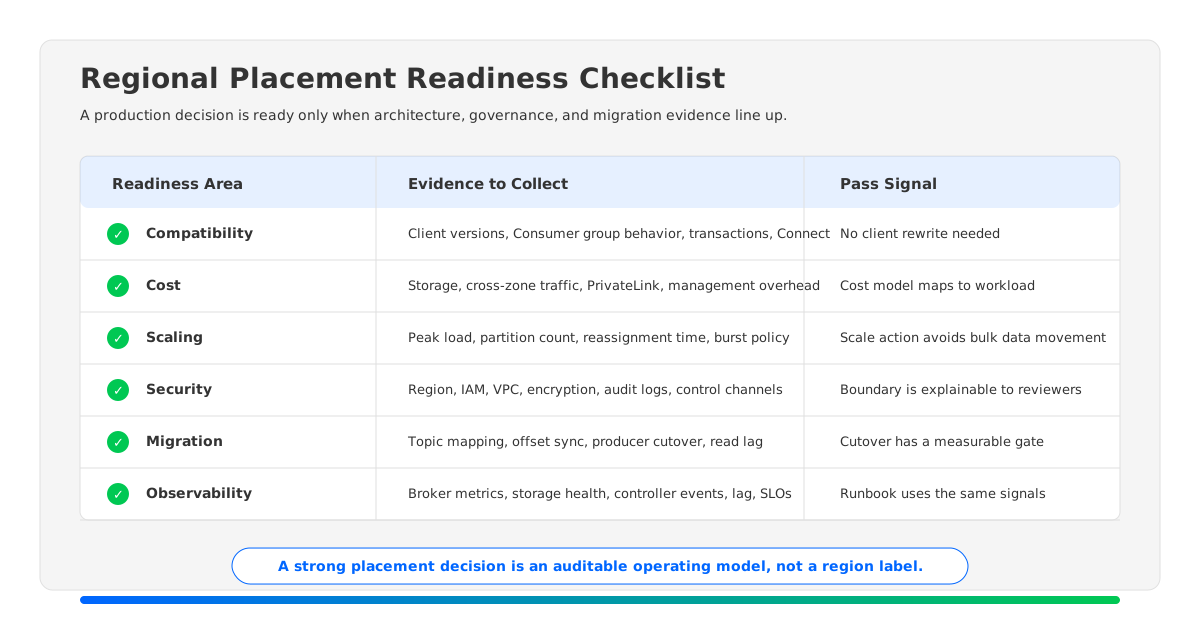
The checklist is intentionally cross-functional. Platform engineering can validate scaling and client behavior. Security can validate the control channel and IAM boundary. Finance can validate network and storage assumptions. Application teams can validate offsets, Consumer groups, and rollback. If one group cannot understand the diagram, the boundary is not ready for production approval.
5How AutoMQ Changes the Operating Model
After the neutral evaluation is complete, AutoMQ enters the discussion as a Kafka-compatible streaming platform designed around Shared Storage architecture. AutoMQ keeps the Kafka protocol and ecosystem surface while replacing broker-local persistent storage with S3Stream, WAL (Write-Ahead Log), data caching, and S3-compatible object storage. That shift changes regional placement because brokers no longer need to own durable partition data on local disks.
In traditional Kafka, broker placement and data placement are tightly connected. In AutoMQ, durable stream data is stored through the shared storage layer, while brokers handle Kafka protocol processing, leadership, caching, and scheduling. When capacity changes, the system can focus on partition ownership and traffic balancing instead of bulk-copying partition data between broker disks. The deployment boundary becomes easier to explain: compute nodes can change, while durable data remains in the customer-controlled storage boundary.
This matters most in AutoMQ BYOC and AutoMQ Software. In AutoMQ BYOC, the control plane and data plane run in the customer's cloud account and VPC. Kafka records and data plane resources remain in the customer-owned environment. In AutoMQ Software, both planes run in the customer's private environment. In both cases, the buying question shifts from "Do we trust an external data plane?" to "Can we audit the management boundary and operate Kafka-compatible streaming inside our own environment?"
AutoMQ's fit is strongest when the buyer has four requirements at the same time: Kafka compatibility, customer-controlled deployment boundaries, elastic operations, and a storage model that does not turn every scale event into a data movement project. Capabilities such as Self-Balancing, Kafka Linking, Table Topic, and zero cross-AZ traffic patterns should still be evaluated against the buyer's own workload and release requirements, not accepted as generic promises.
There are cases where the decision is less clear. A small team with a simple workload, short retention, and no strict regional control requirement may prefer a standard managed service. A team with unusual protocol extensions or broker plugins may need a longer compatibility review. Choose the deployment boundary from workload and governance constraints, not from a fashionable platform label.
6A Practical Decision Matrix
The final decision should produce a short written answer that a security reviewer, finance owner, and platform engineer can all sign. It must be specific.
| Decision Question | Strong Answer | Weak Answer |
|---|---|---|
| Where do Kafka records live? | In customer-owned storage inside the approved region or private environment | "They stay regional" without a storage diagram |
| What does the control plane manage? | Lifecycle, configuration, monitoring, and approved operations | Undefined access to production resources |
| What happens during scaling? | Ownership and traffic are rebalanced without bulk data copy | Large partition movement is expected but not modeled |
| How is migration validated? | Topic, offset, producer, consumer, and rollback gates are tested | Cutover is treated as a DNS or endpoint switch |
| Who owns incident response? | Roles are defined for platform, vendor support, security, and app teams | Ownership depends on the incident type and is decided during the outage |
This matrix turns a vague platform comparison into a boundary review. If a proposed Kafka-compatible platform cannot answer these questions, the buyer is evaluating a product description, not a deployment model.
For teams that want a Kafka-compatible platform with customer-controlled deployment boundaries, the next useful step is to map one real workload against this checklist: one producer group, one critical Consumer group, one retention profile, one region, one migration path, and one rollback plan. To evaluate that path with AutoMQ BYOC or AutoMQ Software, start from the AutoMQ Console entry point: plan an AutoMQ deployment.
7FAQ
7.1What does regional control plane placement mean for Kafka?
It means deciding where the platform management layer runs relative to the Kafka data plane. The control plane may handle provisioning, upgrades, configuration, observability, and lifecycle operations. The data plane handles Kafka brokers, client traffic, records, offsets, and storage. The placement decision defines the trust, network, audit, and operational boundary.
7.2Is BYOC Kafka the same as self-operated Kafka?
No. In a self-operated model, the customer usually owns both infrastructure and day-to-day operations. In a BYOC model, the platform can provide managed automation while the control plane and data plane run in the customer's cloud account. The exact responsibility split depends on the platform contract and architecture.
7.3Why does Kafka storage architecture affect control plane placement?
Kafka storage architecture affects what happens during scaling, failover, and migration. If durable data is tied to broker-local disks, placement changes can require partition data movement. If durable data is stored in a shared storage layer, brokers can be replaced or rebalanced with less dependence on local persistent disks.
7.4How should a team validate Kafka compatibility?
Start with the workload, not a generic claim. Check client versions, authentication, Topic settings, Consumer group behavior, offset handling, transactions, idempotent producers, Kafka Connect, monitoring, and operational workflows. Apache Kafka documentation should be the semantic baseline.
7.5When should AutoMQ BYOC or AutoMQ Software be considered?
Consider AutoMQ BYOC when you want a managed Kafka-compatible operating model inside your own cloud account and VPC. Consider AutoMQ Software when the control plane and data plane must run in a private environment. In both cases, validate the deployment boundary, migration plan, and workload behavior before production approval.


