
Table of Contents
Table of Contents
Teams searching for regulated agent data flows kafka are usually past the prototype stage. An agent has started to call internal tools, write decisions into business systems, trigger human review, or route work across teams. The hard question is whether every action, tool call, policy decision, connector side effect, and replayed event can be explained later.
Kafka-compatible streaming is a natural place to look because agents create event-shaped evidence. A request enters the system, context is retrieved, tools are called, policies are checked, output is produced, and downstream systems react. Each step can be represented as a record with a key, timestamp, schema, headers, producer identity, and consumer progress. That model is useful only if the streaming layer is governed as a system of record rather than a high-speed pipe.
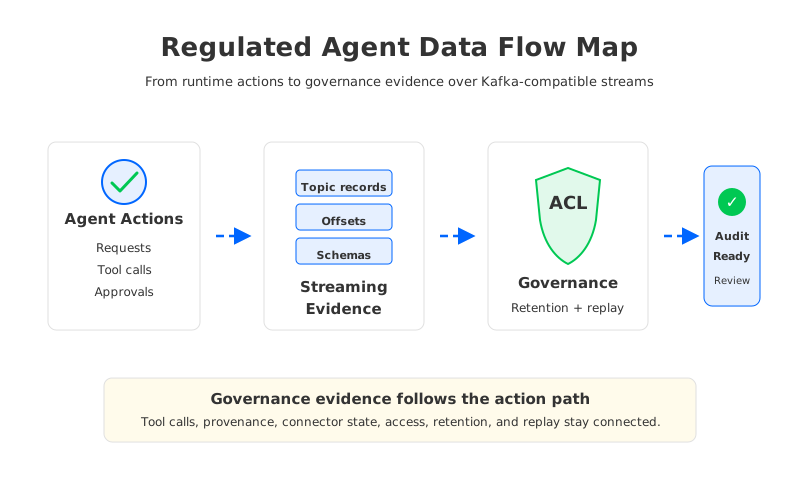
The regulated part changes the design target. A platform team is building an auditable data plane for agent actions: who authorized the action, what context the agent saw, which tool was called, which connector wrote to a system of record, which policy was evaluated, and whether the flow can be replayed without crossing an access boundary.
1Why teams search for regulated agent data flows kafka
Agent systems make familiar governance problems more compressed. A traditional application may call a payment API, write to a database, and emit an audit log in a controlled request path. An agent workflow may decide which tool to call at runtime, include retrieved context in the tool input, emit intermediate reasoning artifacts, wait for a human approval, and resume from state later. The governance system has to follow the work rather than assume a fixed path.
That is where Kafka semantics become valuable. Topics can separate raw agent requests, tool-call intents, tool responses, policy decisions, human approvals, connector writes, and audit envelopes. Consumer groups allow independent teams to process the same evidence for fraud review, compliance reporting, model evaluation, and incident investigation without taking ownership of the application path. Offsets provide a concrete replay position, which matters when a reviewer asks what the system knew before an agent action changed a customer account or internal workflow.
The search phrase also points to a platform boundary. Security teams want access controls, retention, encryption, and provenance. Data engineering teams want schemas, connectors, replay, and lineage. SREs want lag alerts and recovery procedures. Kafka-compatible streaming can connect those concerns, but it can also hide risk if the operating model is treated as someone else's problem.
2The production constraint behind the problem
Regulated agent data flows are hard because the evidence is distributed across time. The user request is not enough, and the final answer is not enough. A complete record needs the sequence between them: context fetch, policy decision, tool selection, tool input, tool output, connector state, retry behavior, human override, and final write. If those events land in different stores with different retention clocks, incident reconstruction becomes a manual archaeology project.
The second constraint is replay. Agent workflows are often revised after production evidence appears. A team may need to replay historical tool-call events through a stricter policy, rebuild an evaluation set from tool outputs, rehydrate a connector sink, or prove that a rejected action stayed rejected after retries. Kafka's retained log and offset model are useful here, but only when retention, compaction, key design, and consumer ownership are planned before the audit request arrives.
The third constraint is access boundaries. Tool-call events may contain regulated data, credentials-adjacent metadata, customer identifiers, model prompts, or proprietary business context. The platform has to answer different questions at the same time:
- Which producers may emit agent actions, and which may emit only observations?
- Which consumers may read raw tool inputs, and which must receive redacted evidence?
- Which connectors are allowed to write back into systems of record?
- Which audit consumers have read-only access across all agent topics?
- Which data must stay inside a specific cloud account, VPC, region, or private environment?
The answers cannot live only in a policy document. They need to be reflected in topic design, Kafka ACLs, client authentication, connector configuration, retention policy, object storage permissions, private networking, and observability.
3Architecture options and trade-offs
The baseline option is self-managed Apache Kafka. It gives platform teams broad ecosystem compatibility and direct control over brokers, topics, ACLs, schemas, Kafka Connect workers, and retention policy. That control is useful because agent evidence is sensitive and the deployment boundary can be inspected. The trade-off is operational coupling: broker-local storage, partition placement, replication, reassignment, and recovery become part of the governance plan.
Managed Kafka services reduce some infrastructure work, and they may fit teams that want a standard Kafka API with fewer broker lifecycle tasks. The review should focus on where regulated evidence lives, who can access service logs, how private networking works, which identities own connector paths, and how service limits affect retention or replay.
Tiered Storage deserves a separate evaluation. It can move older log segments to remote storage and improve long-retention economics. It does not make the broker fleet stateless. The recent write path, partition leadership, local storage pressure, and broker recovery behavior still matter for high-volume agent event topics.
Shared Storage architecture changes the question beneath the Kafka API. In this model, durable stream data is backed by shared object storage, while brokers focus on protocol handling, leadership, caching, and scheduling. The important governance question is whether that separation reduces the operational coupling between agent evidence, broker replacement, scaling, and long retention.
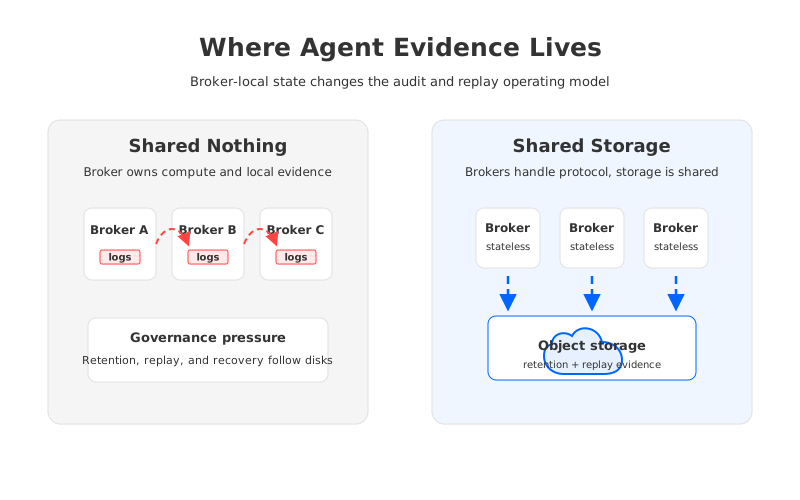
The comparison below keeps the options grounded in regulated agent evidence rather than generic infrastructure preference.
| Architecture choice | Governance strength | Production trade-off for agent flows |
|---|---|---|
| Self-managed Kafka | Maximum deployment control and direct policy ownership | Team owns broker recovery, storage sizing, partition movement, connector workers, and audit integration |
| Managed Kafka with private access | Less broker lifecycle work and familiar Kafka APIs | Data-plane boundary, provider visibility, connector egress, and service limits need careful review |
| Kafka with Tiered Storage | Better fit for longer retention than local disks alone | Hot path and broker-local operations still shape replay, scaling, and recovery |
| Kafka-compatible Shared Storage | Separates retained evidence from broker-local disks | Requires validation of compatibility, WAL behavior, object storage policy, and failure recovery |
None of these choices removes governance work. The useful distinction is which team owns which failure mode. If every increase in retention turns into a disk project, compliance requirements become capacity planning. If every connector writes with broad credentials, access review becomes incident response. If replay requires a privileged operator to stitch together offsets and sink state, the audit trail exists but is not operationally usable.
4Evaluation checklist for platform teams
A regulated agent streaming review should start with the events, not the model. The model, prompts, and tool routing may change. The evidence contract should be more stable than any of them. Define the topic families first: agent requests, context references, policy decisions, tool-call intents, tool responses, connector writes, human approvals, audit envelopes, and dead-letter records.
Then verify the Kafka mechanics that make those records governable:
- Provenance: Each event should carry a stable workflow ID, actor identity, agent version, tool name, policy version, schema version, timestamp, and source system. Headers are useful for routing and metadata, but the audit payload should remain readable without private application state.
- Access boundaries: Topic ACLs, consumer group permissions, client certificates, IAM roles, private endpoints, and object storage policies should describe the same boundary. A consumer that can read raw tool inputs should be rare and named.
- Retention and replay: Retention should match evidence requirements by topic class. Audit envelopes may need a longer window than raw context payloads. Replay runbooks should define who can reprocess events, which consumers are paused, and how outputs are separated from production writes.
- Connector state: Kafka Connect offsets, task failures, dead-letter topics, sink idempotency, and external system write receipts should be part of the governance evidence. A connector is not a sidecar when it writes agent decisions into a regulated system.
- Observability: Lag, retries, failed authorizations, schema errors, connector task state, replay jobs, and policy-denied actions should be visible before an incident. Audit dashboards should not depend on application owners exporting ad hoc logs.
The checklist is deliberately operational. A governance architecture that cannot block a compromised producer, pause a connector, replay a policy decision, or show who consumed a sensitive topic is incomplete.
5How AutoMQ changes the operating model
After the neutral evaluation, the architectural requirement becomes sharper: keep Kafka-compatible behavior for clients and tools, but reduce the amount of long-lived evidence tied to broker-local storage. AutoMQ fits this evaluation as a Kafka-compatible cloud-native streaming system built around Shared Storage architecture and stateless brokers, moving durable stream storage to object storage through S3Stream and a WAL layer.
That storage separation matters because agent evidence grows quickly. Every tool call can produce multiple records, every policy decision can create an audit envelope, and every connector write may need a receipt, dead-letter path, and replay path. In a broker-local model, longer retention and replay-heavy consumers increase pressure on the same broker fleet that is serving live traffic. With shared storage, retained data is less tightly bound to individual brokers, which changes the scaling and recovery conversation.
AutoMQ's Kafka compatibility is relevant because regulated platforms rarely get to replace every producer, consumer, connector, and observability tool at once. Existing Kafka clients, Kafka Connect integrations, consumer groups, and operational practices need a migration path that does not rewrite the application layer. The evaluation should still test produce and consume behavior, admin APIs, ACLs, schema tooling, connector workers, lag monitoring, failure recovery, and rollback.
The deployment boundary is equally important. AutoMQ BYOC is relevant for organizations that want a managed operating model while keeping the data plane in the customer's cloud environment. For regulated agent data flows, the VPC, object storage, IAM, private connectivity, audit integration, and regional controls can remain inside a customer-controlled boundary.
There are still trade-offs to test. WAL selection affects write behavior, object storage policy affects evidence access, connector workers still need careful credentials, and replay jobs still need change control.
6Migration and readiness scorecard
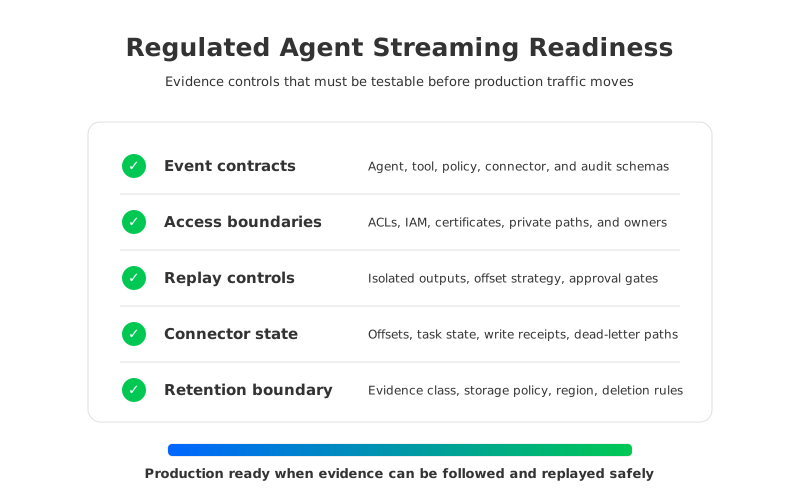
A migration for regulated agent data flows should not begin with bootstrap servers. It should begin with an evidence inventory. List the topics that represent agent actions, tool outcomes, connectors that write into systems of record, and consumers that provide audit or policy review. Then decide which events need byte-for-byte continuity, which need offset continuity, which can be rebuilt, and which must be isolated during replay.
Use a readiness scorecard before production traffic moves:
| Gate | Ready signal | Common failure mode |
|---|---|---|
| Event contract | Agent action, tool-call, policy, connector, and audit schemas are versioned | Audit records depend on application logs that are not retained |
| Access review | Producer, consumer group, connector, and admin privileges are mapped to owners | A broad service account can read raw tool payloads |
| Replay plan | Historical events can be replayed into isolated consumers without writing to production sinks | Replay accidentally triggers downstream actions |
| Connector control | Connector offsets, task state, dead-letter topics, and write receipts are observable | Sink state is treated as external and disappears from the audit trail |
| Retention policy | Retention windows differ by evidence class and are documented | Raw sensitive context is retained longer than needed, while audit envelopes expire too early |
| Deployment boundary | Network, storage, IAM, and support access match regulatory expectations | The Kafka API is private, but evidence crosses an unapproved boundary |
This scorecard prevents a common mistake: proving that agents can publish to Kafka while leaving governance evidence scattered. The platform is ready when a reviewer can choose one agent action and follow it through request, context, policy, tool call, connector write, retention, and replay.
If your agent roadmap is turning Kafka into the evidence layer for regulated actions, evaluate the streaming operating model before the audit trail becomes critical infrastructure. To test a Kafka-compatible, customer-controlled architecture for these flows, start with AutoMQ Cloud.
7References
- Apache Kafka Documentation for Kafka producers, consumers, offsets, transactions, Kafka Connect, KRaft, and Tiered Storage.
- NIST AI Risk Management Framework for a neutral risk-management reference when agent systems enter governed environments.
- AWS PrivateLink documentation for private connectivity concepts such as VPC endpoints and endpoint services.
- Amazon S3 data durability documentation for object storage durability background.
- AutoMQ architecture overview for Shared Storage architecture and stateless broker design.
- AutoMQ compatibility with Apache Kafka for Kafka client and ecosystem compatibility.
- AutoMQ WAL storage for the durable write path used with object-storage-backed streaming.
- AutoMQ BYOC Environment for customer-controlled deployment boundaries.
- AutoMQ migration guide for Apache Kafka to AutoMQ migration planning.
- AutoMQ Zero Cross-AZ Traffic overview for documented inter-zone traffic reduction patterns.
8FAQ
8.1Is Kafka a good fit for regulated agent data flows?
Kafka is a strong fit when agent actions need ordered, replayable, multi-consumer evidence. It is weaker when the system only needs a request log with no replay or connector side effects.
8.2What agent events should be captured as Kafka records?
Capture agent requests, context references, policy decisions, tool-call intents, tool responses, connector writes, human approvals, final outcomes, and dead-letter events. Avoid placing secrets or unnecessary raw sensitive context into long-retention topics.
8.3How should teams prevent replay from triggering real-world actions?
Replay jobs should write into isolated topics, test consumer groups, or sinks with action execution disabled. Production connectors should have explicit replay controls, idempotency checks, and approval gates before historical events are reprocessed.
8.4Does Shared Storage architecture remove governance work?
No. It changes the streaming operating model by reducing broker-local data coupling, but teams still need topic contracts, ACLs, schema governance, connector controls, retention policy, observability, and audit runbooks.
8.5Where should AutoMQ appear in the evaluation?
AutoMQ should appear after the team has defined requirements for Kafka compatibility, evidence retention, replay, access boundaries, connector state, migration, and customer-controlled deployment. It is most relevant when regulated agent evidence needs Kafka-compatible semantics with Shared Storage architecture.


