
Table of Contents
Table of Contents
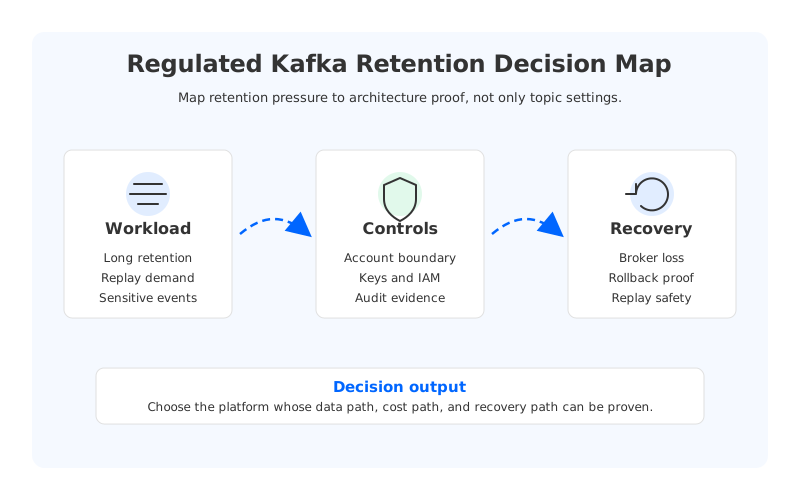
Teams searching for regulated kafka retention are usually past the beginner questions. They already know Kafka can retain data by time, size, topic, and compaction policy. The uncomfortable question is whether that retention model still works when auditors, security reviewers, FinOps, and recovery owners all look at the same cluster and ask different versions of the same thing: where does the data live, who controls it, what does it cost to keep it, and how fast can we recover when the plan fails?
Kafka retention is not only a topic setting in regulated environments. It is a system boundary. Retained event logs can contain payment activity, customer behavior, fraud signals, telemetry, and change data capture streams. Even when payloads are encrypted, surrounding artifacts such as topic names, schemas, consumer group names, offsets, connector errors, and replay patterns can reveal sensitive business behavior. A retention decision therefore becomes a governance decision before it becomes a storage decision.
The practical test is simple to state and hard to pass. A platform team should be able to draw the retained data path from producer acknowledgement to long-term replay, then explain the storage, network, access control, audit, and recovery behavior at each hop. If the answer depends on tribal knowledge, hidden broker state, or untested migration scripts, the retention architecture is not ready for regulated production.
1Why Teams Search for regulated kafka retention
The search often starts after a policy change. A team that kept Kafka data for a few days now needs weeks or months for audit replay, fraud investigation, model feature reconstruction, or incident forensics. Application owners ask for longer retention because replay is valuable. The platform team sees the storage curve. The security team sees a larger sensitive data surface. The recovery owner sees a bigger blast radius if the cluster, account, region, or migration plan breaks at the wrong time.
Kafka makes retention easy to configure, but configuration does not make retention easy to operate. Increasing retention.ms or retention.bytes changes disk pressure, partition placement, page cache behavior, broker replacement time, consumer catch-up behavior, and cloud cost. Compacted topics add another wrinkle: the latest value per key can be useful for state reconstruction, but compaction also changes deletion expectations and audit interpretation. A regulator will not care that the setting was valid if the team cannot prove how retained records are protected and removed.
Three tensions usually appear together:
- Control: retained records, offsets, schemas, and logs must stay inside approved accounts, regions, networks, and key boundaries.
- Cost: long retention turns small inefficiencies in broker storage, cross-zone replication, object requests, and read amplification into durable monthly spend.
- Recovery: retained data is only useful if the team can replay it after broker loss, bad deployment, consumer corruption, or migration rollback.
Those tensions are why retention is a better architecture test than a feature checklist. Any Kafka-compatible platform can describe retention policies. Fewer can show exactly how retained data survives operational change without forcing the team into repeated data movement projects.
2The Production Constraint Behind the Problem
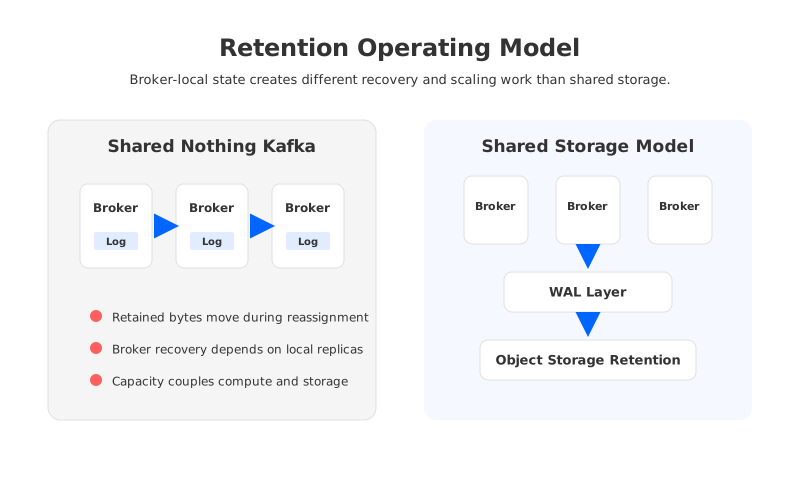
Traditional Kafka follows a Shared Nothing model: each broker owns local persistent logs, and durability comes from replica placement across brokers. That design has served Kafka well because it makes the log local to the broker that serves reads and writes. It also makes retention deeply physical. If a topic has many partitions, long retention, and a high replication factor, the cluster is not keeping one logical stream. It is keeping multiple physical copies distributed across broker disks, and those copies matter every time capacity or placement changes.
In regulated deployments, that physicality shows up in places that are easy to underestimate. Partition reassignment moves retained bytes across the network. Broker replacement requires attention to local data, replica catch-up, and leadership movement. A retention change can force capacity expansion before application traffic changes at all. In a multi-zone cloud deployment, replication and client placement can also create cross-zone data transfer. None of those behaviors are automatically wrong, but they must be planned, budgeted, and documented.
Tiered Storage changes part of the equation by moving older log segments to remote storage. Apache Kafka introduced the Tiered Storage architecture through KIP-405. This is useful for long retention because it reduces pressure on broker-local storage for older data. But tiering is not the same as making brokers stateless. The active log, leader behavior, remote fetch path, metadata, and operational tuning still deserve careful validation.
That distinction matters during recovery. If long-term data is remote but the hot path remains broker-local, the team still needs to test broker failure, remote storage permission errors, old-offset replay, and partition movement during incidents. A retention architecture should be judged by these drills, not by whether a diagram contains an object storage icon.
3Architecture Options and Trade-Offs
Regulated retention planning usually lands in one of four operating models. The right answer depends on latency, retention duration, replay frequency, data boundary, and operational maturity. The wrong answer is to treat these models as equivalent because they all expose Kafka-compatible APIs.
| Architecture option | What it can solve | What still needs proof |
|---|---|---|
| Broker-local Kafka | Predictable Kafka semantics and mature operational knowledge. | Disk growth, replica movement, broker recovery, cross-zone traffic, and long-retention cost. |
| Kafka with Tiered Storage | Lower pressure on broker disks for older log segments and better long-retention economics. | Remote read performance, hot-log dependency, metadata behavior, operational maturity, and deletion semantics. |
| Fully managed Kafka | Reduced day-to-day operations and provider-run lifecycle management. | Data boundary, metadata exposure, private connectivity, support access, retention cost model, and exit path. |
| Shared Storage Kafka-compatible architecture | Durable data separated from broker-local disks, lighter broker replacement, and independent storage scaling. | WAL behavior, object storage permissions, p99 latency, compatibility coverage, and recovery semantics. |
The table is a starting point, not a verdict. For some regulated workloads, broker-local Kafka is still the conservative choice because the team already has tooling, runbooks, and incident response around it. For others, long retention and frequent replay make broker-local storage the wrong center of gravity. The decision should follow workload evidence: write rate, read fanout, replay window, retention duration, partition count, client behavior, and required controls.
Cost should be handled with the same discipline. A storage quote alone is too narrow because retention cost is spread across several layers. Broker disks, remote storage, replication traffic, cross-zone reads, compaction, observability volume, backup workflows, and migration windows all contribute to the total. In cloud environments, even a small amount of unnecessary zone-to-zone movement can become material at Kafka throughput levels. The team should model cost as a data path, not as a SKU comparison.
Governance is the other side of the same path. Retained data should have an owner, classification, deletion rule, encryption boundary, access policy, and replay approval process. That sounds bureaucratic until a downstream team replays months of data into a system that was not designed to receive it. Retention increases Kafka's value; it also increases the ways Kafka can surprise the organization.
4A Practical Evaluation Checklist
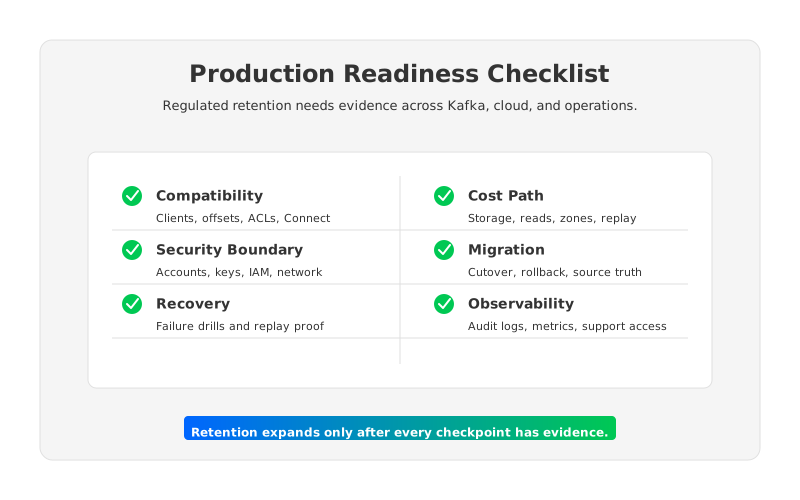
The strongest checklist is written before a proof of concept, not after a vendor demo. A happy-path test that produces one record, consumes it, and expands retention proves very little. Regulated retention needs a test plan that crosses Kafka semantics, storage, security controls, and recovery operations.
Start with these checks:
- Retention inventory. List topics by owner, data classification, retention policy, compaction policy, expected replay window, and deletion obligation.
- Boundary map. Draw producers, brokers, controllers, WAL or local storage, remote storage, schema services, connectors, consumers, metrics, logs, support access, and administrative control planes.
- Compatibility gates. Validate producers, consumers, consumer groups, offsets, idempotent producers, transactions, ACLs, Kafka Connect, stream processing jobs, and admin tooling against the target platform.
- Cost path. Model write traffic, replica traffic, read fanout, catch-up reads, remote reads, storage growth, object operations, and cross-zone transfer instead of only monthly storage capacity.
- Failure drills. Test broker loss, storage permission errors, consumer replay from old offsets, connector failure, corrupted downstream state, blocked management connectivity, and rollback.
- Audit evidence. Confirm where access logs, policy changes, support sessions, retention changes, and deletion events are recorded and who can alter those records.
This checklist intentionally mixes architecture and operations. Kafka retention fails in the handoff between the two. A design can look clean while the team lacks evidence for replay approval, offset preservation, or cross-account storage access. A mature runbook can also hide a poor architecture that requires large amounts of data movement for routine scaling.
5How AutoMQ Changes the Operating Model
After the neutral checklist, the architecture requirement becomes clearer: regulated teams need Kafka compatibility, customer-controlled deployment boundaries, cost visibility, and a retention model that does not make every broker lifecycle event a local-disk project. AutoMQ fits that category as a Kafka-compatible, cloud-native streaming platform built around Shared Storage architecture and stateless brokers.
The design shift is not "Kafka, but with lower-cost storage." The shift is that durable stream data is no longer treated as long-lived broker-local state. AutoMQ uses a WAL layer for the immediate write path and stores stream data in S3-compatible object storage through its shared storage design. Brokers can then be treated more like compute that serves protocol, cache, and coordination responsibilities, while durable retention is anchored in customer-controlled object storage.
For regulated retention, that changes the review conversation in three ways. First, capacity planning can separate compute demand from retained data growth, which helps when compliance windows expand faster than throughput. Second, broker replacement and scaling do not have to imply the same retained-log movement as broker-local architectures. Third, BYOC and software deployment models let teams inspect cloud account boundaries, object storage policies, network paths, keys, and support access with more precision than a black-box hosted service.
AutoMQ still needs diligence. Teams should validate p99 latency with the chosen WAL option, object storage policy, replay throughput, Kafka client compatibility, ACL behavior, consumer group handling, schema workflows, and migration rollback. AutoMQ's Kafka compatibility documentation is the starting point, but production confidence comes from testing the applications that own the retained data. A regulated platform should never outsource that proof to a compatibility slogan.
The useful mental model is separation of concerns. Kafka clients keep the protocol surface they expect. The platform team gets a storage architecture where retained data lives in shared object storage rather than being bound to broker disks. Security and compliance teams get a clearer boundary to inspect: account, network, bucket, key, control plane, observability, and support path. That does not make retention automatic. It makes the retention system easier to reason about.
6Migration And Recovery Readiness
Migration is where retention plans become real. A short-retention Kafka cluster can sometimes survive an imperfect migration because stale data ages out quickly. A regulated cluster cannot make that assumption. If months of data support audit, investigation, or model reconstruction, the migration plan has to preserve live traffic and replay confidence.
The migration plan should define a source of truth for each phase. During dual write or replication, which cluster is authoritative for producers, consumers, offsets, schemas, ACLs, and retained history? During cutover, how will consumers prove they resumed from the intended offsets? During rollback, can the team return to the source cluster without replay gaps, duplicate side effects, or schema drift? These questions reveal whether "Kafka-compatible" has been tested at the workflow level.
Recovery needs the same specificity. A retention platform should document the recovery point and recovery time expectations for broker loss, zone impairment, object storage access error, accidental topic deletion, consumer state corruption, and a bad platform upgrade. The answer does not always need to be zero downtime. It needs to be explicit, tested, and aligned with the value of the retained data.
If your next retention review starts with a topic setting, widen the frame before the setting becomes policy. Draw the retained data path, price the data movement, classify the metadata, and run the failure drills. For teams evaluating a Kafka-compatible shared storage model with customer-controlled deployment boundaries, start an AutoMQ architecture review using your own topics, clients, retention windows, and recovery drills.
7References
- Apache Kafka Documentation
- Apache Kafka KIP-405: Kafka Tiered Storage
- Apache Kafka KIP-1150: Diskless Topics
- AWS S3 Data Durability
- AWS PrivateLink
- AWS EC2 On-Demand Pricing: Data Transfer Notes
- AutoMQ Overview
- AutoMQ Architecture Overview
- AutoMQ Compatibility with Apache Kafka
- AutoMQ and Apache Kafka Tiered Storage
8FAQ
8.1What is regulated Kafka retention?
Regulated Kafka retention is the practice of keeping Kafka records, offsets, schemas, metadata, logs, and replay capability under explicit governance controls. It covers retention duration, storage location, encryption, access control, deletion obligations, audit evidence, cloud account boundaries, and recovery behavior.
8.2Is Kafka Tiered Storage enough for regulated retention?
Kafka Tiered Storage can help reduce pressure on broker-local disks by moving older log segments to remote storage. It does not automatically solve every regulated retention requirement. Teams still need to validate hot-log behavior, remote read performance, deletion semantics, permissions, metadata handling, recovery drills, and audit evidence.
8.3Why does Shared Storage matter for long retention?
Shared Storage separates durable retained data from broker-local disks. That can reduce the amount of retained log data that must move during broker replacement, scaling, or rebalancing. The platform still needs a tested write path, metadata model, and recovery procedure, but the broker lifecycle becomes less coupled to long-term retained bytes.
8.4What should a regulated Kafka retention checklist include?
A practical checklist should include topic ownership, data classification, retention and compaction policy, storage boundary, encryption, IAM and Kafka ACLs, metadata classification, cost model, failure drills, migration rollback, replay approval, observability, and audit log retention.
8.5Where does AutoMQ fit in a regulated retention evaluation?
AutoMQ is relevant when a team wants Kafka-compatible APIs, customer-controlled deployment boundaries, and Shared Storage architecture with stateless brokers. It should be evaluated after the team defines its retention requirements and should be tested with real clients, retention windows, replay workloads, failure drills, and migration rollback plans.


