
Table of Contents
Table of Contents
Kafka retention reviews rarely begin as architecture debates. They usually begin with a dashboard, a renewal worksheet, or a team asking for a longer replay window because fraud models, support tools, CDC recovery, or AI feature pipelines need more history. The first answer sounds harmless: keep more Kafka data, push older segments to object storage, and reduce broker disk pressure. That answer is useful, but incomplete.
The phrase tiered storage decision points kafka captures the real search intent better than a generic tiered storage overview. Teams are asking when remote log tiering changes the production risk profile enough to warrant an architecture review. Retention affects disk sizing, broker replacement, cross-zone traffic, restore behavior, governance, and the cost model for reads that happen months after the data was produced.
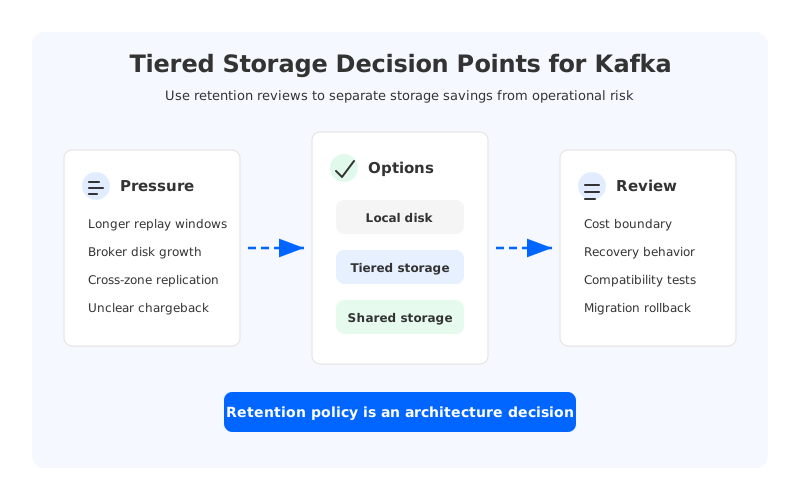
The practical review starts with one uncomfortable observation: retention is a promise to future operators. If a downstream team needs to replay a topic after a bad deployment, a schema error, or a warehouse outage, the Kafka platform must deliver old data predictably, not only at lower cost. A good remote log tiering plan therefore needs two tests: does it lower cost and capacity pressure, and does it keep recovery, consumer behavior, and rollback understandable under stress?
1Why Teams Search for tiered storage decision points kafka
Traditional Kafka retention planning is broker-centric. A topic's retention setting translates into local log segments, local disk capacity, replication between brokers, and operational tasks when a broker fails or a partition moves. The model works when retention windows are short enough for conservative capacity planning. The problem appears when the retention window grows faster than the broker fleet should grow.
The pressure usually shows up in four places:
- Replay requirements outgrow hot storage. Data teams want longer recovery windows, but platform teams do not want every replay requirement to become a broker disk expansion.
- The active broker footprint becomes hard to explain. Finance sees provisioned storage, replicated copies, and data transfer charges, while application teams only see "Kafka retention."
- Scaling and replacement windows stretch. More local state means more data movement when brokers are added, removed, or recovered.
- Governance gets harder. Once Kafka becomes a historical replay layer, retention exceptions, encryption, access scope, and deletion behavior become audit topics instead of cluster tuning details.
Remote log tiering is attractive because it shifts older log segments away from the most expensive and operationally sensitive storage layer. Apache Kafka's tiered storage work, introduced through KIP-405, keeps local broker storage for active log work while using remote storage for historical segments. That is a major improvement over treating broker disks as the full long-term storage tier, but it does not remove every broker-local concern.
The decision point is whether the team only needs colder historical segments, or whether it also needs a different operating model for the Kafka service. "Object storage is involved" can describe several architectures with very different production behavior.
2The Storage Constraint Behind Cloud Kafka
Kafka was designed around brokers that own partition logs. In the classic shared-nothing model, each broker has its own storage, and reliability comes from replication across brokers. This gives Kafka strong locality and a clear partition ownership model, while tightly coupling storage, compute, and failure recovery.
Cloud infrastructure changes the economics of that coupling. Block storage, network transfer, and multi-AZ replication are billed and operated as separate services. A Kafka cluster that replicates data across brokers may also run on cloud storage that already replicates data internally. The result is not necessarily wrong, but it must be reviewed deliberately.
Tiered storage reduces part of that pressure by moving older segments to remote storage. The hot set remains local to brokers, and the historical set can live in lower-cost, more elastic storage. This helps when old data consumes too much local capacity. It is less complete when broker identity, partition state, and local storage still drive the operating model.
| Review question | Why it matters | What to inspect |
|---|---|---|
| How much data must remain local? | Local data still affects broker replacement, reassignment, and disk sizing. | Segment size, local retention bytes, active partitions, and catch-up behavior. |
| Who pays for historical reads? | Replay traffic can move cost from disk to object requests and network paths. | Object storage request pricing, read amplification, cache hit rates, and consumer replay patterns. |
| What happens during broker loss? | A retention plan that saves storage but slows recovery may fail the real SLO. | Recovery runbooks, leader movement behavior, remote fetch latency, and throttling settings. |
| Which workloads need strict Kafka semantics? | Compatibility is broader than producer and consumer APIs. | Transactions, idempotent producers, consumer offsets, Connect, Streams, admin APIs, and monitoring tools. |
This table is intentionally operational rather than theoretical. A retention review that stops at storage dollars will miss the moments when the system is most valuable: recovery after failure, replay after data corruption, and migration after a platform decision changes.
3Architecture Options: Local Disk, Tiered Storage, and Shared Storage
There are three common positions in a Kafka retention review. The first is to keep the existing broker-local model and tune retention, disk, compaction, and topic policies. This can be right for small clusters, short replay windows, or teams that value simplicity over storage optimization. The downside is clear: long retention expands broker-local state, and stateful operations remain tied to data movement.
The second position is Kafka tiered storage. Older log segments move to remote storage, while brokers continue to handle active log work locally. This fits teams that want to reduce local disk pressure without changing the core Kafka operating model. It can improve retention economics, but the hot tier still needs capacity planning, and operators gain a second read path to observe, tune, and rehearse.
The third position is shared storage, where object storage is not only a cold historical tier but the primary durable storage layer behind Kafka-compatible brokers. In this model, brokers can become largely stateless because durable log data is not bound to broker-local disks. That changes the review from "how much history can we offload?" to "how much broker state should exist?"
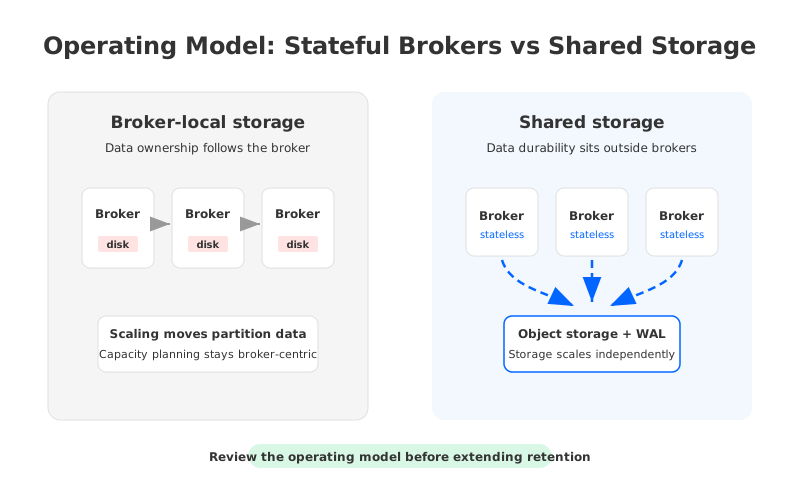
The shared-storage approach is not a universal replacement for every Kafka deployment. It introduces design questions around write-ahead logging, cache behavior, object layout, metadata scale, and cloud storage failure domains. The difference is that these questions center on cloud storage primitives, not on how much local broker state can be tolerated before operations slow down.
4Evaluation Checklist for Platform Teams
A useful tiering review should be concrete enough that SRE, FinOps, security, and application owners can sign off. The platform team owns the architecture, but retention crosses team boundaries. A longer retention window can help data consumers recover faster, while creating an implicit historical data product with compliance and cost obligations.
Start with compatibility. If applications depend on Kafka protocol behavior, the review must include more than a producer throughput test. Consumer groups, offsets, transactions, idempotent producers, Kafka Connect workers, Kafka Streams applications, admin tooling, and observability integrations all need validation. A platform that is "Kafka-like" in the happy path can still break workflows when the team resets offsets, rebuilds a connector, or replays a compacted topic.
Cost comes next, but cost should be decomposed instead of summarized. Broker disk, cloud block storage, object storage capacity, object storage requests, cross-AZ traffic, cache capacity, and replay reads behave differently. The useful output is a map of which costs scale with write throughput, retained bytes, replay frequency, partition count, and availability-zone topology.
Recovery deserves its own rehearsal. Remote storage is often evaluated when everything is healthy, but retention matters most after an incident. Run the tests operators will actually need: replace a broker, replay a high-volume topic from the remote tier, throttle a consumer group, and validate rollback steps. The result should be a runbook with measured behavior, not a slide that says "uses object storage."
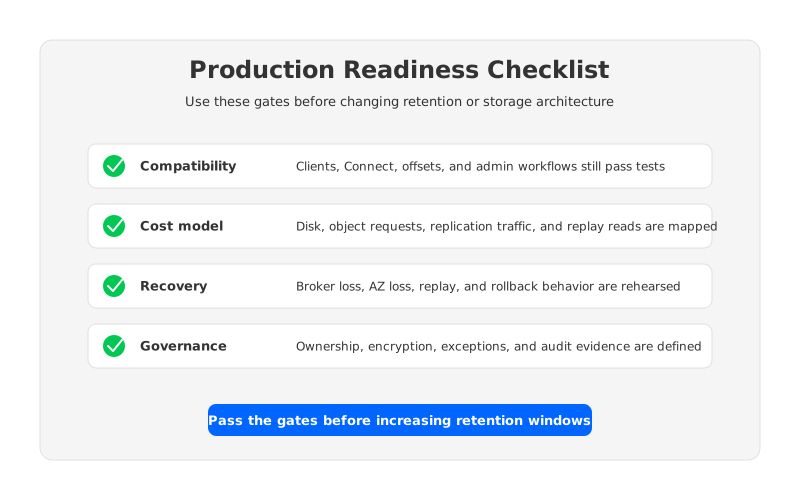
Governance is the final gate. Retention controls how long business events exist, who can access them, and whether deletion expectations are enforceable. For regulated teams, the storage architecture must fit encryption, access control, audit evidence, region control, and data ownership requirements.
5How AutoMQ Changes the Operating Model
Once the review reaches the operating-model question, AutoMQ becomes relevant as a Kafka-compatible shared-storage architecture rather than as another retention toggle. AutoMQ keeps Kafka protocol compatibility while replacing Kafka's broker-local log storage with S3Stream, a shared streaming storage layer built around WAL storage, object storage, and cache. The important shift is that object storage is the primary durable storage layer, so brokers no longer need to own long-lived local partition data.
That change addresses the parts of a retention review that tiering alone may not settle. If durable data is decoupled from broker identity, scaling and broker replacement are less dominated by partition data movement. If storage capacity follows object storage rather than broker disks, retention planning can become less tied to worst-case local disk reservation. Cross-zone traffic, storage durability, and resource ownership can also be reviewed as cloud-service boundaries instead of incidental Kafka side effects.
AutoMQ's architecture is still Kafka-compatible at the API and ecosystem layer, which matters for migration risk. Existing Kafka clients and tools are part of the platform contract. For teams evaluating shared storage, the practical question is whether they can change the storage operating model while keeping the Kafka surface area their applications already use.
There is also a useful way to think about WAL. In traditional Kafka, broker-local storage is the main log store. In AutoMQ, WAL storage is a write-acceleration and recovery component in front of object storage, while object storage remains the main durable store. WAL is not "the new broker disk"; it is a bounded part of the write path that helps make object storage viable for streaming workloads.
This does not remove the need for testing. Teams should still validate latency targets, replay behavior, object storage configuration, deployment boundaries, and observability before production migration. The benefit is that the review can focus on whether shared-storage Kafka fits the workload, rather than spending every retention cycle negotiating how much state each broker can carry.
6A Practical Decision Matrix
The simplest decision matrix uses the retention goal as the first branch. If the goal is a modest extension of replay windows and current broker operations are healthy, Kafka tiered storage may be a pragmatic step. The team should still measure local hot-tier requirements, remote fetch behavior, and object storage request cost, but the architectural blast radius can remain contained.
If the goal is to make Kafka a long-retention event backbone for many teams, the review should be broader. At that point, the platform is promising that old events will remain economically available, operationally recoverable, and governable across many use cases. Broker-local state, cross-zone replication, and manual reassignment windows become strategic constraints rather than tuning topics.
Use this scorecard during the review:
- Choose local disk tuning when retention is short, replay is rare, and the team values the fewest moving parts.
- Choose tiered storage when historical data is the main pressure and the current broker-centric operating model is acceptable.
- Evaluate shared storage when retention, scaling, recovery, and cloud cost are all tied to the same broker-local state problem.
- Run a migration proof of concept when compatibility risk is the gating factor, especially for Connect, transactions, stream processors, and operational tooling.
- Require a governance review when retention changes affect regulated data, regional boundaries, encryption scope, or deletion expectations.
The matrix should be boring enough to survive a production incident. Retention architecture is not only about designing for the happy path; it is about removing ambiguity when a team needs to replay, recover, or resize under pressure.
For teams comparing Kafka tiered storage with cloud-native shared storage, AutoMQ's documentation on Shared Storage architecture, S3Stream, and Kafka compatibility gives a concrete starting point. If your retention review is becoming an architecture decision, you can also contact AutoMQ to discuss whether a Kafka-compatible shared-storage model fits your workload, deployment boundary, and migration path.
7References
- Apache Kafka documentation: Tiered Storage
- Apache Kafka KIP-405: Kafka Tiered Storage
- AutoMQ documentation: Shared Storage Architecture
- AutoMQ documentation: Difference with Tiered Storage
- AutoMQ documentation: S3Stream Shared Streaming Storage
- AutoMQ documentation: Compatibility with Apache Kafka
- AutoMQ documentation: Eliminate Inter-Zone Traffic
8FAQ
8.1Is Kafka tiered storage the same as shared storage?
No. Kafka tiered storage keeps broker-local storage for active log work and offloads older segments to remote storage. Shared storage makes a shared storage service the primary durable layer behind Kafka-compatible brokers. Both use remote storage, but they produce different scaling, recovery, and ownership models.
8.2When should a retention review trigger an architecture review?
Trigger an architecture review when longer retention also affects broker sizing, recovery time, cross-zone traffic, replay frequency, governance, or migration risk. If the issue is a small increase in historical storage, configuration and tiering may be enough. If many operational boundaries move at once, architecture should be reviewed.
8.3What should platform teams test before enabling remote log tiering?
Test producer and consumer compatibility, offset reset workflows, high-volume replay, broker replacement, remote fetch performance, monitoring coverage, object storage request cost, and rollback. Kafka Connect and stream processing workloads deserve explicit validation because they often encode operational assumptions about offsets and replay.
8.4How does AutoMQ fit into Kafka retention planning?
AutoMQ is relevant when the team wants Kafka compatibility but also wants to reduce the operational weight of broker-local durable storage. Its shared-storage architecture uses S3Stream, WAL storage, object storage, and cache to decouple durable data from brokers, which can simplify scaling and retention planning for cloud-native Kafka workloads.
8.5Does shared storage remove all Kafka operational work?
No. Shared storage changes the operating model; it does not remove the need for capacity planning, observability, security controls, compatibility testing, or incident runbooks. The goal is to move the hardest retention pressure away from broker-local disks and into cloud storage primitives that can scale independently.


