
Table of Contents
Table of Contents
Searches for remove local disk dependency kafka usually do not start as architecture research. They start after a broker runs out of disk during a retention spike, a reassignment drags on longer than the maintenance window, or a platform team realizes that adding compute means buying more storage it may not need. Kafka is doing what it was designed to do: keep ordered partition logs on brokers and replicate them for durability. The strain appears when that design becomes the unit of cloud operations.
Local disks make Kafka very concrete. Every partition has a place to live, every replica has a broker, and every retained byte sits somewhere a runbook can point to. That concreteness is also the trap. When storage, compute, failure recovery, and capacity planning share the same broker boundary, a storage decision becomes a cluster lifecycle decision. The question is no longer "Can Kafka use less disk?" It is "Which operational responsibilities still need to be tied to broker-local storage?"
1Why Teams Search for remove local disk dependency kafka
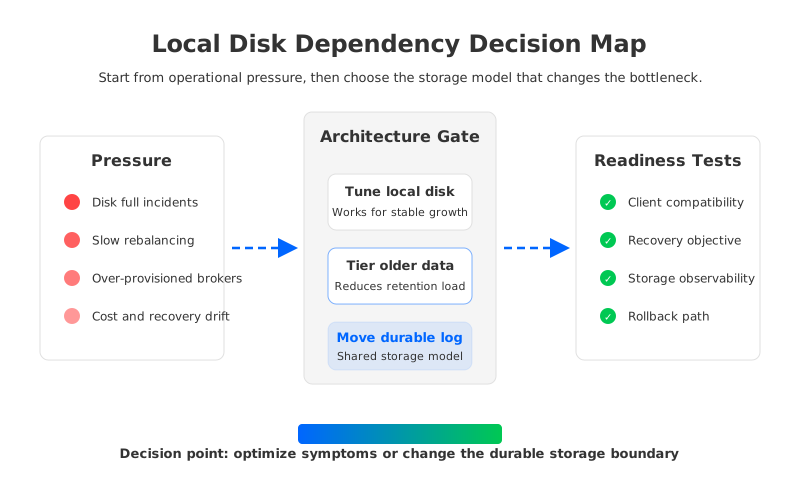
The phrase sounds narrow, but the search intent is broad. Platform teams are not trying to delete disks because disks are bad. They are trying to stop local disk from deciding how fast the Kafka platform can scale, recover, retain data, and fit a cloud cost model. In a steady workload, local storage can be predictable. In a fast-changing workload, it turns into a planning tax paid by SREs, FinOps, and application teams at the same time.
The operational symptoms tend to cluster around a few pressure points:
- Capacity is provisioned at the wrong boundary. Brokers are sized for a combined CPU, network, partition, and storage profile, even when one dimension grows faster than the rest.
- Data movement becomes recovery work. Replacing a broker or rebalancing partitions can require moving retained logs, not only restoring serving capacity.
- Retention turns into infrastructure planning. A topic-level business requirement, such as keeping events for audit replay, changes broker disk sizing and upgrade risk.
- Cloud networking becomes part of storage economics. Replication, client locality, and cross-zone paths can turn a reliability design into a recurring cost line.
None of these problems prove that local disk is wrong for every Kafka cluster. They prove that local disk is not a neutral implementation detail. It is an operating model. Once a team sees that, the evaluation becomes more useful: keep broker-local storage where it matches the workload, use tiered storage where old data is the pressure, and study shared storage when the team wants durable stream data to stop living inside individual brokers.
2The Storage Constraint Behind Cloud Kafka
Traditional Kafka follows a Shared Nothing pattern. Each broker owns local log segments for the partitions assigned to it, and Kafka replication keeps additional copies on other brokers. This model made sense for the environment Kafka came from: machines had attached disks, clusters were built from similar nodes, and moving data between machines was part of running the system. The broker was the natural unit of compute, storage, and failure ownership.
Cloud infrastructure changes that assumption. Compute instances are elastic, object storage is regionally durable, and network paths have explicit cost and locality behavior. A Kafka cluster that still treats broker-local storage as the durable center has to translate cloud elasticity back into broker-shaped operations. Add brokers, and partition data may need to move. Remove brokers, and the system must decide where their replicas go. Increase retention, and the disk plan changes even if CPU demand stays flat.
This is why "diskless Kafka" discussions can be confusing. A system still needs durable storage, write protection, cache behavior, metadata coordination, and failure recovery. Removing local disk dependency does not mean removing storage from Kafka operations. It means moving the durable boundary away from individual broker disks so brokers can behave more like replaceable compute units.
That shift changes the runbook. Instead of asking how long it takes to rebuild a broker's local log, the team asks whether acknowledged writes are protected, whether the durable log is accessible from replacement brokers, whether metadata can safely assign ownership, and whether cache warm-up is visible. The hard problems remain, but they move to places that may fit cloud infrastructure better.
3Architecture Options: Local Disk, Tiered Storage, and Shared Storage
There are three common paths, and they should not be treated as interchangeable. Keeping broker-local storage and tuning it is a valid answer when workloads are stable, retention is bounded, and the team has mature capacity automation. Apache Kafka also includes tiered storage capabilities that offload older log segments to remote storage while the active log remains broker-local. That can be a strong fit when the main pain is long retention rather than broker replacement or compute-storage coupling.
Shared storage is a different architectural move. In a Kafka-compatible shared-storage system, durable stream data is designed around a shared layer such as object storage, while brokers focus on protocol handling, leadership, caching, scheduling, and write staging. The system still needs a low-latency path for acknowledged writes, often through a write-ahead log design, because object storage alone is not a drop-in replacement for every broker-local write path. The point is not that brokers become stateless in the mathematical sense; the point is that long-lived partition history is no longer owned by one broker's local disk.
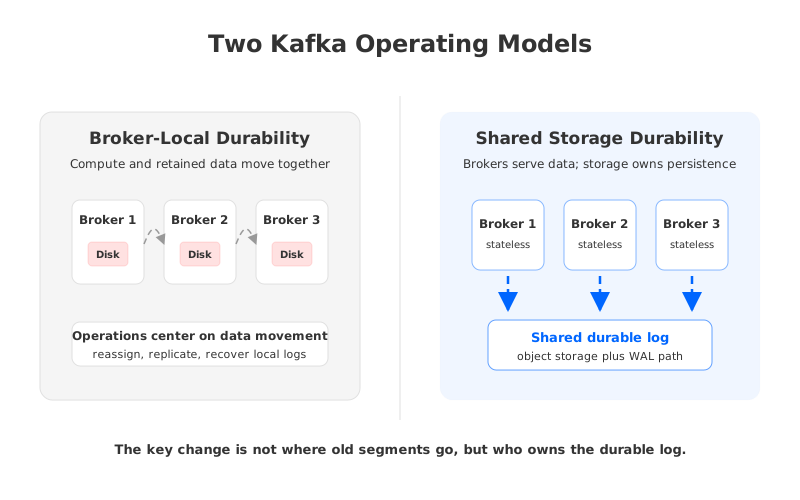
The differences matter most during operations:
| Question | Broker-local Kafka | Tiered storage | Shared storage Kafka-compatible design |
|---|---|---|---|
| Where does the active write path depend on storage? | Broker-local disk | Broker-local disk for hot data | WAL and shared storage design |
| What problem is it strongest at solving? | Predictable low-latency clusters | Long retention pressure | Compute-storage decoupling and faster broker replacement |
| What stays operationally important? | Disk sizing, replica placement, reassignment | Hot-tier sizing and remote-tier behavior | WAL health, object storage, cache, metadata, network locality |
| What should teams verify first? | Capacity and failure-domain plans | Topic eligibility and read patterns | Kafka compatibility and recovery semantics |
The table is intentionally practical. If your cluster mainly needs longer retention for compliance replay, tiered storage may reduce disk pressure without changing the whole platform. If the pain is that every scale event, broker replacement, or recovery drill is dominated by local data ownership, a shared-storage model deserves a deeper look. If the team cannot tolerate any change in operational semantics, local disk plus better automation may be the safer near-term move.
4Evaluation Checklist for Platform Teams
Removing broker-local disk dependency is a production decision, not a diagramming exercise. The architecture must preserve the Kafka behaviors applications rely on while changing the infrastructure behaviors operators struggle with. That makes the checklist broader than storage throughput. It should cover compatibility, durability, cost, security, migration, rollback, and observability before any team treats the target architecture as production-ready.
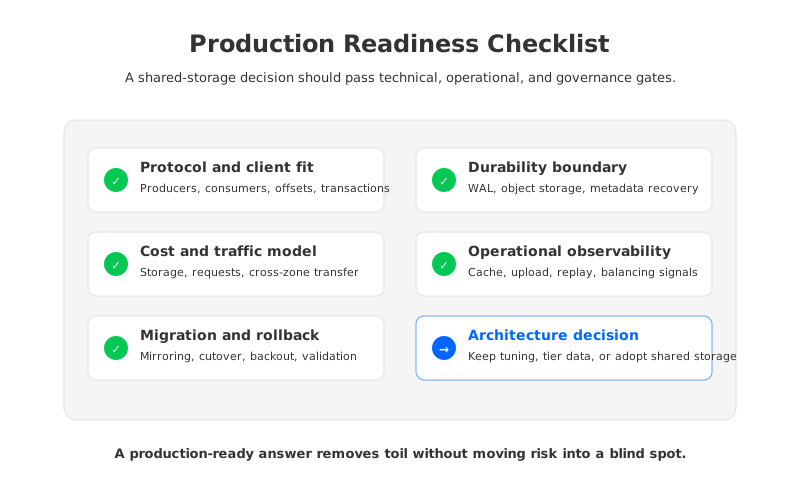
Start with protocol and client compatibility. Kafka clients care about topics, partitions, offsets, consumer groups, producer acknowledgments, transactions where used, ACL expectations, and operational tooling. A Kafka-compatible platform should be tested with the actual client versions, serializers, connector tasks, monitoring probes, and failure patterns your estate uses. A small benchmark that only measures happy-path produce and consume throughput will miss the behaviors that matter during cutover.
Durability is the next gate. In broker-local Kafka, the mental model is concrete: replicas on separate brokers protect data. In a shared-storage design, the team needs a different but equally concrete model: what protects acknowledged writes, what happens before data is uploaded to object storage, how metadata recovers ownership, how the system behaves during an object storage or network impairment, and which alerts prove the durability path is healthy. The model can be stronger, but it must be explicit.
Cost evaluation should include more than disk price. Teams should model instance types, attached storage, object storage capacity, object storage requests, cross-zone or inter-zone traffic, private connectivity, observability cost, and operational labor. The important comparison is not "disk versus object storage" as a unit price. It is the monthly cost of satisfying the same retention, replay, availability, and scaling requirements under each architecture.
Governance also changes. When durable data moves into shared storage, the platform team has to define who controls buckets or equivalent storage resources, encryption keys, identity policies, region boundaries, backup assumptions, and deletion workflows. For BYOC-style deployments, this can be an advantage because data and cloud resources remain inside the customer boundary. It still requires clear ownership. A storage layer that is shared across brokers should not become a storage layer nobody owns.
The final gate is migration and rollback. A good plan defines source and target clusters, mirroring strategy, producer cutover, consumer offset handling, validation queries, lag thresholds, and the conditions that trigger rollback. The rollback path must be rehearsed while the source cluster is still a valid recovery point. Once consumers, producers, and retention policies diverge, "we can go back" becomes a hope instead of a plan.
5How AutoMQ Changes the Operating Model
Once the evaluation is framed this way, AutoMQ fits as a Kafka-compatible shared-storage architecture rather than a generic Kafka hosting option. AutoMQ keeps the Kafka protocol surface while redesigning the storage layer around S3Stream, WAL storage, object storage, and stateless brokers. In practical terms, brokers are no longer the long-term home of retained partition data. They still serve Kafka traffic, coordinate leadership, use cache, and participate in cluster operations, but durable stream data is centered on shared storage.
That changes the shape of several routine tasks. Scaling compute does not have to imply moving the same volume of retained data between broker disks. Broker replacement is less tied to preserving a specific local volume. Retention growth can be evaluated against object storage economics and replay behavior instead of broker disk ceilings alone. AutoMQ also documents zero cross-AZ traffic capabilities for reducing inter-zone transfer in supported cloud layouts, which is relevant when Kafka replication traffic has become part of the cost problem.
The trade-off is worth stating clearly. A shared-storage architecture does not remove the need for engineering discipline. It changes what the team must observe and test. WAL health, object storage latency, upload progress, cache efficiency, metadata correctness, and cloud identity policy become first-class operational topics. That is a better deal only when those topics are easier to control than broker-local data movement, disk expansion, and replica reassignment in the current environment.
For many teams, the right adoption path is not a flag day. Start with a workload where the local disk dependency is already expensive: high retention with irregular replay, clusters with frequent broker replacement, environments where compute and storage grow at different rates, or teams that want Kafka compatibility inside their own cloud account. Keep the first proof of concept narrow enough to learn the target failure model. Then widen it after the team can explain both recovery paths without hand-waving.
6A Practical Migration Scorecard
A platform team can turn the decision into a scorecard before it runs a proof of concept. Give each category a plain status: green when it is tested, yellow when assumptions remain, and red when the risk is not yet owned. The score itself matters less than the discussion it forces.
| Category | Green signal | Red signal |
|---|---|---|
| Compatibility | Real clients and tools pass functional tests | Testing stops at a synthetic producer and consumer |
| Durability | Failure drills prove write protection and recovery | The team cannot explain the WAL and storage boundary |
| Cost | Model includes compute, storage, requests, and traffic | The model compares only disk capacity to object storage capacity |
| Operations | Alerts cover cache, upload, storage, metadata, and balancing | Existing Kafka disk alerts are renamed without new signals |
| Migration | Cutover and rollback are rehearsed | Rollback depends on assumptions after source and target diverge |
| Governance | Cloud resources, keys, and deletion policy have owners | Shared storage is treated as an implementation detail |
The scorecard also prevents a common mistake: treating tiered storage and shared storage as competing slogans. They solve overlapping but different problems. Tiered storage is often the least disruptive answer to long-retention pressure. Shared storage is the answer to a deeper operating-model problem: durable data should not be locked to the lifecycle of individual brokers. Teams that name the problem precisely make better architecture choices.
7Closing Thought
The point of removing local disk dependency from Kafka operations is not to make storage disappear. Storage is still the source of durability, replay, and trust. The point is to stop broker-local disks from quietly deciding every scaling, recovery, and retention conversation. If that constraint is already shaping your Kafka roadmap, review the AutoMQ architecture overview and test the shared-storage model against one workload where the current local-disk boundary is causing measurable operational drag.
8References
- Apache Kafka documentation: Tiered Storage
- Apache Kafka release notes: Apache Kafka 3.9.0 release announcement
- Apache Kafka documentation: Consumer groups
- AutoMQ documentation: Architecture overview
- AutoMQ documentation: S3Stream shared streaming storage
- AutoMQ documentation: Eliminate inter-zone traffic
9FAQ
9.1Does removing local disk dependency mean Kafka no longer needs storage?
No. It means durable stream data is no longer designed around the lifecycle of individual broker-local disks. A production system still needs write protection, durable storage, metadata recovery, cache behavior, observability, and clear ownership.
9.2Is Kafka tiered storage the same as shared storage?
No. Tiered storage moves older completed log segments to remote storage while the active log remains tied to broker-local storage. Shared storage makes the durable storage layer a primary part of the architecture, with brokers acting more like replaceable compute nodes.
9.3When should a team keep broker-local Kafka?
Keep broker-local Kafka when workloads are stable, retention is bounded, operational automation is mature, and the team does not see broker-local data movement as a recurring bottleneck. Architecture change is expensive, so the operational pressure should be real before migration becomes attractive.
9.4What should a proof of concept test first?
Test real client compatibility, acknowledged-write durability, broker replacement, scale-out and scale-in behavior, replay from retained data, observability, and rollback. Throughput is important, but it is not enough to prove the operating model.
9.5Where does AutoMQ fit in this decision?
AutoMQ fits when a team wants Kafka protocol compatibility with shared storage, stateless brokers, object-storage-backed durability, and customer-controlled deployment boundaries. It should be evaluated with the same checklist as any production streaming platform: compatibility, durability, cost, governance, migration, and operations.


