
Table of Contents
Table of Contents
Teams searching for an open source WarpStream alternative usually are not asking a philosophical question. They are trying to reduce dependency risk around a production event-streaming platform that sits between applications, data systems, security controls, and incident response. "Open" becomes a practical requirement: can the team inspect the system, keep Kafka clients and tools working, run the data plane where governance requires it, and leave later without rewriting half the platform?
That question became sharper after Confluent announced that it completed the acquisition of WarpStream on September 9, 2024. The acquisition does not make WarpStream technically weaker. It does, however, change the procurement context. Buyers who were attracted to WarpStream for cloud-native Kafka economics, object storage, and BYOC boundaries may now ask how roadmap, packaging, support, and commercial terms will evolve inside a larger vendor portfolio.
An open-source-friendly replacement should therefore be judged by more than whether it accepts Kafka protocol traffic. Kafka estates are social and operational systems as much as they are brokers. They include client libraries, Connect pipelines, stream processing applications, ACLs, topic conventions, monitoring dashboards, runbooks, compliance reviews, and engineers who know how Kafka behaves under pressure.
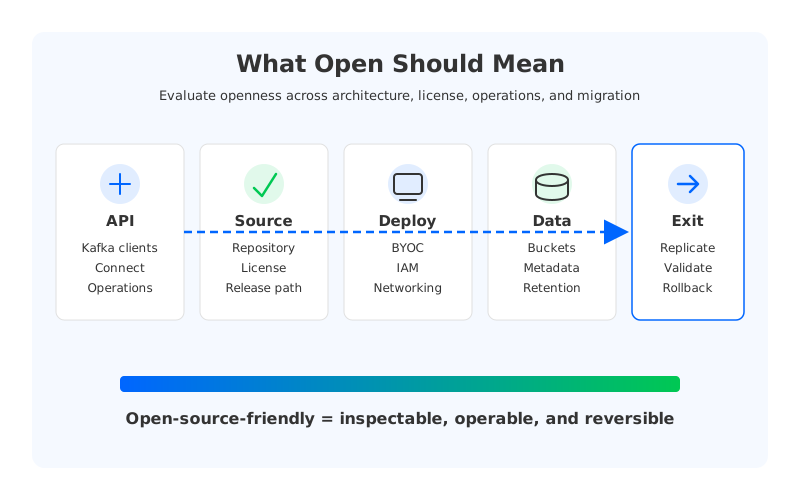
1Why open-source posture matters after vendor consolidation
Vendor consolidation changes the questions a buyer should ask. Before consolidation, the core question is often product fit: does the platform solve the storage, cost, and operations problem better than existing Kafka? After consolidation, product fit still matters, but the governance surface gets wider. The buyer also has to reason about integration into the acquirer's portfolio, future SKU boundaries, support channels, roadmap priority, pricing signals, and the exit path if the combined platform no longer matches the team's constraints.
For streaming infrastructure, those concerns are not abstract. Kafka clusters often become a shared internal utility. A decision made by one platform team can affect application teams, analytics users, security reviewers, and cloud finance. If the platform later becomes harder to run, harder to budget, or harder to leave, the switching cost is paid across the organization.
That is why "open-source-friendly" is a useful phrase, but only if it is defined carefully. It does not mean every component must be community-governed in the same way as Apache Kafka. It does not mean commercial support is a problem. It means the buyer has enough technical and contractual surface area to verify the platform, operate it responsibly, and preserve optionality.
The strongest evaluation starts with the parts of Kafka that must remain open in practice:
- The application surface: producers, consumers, admin clients, Connect, Streams, schemas, and observability integrations should remain familiar.
- The operational surface: deployment, failure handling, scaling, upgrades, backup, and audit boundaries should be reviewable by the team that owns production.
- The legal surface: licenses, commercial editions, and support terms should be understandable before the platform becomes hard to replace.
- The data surface: durable data, metadata, object storage layout, and migration tooling should not become opaque dependencies.
- The exit surface: the buyer should know how to move topics, offsets, workloads, and operational ownership away from the platform.
This is a stricter bar than "Kafka-compatible." A system can be Kafka-compatible for day-one client traffic and still be closed in the places that matter during a security review, cost review, or migration review.
2Five dimensions of openness
The first dimension is API and protocol compatibility. Apache Kafka's public documentation describes a broad platform surface: producers and consumers, topic configuration, consumer groups, transactions, security, Kafka Connect, MirrorMaker, Streams, and operational tooling. A replacement should preserve the parts your workloads use, not the parts a vendor demo happens to exercise. Compatibility testing should include failure cases, consumer lag recovery, offset commits, connector behavior, transactional producers if used, and admin operations such as topic changes.
The second dimension is source and license clarity. Apache Kafka is licensed under the Apache License 2.0, which is a familiar baseline for many enterprise legal teams. For alternatives, read the repository, license, contributor model, commercial edition boundary, and release process. The question is not whether a vendor has a GitHub repository. The question is whether your engineers and legal reviewers can understand what is open, what is proprietary, what can be self-built, and what requires a commercial relationship.
The third dimension is deployment control. WarpStream's documentation describes an architecture where agents run in the customer's cloud account while a WarpStream control plane coordinates the service. That model can be attractive because the data plane lives close to the buyer's cloud boundary. An open-source-friendly replacement should make similar boundaries explicit: where brokers run, where metadata lives, what credentials are needed, what support access exists, and how logs and metrics flow.
The fourth dimension is data ownership. Object storage as primary storage can improve the economics and elasticity of Kafka-like systems, but it also changes the data governance questions. Who owns the buckets? What format is stored? What happens if the control plane is unavailable? Can data be inspected, retained, deleted, or migrated according to internal policy? If a vendor says "your data stays in your cloud," the follow-up is "what exactly can we do with it without the vendor?"
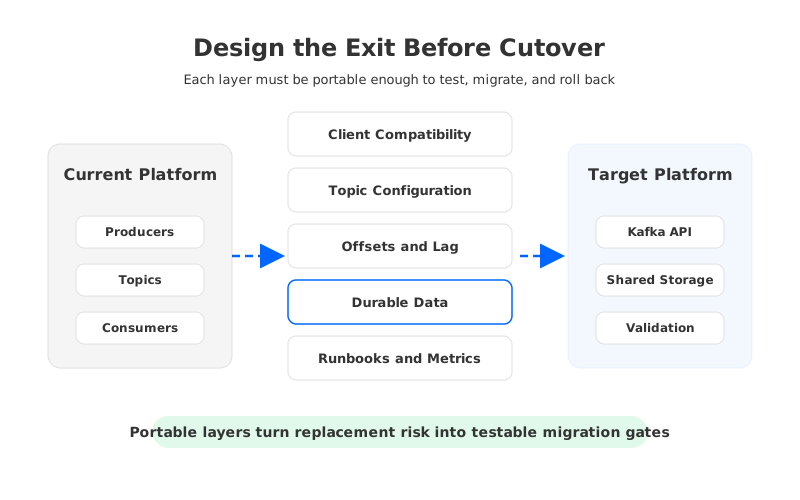
The fifth dimension is operational reversibility. A good exit path is not a dramatic disaster plan. It is an everyday architecture property. If you can replicate data out, preserve offsets or rebuild them predictably, run parallel consumers, validate topic configs, and cut over producer traffic with rollback windows, you have leverage. If the platform hides key metadata or makes migration dependent on bespoke services, openness becomes weaker at the moment you need it most.
| Openness dimension | What to ask | What good looks like |
|---|---|---|
| API and protocol | Which Kafka APIs and ecosystem tools are supported for our workload? | Existing clients and operations work with measured, documented exceptions |
| Source and license | What code is available, under which license, and where is the commercial boundary? | Legal and engineering teams can inspect the license and build path |
| Deployment control | Which components run in our account, and which depend on a vendor control plane? | Data-plane, metadata, IAM, network, logs, and support access are mapped |
| Data ownership | Where do log data and metadata live, and how can they be exported? | Durable data is governed by the buyer and migration paths are tested |
| Exit path | How would we leave without rewriting applications? | Replication, validation, cutover, and rollback are part of the design |
3How to evaluate WarpStream alternatives
Start by separating architecture fit from openness fit. WarpStream's value proposition is not generic managed Kafka. It is closer to a diskless, object-storage-backed Kafka-compatible architecture in which agents handle the data plane in the customer's environment. A replacement that preserves governance but returns to broker-local disks may solve the open-source concern while reopening the scaling and storage-cost problem. A replacement that preserves object storage but closes source, license, and exit-path visibility may solve the cost concern while leaving the governance concern unresolved.
The evaluation should therefore compare categories:
- Apache Kafka gives the strongest ecosystem and license baseline. It is the reference point for compatibility and governance, but teams still own broker-local storage, replication, partition reassignment, and capacity planning unless they add managed services or tiered storage features.
- Managed Kafka services reduce operational burden, but the provider's control plane, service packaging, and pricing model determine how open the operating boundary feels in practice.
- Diskless or object-storage-first systems target the same cloud cost and elasticity problem that made WarpStream interesting. They need deeper validation around latency, fetch-heavy workloads, compaction, metadata behavior, and failure recovery.
- Kafka-compatible shared-storage systems try to keep the Kafka ecosystem while changing the storage architecture. These systems should be judged on compatibility, license clarity, deployment model, and whether stateless compute actually reduces day-two operations for your workloads.
Use a workload inventory before vendor conversations. Record topic count, partition count, retention policies, compaction usage, peak produce throughput, sustained throughput, read fan-out, consumer lag tolerance, connector dependencies, schema registry dependencies, security requirements, and disaster recovery expectations. Without that inventory, "open" can become a branding discussion instead of an engineering review.
The PoC should contain the uncomfortable tests. Run normal traffic, peak traffic, consumer replay, broker failure, scale-out, scale-in, object storage impairment where safe, schema evolution, ACL checks, connector restart, and rollback. A platform that looks open on paper but requires opaque vendor intervention during these tests is not open enough for critical streaming workloads.
4Where AutoMQ fits
After the rubric is explicit, AutoMQ becomes one candidate in a clear architecture category rather than a slogan. AutoMQ is an open source Kafka-compatible streaming system whose public repository is available on GitHub under the Apache License 2.0. Its architecture uses S3-compatible object storage through S3Stream as the persistent storage layer and treats brokers as stateless compute, which is intended to reduce the data movement associated with traditional Kafka broker-local disks.
That positioning matters for teams replacing WarpStream because it addresses two separate concerns at once. The first is architectural: keep the Kafka protocol and ecosystem while moving durable storage to object storage. The second is governance-oriented: give engineering teams source visibility, license clarity, and deployment patterns that can be reviewed before a production commitment.
AutoMQ should still be evaluated with the same discipline as any other replacement. Open source availability does not remove the need to test latency, compatibility, operational maturity, support model, observability, upgrade behavior, or feature coverage. A Kafka-compatible system can be a close fit for producers and consumers while still requiring careful review for transactions, compaction, security integrations, Connect workloads, and internal platform automation.
The useful question is not "Is AutoMQ more open?" in the abstract. The useful question is whether AutoMQ makes the specific boundaries your organization cares about inspectable:
- Can engineers inspect the source and license before architecture review?
- Can the platform team run a PoC in the target cloud environment?
- Can existing Kafka clients and tools move with acceptable change?
- Can object storage ownership, IAM, encryption, logs, and metrics be mapped clearly?
- Can the team design an exit path before the first production cutover?
If the answer is yes for your workload, AutoMQ belongs on the shortlist for an open-source-friendly WarpStream replacement. If the workload depends on a specific WarpStream feature, a particular Confluent integration, or a managed-service operating model that your team does not want to own, the shortlist should reflect that reality.
5Governance checklist for an open-source-friendly replacement
The final decision should be made with a checklist that both platform engineering and procurement can read. Keep the checklist concrete enough that each item can be marked pass, fail, or needs PoC evidence.
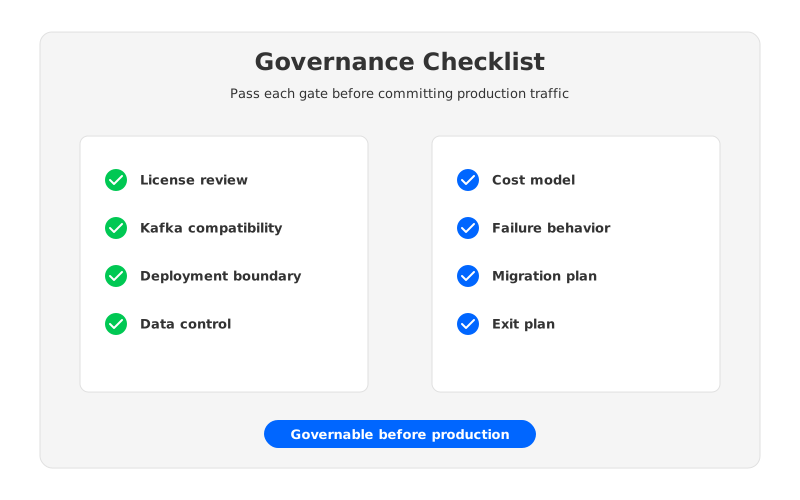
| Gate | Required evidence |
|---|---|
| License review | Repository, license file, commercial boundary, dependency notices, support terms |
| Kafka compatibility | Tested clients, admin APIs, consumer groups, Connect, Streams, security, schemas |
| Deployment boundary | Component map for brokers or agents, control plane, metadata, object storage, IAM, network |
| Data control | Bucket ownership, encryption, retention, deletion, backup, export, audit logs |
| Cost model | Compute, object storage, requests, network, control plane, support, operational labor |
| Failure behavior | Broker or agent failure, control-plane impairment, object storage errors, recovery procedure |
| Migration plan | Topic inventory, replication, offset strategy, producer cutover, consumer validation, rollback |
| Exit plan | Documented path to move data and workloads away before production commitment |
This checklist also prevents a common mistake: treating open source as a yes-or-no label. Openness is stronger when source visibility, license terms, deployment control, data ownership, and exit mechanics reinforce each other. It is weaker when one layer is open but another layer becomes the real lock-in point.
For teams replacing WarpStream, the goal is not to reject commercial platforms. The goal is to keep streaming infrastructure governable. A platform can be commercially supported and still be open-source-friendly if it gives buyers enough visibility and control to operate responsibly. A platform can be technically elegant and still be risky if the exit path is not credible.
6FAQ
6.1Is WarpStream open source?
WarpStream is documented as a commercial Kafka-compatible streaming service with a BYOC architecture. Teams evaluating its openness should review the current WarpStream documentation, license information, product packaging, and contractual terms directly rather than assuming that Kafka compatibility implies open source availability.
6.2Does Kafka compatibility mean an alternative is open?
No. Kafka compatibility is one layer. An open-source-friendly Kafka alternative should also provide license clarity, inspectable code where relevant, deployment control, data ownership, and a tested exit path.
6.3Why does the Confluent acquisition matter for replacement planning?
Confluent completed its acquisition of WarpStream on September 9, 2024. That fact can change procurement questions around roadmap, packaging, support, and pricing. It does not by itself determine whether WarpStream is a good or poor technical fit.
6.4Is Apache Kafka the safest open source replacement?
Apache Kafka is the reference open source baseline and remains a strong option when a team wants maximum ecosystem standardization and can operate Kafka well. It may not solve the same object-storage-first and stateless-scaling goals that led the team to evaluate WarpStream.
6.5Where does AutoMQ differ from traditional Kafka?
AutoMQ keeps Kafka compatibility as the application-facing surface while using S3-compatible object storage as the persistent storage layer. Its stateless broker design targets faster scaling and recovery by reducing dependence on broker-local durable disks.
6.6What should a PoC prove before replacing WarpStream?
A PoC should prove compatibility for critical clients and tools, predictable cost drivers, clear data-plane boundaries, failure behavior, migration mechanics, and rollback. The exit path should be designed before production traffic moves.


