
Table of Contents
Table of Contents
A Confluent replacement project rarely fails because the new Kafka broker cannot accept a producer request. The harder failures show up around the broker: CDC connectors that depend on a packaged plugin, ETL jobs whose offsets no longer mean what the team thinks they mean, schemas registered under subject names that client code assumes are permanent, and compatibility rules that quietly protect downstream consumers from breaking changes. Broker compatibility matters, but it is only one layer in a larger data movement contract.
That distinction is easy to miss because Confluent Platform packages several concerns under one operational umbrella. Kafka Connect moves data between Kafka and external systems. Schema Registry stores schemas and enforces evolution rules for Avro, JSON Schema, and Protobuf workloads. Converters, serializers, connector plugins, worker internal topics, dead letter queues, and monitoring conventions all become part of the production surface area. Replacing Confluent means deciding which of those surfaces remain unchanged, which are replatformed, and which need a controlled cutover.
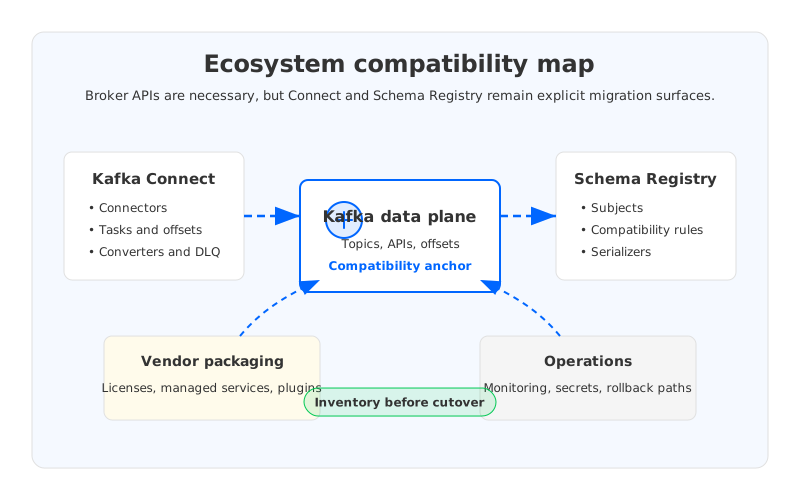
The practical migration question is not "can we run Kafka elsewhere?" It is "can every pipeline continue to interpret data, offsets, schemas, and errors the same way after the change?" For data engineering and platform teams, that question should be answered before the broker switch, not during the first failed connector restart.
1Why broker compatibility is not the whole migration
Kafka Connect is part of Apache Kafka and uses Kafka as its durable coordination and storage layer. In distributed mode, workers use internal topics for connector configuration, offsets, and task status. Connectors also create their own operational dependencies: source systems, sink systems, credentials, transformations, converters, error handling behavior, and plugin packaging. A broker replacement that preserves Kafka protocol behavior can keep many of those mechanics intact, but it does not automatically validate every connector binary or license term.
Schema Registry adds another contract. Producers and consumers do not only exchange bytes; they often exchange a schema ID embedded by a serializer, then use Schema Registry to resolve the schema and validate evolution. A consumer may be compatible with the Kafka broker and still fail if the subject naming strategy changes, if compatibility is set differently, or if the registry endpoint and credentials are not carried forward. This is why the migration plan needs a compatibility inventory, not a generic "Kafka compatible" checkbox.
The inventory should separate three layers:
- Kafka protocol and client behavior. Producers, consumers, Connect workers, and stream processors must be able to use the same Kafka APIs, security model, topic configuration expectations, and offset semantics.
- Ecosystem service behavior. Kafka Connect workers, connectors, converters, Schema Registry APIs, serializers, compatibility levels, and subject naming strategies must be tested as explicit migration surfaces.
- Vendor-specific packaging and operations. Managed connectors, proprietary connector builds, commercial licenses, monitoring dashboards, RBAC integrations, and cloud-specific networking assumptions need separate review.
This separation keeps the project honest. It lets a team say, for example, "our Kafka clients can remain mostly unchanged, but our Oracle CDC connector license and Schema Registry subject migration still need proof." That is a much better status report than discovering the same boundary after production cutover.
2Kafka Connect migration checklist
Start with Connect because it is where broker compatibility meets real external systems. A connector does not only talk to Kafka; it talks to MySQL, PostgreSQL, Oracle, S3, Snowflake, Elasticsearch, JDBC targets, object stores, SaaS APIs, and internal services. The migration should therefore inventory both the Connect framework objects and the non-Kafka dependencies that each connector reaches.
At minimum, export or document these objects for every Connect cluster:
- Connector names, connector classes, plugin versions, worker mode, task counts, and connector configuration with secrets redacted.
- Source and sink systems, network paths, authentication methods, and any allowlists tied to old Confluent infrastructure.
- Single Message Transforms, predicates, converters, header converters, key/value schema settings, and dead letter queue configuration.
- Internal topics for config, offsets, and status, including replication factor, cleanup policy, partitions, and retention settings.
- Operational expectations such as restart behavior, task assignment, error tolerance, backoff settings, monitoring alerts, and runbooks.
The internal topics deserve special attention. Kafka Connect distributed workers store connector configurations, source connector offsets, and status information in Kafka topics configured by properties such as config.storage.topic, offset.storage.topic, and status.storage.topic. Treat those topics as state, not as incidental metadata. If you rebuild a Connect cluster without preserving or intentionally resetting that state, a source connector may reread from an old position, a sink connector may replay records, or operators may lose the status history they rely on during incident response.
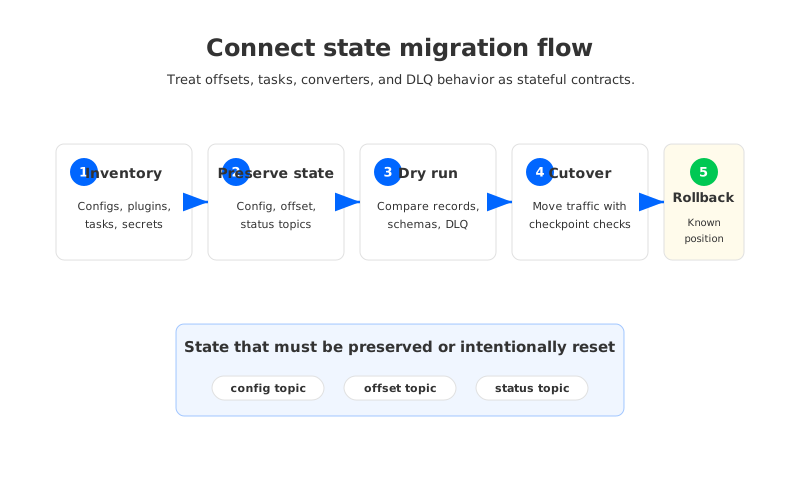
Converter compatibility is the next common trap. A Connect worker can use JSON, Avro, Protobuf, or String converters, and Confluent's Avro, Protobuf, and JSON Schema converters commonly integrate with Schema Registry. A connector migration that changes the converter class, converter options, schema enablement, or registry URL can change the bytes written to Kafka even when the connector class is the same. That is why test runs should compare record keys, values, headers, schemas, tombstones, and error output, not only connector liveness.
The licensing question belongs in the first week of planning, not procurement cleanup. Some connectors are open source, some are commercial, some are packaged for Confluent Platform, and some are managed service features rather than portable binaries. Do not promise a seamless migration for proprietary connectors until the license, redistribution rights, version support, and runtime dependencies are verified. The engineering work may be straightforward; the right to run the same artifact in a different environment may not be.
3Schema Registry migration checklist
Schema Registry looks simpler than Connect because it has a clear API surface: subjects, versions, schema IDs, compatibility settings, and serializer/deserializer integrations. In production, however, those objects encode years of application assumptions. Client teams may not remember which subject naming strategy they use. Batch jobs may have hard-coded registry URLs. Consumers may depend on backward compatibility rules without knowing the term "backward compatibility."
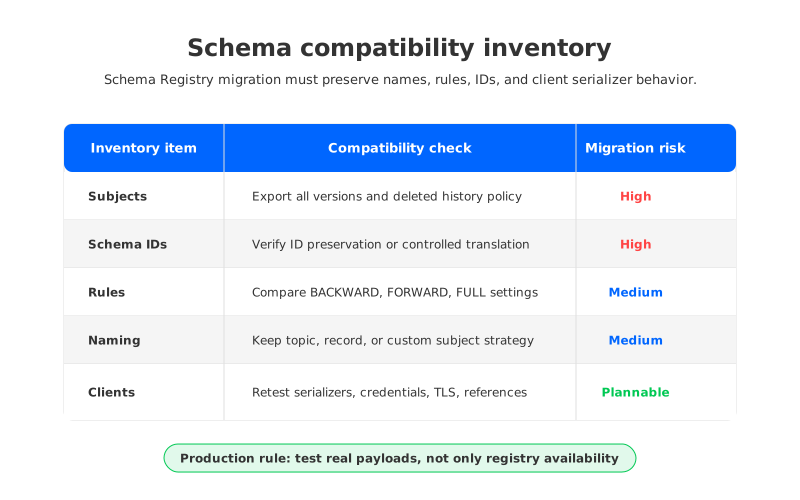
For each registry environment, inventory the following before changing endpoints:
| Object | Why it matters during replacement |
|---|---|
| Subjects and versions | Producers and consumers resolve schema history through subject/version metadata, not only through the latest schema. |
| Schema IDs | Serialized payloads often carry a registry schema ID, so ID preservation or controlled translation must be planned. |
| Compatibility levels | Rules such as BACKWARD, FORWARD, FULL, and transitive variants define whether new schemas can safely coexist with old data and clients. |
| Subject naming strategy | Topic-based, record-based, or custom strategies change which subject a client reads or writes. |
| Client serializers | Avro, Protobuf, and JSON Schema serializers each have configuration and schema reference behavior that must be retested. |
3.1Subjects and compatibility rules
Confluent documents compatibility types such as backward, forward, full, and their transitive variants. The words are familiar, but the migration implication is specific: compatibility is evaluated per subject according to configured rules. If the replacement registry has a different default compatibility level, a schema that used to be rejected may be accepted, or a schema that used to pass may fail. Both outcomes are operationally dangerous because they change the guardrails around event evolution.
The safest approach is to export subject-level settings and compare them against the target registry before any client writes to it. Global defaults are useful, but they are not enough when individual subjects override the default. Teams should also identify deleted subjects, soft-deleted history, schema references, and any client behavior that auto-registers schemas. Auto-registration is convenient in development, but during migration it can create new subjects or versions before the target registry has been validated.
3.2Producers, consumers, and serializers
Serializer configuration is where registry migration reaches application code. A Java producer using Confluent's Avro serializer, a Kafka Connect sink using an Avro converter, and a Python consumer using a registry-aware deserializer may all depend on the same registry service through different configuration paths. The broker can be fully reachable while one of those clients fails because the registry URL, credentials, TLS settings, subject naming strategy, or schema reference behavior changed.
Test payload compatibility with real messages. Produce sample records from each critical pipeline, consume them with existing downstream clients, and verify that schema IDs resolve as expected. Include deletes and tombstones for compacted topics, nullable fields, logical types, Protobuf references, JSON Schema validation behavior, and headers if downstream systems use them. A migration that only validates a happy-path insert record is not testing the contract that CDC and ETL workloads actually depend on.
4Vendor-specific dependencies to find early
Confluent replacement planning often starts with cost, control, or cloud architecture goals. Those are valid motivations, but ecosystem dependencies are where hidden coupling lives. A team may believe it is using "Kafka Connect" when the runtime depends on a Confluent-managed connector, a proprietary connector package from Confluent Hub, a platform-specific secret provider, or a monitoring workflow built around Confluent Control Center. None of those should be treated as Apache Kafka compatibility.
The dependency review should ask blunt questions:
- Is this connector open source, commercially licensed, or only available as a managed connector?
- Does the connector version support the target Kafka version, Java version, authentication mechanism, and deployment model?
- Does it depend on Confluent-specific libraries, interceptors, metrics reporters, secret providers, or REST extensions?
- Can offsets be preserved safely, or should the pipeline cut over through a controlled replay window?
- What is the rollback path if a source connector resumes from the wrong position or a sink connector duplicates writes?
These questions are not a warning against migration. They are what make migration boring in the best sense. The more specific the dependency map is, the less the team has to rely on hope during cutover.
5How AutoMQ fits into the broader migration plan
AutoMQ is a Kafka-compatible, cloud-native streaming engine that reimplements Kafka's storage layer on object storage while preserving Kafka protocol and API compatibility for common Kafka clients and ecosystem components. In a Confluent replacement project, that compatibility is valuable because it can reduce disruption to producers, consumers, Connect workers, stream processors, and tools that already speak Kafka. The important boundary is that Kafka broker compatibility does not automatically migrate Connect plugins or Schema Registry state.
A useful way to frame AutoMQ is as the Kafka data plane candidate in a larger ecosystem migration. If existing clients and workers can continue to use Kafka-compatible APIs, the team can focus more attention on the surfaces that are not broker APIs: connector artifacts, offsets, converters, registry subjects, compatibility settings, and operational workflows. That division is healthy. It avoids turning a broker evaluation into an untested promise about every service that used to ship with Confluent.
For platform teams, the practical plan usually looks like this:
- Validate Kafka client compatibility against representative producer, consumer, Connect worker, and stream processing workloads.
- Run a Connect compatibility proof for each connector family, including plugin packaging, converter output, offsets, DLQ behavior, and restart semantics.
- Run a Schema Registry proof that exports subjects and compatibility rules, tests serializers and deserializers, and verifies schema ID handling.
- Define cutover and rollback paths per pipeline, not only per cluster.
This is also the right place to involve legal and procurement teams for connector licensing. Engineering can prove that a connector works; the organization still needs permission and support terms to operate it in the target environment. Keep those decisions visible in the migration checklist, because an unlicensed connector is not a technical debt item. It is a production risk.
If your Confluent replacement evaluation includes AutoMQ, use the Kafka compatibility work as the foundation, then build an explicit Connect and Schema Registry plan on top of it. AutoMQ can help preserve Kafka-facing clients and ecosystem integrations, but each connector, converter, schema registry dependency, and proprietary package should still be verified before production cutover. The end state should be a migration plan that names what stays compatible, what changes, and who owns each risk.
6References
- Apache Kafka Documentation: Kafka Connect
- Confluent Documentation: Kafka Connect
- Confluent Documentation: Kafka Connect user guide and converters
- Confluent Documentation: Schema Registry schema evolution and compatibility
- Confluent Documentation: Schema Registry serializers and deserializers
- Confluent Documentation: Schema Registry API
- Confluent Documentation: Confluent Hub client
- AutoMQ Documentation: Compatibility with Apache Kafka
7FAQ
7.1Can I replace Confluent Connect with open-source Kafka Connect?
Kafka Connect is part of Apache Kafka, but a production Connect deployment is more than the framework. You must verify connector plugins, versions, licenses, converters, internal topics, secret handling, monitoring, and restart behavior. Open-source Kafka Connect may be a good foundation, but it does not guarantee that every Confluent-packaged or managed connector can move unchanged.
7.2Can I migrate Schema Registry by pointing clients to a new URL?
Only if the new registry preserves the schema contract your clients depend on. Inventory subjects, versions, schema IDs, compatibility levels, subject naming strategy, serializer configuration, credentials, and TLS settings. Then test real producer and consumer payloads before switching application traffic.
7.3Does Kafka compatibility cover Connect and Schema Registry automatically?
No. Kafka compatibility helps clients and tools that use Kafka protocol and APIs. Kafka Connect workers rely on Kafka, so broker compatibility is important, but connector plugins, converters, offsets, and external systems still need separate validation. Schema Registry is a separate service with its own API and state.
7.4What is the biggest risk in replacing Confluent Connect?
The biggest risk is assuming connector liveness equals data correctness. A connector can start successfully and still write different record bytes, resume from the wrong source position, duplicate sink writes, or route failures differently. Migration tests should compare data output, offsets, schemas, DLQ behavior, and rollback paths.
7.5How should AutoMQ be evaluated in this migration?
Evaluate AutoMQ as a Kafka-compatible broker and data plane option first, using representative clients, Connect workers, and operational workflows. Then evaluate Connect plugins and Schema Registry migration as separate workstreams. That framing preserves the benefit of Kafka compatibility without over-promising seamless migration for proprietary ecosystem components.


