
Table of Contents
Table of Contents
When a platform team searches for replication topology review kafka, the cluster is usually already important enough to make people nervous. The question is not whether Kafka can replicate data. Kafka has mature primitives for replication, consumer groups, offsets, transactions, Kafka Connect, and KRaft-based metadata management. The harder question is whether the current topology still matches the failure modes, cost model, compliance boundaries, and recovery objectives around the business.
Cross-region streaming turns that question into a production review. A topology that worked inside one region can become fragile when the team adds a second region, a backup environment, a migration lane, or a data product that must survive regional disruption. Replication factor, ISR behavior, topic placement, connector ownership, consumer lag, offset translation, network egress, and operational runbooks all start to interact. The review becomes less about drawing arrows between clusters and more about proving that those arrows can carry traffic under stress.
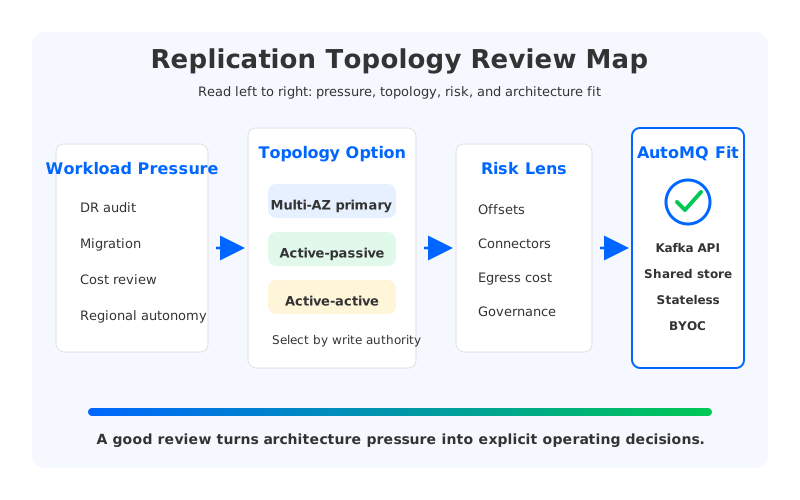
1Why Teams Search for replication topology review kafka
The search intent is usually triggered by a concrete decision. A team may be preparing a disaster recovery audit, consolidating Kafka clusters, separating regulated workloads, or deciding whether active-active streaming is worth the operational cost. In each case, the topology has to answer the same uncomfortable question: what happens when the primary path is no longer available?
That answer has several layers. Producers need a write target, consumers need a consistent offset story, connectors need source and sink ownership, and security teams need to know where data crosses regions or accounts. The topology review is where those layers are reconciled before an incident forces the team to discover them in the wrong order.
For Kafka-compatible platforms, the most useful review starts with business intent rather than product labels:
- High availability inside one region keeps workloads running through broker, node, or availability-zone failures. It is usually evaluated with replication factor, rack awareness, follower fetching, and capacity headroom.
- Disaster recovery across regions keeps the organization able to restore service when a region is impaired. It depends on replicated data, recoverable metadata, tested promotion steps, and realistic recovery point and recovery time objectives.
- Migration and replacement keeps applications moving while both old and target systems run in parallel. It depends on compatibility, dual-write or mirror paths, offset handling, rollback, and observability.
- Data distribution and governance moves selected topics to analytics, AI, lakehouse, or regional teams. It depends on filtering, schema control, identity boundaries, auditability, and connector lifecycle management.
Those goals can share infrastructure, but they should not be treated as the same goal. A topology optimized for audit-friendly disaster recovery may be too slow for active-active application serving. A topology built for bidirectional serving may be too complex for a controlled migration. The review should make that mismatch visible before the team commits to a design.
2The Production Constraint Behind the Problem
Traditional Kafka is a shared-nothing system: brokers own local log segments, partitions are assigned to brokers, and replication moves data between broker-local storage. That model has served Kafka well because it keeps the log abstraction close to the compute process that serves reads and writes.
The pressure appears when the topology must change quickly. Adding capacity means placing more broker-local storage and then moving partitions. Rebalancing a hot topic means copying log data to another broker. Replacing failed capacity means catching replicas up before the cluster has the same safety margin again. Extending the system across regions adds network distance and governance boundaries to a model that already couples compute placement with data placement.
The result is not one single bottleneck. It is a set of coupled constraints that show up during every serious topology review:
| Review Area | What The Team Checks | Why It Becomes Hard Cross-Region |
|---|---|---|
| Data placement | Which broker, zone, region, and account owns each partition | Placement decisions affect storage, network, failover, and compliance at the same time |
| Consumer continuity | Whether offsets and group behavior remain understandable after promotion | Consumers may resume in a different cluster, region, or mirror lineage |
| Connector ownership | Which side runs source and sink connectors | A connector can duplicate writes, reverse data flow, or violate a data boundary |
| Scaling path | How capacity changes during traffic spikes or failover | Broker-local storage can turn scaling into a data movement project |
| Cost exposure | Which paths create inter-AZ, cross-region, PrivateLink, or NAT traffic | Replication and reads can generate durable cloud-network costs |
| Recovery runbook | Who promotes, rolls back, and verifies correctness | The topology may be technically valid but operationally unowned |
This is why topology reviews often become larger than expected. A cross-region Kafka diagram may show two clusters and a replication arrow, but production readiness lives in the details around that arrow. Which topics are mirrored? Where do consumer offsets live? What happens to connectors during failover? Who can promote the secondary side?
3Architecture Options and Trade-Offs
Most teams evaluate three broad patterns. The first is a single regional Kafka cluster with strong multi-AZ design. It keeps metadata, offsets, producers, consumers, and connectors in one administrative boundary. The trade-off is that regional failure becomes a business continuity problem rather than a cluster failover problem.
The second pattern is active-passive replication. A primary cluster serves traffic while a secondary cluster receives mirrored topics and waits for promotion. This is often the clearest disaster recovery model because there is one write authority under normal conditions. The hard parts are recovery point, recovery time, offset continuity, connector freeze rules, configuration drift, and failover exercises.
The third pattern is active-active or multi-writer streaming. It can reduce regional serving latency and support local autonomy, but it raises the bar on application semantics. Kafka gives ordering guarantees within partitions, not a global conflict-resolution system across independently writable regions. If the application cannot tolerate duplicate events, divergent ordering, or region-specific writes, the topology has to encode those constraints explicitly.
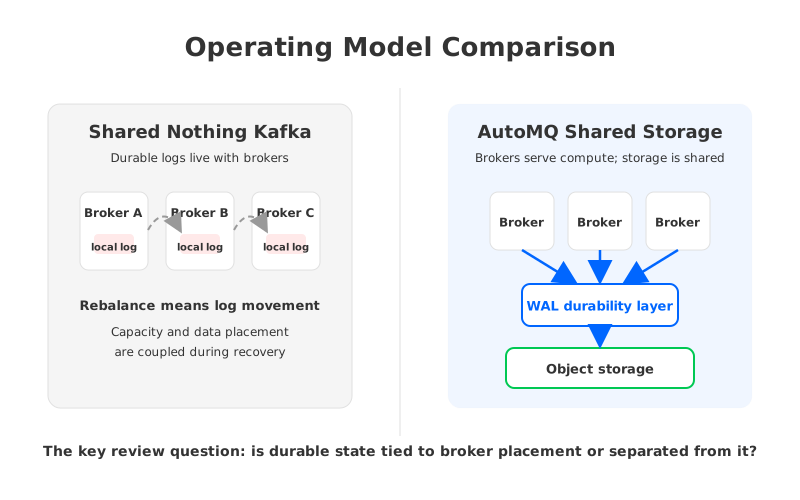
The uncomfortable part is that all three patterns inherit shared-nothing operating cost when the platform keeps durable state on brokers. Replication topology becomes connected to storage topology. Capacity planning becomes connected to data movement. A review that stops at "we have replication" misses the mechanism that determines how the system behaves when traffic, storage, or failure domains move.
Tiered Storage helps with retention economics by moving older log segments to remote storage, and Kafka's own documentation is the right place to evaluate its exact behavior for a given version. But tiering does not automatically make brokers stateless, and it does not remove the need to reason about leader placement, hot data, failover, rebalancing, and client behavior. For topology review purposes, the key distinction is whether object storage is a colder retention tier or the primary durable storage foundation.
4Evaluation Checklist for Platform Teams
A useful replication topology review should produce decisions, not a diagram that looks plausible. The review needs to identify which workloads belong in the topology, which failure scenarios are in scope, and which trade-offs are accepted by application owners. Most topology failures are caused by unclear ownership under pressure, not a missing box on a diagram.
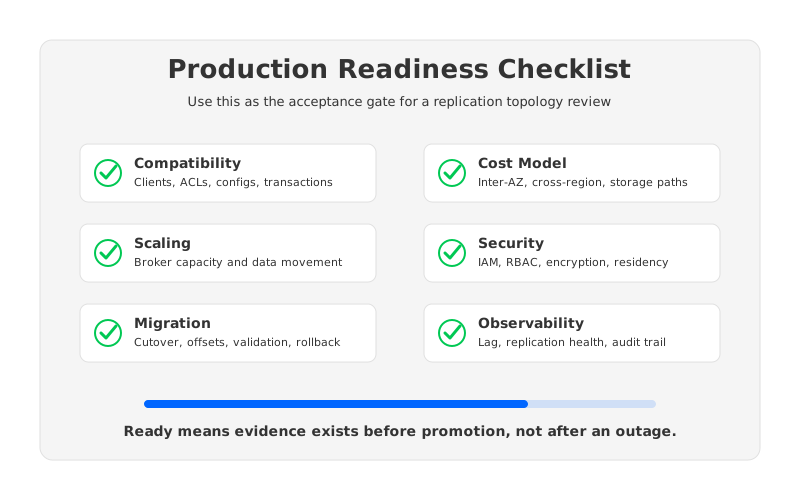
| Dimension | Review Question | Evidence To Collect |
|---|---|---|
| Compatibility | Can current clients, ACLs, topic configs, transactions, connectors, and observability tools operate on the target platform? | Client matrix, integration tests, connector inventory, authentication and authorization mapping |
| Recovery objective | What data loss and recovery time are acceptable per workload class? | RPO/RTO table, failover drill results, topic criticality labels |
| Offset and state | How will consumers resume after promotion or migration? | Offset translation plan, lag metrics, replay tests, stateful processor validation |
| Write authority | Which region or cluster accepts writes under normal and degraded conditions? | Producer routing policy, DNS or service discovery plan, duplicate write controls |
| Cost model | Which replication, fetch, connector, and control-plane paths create network or storage cost? | Cloud billing model, traffic measurements, zone and region placement map |
| Governance | Who can access data and metadata in each region, account, or VPC? | IAM/RBAC design, encryption policy, audit requirements, data residency rules |
| Operations | Who owns failover, rollback, verification, and post-incident reconciliation? | Runbooks, dashboards, alert routes, on-call boundaries |
This checklist should be run per workload class, not once per platform. A fraud detection stream, a marketing analytics feed, and a CDC pipeline feeding a warehouse may all use Kafka-compatible APIs, but they do not carry the same tolerance for lag, replay, duplication, or regional routing.
The review should also separate control-plane recovery from data-plane recovery. KRaft removed the ZooKeeper dependency from Kafka metadata management, but metadata safety is still part of the failure story. A secondary cluster with topic data but mismatched topic settings, ACLs, or connector configs is not ready to take traffic.
5How AutoMQ Changes the Operating Model
After the neutral review is complete, the architecture question becomes sharper: what would change if brokers did not have to be the long-term home of the data they serve? AutoMQ is a Kafka-compatible cloud-native streaming platform that keeps Kafka protocol compatibility while moving durable stream data to shared object storage with stateless brokers. That changes the topology review from "how do we move broker-owned data safely?" toward "how do we place compute, govern access, and recover around shared durable storage?"
In AutoMQ's Shared Storage architecture, brokers rely on an object-storage-backed data layer, with WAL options used for low-latency durability before data is persisted into object storage. The important topology effect is that compute and storage can scale independently. Broker replacement, scaling, and partition movement no longer have to imply the same volume of broker-to-broker log copying that a shared-nothing design would require.
That shift matters for cross-region review. Object storage becomes the durable foundation rather than a remote archive bolted onto broker disks. Recovery is less tied to one broker's local data, and scaling can focus on serving capacity instead of pre-positioning local storage for every spike. Governance boundaries can also map to customer-controlled cloud resources.
AutoMQ's Kafka compatibility is the reason this is relevant to a topology review rather than a greenfield rewrite. Existing clients, Kafka Connect patterns, and migration paths remain part of the discussion. Linking and migration workflows help teams control cutover and rollback; self-balancing reduces the operational weight of capacity changes.
Zero cross-AZ traffic is another review point because network paths are often the hidden cost in regional Kafka operations. Traditional designs can pull replication and reads across availability zones depending on leader and client placement. AutoMQ's documented inter-zone traffic model uses S3-based storage architecture and client/broker configuration to reduce cross-zone transfer exposure, but the review still has to validate the specific cloud, region, and workload.
This does not remove the need for design work. Cross-region writes, conflict handling, connector ownership, and application-level idempotency remain application concerns. A Kafka-compatible platform can preserve familiar APIs, but it cannot decide whether two independently writable regions should merge conflicting business events. The value of changing the storage architecture is narrower: it reduces operational work caused by broker-local durable state.
For a team evaluating replacement or migration, the practical scorecard is straightforward:
| Question | Traditional Shared-Nothing Review | AutoMQ-Oriented Review |
|---|---|---|
| How do we add serving capacity? | Add brokers, allocate disks, rebalance partitions, wait for data movement | Add broker capacity while durable data remains in shared storage |
| How do we recover a failed broker? | Restore replicas and catch up broker-local logs | Replace compute and reconnect to shared durable storage |
| How do we control cross-AZ cost? | Tune rack awareness, follower fetching, leader placement, and client placement | Use S3-based storage architecture plus zone-aware client and broker configuration |
| How do we migrate? | Mirror data, coordinate clients, offsets, configs, and rollback | Use Kafka-compatible migration and linking workflows while validating workload semantics |
| How do we govern deployment boundaries? | Often tied to cluster ownership and broker placement | Map BYOC or private deployment resources to customer-controlled cloud boundaries |
The review should end with a decision, not with a preference for a diagram style. If the business needs active-active writes with conflict reconciliation, that should be stated as an application architecture requirement. If the business needs audit-friendly disaster recovery, the runbook and evidence should matter more than symmetric arrows. If the business wants to reduce the operational drag of broker-local state while keeping Kafka compatibility, shared storage and stateless brokers deserve a serious evaluation.
If your team is reviewing Kafka replication topology as part of a migration, DR audit, or cloud cost review, AutoMQ's architecture docs and migration guidance are a useful next step. You can also contact the AutoMQ team through the verified product contact page with this campaign link: discuss your Kafka-compatible topology review.
6References
- Apache Kafka documentation: consumer groups, offsets, transactions, KRaft, Tiered Storage, Kafka Connect, and producer/consumer configuration: https://kafka.apache.org/documentation/
- AutoMQ Kafka compatibility: https://docs.automq.com/automq/what-is-automq/compatibility-with-apache-kafka.md?utm_source=blog&utm_medium=reference&utm_campaign=rpb-0089
- AutoMQ Shared Storage architecture overview: https://docs.automq.com/automq/architecture/overview.md?utm_source=blog&utm_medium=reference&utm_campaign=rpb-0089
- AutoMQ WAL storage: https://docs.automq.com/automq/architecture/s3stream-shared-streaming-storage/wal-storage.md?utm_source=blog&utm_medium=reference&utm_campaign=rpb-0089
- AutoMQ inter-zone traffic guidance: https://docs.automq.com/automq/eliminate-inter-zone-traffics/overview.md?utm_source=blog&utm_medium=reference&utm_campaign=rpb-0089
- AutoMQ migration guide: https://docs.automq.com/automq/migration/migrating-from-apache-kafka-to-automq.md?utm_source=blog&utm_medium=reference&utm_campaign=rpb-0089
7FAQ
7.1What is a replication topology review for Kafka?
A replication topology review is an operational assessment of how Kafka-compatible data moves across brokers, zones, regions, and clusters. It checks replication paths, consumer offset behavior, connector ownership, failover steps, governance boundaries, cloud-network exposure, and application semantics. The output should be a decision record and runbook, not only an architecture diagram.
7.2Is active-active Kafka replication always better than active-passive?
No. Active-active designs can help with regional serving latency and local autonomy, but they require strong application rules for ordering, duplication, conflict handling, and write authority. Active-passive designs are often easier to operate for disaster recovery because there is one primary write path under normal conditions. The right pattern depends on workload semantics and recovery objectives.
7.3Does Tiered Storage make Kafka brokers stateless?
Tiered Storage can move older log segments to remote storage and improve retention economics, but it does not automatically make brokers stateless for all operational purposes. A topology review should distinguish between remote retention and a shared-storage architecture where durable data placement is decoupled from broker-local disks.
7.4Where should AutoMQ appear in a topology evaluation?
AutoMQ should appear after the team has defined workload goals, recovery objectives, cost exposure, and governance boundaries. At that point, its Kafka-compatible API, Shared Storage architecture, stateless brokers, self-balancing behavior, migration workflows, and inter-zone traffic controls can be evaluated against concrete requirements rather than abstract platform claims.


