
Table of Contents
Table of Contents
A shopper scans a loyalty card, compares two jackets, receives a coupon, abandons the cart, and later opens the mobile app near a store. None of those events is impressive by itself. The hard part is keeping the context current enough that the next decision, whether it is a recommendation, fraud check, inventory promise, or service interaction, uses the same version of the customer that the business is already acting on.
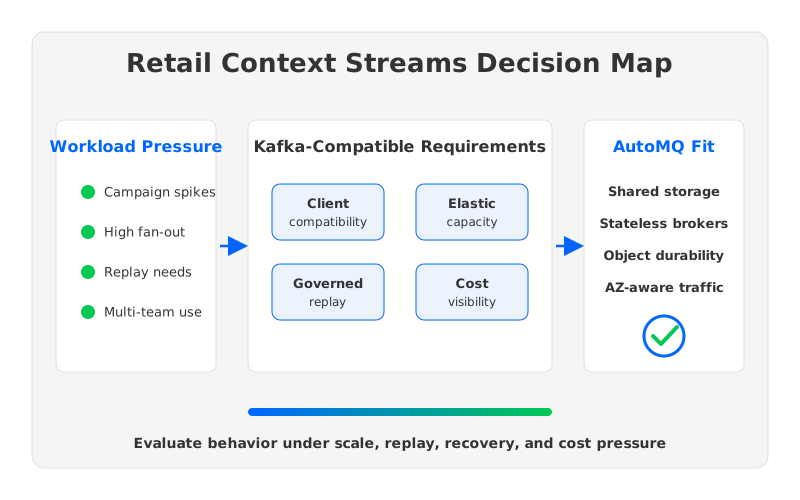
That is why teams search for retail context streams kafka. They are usually not looking for a generic event streaming introduction. They are trying to decide whether Kafka-compatible infrastructure can carry a messy retail workload where point-of-sale systems, ecommerce sessions, loyalty profiles, inventory updates, call-center events, and campaign decisions all need to move through a shared real-time backbone without becoming another fragile integration layer.
1Why Retail Context Streams Stress Kafka Platforms
Retail context is not a single stream. It is a changing join between customer identity, session behavior, product availability, channel preference, promotion eligibility, payment risk, and fulfillment state. Each domain has a different owner, cadence, schema discipline, and operational tolerance. Store systems may burst around business hours, mobile clickstream traffic can spike during a campaign, and inventory corrections may arrive late from a warehouse feed.
Kafka is a natural fit because it gives teams durable topics, independent producers and consumers, consumer groups, offset-based replay, and an ecosystem for connectors and stream processing. Those primitives are exactly what retail teams need when the same event has to feed personalization, analytics, fraud detection, and operational dashboards. The problem starts when the platform grows from "Kafka carries events" into "Kafka is where the live customer context is assembled and recovered."
At that point, the platform is judged by different questions:
- Can teams add capacity for a promotion spike without spending days moving data between brokers?
- Can downstream systems replay customer context safely after a bad deployment or schema change?
- Can the platform isolate store, ecommerce, and marketing workloads without creating a topic maze?
- Can SREs recover from broker loss without turning a retail incident into a storage rebalance project?
- Can FinOps explain why the streaming bill grows when the business adds regions, replicas, or availability zones?
Those questions are operational, not conceptual. A reference architecture can look clean on a whiteboard and still fail the Monday morning test when a broker fills up, a consumer group falls behind, or an integration team needs to rewind offsets without disturbing other consumers.
2The Production Constraint Behind the Problem
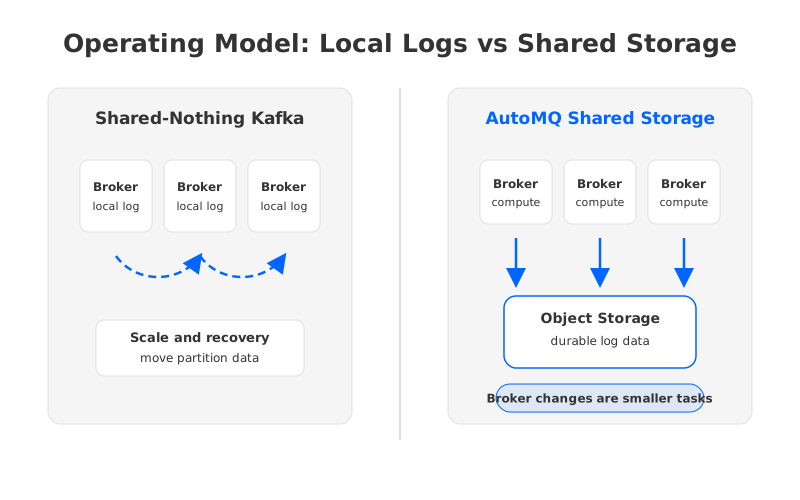
Traditional Kafka uses a shared-nothing broker model: each broker owns local log segments for its assigned partitions, and replication happens between brokers. This design made sense for Kafka's original environment, where local disks and machine-to-machine replication were the available primitives. In cloud retail environments, the same design often turns storage locality into an operational constraint.
The constraint shows up during ordinary platform tasks. When a team expands a cluster before a campaign, new brokers are empty, so partition reassignment has to move data before the cluster is balanced. When a broker fails, recovery is not only a compute replacement; it is a data placement problem. When retention grows because teams want longer replay windows, storage capacity and broker count become linked in ways that may not match CPU or network demand.
Retail makes this tighter because context streams have uneven value over time. Fresh session events may be latency-sensitive for minutes. Loyalty changes and order-state updates may need durable replay for days or weeks. Fraud and customer-service workflows may need a defensible audit trail. Putting all of that on broker-local storage forces platform teams to choose between overprovisioning, aggressive retention trimming, or frequent data movement.
The architecture choice is therefore less about whether Kafka can handle retail events. It can. The sharper question is whether the operating model still works when retail context becomes a product dependency rather than a data pipeline convenience.
3Architecture Options and Trade-Offs
Most retail teams end up evaluating four broad patterns. The names matter less than the failure modes behind them.
| Pattern | Where it fits | What to watch |
|---|---|---|
| Self-managed Kafka | Teams with deep Kafka operations skills and custom platform needs. | Broker-local storage, partition reassignment, upgrade discipline, and 24/7 operational ownership remain internal responsibilities. |
| Managed Kafka service | Teams that want infrastructure tasks delegated while keeping familiar Kafka APIs. | Service boundaries may reduce toil, but capacity planning, data movement behavior, networking cost, and ecosystem constraints still need evaluation. |
| Kafka plus stream processing layer | Teams building customer profiles, inventory views, or recommendation features from multiple topics. | The stream processor does not remove the need for durable, replayable, governed event logs underneath it. |
| Kafka-compatible shared storage architecture | Teams that want Kafka semantics while separating broker compute from durable storage. | Compatibility, latency path design, failure recovery, and migration tooling must be validated carefully. |
This table hides a common trap: "managed" and "cloud-native" are not the same architectural claim. A managed service can reduce who performs operations, while the underlying data model may still bind partitions to broker-local disks. A cloud-native design should change what operations are necessary around storage growth, broker replacement, and cross-zone traffic.
For retail context streams, the distinction is practical. If the platform is mostly a pass-through event bus, managed operations may be enough. If the platform is the source of replay, customer state reconstruction, campaign decisioning, and incident recovery, then storage architecture becomes part of the application reliability model.
4Evaluation Checklist for Platform Teams
A useful evaluation framework starts with the behavior the business needs, then maps those behaviors to platform properties. Retail architects should resist the urge to compare product pages feature by feature. The better question is: what must remain true when traffic doubles during a promotion, a schema change breaks a consumer, or a region-level network path behaves badly?
Use this checklist before selecting or redesigning a Kafka-compatible platform.
| Evaluation area | Practical question for retail context streams |
|---|---|
| Kafka compatibility | Do producers, consumers, transactions, ACLs, offset management, and existing client versions behave as expected under the target platform? |
| Elastic scaling | Can the team add or remove broker compute without large partition-data movement projects? |
| Replay and retention | Can multiple teams replay context independently without putting storage pressure on broker capacity? |
| Cost visibility | Are storage, compute, cross-zone traffic, connector runtime, and observability costs visible enough for FinOps to forecast? |
| Governance | Are schemas, topic naming, access controls, data classification, and retention policies enforceable across business domains? |
| Failure recovery | What actually happens after broker loss, availability-zone impairment, connector failure, or a bad deployment? |
| Migration risk | Can teams migrate topic by topic, validate consumers, and roll back without freezing retail delivery work? |
The compatibility row deserves special attention. Retail systems tend to have long-lived integrations: store software, ERP connectors, marketing platforms, fraud engines, and data warehouse ingestion jobs may not upgrade in lockstep. A platform that claims Kafka compatibility should be tested with real client configurations, consumer group behavior, offset commits, transaction usage, and connector expectations, not a producer and consumer smoke test.
The cost row is important, but it is often evaluated too late. Retail workloads can be bursty, multi-region, and fan-out heavy. A single purchase event may be consumed by fulfillment, personalization, analytics, financial reconciliation, fraud, and customer support systems. Replication traffic, cross-availability-zone paths, and connector egress can grow faster than raw ingest. If cost is only reviewed after the architecture is deployed, the team has fewer levers left.
5How AutoMQ Changes the Operating Model
Once the evaluation turns from feature lists to operating behavior, a different architectural requirement appears: Kafka-compatible APIs with broker compute separated from durable storage. That is where AutoMQ, a Kafka-compatible cloud-native streaming platform, enters the discussion. It keeps the Kafka protocol and client-facing model familiar while moving the durability layer to shared object storage and making brokers stateless where data locality traditionally creates pressure.
The immediate benefit is not a slogan about lower cost. The more important shift is that broker replacement and storage growth stop being the same problem. In a shared-nothing Kafka cluster, adding brokers, losing brokers, and extending retention all pull on local disk placement. In AutoMQ's shared storage architecture, durable log data is backed by object storage, while brokers serve Kafka traffic and coordinate the hot path through the write-ahead log design.
For retail context streams, that changes several day-to-day platform decisions:
- Promotion readiness becomes more compute-oriented. Teams can plan broker capacity around traffic and serving load without treating every scale event as a storage rebalance exercise.
- Longer replay windows become easier to discuss. Retention can be evaluated as an object-storage-backed durability and governance decision, not only as broker disk pressure.
- Failure recovery has fewer moving parts. Replacing broker compute is a different operational act from reconstructing local disk ownership.
- Cloud network design becomes part of the platform value. AutoMQ documents a zero cross-AZ traffic approach for eligible deployments, which matters when retail fan-out and replication patterns make network charges visible.
There are still engineering checks to run. Shared storage does not remove the need to validate producer latency, consumer lag, transaction behavior, connector throughput, observability, and security boundaries. It also does not replace stream processing; customer context assembly still needs stateful applications, schema contracts, and replay discipline. The point is narrower: when storage is no longer welded to broker identity, several painful Kafka operations become smaller, more predictable tasks.
6A Practical Retail Context Stream Design
A production design usually starts with domain-aligned topics rather than a single universal customer stream. Customer identity changes, session events, inventory updates, order events, promotion decisions, and customer-service interactions should be modeled as separate streams with clear ownership. The real-time context view is built downstream by stream processing jobs or service-specific materialized views, not by forcing every producer to write into one overloaded topic.
That separation lets teams apply different retention, access, and schema policies. Session telemetry may tolerate a shorter replay horizon. Order and loyalty events may require longer retention and stricter governance. Inventory corrections may need explicit ordering guarantees within a product or location key. The Kafka platform should make those differences manageable instead of turning them into a broker capacity puzzle.
The consumer side needs the same discipline. A personalization service should not share operational fate with a reporting sink merely because both read customer events. Consumer groups, offsets, dead-letter topics, and backfill workflows should be designed so one team can pause, replay, or fix its own workload without creating a platform incident. Kafka's consumer group and offset model gives the primitives; the platform team has to enforce the operating rules around them.
The final design choice is migration shape. Few retailers can stop a working event platform and replace it in one move. A lower-risk approach is to select a bounded domain, mirror or dual-write where appropriate, validate ordering and lag, compare downstream outputs, then move consumers in controlled waves. Apache Kafka's ecosystem includes tools and patterns for replication and migration, but every organization still needs a rollback point that is specific to its topics, schemas, and consumers.
7Readiness Scorecard
Before committing to a platform, score the target architecture against production behaviors rather than vendor labels.
| Scorecard item | Ready signal | Risk signal |
|---|---|---|
| Workload model | Topic ownership, keying strategy, retention, and fan-out are documented by business domain. | A single "customer context" topic collects unrelated events because it is easier to start. |
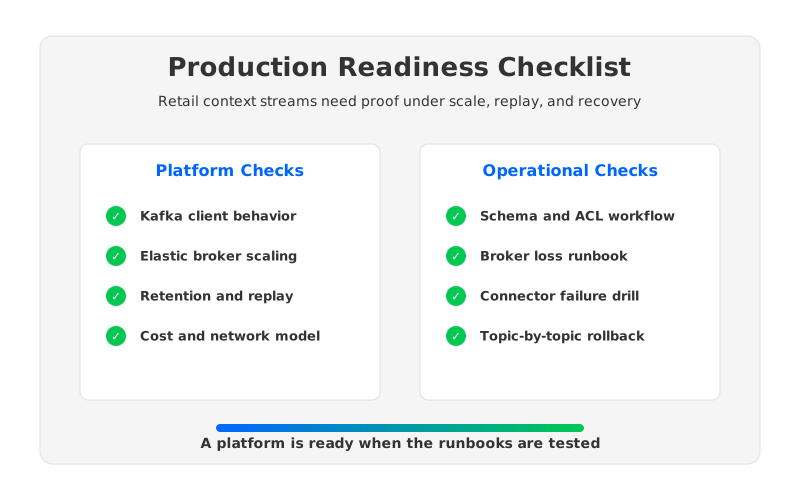
| Operations | Broker scale, broker loss, replay, and connector failure have runbooks that SREs have tested. | Recovery depends on tribal knowledge or manual partition movement under pressure. |
| Governance | Schema rules, ACLs, retention, and sensitive-data handling are part of the delivery workflow. | Governance is reviewed after topics already exist in production. |
| Cost | Compute, storage, cross-zone traffic, and connector costs are forecast separately. | The team only tracks aggregate cluster spend. |
| Migration | Topic-by-topic cutover, validation, and rollback paths are documented. | Migration is treated as a one-time infrastructure switch. |
The scorecard is deliberately boring. Retail context streams fail in the boring places: unclear ownership, uneven retention rules, slow replay, untested recovery, and costs that no team can explain. The architecture should make those boring parts easier to control.
8Take the Next Step
If your team is evaluating retail context streams on Kafka-compatible infrastructure, start by mapping the operating behaviors above to your current cluster: scale events, replay windows, broker recovery, cross-zone traffic, and migration rollback. Then compare that baseline with a shared-storage model where broker compute and durable storage are separated.
To see how AutoMQ approaches that model, start with the AutoMQ Cloud trial and use the architecture as a technical checklist for your own proof of concept, not as a substitute for one.
9References
- Apache Kafka Documentation
- Apache Kafka KIP-405: Kafka Tiered Storage
- Apache Kafka KIP-1150: Diskless Topics
- Apache Kafka MirrorMaker 2 Configuration
- AWS S3 Data Durability
- AutoMQ Compatibility with Apache Kafka
- AutoMQ Zero Cross-AZ Traffic Best Practice
10FAQ
10.1What are retail context streams?
Retail context streams are event streams that keep customer, session, product, inventory, order, loyalty, and channel signals current enough for real-time decisions. They usually feed personalization, fraud detection, customer service, campaign execution, and operational analytics.
10.2Why use Kafka for retail context streams?
Kafka gives retail teams durable topics, independent producers and consumers, offset-based replay, consumer groups, and a broad connector ecosystem. Those primitives are useful when many teams need the same event data for different analytical workflows.
10.3Is managed Kafka enough for retail context streams?
It can be enough for teams that mainly need operational delegation. Teams with bursty traffic, long replay windows, strict recovery goals, or high fan-out should also evaluate the underlying storage model, network cost behavior, migration path, and failure recovery mechanics.
10.4How does shared storage help Kafka-compatible retail workloads?
Shared storage separates durable log data from broker-local identity. That can reduce the amount of data movement tied to broker scaling and replacement, while making retention and replay decisions less dependent on local broker disk capacity.
10.5Where should AutoMQ be evaluated in a retail architecture?
AutoMQ is most relevant when a team wants Kafka-compatible behavior but needs a more cloud-native operating model for elastic scaling, object-storage-backed durability, broker replacement, and cross-availability-zone traffic control. It should be tested with real producers, consumers, connectors, security policies, and recovery workflows before production adoption.


