
Table of Contents
Table of Contents
Kafka cost planning often starts late. By the time a team compares instance prices, broker-hour rates, storage volumes, and managed service line items, the expensive decisions have already been made in the workload model: how long data stays hot, how often consumers replay it, where replicas move, and whether bytes cross an availability-zone boundary on their way to durability.
That is why kafka cost is not a narrow pricing question. It is a planning question about data movement. Two clusters can have the same write throughput and retention, yet land on different bills because one keeps storage tied to brokers and another moves retained data into shared object storage. Two teams can buy the same managed Kafka service, yet one sees network charges climb because consumers run in a different zone from their fetch path.
The practical starting point is a worksheet, not a vendor shortlist. Capture the workload shape first, map it to infrastructure choices, then ask whether self-managed Apache Kafka, a managed Kafka service, or a Kafka-compatible cloud-native architecture is the right fit.
1Why teams search for kafka cost
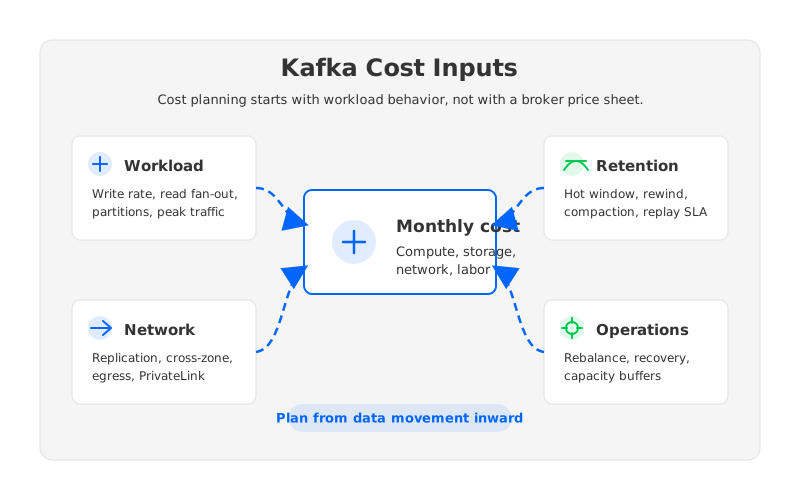
Most teams searching for Kafka cost are not trying to learn what Apache Kafka is. They already have producers, consumers, topic owners, SREs, and a business reason to keep events available for more than a few hours. The real problem is that the monthly bill is hard to explain. Compute is visible, storage is visible, but replication, cross-zone traffic, catch-up reads, rebalances, and operational labor are spread across different dashboards.
The first useful split is between four inputs:
- Write and read shape. Measure sustained write rate, peak write rate, compression ratio, consumer fan-out, and replay frequency. A topic with many independent consumer groups can be network-heavy even when write traffic is modest.
- Retention and replay. Separate hot retention used for near-real-time consumers from long retention used for audit, reprocessing, or backfill. These two windows have different cost and latency expectations.
- Network boundary. Identify whether traffic stays inside one zone, crosses zones, crosses regions, uses PrivateLink, or exits the cloud provider. Network pricing often depends on path, not only volume.
- Operational movement. Track data moved by partition reassignment, broker replacement, scaling events, and disaster recovery tests. These flows are often ignored because they are not part of application throughput.
Once those inputs are visible, the planning conversation changes. Instead of asking only “How many brokers do we need?” the team asks which bytes require broker-local durability, which bytes require long retention, and which bytes should not cross a paid network boundary.
2The hidden cost of retention
Retention looks harmless in a spreadsheet because it is usually represented as GB retained. In Kafka architecture, retained data is a storage number, a recovery constraint, and a capacity planning input at the same time. It affects broker sizing, disk headroom, recovery time, rebalance duration, and the amount of infrastructure kept online for data that may be read rarely.
Traditional Kafka stores log segments on broker-attached disks. That model is mature and well understood. It also means the broker is both a serving node and a durable data holder. If retention grows, disk capacity grows, retained bytes are multiplied across replicas, and broker recovery may require large log transfers.
Tiered storage in Apache Kafka changes part of that equation by allowing older log segments to move to remote storage. Kafka documentation describes tiered storage as a way to keep most data in remote storage while brokers retain a smaller local working set. That is a meaningful improvement for long retention, though the local broker still serves active traffic, manages fetch behavior, and participates in replication for recent data.
Retention planning needs two numbers, not one. The first is the active window, where low-latency produce and consume paths matter. The second is the historical window, where durability, replay, and storage economics matter more than broker-local disk speed. A platform that treats both windows the same will overpay for one of them.
| Input | Why it matters | Planning question |
|---|---|---|
| Hot retention | Drives local disk, cache, and recovery pressure | How many hours must remain close to the broker? |
| Historical retention | Drives object storage, retrieval, and replay design | How often do teams re-read older data? |
| Compaction | Changes storage shape and cleanup behavior | Which topics keep only the latest key state? |
| Backfill SLA | Turns cold data into operational traffic | How fast must a failed consumer catch up? |
The table is deliberately workload-centric. A cost-effective Kafka platform gives each topic a retention model that matches its business use, then uses architecture to avoid coupling rarely read historical bytes to always-on broker capacity.
3Network paths decide whether the bill scales linearly
Cloud network cost is boring until it is the line item nobody owns. Kafka makes that line item complicated because data moves through the system more than once: producers send records to leaders, brokers replicate records to followers, consumers fetch records, and administrators move partitions during balancing or failure recovery.
AWS pricing pages make the general rule visible: data transfer, PrivateLink processing, object storage requests, and managed service usage are priced separately. Amazon MSK pricing also separates broker, storage, data transfer, and related feature charges. The exact number depends on region and configuration, so a durable cost model should reference the current pricing page instead of hard-coding assumptions.
The important architectural point is stable across regions: replication and reads are not the same kind of traffic. Replication exists because the platform needs durability; consumer traffic exists because applications need data. When both cross paid boundaries, the platform pays for internal safety and business demand at the same time.
Three network questions should be answered before comparing platforms:
- Where are the leaders, followers, and consumers? Kafka rack awareness and follower fetching can reduce unnecessary cross-zone reads when clients are configured with zone locality.
- Where does durable storage live? Broker-local replication moves copies between brokers. Shared storage designs can change the replication path.
- Where do administrative flows go? Reassignment, broker replacement, and scaling can move large volumes when the cluster is already under pressure.
If a team only models application ingress and egress, it undercounts Kafka. A practical network model adds replication traffic, catch-up traffic, and rebalancing traffic. It also records the network boundary for each flow: same zone, cross zone, cross region, private endpoint, or internet egress.
4Architecture choices that change the cost curve
Cost planning becomes more useful when architecture is treated as a variable. Self-managed Apache Kafka, Amazon MSK, Confluent Cloud, Aiven, Redpanda, and other managed or Kafka-compatible offerings all make different trade-offs around operational control, compatibility, pricing model, storage, and cloud integration. The right comparison is not “which one is lower cost” in isolation. The right comparison is “which architecture gives this workload the least waste while preserving the semantics we need.”
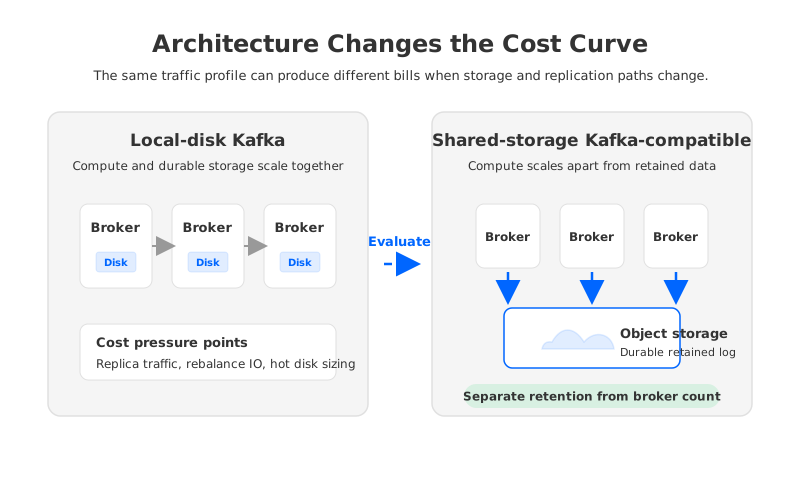
For local-disk Kafka, compute and storage are naturally coupled. More retained data often means larger disks or more brokers. More partitions can increase metadata and operational overhead. More recovery headroom may require spare capacity that sits idle during normal traffic. These trade-offs can be acceptable when the workload is stable and the team values direct control.
Managed Kafka services can reduce operational labor by shifting broker maintenance, patching, provisioning workflows, and service integration to a provider. That operational value is real. The cost model still needs to account for broker or capacity-unit pricing, storage pricing, network pricing, feature charges, and scaling granularity.
Shared-storage Kafka-compatible architectures change a different part of the curve. By moving durable retained data away from broker-local disks, they can let compute scale with active traffic while storage scales with retained bytes. The question is whether the implementation preserves Kafka protocol compatibility, latency expectations, durability, security controls, and observability.
That is where AutoMQ fits the evaluation. AutoMQ is a Kafka-compatible cloud-native streaming system built around shared storage, S3Stream, stateless brokers, and object-storage-backed durability. Its documentation describes Kafka API compatibility, shared storage architecture, WAL storage options, self-balancing, and inter-zone traffic reduction. Those capabilities target the expensive coupling points: retained data tied to broker disks, scaling tied to partition movement, and cross-zone traffic created by broker-to-broker replication paths.
Evaluate AutoMQ the same way you would evaluate any Kafka-compatible platform: test existing clients, validate security and ACL behavior, measure tail latency and catch-up reads, inspect failure recovery, and map every data path to the cloud bill. The product should enter the conversation after the workload model shows that storage coupling and network movement are the dominant cost drivers.
5A cost planning worksheet that SRE and FinOps can share
A useful Kafka cost worksheet is boring enough to maintain every month. It should not require deep Kafka internals knowledge, but it must expose the flows that change the bill. Start with one row per workload class, not one row per cluster. A single cluster may host several cost profiles, and averaging them hides the reason a bill is rising.
Use a worksheet with these columns:
| Column | Example value | Why it belongs in the model |
|---|---|---|
| Sustained write | 200 MiB/s | Baseline broker, storage, and network pressure |
| Peak write | 600 MiB/s | Capacity buffer and throttling risk |
| Read fan-out | 4 consumer groups | Multiplies fetch traffic |
| Hot retention | 24 hours | Drives local serving and recovery expectations |
| Historical retention | 7 days | Drives storage economics and replay strategy |
| Replication model | Multi-AZ | Determines durability traffic path |
| Client locality | Same-zone preferred | Affects cross-zone read cost |
| Rebalance frequency | Monthly or event-driven | Adds operational data movement |
| Recovery objective | Minutes vs hours | Determines spare capacity and data movement budget |
This worksheet gives procurement and platform teams a shared language. Procurement can compare unit prices, while SRE can explain why a lower storage price may not help if recovery requires moving terabytes between brokers.
The worksheet should be versioned with architecture assumptions. If a team changes retention from 24 hours to 7 days, the model should show whether the change increases broker disk, object storage, or both. If consumers move into another VPC or region, the network boundary should change before the invoice arrives.
6Production readiness matters more than a low estimate
A Kafka cost estimate that ignores production readiness is a budget risk, not a savings plan. The lowest number on a spreadsheet can become expensive if it increases migration risk, breaks existing clients, lengthens recovery, or pushes more operational work onto a small SRE team.
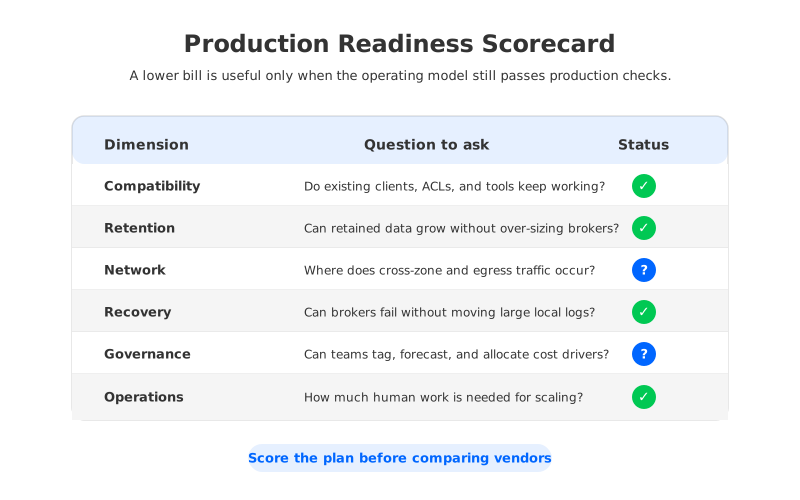
Use a scorecard before selecting a platform:
- Compatibility: Existing producers, consumers, Kafka Connect jobs, ACLs, quotas, monitoring tools, and admin workflows should be tested. Kafka-compatible does not mean every operational assumption is identical.
- Latency and throughput: Measure the workload you actually run, including compression, batching, acknowledgments, and consumer fetch patterns. Synthetic peak throughput alone is not enough.
- Retention and replay: Test normal reads and catch-up reads. Long retention only helps if consumers can replay within the business window.
- Network governance: Confirm where traffic crosses zones, regions, VPC endpoints, or public egress. Add monitoring for those paths so the cost model can be audited.
- Failure recovery: Replace brokers, scale the cluster, and simulate consumer backlog. The cost of recovery includes time, data movement, and human coordination.
- Security and operations: Validate encryption, identity, audit, RBAC, metrics, alerting, backup posture, and upgrade workflows.
A production Kafka platform is closer to a database decision than a SaaS seat purchase. Cost estimates need measurements, failure tests, and a clear migration path. A platform that looks cost-effective under steady traffic can still be expensive if scaling or recovery requires repeated manual data movement.
7A neutral decision path
For a stable workload with modest retention, low consumer fan-out, and a team already skilled in Kafka operations, well-run Apache Kafka can be a rational choice. For teams that want managed operations and are comfortable with the provider’s pricing model, a managed Kafka service can be the right trade-off. For workloads where retention growth, cross-zone traffic, and scaling operations dominate the bill, Kafka-compatible shared-storage architectures deserve a serious evaluation.
The decision path is straightforward:
- Build the workload model from traffic, retention, network boundaries, and operational movement.
- Map the model to candidate architectures, including self-managed Kafka, managed Kafka, and Kafka-compatible shared-storage options.
- Run proof-of-concept tests with existing clients and representative traffic.
- Compare the full cost model: compute, storage, network, managed service fees, migration work, and operational labor.
- Keep the worksheet alive after migration so retention and network changes are reviewed before they become billing surprises.
If your current Kafka bill is hard to explain, start with the bytes. Once the retention windows and network paths are visible, the architecture conversation becomes much more concrete. AutoMQ’s shared-storage Kafka-compatible architecture is one option to evaluate when broker-local storage and cross-zone movement are the main cost drivers; you can review the architecture and discuss a workload-specific assessment through the AutoMQ demo page.
8References
- Apache Kafka documentation: Tiered storage
- Apache Kafka documentation: KRaft mode
- AWS: Amazon MSK pricing
- AWS: Amazon EC2 On-Demand pricing and data transfer notes
- AWS: AWS PrivateLink pricing
- AWS: Amazon S3 pricing
- AutoMQ documentation: Shared Storage architecture
- AutoMQ documentation: Native compatible with Apache Kafka
- AutoMQ documentation: Eliminate inter-zone traffic
9FAQ
9.1What is the biggest hidden cost in Kafka?
The biggest hidden cost is usually data movement. Broker-to-broker replication, cross-zone consumer reads, catch-up traffic, and partition reassignment can all add cost beyond the visible broker and disk line items.
9.2Does longer retention always make Kafka expensive?
Longer retention becomes expensive when retained data forces larger broker disks, more brokers, slower recovery, or more rebalance traffic. Tiered storage and shared-storage designs can reduce the coupling between retained bytes and broker capacity, but each implementation still needs workload testing.
9.3Should Kafka cost planning start with managed service pricing?
No. Start with workload inputs: write rate, read fan-out, retention, network boundaries, and recovery objectives. Managed service pricing matters, but apply it after the workload model is clear.
9.4How does cross-AZ traffic affect Kafka cost?
Kafka can generate cross-AZ traffic through replication, consumer fetches, rebalancing, and recovery. The effect depends on cloud pricing, client placement, broker placement, and whether the architecture uses broker-local replication or shared storage for durability.
9.5Where does AutoMQ fit in a Kafka cost comparison?
AutoMQ fits when a team wants Kafka compatibility while evaluating shared storage, stateless brokers, object-storage-backed durability, self-balancing, and reduced inter-zone traffic. It should be tested with existing clients and representative workloads before any production decision.


