
Table of Contents
Table of Contents
The search for retention cost breakpoints kafka usually begins after a Kafka estate stops behaving like a transport layer and starts behaving like durable data infrastructure. A platform team extends retention from hours to days for replay, audit, fraud investigation, CDC recovery, observability, AI feature rebuilds, or customer analytics. The request sounds like a topic configuration change. The bill and the operations queue reveal the real problem: retention length changes the storage model, broker lifecycle, network path, and ownership model of the whole estate.
That is why a breakpoint matters. A breakpoint is the point where tuning an existing Kafka cluster is no longer enough to keep retention affordable and operable. It is not a universal number of days or terabytes. It is the moment when retained history starts forcing broker over-provisioning, slow partition movement, risky maintenance windows, or arguments between FinOps, SRE, data governance, and application teams. A useful retention cost model therefore has to look beyond bytes stored.
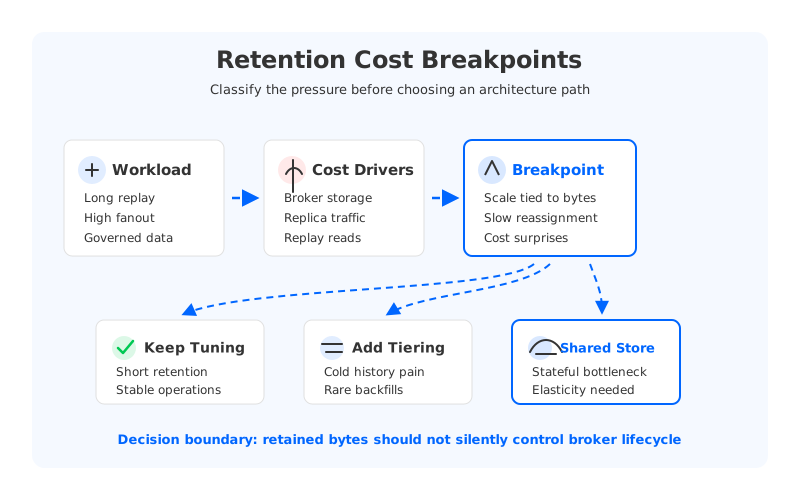
Kafka operators already know the basic controls: topic retention, compaction, offsets, consumer groups, and client configuration. The harder question is whether those controls still fit the business promises attached to the data. A short-lived operational stream can tolerate a narrow replay window. A compliance topic, CDC changelog, or AI feature source cannot. Once the estate contains many stream classes, the platform needs a framework for deciding what can stay on the current architecture and what needs a different operating model.
1Why Teams Search for retention cost breakpoints kafka
Retention cost becomes visible when a team realizes that retained Kafka history is not passive. It has to be replicated, indexed, fetched by consumers, protected during failure, and included in capacity planning. The first warning sign is often a storage request: a team asks for longer retention because it wants safer replay. The second sign is operational: the cluster needs more broker disk, partition reassignment takes longer, or scale-in becomes politically impossible because every broker carries too much local history.
The search intent behind the keyword is practical. FinOps wants to know why a Kafka line item keeps growing faster than traffic. SREs want to know whether longer retention will make broker replacement and recovery harder. Cloud architects want to know how much cross-zone movement is created by replication and consumer placement. Data governance teams want to know whether retention can be shortened without breaking audit or replay requirements. These groups are all asking the same question from different angles: when does retention stop being a setting and become an architecture decision?
There are four recurring triggers:
- Replay moves from exception to routine. Backfills, offset resets, model retraining, and data product rebuilds become normal operations, so old data is read more often and by more teams.
- Retained bytes start controlling broker capacity. Brokers are sized around history and headroom rather than current write throughput, which makes compute and storage scale together even when the workload does not need them to.
- Operational changes copy too much data. Partition movement, broker replacement, and cluster resizing become slow because the durable log is closely tied to broker-local storage.
- Governance rules out broad defaults. One estate contains audit topics, compacted CDC topics, observability streams, application events, and experimental AI data. A single retention rule hides real risk.
The breakpoint appears when these triggers compound. A team may tolerate extra storage for a few critical topics, longer reassignments for a stable cluster, or cross-zone replication costs when traffic is modest. The architecture review becomes urgent when the same estate has long retention, high write volume, large read fanout, bursty replay, and strict governance.
2The Cloud Cost Drivers Behind the Workload
A Kafka retention model that only multiplies retained data by a storage price misses the cloud mechanics that make production expensive. Traditional Kafka's Shared Nothing architecture stores partition replicas on brokers. That model worked well in environments where servers owned their disks and intra-cluster data movement did not show up as a separate cloud bill. In the cloud, the same design can turn retention into a bundle of compute, block storage, object storage, data transfer, and operational labor.
The cost drivers are easier to reason about when separated by the path the data takes:
| Cost driver | Why it matters for retention | Breakpoint signal |
|---|---|---|
| Broker-local storage | Longer history increases disk footprint and recovery headroom | Broker sizing follows retained bytes, not active throughput |
| Replica traffic | Durable copies move through the broker network path | Cross-zone or inter-broker movement dominates the bill |
| Replay reads | Historical fetches compete with live consumers and broker resources | Backfills create lag or require temporary over-provisioning |
| Partition movement | Reassignment can move retained data, not only active traffic | Maintenance windows grow with topic history |
| Governance operations | Retention changes require approvals, audit, and rollback | Policy lives in tickets instead of platform controls |
This table is a breakpoint map, not a pricing calculator. Pricing pages change by region and provider, and enterprise discounts can change the final number. The architecture pattern is more stable: if retained history is physically tied to brokers, additional history can affect every broker lifecycle operation. If the workload has high read fanout or frequent backfills, the retained data is no longer cold. It becomes an active operational surface.
Cloud provider pricing pages make this review concrete. Object storage, block storage, managed streaming services, private connectivity, and data transfer have different meters. Teams should verify the current pages for their regions, then model the estate by workload class rather than averaging the whole cluster.
3Storage, Network, and Compute Trade-Offs
The most common mistake is treating Tiered Storage, broker-local storage, and shared storage as interchangeable answers to "Kafka retention cost." They solve related problems, but they do not create the same operating model. Tiered Storage can reduce pressure from older segments by moving historical data to remote storage. Broker-local storage keeps the classic Kafka ownership model. Shared Storage architecture changes a deeper assumption: durable data is no longer primarily owned by a broker's local disk.
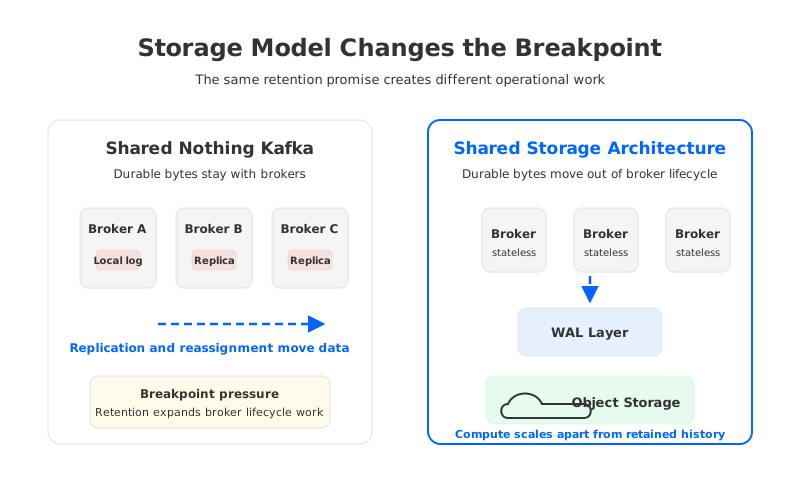
This distinction matters because the breakpoint may be about cold history, active operations, or both. If the main pain is keeping more old data available for rare replay, tiering can be a valid path. If the main pain is that scaling, failure recovery, and broker replacement all become stateful data-copy events, the team is dealing with a compute-storage coupling problem. If the main pain is cross-zone replication economics, the network path and durability model need the same scrutiny as storage price.
Kafka compatibility belongs in this section, not as an afterthought. A platform that reduces storage cost but breaks clients, connector behavior, offset workflows, transactions, or consumer group operations can move cost from infrastructure to application teams. The evaluation should preserve the operational habits that make Kafka valuable: existing producers and consumers, connector ecosystems, monitoring, offset reset workflows, and security controls.
A practical architecture review should ask direct questions:
- Does longer retention increase only stored bytes, or does it also increase broker count, reassignment time, and failure recovery complexity?
- Are historical reads isolated enough that backfills do not disturb live consumer groups?
- Does the platform preserve Kafka protocol behavior, client compatibility, offsets, and transaction semantics that existing applications depend on?
- Where does cross-zone traffic appear: producer writes, replica movement, consumer reads, private networking, or all of them?
- Can the team scale compute independently from retained data, or does every capacity change move durable bytes?
The answers will not be identical across the estate. That is the point. A compacted control-plane topic may care about semantic correctness and tombstone handling more than storage price. A telemetry topic may care about retention cost and replay isolation. A customer-facing event stream may care most about latency and rollback safety. Assign breakpoints by workload class, then roll them into an estate-level plan.
4Evaluation Checklist for FinOps and Platform Teams
FinOps teams often inherit Kafka costs after the architecture is already fixed. Platform teams often inherit retention requests after the business has already promised replay. The useful process puts both groups in the same review before the next expansion. It should translate business retention requirements into infrastructure behavior, migration risk, and governance controls.
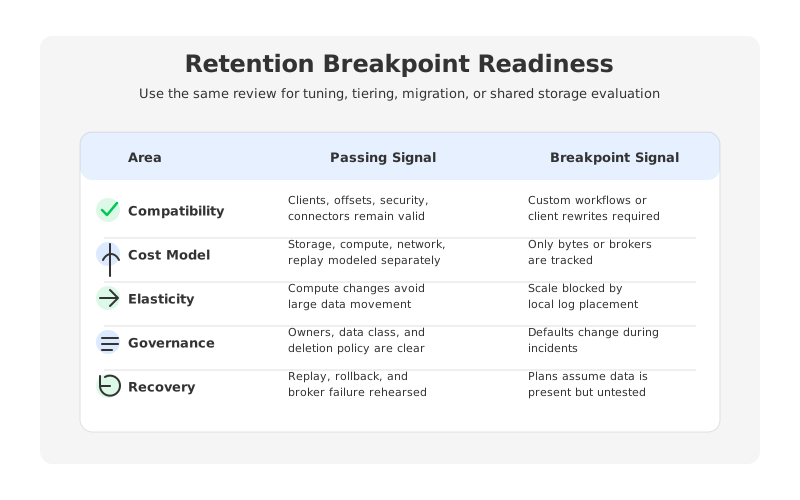
Start with the source of the retention requirement. "Keep data for 30 days" is not enough. The team needs to know whether those days support audit, customer dispute investigation, delayed consumers, incident replay, ML training, or lakehouse rebuilds. Each reason implies a different tolerance for data loss, historical read performance, deletion rules, and rollback. A platform team cannot choose the right architecture until the workload owner names the recovery promise.
Then evaluate the platform against a scorecard:
| Review area | Passing signal | Breakpoint signal |
|---|---|---|
| Compatibility | Existing Kafka clients, offsets, security, and connectors remain valid | Migration requires client rewrites or custom operational workflows |
| Cost model | Storage, compute, network, replay, and operations are modeled separately | The team only tracks stored bytes or broker instance count |
| Elasticity | Compute can grow and shrink without moving large retained histories | Scale decisions are blocked by local log placement |
| Governance | Retention changes are tied to owners, data class, and deletion policy | Defaults are changed manually during incidents |
| Recovery | Broker failure, replay, rollback, and migration are rehearsed | Recovery plans assume retained data is present but do not test it |
| Observability | Lag, historical fetches, storage paths, and network traffic are visible | Backfills and cold reads surprise live workloads |
The scorecard prevents two bad outcomes. The first is overreacting to a bill and cutting retention without understanding why data teams asked for it. The second is extending retention for every team and hoping the infrastructure absorbs the cost. Neither is a strategy. A breakpoint review should produce a workload classification: keep tuning, add tiering, isolate replay workloads, migrate selected topics, or evaluate a shared storage design.
There is also a migration boundary. If a cluster is stable, lightly retained, and rarely replayed, a full platform change may be unnecessary. Improve topic policy, compact where appropriate, right-size brokers, and clean up consumers first. If a cluster is retention-heavy, replay-heavy, expensive to rebalance, and politically impossible to scale down, the team has already crossed the architecture breakpoint.
5How AutoMQ Changes the Operating Model
At this point the evaluation has a clear shape: keep Kafka-compatible application behavior while reducing the coupling between retained data and broker-local operations. This is where AutoMQ becomes relevant as a Kafka-compatible streaming platform built around Shared Storage architecture. The important idea is not that object storage is inexpensive in isolation. The important idea is that durable stream data can be moved out of the broker lifecycle while brokers focus on compute and network I/O.
AutoMQ uses object-storage-backed durable storage with a WAL layer and stateless brokers. That shifts the retention conversation from "how much local broker disk must we reserve" to "what lifecycle policy should this stream have, and what compute do we need for current writes, reads, and replay." The difference is operational. Broker replacement, scaling, and partition movement are less tied to copying retained bytes between local disks. For estates where retention is blocking elasticity, that changes the breakpoint.
AutoMQ also fits the governance side of the problem. AutoMQ BYOC and AutoMQ Software deployment models are relevant when teams want Kafka compatibility while keeping infrastructure, network paths, and data boundaries under customer control. Features such as Self-Balancing, AutoMQ Linking for migration, and Zero cross-AZ traffic patterns should be evaluated against the same checklist as any other platform capability: compatibility first, then cost, elasticity, recovery, observability, and rollback.
This is not a reason to replace every Kafka cluster. A low-volume cluster with short retention and stable ownership may be better served by operational hygiene. AutoMQ is worth testing when the estate's breakpoint is structural: retained data controls broker sizing, cross-zone traffic is a recurring cost issue, reassignments carry too much operational risk, or teams want longer replay windows without turning brokers into long-term storage appliances.
Run the proof with real topic shapes. Include compacted topics, delayed consumers, peak write periods, historical fetches, connector workloads, and failure drills. Measure not only steady-state cost, but also the work required to scale, recover, replay, and roll back. Retention cost is rarely the cost of keeping bytes alone. It is the cost of keeping promises around those bytes.
If your review shows that retained history is now shaping broker capacity, recovery, and cloud networking, the next step is to compare the operating model directly: review AutoMQ's Shared Storage architecture.
6References
- Apache Kafka documentation
- Apache Kafka consumer configuration
- Apache Kafka producer configuration
- Apache Kafka KRaft documentation
- Apache Kafka Tiered Storage design documentation
- AWS Data Transfer pricing
- AWS S3 pricing
- Amazon MSK pricing
- AutoMQ Shared Storage architecture
- AutoMQ deployment overview
- AutoMQ inter-zone traffic overview
7FAQ
7.1What is a Kafka retention cost breakpoint?
A Kafka retention cost breakpoint is the point where longer retention changes more than the storage bill. It appears when retained data starts controlling broker sizing, recovery plans, partition movement, cloud network cost, replay behavior, or governance risk. The breakpoint is workload-specific, so teams should model it by topic class rather than by a single estate-wide number of days.
7.2Does Tiered Storage solve Kafka retention cost?
Tiered Storage can help when the main problem is keeping older log segments online without sizing all history on broker-local disks. It does not automatically remove every stateful-broker concern. Active log placement, broker lifecycle, reassignment behavior, historical fetch patterns, and compatibility requirements still need to be reviewed. The right question is whether the pain is cold-history cost, compute-storage coupling, cross-zone traffic, or all three.
7.3What should FinOps include in a Kafka retention model?
FinOps should include broker compute, broker-local or block storage, object storage, cross-zone and private network traffic, replay reads, operational headroom, migration work, and incident recovery cost. The model should separate steady-state writes from historical reads because replay-heavy workloads can change both infrastructure cost and SRE workload.
7.4When should AutoMQ enter the evaluation?
Evaluate AutoMQ after the team has identified a structural breakpoint: retained bytes are tied too closely to broker lifecycle, cross-zone traffic is a major concern, scaling requires too much data movement, or governance requires longer replay windows without expanding local broker storage. AutoMQ should be tested with real Kafka clients, topics, consumers, connectors, and rollback drills rather than judged from a feature checklist alone.


