
Table of Contents
Table of Contents
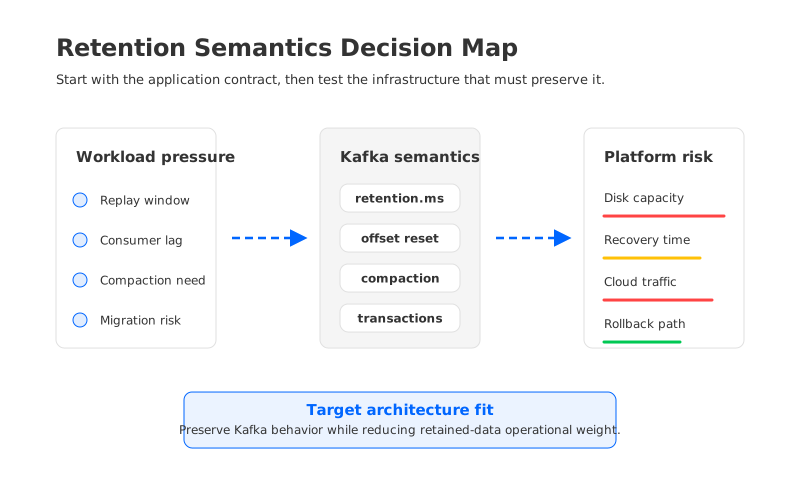
Application teams rarely ask for "retention semantics" during architecture review. They ask whether a failed pipeline can replay yesterday's orders, whether a consumer group can be reset without corrupting downstream state, whether a compacted topic can still serve the latest account profile, or whether another service can bootstrap from Kafka after a regional incident. Under those questions sits the same search intent: retention semantics kafka.
The phrase sounds narrow, but it is really about trust. Kafka retention controls how long log data remains available, compaction controls which records survive when keys are updated, and consumer offsets define where an application believes it has already processed. Application teams build operational habits around those behaviors. They assume replay windows are predictable, offsets are recoverable, and topic policy changes do not silently invalidate incident playbooks.
That trust becomes expensive when the platform moves from a few broker-local disks to a cloud production estate. Longer retention increases storage footprint. More replay increases read traffic. More applications create more consumer groups, offset histories, topic-level exceptions, and compliance questions. A platform team that treats retention as a topic setting will miss the real problem: retention semantics are an application contract, and the infrastructure has to pay for that contract every day.
1Why teams search for retention semantics kafka
The search often starts after a normal-looking change behaves in a non-normal way. A team increases retention.ms to support a longer recovery window and discovers that broker disks now dominate capacity planning. Another team shortens retention to control cost and later finds that a delayed consumer can no longer catch up. A third team enables log compaction for a state topic, then realizes the application depended on intermediate events that compaction is designed to remove.
These are not beginner mistakes. Kafka gives operators powerful controls, and those controls interact with application behavior in ways that are easy to under-document:
- Replay availability. Teams assume records remain available long enough for backfills, incident recovery, and late consumers. The relevant window is not always the same as the business SLA; it also includes detection time, approval time, and operational execution time.
- Offset meaning. Consumer offsets are treated as progress markers, but the marker is only useful if the corresponding record still exists and the consumer code can process it safely after a reset.
- Compaction intent. A compacted topic preserves the latest value per key, not every state transition. That is excellent for lookup-style state, but risky for audit, billing, or workflow systems that need history.
- Operational reversibility. Teams assume platform changes can be undone. Retention changes, topic deletion, schema evolution, and connector rewrites can break that assumption if the rollback path depends on data that has already expired.
The common thread is that retention semantics cross team boundaries. Application developers own business correctness. Platform engineers own Kafka policy and cost. SREs own incidents. Security and governance teams own deletion, access, and audit requirements. When those groups use the same topic for different mental models, the first production incident becomes the specification.
2The production constraint behind the problem
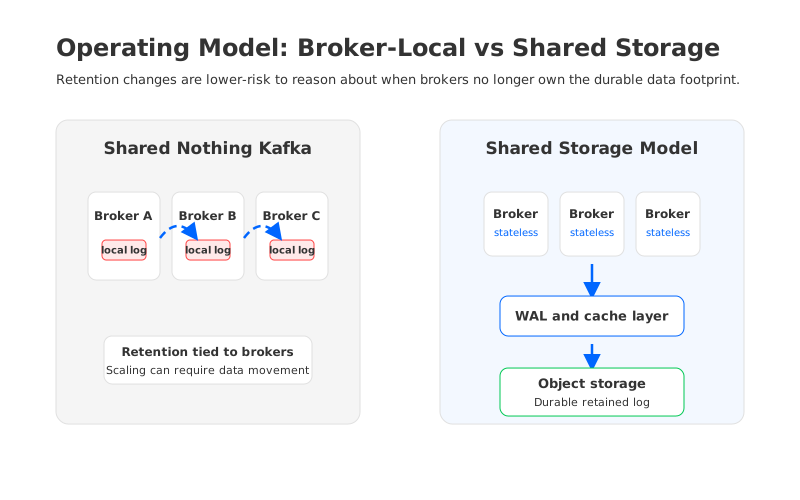
Traditional Kafka stores topic partitions on broker-local storage and replicates them across brokers for availability. That design is coherent and battle-tested. It also means retained data is physically tied to the broker fleet, so a retention decision becomes a compute, storage, replication, and network decision at the same time.
Consider a topic with a seven-day replay requirement. The application team experiences that as "we can replay seven days." The platform team experiences it as local disk capacity, page cache behavior, broker replacement time, partition reassignment risk, and replication traffic. When the replay window becomes thirty days, the application contract changes by one sentence, but the platform surface area changes in several places.
The production pressure is not only capacity. Retention interacts with consumer progress and failure recovery. Kafka's auto.offset.reset behavior matters when a consumer group has no valid offset. Offset retention matters when dormant applications return after a long pause. Topic retention matters when a consumer offset points to data that has aged out. The application sees these as semantic edge cases; the platform sees them as policy defaults that must work across hundreds or thousands of topics.
Compaction adds another dimension. A compacted topic may be the right choice for the latest value per key, but it is not a substitute for an append-only event history. Tombstones, delete retention, and segment cleanup timing become part of the application contract. A platform team can expose compaction as a topic option, but it cannot know whether a payment workflow, CDC sink, or feature store expects every transition to remain replayable unless ownership is explicit.
That is why retention reviews should begin with application questions before infrastructure questions:
| Application assumption | Kafka mechanism | Platform risk if undocumented |
|---|---|---|
| "We can replay the incident window." | Topic retention and segment deletion | Data expires before detection or approval completes |
| "We can reset this consumer group." | Committed offsets and auto.offset.reset | Reset lands before earliest available offset or reprocesses unsafe side effects |
| "This topic is a current-state table." | Log compaction and tombstones | Consumers mistake latest-state semantics for full audit history |
| "We can migrate without behavior change." | Client APIs, admin APIs, offsets, retention policy | Compatibility tests pass at connection level but fail under replay and rollback |
The table looks operational, but it is architectural. Once application teams depend on a replay or compaction behavior, the platform cannot change the underlying storage model, managed service tier, or migration strategy based only on throughput and cost. It has to preserve the contract the applications actually use.
3Architecture options and trade-offs
The first option is classic broker-local Kafka. It gives teams the reference behavior most Kafka users understand: partitions live on brokers, leaders own writes, followers replicate, consumers commit offsets, and topic cleanup policy governs retained log segments. Its strength is predictability through familiarity. Its cost is that longer retention increases durable state attached to brokers, and scaling or replacing brokers can require moving partition data around the cluster.
The second option is tiered storage. Tiered storage reduces pressure on local broker disks by moving older log segments to remote storage. That can be valuable for long retention because the hot local tier no longer needs to hold the full history. The trade-off is that the broker-local layer still matters. Recent data, fetch behavior, remote read performance, and operational tooling all need validation. Tiered storage can reduce one part of the retention burden, but it does not make brokers stateless.
The third option is a shared-storage Kafka-compatible architecture. In this model, the platform keeps Kafka-facing semantics while moving durable retained data away from broker-local ownership. Brokers become closer to compute nodes, and storage durability is provided by a shared storage layer with a write-ahead log and object storage behind it. The operational question changes from "how much partition data does this broker own?" to "which compute node is serving this partition, and where is the durable log stored?"
The right answer depends on the workload. A short-lived telemetry topic with best-effort consumers can tolerate different trade-offs from a payment event stream with strict replay windows. A Kafka Streams application may care about transaction behavior, changelog topics, and state restoration. A CDC pipeline may care about connector offsets and exactly how delete events are represented. A data lake ingestion topic may care more about long retention and cost-effective replay than single-digit millisecond latency.
That variation is the reason retention semantics should be evaluated as a matrix, not a single checkbox. A platform that is Kafka-compatible at the protocol level still needs to prove the behaviors your applications depend on: consumer group management, offset reset, compaction, transactions, admin operations, connector behavior, stream processing state, and failure recovery under the retention windows you promise.
4Evaluation checklist for platform teams
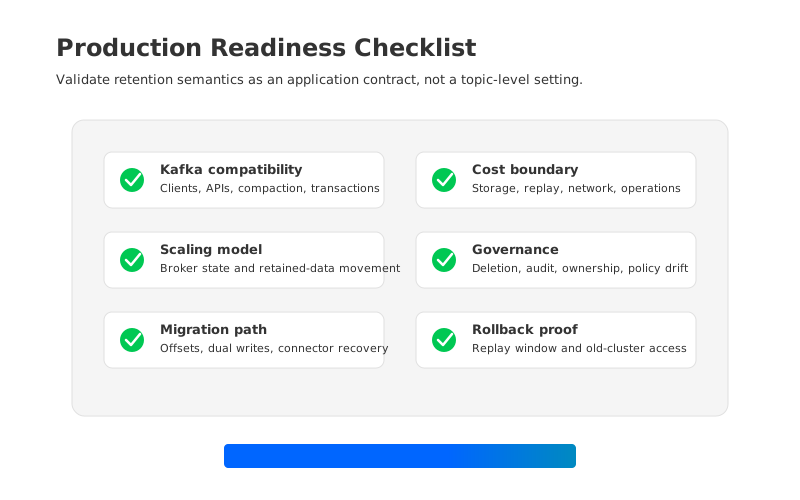
A useful review starts with the application contract and then maps it to infrastructure evidence. The goal is not to write a policy document that nobody reads. The goal is to make hidden assumptions visible before a migration, cost-cutting effort, or retention change turns them into production risk.
Use this checklist during platform selection or architecture review:
- Define replay windows by scenario. Separate normal lag tolerance, incident replay, compliance retention, and historical analytics. They are often different windows served by the same topic.
- Record offset reset rules. Identify which consumer groups can safely reprocess, which require idempotent sinks, and which must never reset without application owner approval.
- Classify cleanup policy by business meaning. Append-only, compacted, and delete-enabled topics should map to different application expectations. Do not let storage cost be the sole driver for compaction.
- Test compatibility beyond connection success. Run real consumers, producers, transactions, compaction cases, connector jobs, and administrative workflows against the target platform.
- Model recovery with elapsed time. Include detection, decision, change approval, and execution time. A seven-day retention policy is not a seven-day recovery plan if the organization needs three days to approve replay.
- Price the behavior, not the setting. Long retention, repeated replay, cross-zone reads, PrivateLink, broker disks, object storage, and operational labor can sit in different budget lines while serving one application assumption.
The governance side deserves equal attention. Retention is sometimes used as a compliance control, but Kafka is not a complete records-management system by default. If a topic contains regulated data, the team needs to know who can extend retention, who can delete topics, whether tombstones are enough, how remote tiers behave, and whether downstream sinks retain data longer than Kafka.
Migration readiness is the final test. If you are moving from self-managed Kafka to a managed or Kafka-compatible platform, write down the rollback path before the first production topic moves. Which offsets move? Which topics can be dual-written? How will compaction state be validated? How long will the source cluster remain available for replay? What happens if a connector lands in the target platform but its recovery checkpoint still points to the source cluster?
5How AutoMQ changes the operating model
After the neutral evaluation, the architectural target becomes clearer. Application teams want Kafka-facing behavior they already understand, while platform teams want retention, scaling, and recovery to stop being dominated by broker-local storage. That is where AutoMQ fits: it is a Kafka-compatible streaming system that keeps the Kafka protocol surface while replacing the storage layer with a shared-storage architecture.
AutoMQ's design uses stateless brokers, S3Stream shared storage, a WAL layer, and object storage as the durable data foundation. Retained log data is not owned by a single broker's local disk in the traditional way. Brokers serve Kafka-compatible traffic, but the durable storage model moves toward shared cloud storage. Longer replay windows still need governance and cost modeling, but they are less tightly coupled to broker disk sizing and partition data movement.
This distinction matters for retention semantics because the application contract can remain familiar while the platform contract changes. Applications still need to validate consumer groups, offset behavior, compaction, transactions, connectors, and stream processing workflows. Platform teams, however, can reason separately about compute capacity, WAL choice, object storage, cache behavior, and network placement. That separation is difficult in a broker-local model because the broker is simultaneously compute, storage owner, replication participant, and recovery unit.
AutoMQ also changes the cost conversation around cloud deployment. In traditional multi-AZ Kafka, broker replication and consumer traffic can create cross-zone network charges depending on placement and fetch patterns. AutoMQ documentation describes deployment approaches designed to reduce inter-zone traffic by using shared storage and stateless broker operation. The exact savings still depend on workload shape and cloud configuration, so the evaluation should be based on measured throughput, read fanout, retention, and network paths rather than a generic percentage.
The migration lesson is straightforward: do not evaluate AutoMQ, or any Kafka-compatible platform, only by producing and consuming a few test records. Build a retention-semantics test plan. Create topics with delete and compact policies. Reset consumer groups. Let offsets expire in a test environment. Restore a stream processor from changelog topics. Run connector failure and retry cases. Validate replay under the longest promised retention window.
If your team is reviewing Kafka retention because replay windows, cloud storage cost, or migration risk are starting to collide, use the checklist above as the first pass. Then compare the operating model against your current platform. For a concrete shared-storage reference, review the AutoMQ architecture documentation and, when you are ready to test the model against your own workload, book a technical discussion with AutoMQ.
6References
- Apache Kafka documentation
- Apache Kafka tiered storage operations documentation
- Apache Kafka KRaft operations documentation
- Apache Kafka transaction protocol documentation
- AutoMQ architecture overview
- AutoMQ compatibility with Apache Kafka
- AutoMQ WAL storage documentation
7FAQ
7.1What does retention semantics mean in Kafka?
Retention semantics describe what data remains available, for how long, and under which cleanup policy. In Kafka, that includes topic retention settings, log compaction behavior, tombstone handling, consumer offsets, and the behavior applications see when they replay or reset processing.
7.2Is Kafka retention the same as consumer offset retention?
No. Topic retention controls how long records remain in the log, while consumer offset retention controls how long committed group offsets are retained. A consumer can have an offset that no longer points to an available record, or it can lose its committed offset and fall back to auto.offset.reset behavior.
7.3When should a topic use log compaction?
Log compaction fits topics where the latest value for each key is the contract, such as current account state or table-like changelog data. It is a poor fit when consumers need every historical event for audit, billing, workflow reconstruction, or legal traceability.
7.4Does tiered storage solve retention cost by itself?
Tiered storage can reduce local disk pressure by moving older segments to remote storage, but the broker-local layer still affects operational behavior. Teams should test remote reads, replay speed, failure recovery, and compatibility with their actual consumers and connectors.
7.5How is AutoMQ relevant to retention semantics?
AutoMQ is relevant when the application needs Kafka-compatible behavior but the platform team wants retained data, scaling, and recovery to be less dependent on broker-local disks. Its shared-storage architecture and stateless brokers change the operating model while preserving Kafka-facing compatibility goals.


