
Table of Contents
Table of Contents
A RAG answer can be wrong even when the model is healthy, the vector database is online, and the application latency dashboard is green. The failure often starts earlier: a policy document changed, an entitlement record moved, a support ticket arrived, or an incident signal crossed a threshold, but the retrieval layer kept serving older context. For an agentic application, that stale context does not stay in the chat window. It can trigger the wrong tool call, route a workflow to the wrong owner, or produce an audit trail that is hard to defend.
That is why teams search for retrieval freshness sla kafka. They are not looking for a generic "real-time AI" promise. They are trying to define how old retrieved context may be at decision time, and they need the streaming backbone to keep that promise during normal traffic, backfill, index rebuilds, connector failures, and platform maintenance. Kafka is often part of the answer because it gives teams durable events, replay, consumer groups, offsets, and a mature connector ecosystem. The hard part is turning those primitives into an end-to-end retrieval freshness contract.
1Why Retrieval Freshness Is Different From Pipeline Latency
Retrieval freshness measures the age of the information used by the AI application, not the time it takes one service to call another. The clock may start when a source record commits, when a document version is published, or when a business event is emitted. It stops when the retriever can return the corresponding chunk, metadata filter, feature value, or event-derived state to the model or agent. A Kafka topic in the middle can have low consumer lag while the retrieval layer is still stale because embedding generation, metadata writes, index refresh, or cache invalidation is delayed.
The distinction matters because RAG and agents mix write paths and read paths that were designed by different teams. A document platform may care about version history. A CDC pipeline may care about database consistency. A vector index may care about batch efficiency. An agent runtime may care about tool-call latency. A retrieval freshness SLA forces those teams to agree on a single question: "How old can the context be when the AI system acts?"
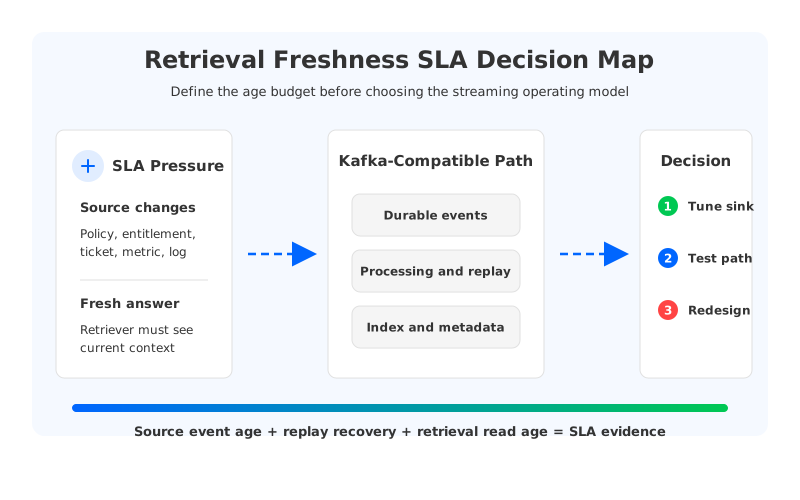
A useful SLA starts with a budget, not a vendor feature. Most teams end up splitting the path into stages:
- Source-to-event budget: time from source commit or document publication to a durable event.
- Event-to-processing budget: time spent in Kafka-compatible storage, stream processing, enrichment, filtering, and routing.
- Processing-to-retrieval budget: time for embedding, index refresh, metadata update, cache invalidation, or feature-store write.
- Recovery budget: time to catch up after outage, replay, schema rollback, connector failure, or index rebuild.
The recovery budget is where fragile designs become visible. A quiet pipeline can meet a freshness target for weeks, then miss it during a high-priority reindex because historical reads compete with tail updates. RAG systems make this tension worse because they need both current updates and repeated reads of older context for evaluation, grounding checks, red-team tests, and incident reconstruction.
2The Governance Problem Behind Fresh AI Context
Freshness without governance is a fast way to retrieve the wrong thing. A support agent should not see a deleted entitlement. A compliance assistant should not cite a superseded policy. A coding assistant should not retrieve a secret-bearing log line because a metadata filter arrived after the embedding. These failures are not model hallucinations in the narrow sense. They are data-plane failures exposed through a model interface.
Kafka-compatible streaming gives platform teams a useful governance boundary because it can preserve event order within partitions, replay history, route multiple consumers, and attach processors that validate schemas or enrich metadata. The design still needs discipline. The retrieval layer must know which version is active, which tenant or user may read it, which source timestamp is authoritative, and what happens when a downstream index temporarily falls behind. Consumer offsets are operational evidence, but they are not the whole evidence chain.
A retrieval freshness review should ask for artifacts that auditors and SREs can both understand:
| Review item | Why it matters | Evidence to collect |
|---|---|---|
| Event age | Shows whether the retrieved record is current enough for the decision. | Source timestamp, broker append time, processor output time, retrieval read time. |
| Version validity | Prevents old document chunks or revoked attributes from staying queryable. | Version IDs, tombstones, metadata updates, index refresh logs. |
| Access boundary | Keeps the retriever from mixing tenants, roles, regions, or data classes. | ACLs, service identities, topic policy, index filters, audit logs. |
| Replay behavior | Proves that rebuilds do not corrupt current retrieval state. | Backfill plan, consumer offsets, idempotent writes, rollback checkpoint. |
This is also where Kafka operations and AI governance meet. The AI team may define the acceptable context age, but the platform team owns the durable path that proves it. If that path is built on local broker disks, connector queues, processors, object stores, and indexes, the SLA needs observability across all of them rather than a single "Kafka lag" chart.
3Architecture Options for Durable, Replayable AI Context
The first option is to tune the existing Kafka estate. This path is sensible when the freshness miss comes from partitioning, consumer parallelism, connector configuration, source throttling, or a slow sink. Better keys, smaller batches, bounded retries, dead-letter handling, and per-stage age histograms can improve a retrieval SLA without changing the streaming platform. The risk is that the team may solve the happy path while leaving scaling, replay, and broker recovery coupled to local storage.
Traditional Kafka's shared-nothing model stores partition logs on broker-local disks and replicates data between brokers. That design has served production systems for years, and it remains a strong baseline when workload shape is stable. The operational pressure appears when retrieval workloads demand long retention, large fan-out, and frequent replays. Expanding a cluster, reassigning partitions, recovering a broker, or rebuilding consumers can require moving or rereading large data sets through the same broker resources that are expected to protect tail freshness.
The second option is managed Kafka. Delegating broker lifecycle work can reduce operational load, and for many teams that is the right tradeoff. The evaluation should still inspect private connectivity, multi-AZ network paths, storage growth, connector placement, observability export, and replay behavior. A managed control plane does not automatically change the storage model or remove the need to prove event age during recovery.
The third option is a Kafka-compatible Shared Storage architecture. The API and ecosystem remain Kafka-oriented, while durable stream storage is moved away from broker-local disks into shared cloud storage. Brokers become less stateful, and compute capacity can be adjusted with less partition data movement. This category is worth evaluating when the retrieval freshness SLA is constrained by replay volume, long retention, bursty agent traffic, and recovery time rather than by ordinary consumer code.
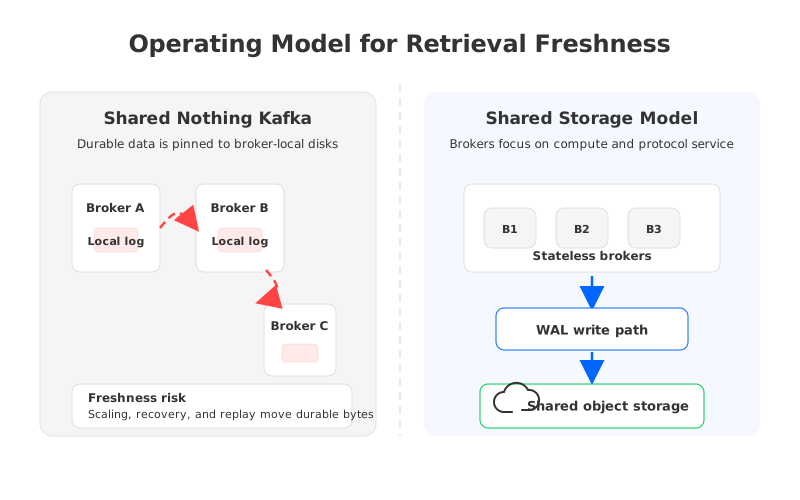
The point is not that one architecture wins every retrieval workload. A small internal assistant with low update volume may run well on a tuned Kafka cluster and a disciplined indexer. A regulated enterprise agent that must answer from current entitlements, preserve replayable evidence, and support multiple teams rebuilding context may need a different operating model. The decision should be based on what the SLA needs the platform to do under correction, not what it does on a clean ingest benchmark.
4Evaluation Checklist for Platform Teams
Start the evaluation by writing the SLA as a contract between the source system and the AI application. For example: "A published policy change must be retrievable by tenant-aware RAG within the agreed percentile target, including during connector restart and index refresh." The exact target belongs to the business, not to the platform vendor. The platform team's job is to prove that the target is measurable, recoverable, and affordable.
Then test the architecture against seven questions:
- Compatibility: Do existing Kafka clients, connectors, stream processors, ACLs, offset tools, and monitoring assumptions continue to work?
- Freshness observability: Can you measure source event age, broker append time, processing delay, index refresh delay, and retrieval read age in one traceable path?
- Replay isolation: Can backfill and index rebuilds run without breaking current document updates or agent-critical events?
- Elasticity: Can capacity change during bursty ingestion or agent adoption without large partition data movement?
- Cost model: Does the budget include compute, storage, object-store requests, network placement, PrivateLink or equivalent connectivity, observability, and operational labor?
- Governance: Can the deployment boundary satisfy tenant isolation, encryption, data residency, access control, and audit requirements?
- Migration and rollback: Can the team mirror topics, compare retrieval results, preserve offsets, pause consumers, and roll back without losing evidence?
This checklist separates pipeline tuning problems from platform architecture problems. If freshness misses come from a slow embedding model or a vector index refresh policy, changing the Kafka-compatible backbone will not repair the sink. If misses come from broker-local storage pressure, slow reassignments, high replay contention, or retention growth, the storage architecture deserves a deeper look.
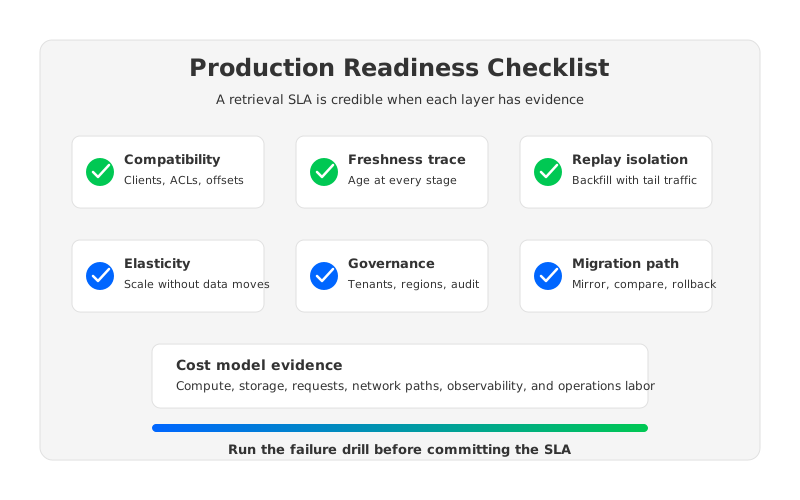
A practical proof of concept should be adversarial. Mirror a representative set of topics, run the same producers and consumers, trigger a document backfill, rebuild an index, restart a connector, scale brokers, and simulate a node failure while measuring retrieval age. The test should include current updates and historical reads at the same time, because production retrieval systems rarely choose between them. They need both.
5How AutoMQ Changes the Operating Model
After the SLA, checklist, and failure drills are defined, AutoMQ becomes a concrete candidate to evaluate. AutoMQ is a Kafka-compatible streaming platform that uses Shared Storage architecture, stateless brokers, WAL storage, and object-storage-backed durability to change the relationship between compute capacity and durable stream data. For retrieval freshness, the relevant idea is narrow: keep Kafka protocol compatibility while reducing the operational coupling between broker compute, local disks, retention growth, and replay.
That change affects several parts of the SLA discussion. Stateless brokers can make capacity changes and broker replacement less dependent on moving durable partition data. Shared object storage can make long retention and replay planning less tied to hot broker disk sizing. AutoMQ's Kafka compatibility matters because retrieval pipelines are usually built from existing producers, consumers, Kafka Connect-style ingestion, stream processors, ACL practices, and monitoring conventions. The migration risk is lower when the candidate can be tested with the same Kafka ecosystem expectations rather than a different application protocol.
AutoMQ's deployment model is also relevant for AI governance. Many retrieval systems handle regulated documents, customer records, operational logs, or security signals. A platform review should therefore inspect where the data plane runs, how cloud resources are controlled, which private network paths are used, and how observability is exported. AutoMQ's BYOC-oriented materials and cloud-native deployment options give teams a way to evaluate Kafka-compatible streaming while keeping customer-controlled cloud boundaries in the decision.
There are still design questions to test. Object storage introduces its own request patterns, cache behavior, and cloud pricing dimensions. WAL choice affects write path assumptions. Connector placement, indexer parallelism, schema handling, and vector database refresh policy remain outside the broker itself. AutoMQ should be evaluated as part of the full retrieval freshness path, not as a shortcut around end-to-end measurement.
The right next step is to turn the SLA into a workload test. If your RAG or agentic application is moving from "near real time" language to a contractual freshness target, build the event-age budget, run the replay drill, and compare your current Kafka-compatible backbone with a shared-storage candidate under the same conditions. When broker-local storage and recovery behavior become the bottleneck, talk to AutoMQ about a Kafka-compatible evaluation instead of treating retrieval freshness as a vector database issue alone.
6References
- Apache Kafka Documentation
- Apache Kafka Documentation: Message Delivery Semantics
- Apache Kafka Documentation: KRaft
- Apache Kafka Documentation: Tiered Storage
- Apache Kafka Documentation: Kafka Connect
- AutoMQ Documentation: Architecture Overview
- AutoMQ Documentation: S3Stream Shared Streaming Storage
- AutoMQ Documentation: WAL Storage
- AutoMQ Documentation: Stateless Broker
- AutoMQ Documentation: Compatibility with Apache Kafka
- AutoMQ Documentation: Eliminate Inter-Zone Traffic
- AutoMQ Documentation: Kafka Connect
- AutoMQ Documentation: Table Topic
- AWS S3 Pricing
- AWS PrivateLink Documentation
7FAQ
7.1What is a retrieval freshness SLA?
A retrieval freshness SLA defines the maximum acceptable age of context returned to a RAG or agentic application. It should cover the full path from source commit or document publication through Kafka-compatible streaming, processing, embedding, indexing, cache refresh, and retrieval.
7.2Is Kafka enough for retrieval freshness?
Kafka is a strong foundation when the system needs durable events, replay, consumer groups, offsets, and ecosystem integration. It is not enough by itself. Teams must measure source event age, downstream processing delay, index refresh behavior, and recovery time to prove the retrieval SLA.
7.3How should teams measure retrieval freshness?
Measure timestamps at the source, broker append point, processor output, index update, cache invalidation, and retrieval read. Alert on percentile event age for critical retrieval paths, and run replay drills while current updates continue.
7.4When should teams evaluate Shared Storage architecture?
Evaluate Shared Storage architecture when retrieval freshness risk is driven by long retention, high replay volume, bursty agent traffic, broker recovery, partition reassignment, or local disk capacity. If the miss comes from embedding latency or index refresh policy, fix that layer first.
7.5Where does AutoMQ fit in a RAG or agentic AI architecture?
AutoMQ fits in the streaming backbone when teams want Kafka compatibility with a cloud-native operating model based on shared object storage and stateless brokers. It should be tested after the freshness budget, governance boundary, migration plan, and replay workload are defined.


