
Table of Contents
Table of Contents
Searching for streaming reverse etl usually means the analytics platform has become too slow for the systems that act on data. A warehouse or lakehouse may already hold modeled customer, account, entitlement, fraud, inventory, or product-usage records, but sales tools, support consoles, personalization engines, risk services, and AI applications need those signals while they are still operationally useful. The pressure is not only to move data out of analytics. It is to move the right data with enough freshness, governance, and failure control that application teams can safely depend on it.
Traditional reverse ETL tools are often batch oriented. They sync modeled tables from a warehouse into SaaS applications or operational databases on a schedule. That works for many lifecycle marketing, CRM enrichment, and account-scoring workflows. It strains when minutes of delay, duplicate writes, schema drift, or a failed sync can alter the user experience. At that point, reverse ETL becomes a streaming platform question.
Kafka-compatible streaming gives teams a way to treat analytics-derived changes as durable events. Instead of pushing every downstream system from a scheduled job, a platform team can publish change records, feature updates, or activation commands into topics and let applications consume them with backpressure, offsets, replay, and failure isolation. The benefit is real, but it comes with an architectural catch: the moment reverse ETL closes the loop into apps, the streaming layer becomes part of the production control plane.
1Why streaming reverse etl matters now
The first generation of reverse ETL solved a practical activation problem. Business teams wanted governed analytics data back in the tools where work happened. A customer health score became a CRM field. A product-qualified lead score became a sales action. A lifecycle segment became a marketing audience. Those workflows still matter, and many do not need sub-second delivery.
The search intent changes when teams add the word "streaming." They are usually dealing with one of three pressures. The first is freshness: an application needs a recommendation, risk signal, entitlement update, or routing decision before the next batch window. The second is reliability: an activation job cannot silently skip records or overwrite target state without a trace. The third is scale: one modeled data product may feed many applications with different retry, ordering, and replay behavior.
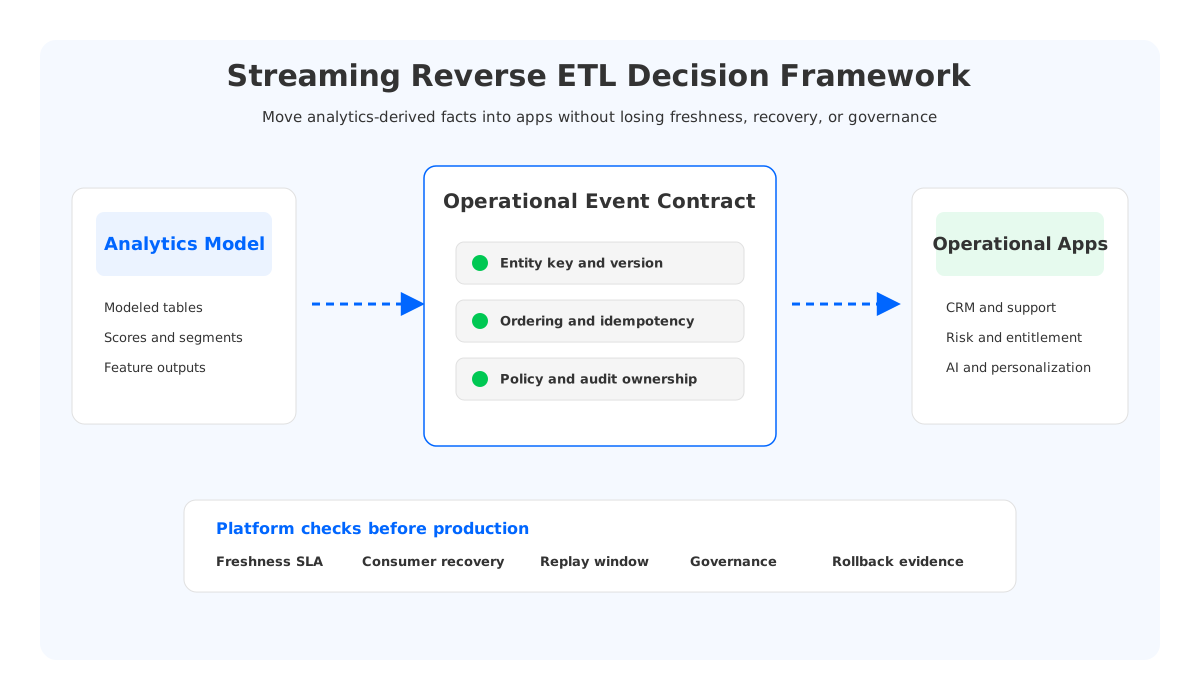
Streaming reverse ETL also changes ownership. The analytics team may own the model, but the application team owns the user-visible behavior. The platform team sits between them, responsible for contracts, transport, security, and recovery. That boundary is where batch sync language becomes too thin. A production design needs to answer how data changes are detected, how records are keyed, how consumers recover, and how teams stop a bad activation from spreading.
There is a useful mental shift: reverse ETL should not be treated as "export analytics rows to apps." It should be treated as "publish operationally safe facts derived from analytics." That language forces teams to define the event contract rather than exposing every intermediate table to every target.
2The production constraints behind the search
A streaming reverse ETL design starts with change semantics. Some teams publish every changed row from a modeled table. Others emit domain-specific events such as customer_risk_score_changed, account_entitlement_updated, or user_segment_membership_changed. Row-level changes are easier to automate, but they often leak analytics implementation details. Domain events require more design work, but they give application teams a clearer contract.
The next constraint is ordering. Kafka topics preserve order within a partition, so the partition key becomes part of the application contract. If an entitlement update and a downgrade event for the same account are processed out of order, the target app may temporarily expose the wrong access level. If every update for a large tenant uses the same key, the stream may preserve order while creating hot partitions. The key has to reflect the business invariant, not only the desired load distribution.
Delivery behavior is equally important. Kafka consumer groups, offsets, and retries let applications resume from committed positions, but they do not remove the need for idempotent writes into target systems. A CRM, support database, vector index, feature store, or authorization service may have different conflict rules. The streaming platform can provide durable transport and replay. The application integration still needs target-side deduplication, version checks, and rollback behavior.
Governance is the fourth constraint. Reverse ETL often moves derived customer or account attributes from an analytics boundary into operational tools. That can change who can see the data, where audit evidence lives, and which systems become subject to retention or deletion policies. Streaming makes the movement faster; it should not make the policy weaker.
| Constraint | Architecture question | Evidence to collect |
|---|---|---|
| Freshness | Which targets need event-time delivery rather than scheduled sync? | SLA by target, acceptable staleness, lag alerts |
| Event contract | Is the stream a table change, a domain event, or an activation command? | Schema ownership, compatibility policy, target write rules |
| Ordering | Which key preserves the user-visible invariant? | Key distribution, hot partition tests, replay ordering checks |
| Recovery | Can a consumer retry, replay, or roll back without corrupting target state? | Offset handling, idempotency keys, dead-letter workflow |
| Governance | Who may publish, consume, replay, and export derived attributes? | ACLs, audit logs, classification, deletion policy |
These constraints are not theoretical. They decide whether streaming reverse ETL becomes a reusable data activation layer or a faster version of a fragile export job.
3Architecture patterns teams usually compare
The simplest pattern is warehouse-to-topic activation. A job observes changes in modeled tables and publishes records into Kafka topics. Downstream services consume the topics and update operational targets. This pattern is attractive when the warehouse or lakehouse remains the source for business logic, and the stream is mainly a reliable activation path. Its risk is that analytics table structure can leak into application contracts unless the publishing layer translates rows into stable events.
A second pattern is CDC-to-analytics-to-stream. Source systems publish changes into a streaming layer, transformations enrich or aggregate those records, and derived results return to operational apps through topics. This gives teams a continuous loop, but it creates a longer chain of accountability. If a downstream app receives a bad score, the investigation may cross the source event, transformation code, topic retention, consumer offset, and target write path.
A third pattern is application eventing with analytics feedback. Applications publish domain events, analytics systems compute features or segments, and selected results are published back as operational events. This is often the most explicit design because the app and analytics teams agree on event names and target behavior. It also requires strong schema discipline because the same platform now carries both source events and analytics-derived feedback.
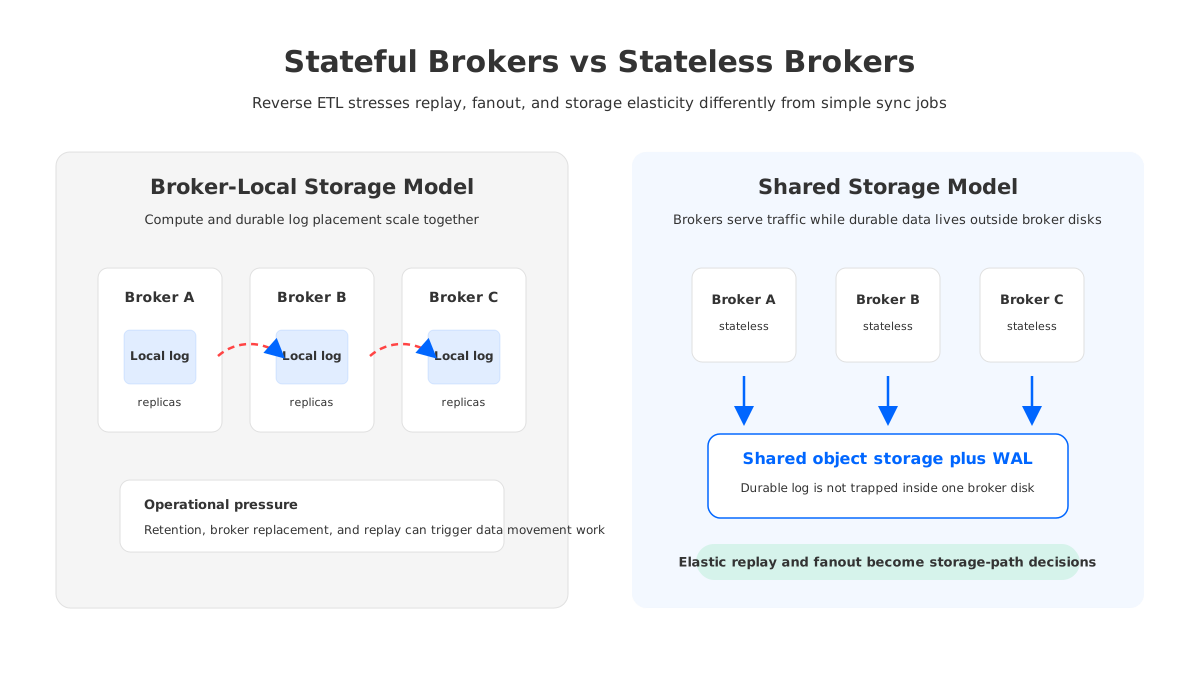
These patterns differ in where the durable streaming platform sits. In traditional Kafka Shared Nothing architecture, brokers own partition replicas on local or attached disks. Producers write to leaders, replicas are copied across brokers, and retention consumes broker storage. The model is familiar and widely deployed, but it couples compute, storage, and data movement. When reverse ETL increases retained history, replay demand, or target fanout, the platform team may need more broker capacity even when CPU is not the limiting factor.
Kafka tiered storage can reduce local disk pressure for older segments, but platform teams still need to inspect which data remains on the hot path, how restore and read-after-offload behave, and how operational responsibility changes. For streaming reverse ETL, the question is whether the storage architecture supports replay, recovery, and elastic serving without turning every capacity change into a data movement event.
4Evaluation checklist for platform teams
Start by separating the analytics model from the operational event contract. A modeled table can contain dozens of columns that help analysts explain behavior, while an application may need a small, versioned record with a clear update rule. If the consumer writes into a target system, the event should say what changed, which entity it applies to, which version it represents, and how consumers should handle duplicate or stale records.
Then test the Kafka-compatible surface as an application contract. Producers, consumers, Connect workers, stream processors, ACLs, TLS, schemas, consumer groups, offset resets, and admin operations should be part of the readiness plan. A platform that keeps Kafka client behavior familiar can reduce migration effort, but compatibility should be proven with representative clients rather than assumed from a product page.
The checklist should also include cost and failure boundaries. Streaming reverse ETL often has asymmetric load: small writes from analytics, high fanout to many targets, long retention for replay, and bursty backfills after model changes. If storage and compute scale together, the team may overprovision brokers to retain data or rebuild target state. If storage is externalized, the team must validate object storage behavior, WAL health, cache behavior, and read patterns.
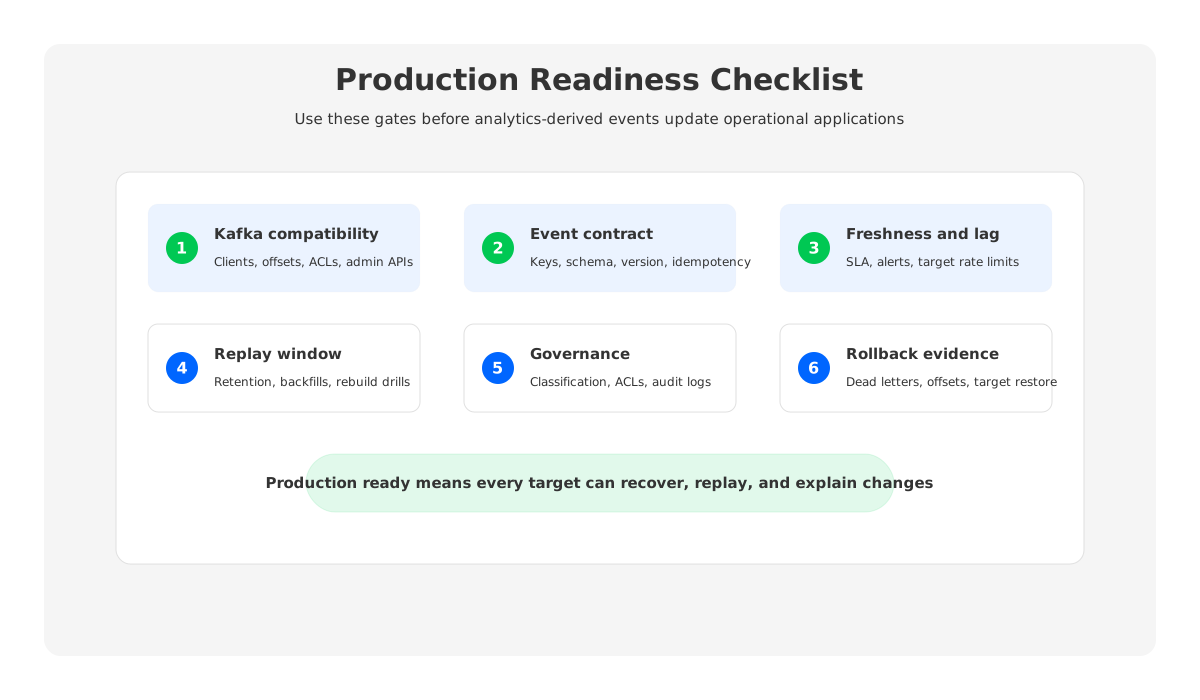
Use this sequence before treating a streaming reverse ETL design as production ready:
- Define whether each stream carries table changes, domain events, or activation commands.
- Pick partition keys from target-side correctness rules, then test load distribution.
- Set retention from replay and backfill needs, not from default broker disk size.
- Require idempotency keys or version checks for every target write.
- Prove consumer restart, offset reset, dead-letter, and rollback workflows.
- Map data classification, ACLs, audit logs, and deletion policy before onboarding targets.
- Revisit broker storage architecture if fanout, replay, or retention becomes the scaling limit.
This sequence keeps the decision vendor-neutral. It also prevents a common failure mode: choosing a connector before defining the event contract and operating model.
5Where AutoMQ changes the operating model
Once the evaluation reaches retention growth, target fanout, broker replacement, and customer-controlled deployment boundaries, AutoMQ becomes relevant as a Kafka-compatible cloud-native streaming option built around Shared Storage architecture. The point is not that every reverse ETL workload needs a different Kafka implementation. The point is that some workloads expose the cost of binding durable log data to broker-local storage.
AutoMQ keeps the Kafka-facing model while changing the storage layer underneath. Its architecture uses stateless brokers with shared storage and a WAL path, so durable data is not treated as state owned by an individual broker disk. For streaming reverse ETL, that shift matters when teams want long replay windows for target rebuilds, many consumers reading the same derived facts, or elastic compute capacity during backfills and campaign launches.
The deployment boundary matters too. Reverse ETL often moves governed analytics-derived attributes into operational applications. Teams may need the data plane to remain in a customer cloud account or a controlled private environment. AutoMQ BYOC and AutoMQ Software are relevant in that evaluation because they let teams assess Kafka-compatible streaming within their own network, IAM, audit, and storage boundaries rather than treating data placement as an afterthought.
AutoMQ should still be tested through the same checklist. Platform teams should validate client compatibility, end-to-end latency, consumer replay, ACL and schema operations, failure recovery, WAL behavior, object storage behavior, and migration tooling against their own workloads. A shared-storage architecture changes the operating model; it does not remove the need for disciplined production proof.
The practical advantage of introducing AutoMQ at this stage is that the conversation stays architectural. Application teams keep a Kafka-compatible contract, analytics teams publish governed facts, and platform teams evaluate whether shared storage improves the parts of the system that batch reverse ETL did not have to solve: replay, elasticity, and recovery under operational load.
6Decision table for streaming reverse ETL
Not every activation workflow deserves streaming infrastructure. A nightly lifecycle sync into a low-risk SaaS field may be served well by batch reverse ETL. Streaming earns its complexity when target behavior depends on fresh, ordered, recoverable data and when multiple systems need to consume the same facts without re-querying analytics.
| If your main pressure is... | Prefer this path | Watch for |
|---|---|---|
| CRM or marketing enrichment on a schedule | Batch reverse ETL | Sync failures, field ownership, consent policy |
| Operational apps need fresh analytics-derived state | Streaming reverse ETL | Event contracts, ordering, idempotent target writes |
| Many targets consume the same derived facts | Kafka-compatible shared topics | Fanout, ACLs, consumer lag, replay retention |
| Backfills and model changes rebuild target state | Longer retention and replay design | Storage cost, offset reset, target rate limits |
| Broker-local storage limits elasticity | Shared-storage Kafka-compatible evaluation | WAL health, object storage behavior, latency tests |
The original search phrase, streaming reverse etl, points to a useful architectural question: how should analytics close the loop into applications without turning activation into a hidden production dependency? The answer is not to stream every table everywhere. Publish stable operational facts, make consumer recovery explicit, keep governance attached to the data, and choose a Kafka-compatible platform whose storage model fits the replay and elasticity profile. For teams evaluating the shared-storage path, compare the AutoMQ deployment overview with the activation boundaries in your own environment.
7References
- Apache Kafka documentation
- Apache Kafka documentation: Kafka Connect
- Apache Kafka documentation: consumer configuration
- Apache Kafka documentation: transactions
- AutoMQ documentation: compatibility with Apache Kafka
- AutoMQ documentation: architecture overview
- AutoMQ documentation: deployment overview
8FAQ
8.1Is streaming reverse ETL the same as CDC?
No. CDC captures changes from source systems or tables. Streaming reverse ETL publishes analytics-derived or transformed facts back into operational systems. CDC may feed the analytics layer, and CDC-style change detection may help publish modeled data, but the reverse ETL contract is defined by the target application behavior.
8.2When is batch reverse ETL still the right choice?
Batch reverse ETL is often enough for low-risk enrichment, periodic lifecycle marketing, internal reporting fields, or SaaS syncs where delay does not change user-visible behavior. Streaming is useful when target systems need freshness, ordering, replay, and failure isolation.
8.3Why use Kafka-compatible streaming for reverse ETL?
Kafka-compatible streaming gives teams durable topics, partitioned ordering, consumer groups, offsets, replay, and broad client ecosystem support. Those capabilities help when multiple applications consume the same derived facts or when a failed target integration needs controlled recovery rather than a blind resync.
8.4What should be tested before production cutover?
Test partition keys, schema compatibility, producer retries, consumer restarts, offset reset behavior, idempotent target writes, dead-letter handling, target rate limits, ACLs, audit logs, replay, and rollback. The target write path deserves as much attention as the stream itself.
8.5Where does AutoMQ fit?
AutoMQ fits when a team wants Kafka compatibility but expects pressure around long retention, high fanout, broker-local storage, elastic scaling, cloud cost, or customer-controlled deployment boundaries. Evaluate it with production-shaped reverse ETL workloads rather than as a drop-in answer for every activation job.


