
Table of Contents
Table of Contents
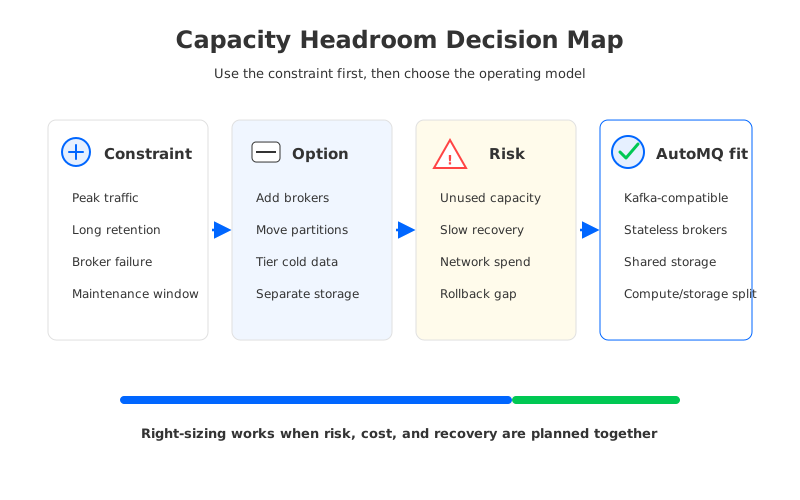
Someone searching for capacity headroom planning kafka is usually past the easy part of Kafka operations. The cluster is already important, the business depends on it, and the platform team is asking a question that does not fit neatly into a CPU or disk chart: how much spare capacity protects reliability, and how much is waste?
The trap is that headroom sounds like a percentage. In practice, it is an operating contract. It defines whether a broker can fail without creating a second incident, whether a maintenance window can finish before customer traffic changes, whether a consumer replay can run without starving production reads, and whether a sudden producer burst burns through the cushion that was supposed to protect recovery. FinOps sees the unused portion of the bill. SRE sees the portion that keeps a bad day from becoming a worse day. Both views are true, which is why right-sizing has to start with the failure and change scenarios the cluster must survive.
Kafka makes this conversation harder because capacity is not one pool. A production cluster has compute headroom for request handling, disk headroom for retention and replica catch-up, network headroom for replication and consumer fan-out, and operational headroom for reassignments, upgrades, and incident response. Optimizing one pool in isolation can move risk into another: cutting broker count may improve the bill until a partition reassignment has nowhere safe to run.
1Why Teams Search for capacity headroom planning kafka
The search usually starts after a concrete trigger, not from abstract curiosity. A cloud bill audit finds brokers running far below average CPU utilization. A product team asks for longer retention. An SRE team wants to reduce broker count after a traffic peak has passed. Procurement asks why a Kafka estate still needs so much standby capacity when the rest of the cloud platform scales more elastically.
Those triggers all point to the same tension: Kafka capacity is sized for the worst credible operating moment, while finance reviews often start from average utilization. Average write throughput does not describe a broker restart, and average consumer lag does not describe several downstream teams replaying after a rollback. The useful unit of planning is therefore not “average utilization,” but “what must the platform do while something else is already consuming capacity?”
Four scenarios deserve explicit treatment before anyone changes a cluster size:
- Steady-state growth. Producers, partitions, retention, and read fan-out grow at different rates, so CPU can look healthy while storage or network becomes the limit.
- Failure recovery. Broker loss, zone impairment, leader changes, replica catch-up, and client reconnect behavior all consume capacity at the moment the system has fewer healthy resources.
- Planned change. Upgrades, broker replacement, partition movement, and configuration rollout require room to move traffic without violating service-level objectives.
- Backfill and replay. Consumer recovery can turn older data into active traffic. That matters for fetch latency, cache pressure, and downstream freshness.
If these scenarios are not modeled separately, right-sizing becomes a negotiation between fear and cost pressure. A better planning model makes the risk surface visible enough that platform and finance teams can agree on what the reserve is actually buying.
2The Production Constraint Behind the Problem
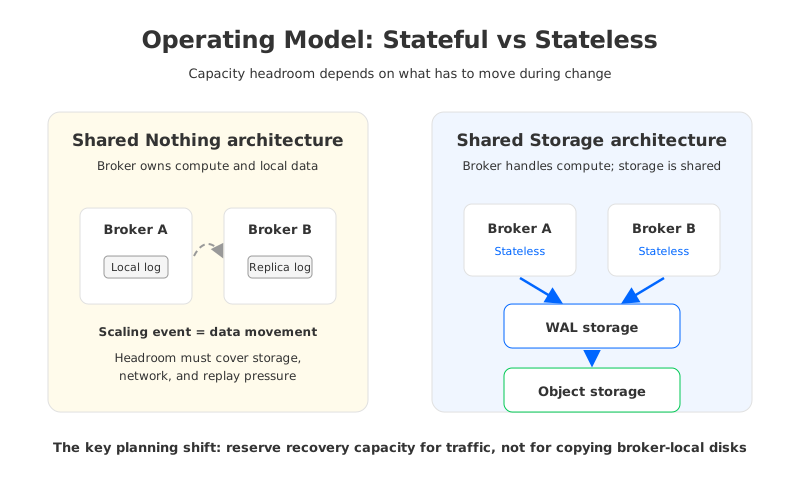
Traditional Apache Kafka uses a Shared Nothing architecture: each broker owns local log storage, and partitions are replicated across brokers for durability and availability. That design is proven and familiar, but it ties broker capacity to data placement. When the cluster changes shape, operators must think about where leaders and replicas live, how much disk each broker has, how much network can be used for catch-up, and how quickly the cluster can return to balance.
That coupling is why Kafka headroom is not generic compute headroom. In a stateless web tier, adding or removing instances mostly changes request capacity. In a traditional Kafka cluster, adding or removing brokers can also trigger data movement and placement work. The spare capacity must cover user traffic and operational work together. A cluster that can serve traffic may still lack capacity to rebalance safely.
The storage side creates a second constraint. Long retention is not only a storage cost question; it changes recovery and movement behavior. More local data per broker makes broker replacement more sensitive and can make partition movement slower or more expensive. Apache Kafka's Tiered Storage reduces the amount of older data that must stay in local storage, but the local hot tier still matters for writes, recent reads, and operational movement.
The network side is the quiet third constraint. Multi-zone Kafka deployments use replication and client traffic patterns that must be understood in the context of cloud network pricing and topology. Public cloud pricing pages distinguish data transfer paths by service, Region, zone, and direction, so teams should validate their own account and deployment pattern before turning a network assumption into a budget number.
3Architecture Options and Trade-Offs
There are several ways to reduce waste without pretending reliability is optional. The right answer depends on which constraint drives the current over-provisioning. A cluster oversized for peak compute has a different problem from one oversized because partition movement is slow, long retention is expensive, or consumer fan-out is unpredictable.
The most common options are:
| Option | What it improves | What still needs planning |
|---|---|---|
| Tune topic and client behavior | Reduces avoidable partitions, retention, producer retries, and consumer inefficiency | Does not change the storage architecture or broker replacement model |
| Add tiered storage | Moves older data to object storage and can reduce local storage pressure | Hot data, write path behavior, broker-local placement, and operational movement still matter |
| Use managed Kafka | Moves some operational responsibility to a provider | Workload design, cost modeling, network paths, and capacity policies still remain customer concerns |
| Separate compute and storage | Makes durable data less tied to individual brokers | Requires validation of compatibility, WAL choice, object storage behavior, and migration process |
The table matters because “reduce Kafka cost” is too broad to guide a production decision. If the main issue is sloppy retention policy, architecture migration is premature. If every scaling event turns into a data movement project, retention cleanup will not change the operating model. If cross-zone or replay traffic is the issue, cutting brokers may make the next incident more expensive even if compute spend falls.
A neutral evaluation should therefore ask the same questions for each architecture, not only for the one already in production. How does the platform preserve Kafka client behavior? Which resources must be pre-provisioned? What happens when a broker disappears? How long does traffic balancing take? Where does durable data live? Who owns the cloud account, encryption policy, observability stack, and rollback plan? The value of the framework is that it forces cost, reliability, and governance into the same conversation.
4Evaluation Checklist for Platform Teams
Before changing capacity policy, build a small decision record that separates measured workload demand from risk reserve. It should be concrete enough that an SRE, FinOps reviewer, and application owner can read the same document and understand why the cluster is sized the way it is.
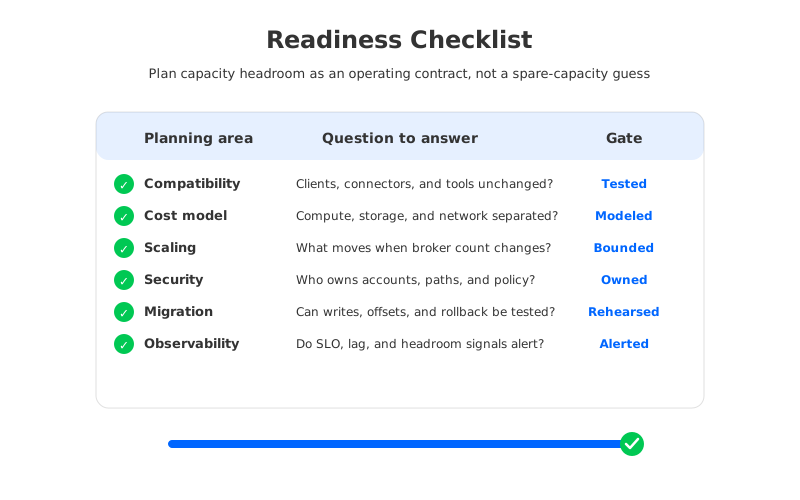
Start with six planning gates:
- Compatibility gate. List client versions, protocol features, connectors, stream processors, schema tooling, observability integrations, and administrative workflows. If a platform change breaks any of these, the apparent savings are not real.
- Cost gate. Split the model into compute, storage, network, operations, and support. Keep negotiated discounts separate from architecture effects, or the model will not survive renewal.
- Scaling gate. Identify what must move when broker count changes. Leadership changes are different from copying partition data, and the headroom requirement depends on that difference.
- Security and governance gate. Define where data is stored, which account owns it, how access is controlled, and how audit evidence is collected.
- Migration gate. Rehearse writes, reads, offset continuity, cutover criteria, and rollback. A capacity plan that cannot be migrated safely is only a spreadsheet.
- Observability gate. Tie headroom to SLOs and alerts: latency, consumer lag, broker saturation, storage growth, network throughput, and recovery progress.
This checklist prevents a common planning error: treating spare capacity as one undifferentiated buffer. Some reserve protects peak traffic, failure recovery, or operational change. Some is accidental waste. The goal is to stop paying for headroom whose purpose nobody can name.
5How AutoMQ Changes the Operating Model
Once the evaluation points to broker-local state as the root of the planning problem, a different architecture becomes relevant. AutoMQ is a Kafka-compatible, cloud-native streaming platform that keeps Kafka protocol and ecosystem compatibility while replacing the broker-local storage layer with Shared Storage architecture. The key shift is that durable stream data is no longer planned as data that must live and move with a specific broker.
AutoMQ uses S3Stream to offload durable data to object storage, with WAL (Write-Ahead Log) storage in the write path for durable acknowledgement and recovery of data not yet uploaded to object storage. This makes AutoMQ Brokers stateless in the operational sense: a broker can be added, replaced, or removed without treating its local disk as the long-term home of partitions. Capacity planning changes because compute and storage can be sized along different axes.
That does not mean planning disappears. It means the planning units become cleaner. Compute headroom can be discussed in terms of request handling, network, cache behavior, and failover capacity. Storage headroom can be discussed in terms of object storage retention, WAL type, durability boundary, and read patterns. Operational headroom can focus on reassignment and traffic balancing rather than copying large volumes of broker-local data.
AutoMQ's Self-Balancing and seconds-level partition reassignment capabilities build on this separation. Because reassignment does not require the same broker-local data synchronization model, balancing can focus on traffic distribution and resource pressure. In cloud deployments, AutoMQ also supports Zero cross-AZ traffic patterns for Kafka data paths in the Shared Storage model, which changes how teams model network spend. These are architecture effects, so evaluate them against workload shape rather than generic savings claims.
Deployment boundary matters as much as architecture. AutoMQ BYOC runs the control plane and data plane in the customer's cloud account and VPC, while AutoMQ Software is designed for customer-operated private environments. Governance remains explicit: who owns the bucket, keys, network paths, monitoring data, and access policy? The point is to make capacity elastic while keeping control boundaries reviewable.
6A Practical Headroom Scorecard
The final planning artifact can be a scorecard rather than a giant model. Score each dimension from one to five, where one means “unknown or manually handled” and five means “measured, automated, and rehearsed.” The score exposes where the risk really lives.
| Dimension | Low maturity signal | High maturity signal |
|---|---|---|
| Workload measurement | Average throughput drives sizing | Peak, replay, failover, and maintenance profiles are separated |
| Storage elasticity | Retention growth forces broker-local expansion | Retention and compute capacity can be planned independently |
| Scaling operation | Broker changes require long data movement windows | Broker changes mostly adjust compute and traffic ownership |
| Recovery reserve | Headroom is a fixed percentage | Reserve is tied to named failure scenarios |
| Cost attribution | Kafka spend is blended into cloud categories | Compute, storage, network, and operations have owners |
| Migration safety | Cutover depends on a single maintenance window | Compatibility, offsets, rollback, and observability are rehearsed |
If the low-maturity column describes the current platform, cutting headroom first is the wrong move. The safer sequence is to measure workload shape, name the scenarios the reserve must protect, reduce accidental waste, and then evaluate whether the architecture still forces too much standby capacity. If the high-maturity column is already close to reality and the bill still looks structurally high, the operating model deserves attention.
The reason this framing works is that it avoids the false choice between reliability and cost. Reliability does require reserve, but not all reserve is equally useful. Cost optimization does require pressure, but pressure without scenario modeling turns into hidden risk. A good Kafka capacity plan gives every unit of headroom a job.
For teams evaluating a Kafka-compatible platform with Shared Storage architecture, the next step is to test the model against real workload profiles rather than generic benchmarks. Map one production cluster's traffic, retention, read fan-out, recovery objectives, and governance boundaries, then compare how each architecture handles the same scenarios. To evaluate AutoMQ with your own capacity assumptions, start from the AutoMQ BYOC path here: try AutoMQ.
7FAQ
7.1What is capacity headroom planning in Kafka?
Capacity headroom planning in Kafka reserves enough compute, storage, network, and operational capacity for peak traffic, failures, maintenance, and replay without overpaying for unused infrastructure. It should be based on named scenarios, not only average utilization.
7.2How much Kafka headroom should a production cluster keep?
There is no universal percentage. The right amount depends on replication settings, retention, partition count, traffic peaks, consumer fan-out, recovery objectives, maintenance practices, and cloud topology.
7.3Does Tiered Storage remove the need for Kafka capacity headroom?
No. Tiered Storage can reduce pressure from older data by moving it to object storage, but the broker-local hot tier, write path, recent reads, failure recovery, and operational movement still need capacity planning.
7.4How does Shared Storage architecture affect Kafka headroom?
Shared Storage architecture changes what has to move during scaling and recovery. When durable data is stored in shared object storage rather than tied to broker-local disks, broker replacement and scaling behave more like compute operations.
7.5Is AutoMQ a drop-in replacement for Apache Kafka?
AutoMQ is designed for Kafka protocol and ecosystem compatibility, but production migration still requires validation. Teams should test clients, connectors, security settings, monitoring, offset handling, rollback, and workload-specific latency expectations before cutover.


