
Table of Contents
Table of Contents
Someone searching for cloud kafka renewal modeling is usually staring at a renewal window, not a greenfield architecture diagram. The Kafka estate is already carrying production traffic. Finance wants a defensible number. Platform engineering wants enough headroom to avoid a bad night. Security and procurement want to know whether any platform change will move data, control access, or operational responsibility into a boundary they cannot approve.
That is why renewal modeling is different from ordinary right-sizing. A renewal model is a decision model under constraint. It has to ask what the next contract or annual commitment is really buying: broker capacity, storage retention, network movement, operational coverage, migration optionality, or reliability insurance. If the model reduces the whole system to "current spend plus growth," it quietly preserves every architectural assumption that created the current spend.
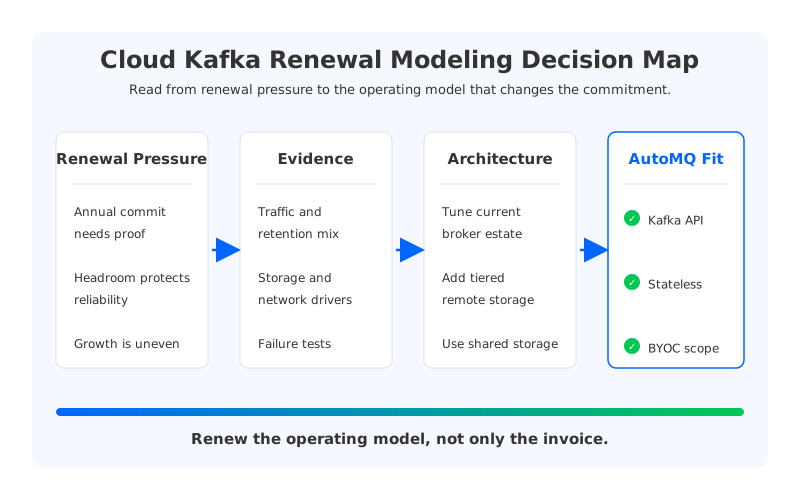
The useful question is sharper: which costs are workload requirements, and which costs are artifacts of the Kafka operating model? The answer determines whether the renewal should fund the existing platform, a tuned version of it, or a Kafka-compatible architecture with a different storage and scaling boundary.
1Why teams search for cloud kafka renewal modeling
Kafka renewals tend to become urgent after the platform succeeds. A single team may have started with a few topics and a predictable retention window. As more internal teams adopt it, the cluster becomes a shared service for CDC, fraud signals, telemetry, operational analytics, AI feature pipelines, and audit streams. Each use case brings a different tolerance for lag, replay, isolation, and recovery. The platform team cannot treat them as one homogeneous stream just because they all use the Kafka API.
The renewal conversation also joins groups that normally speak different languages. FinOps asks for cost drivers and commitment risk. SRE asks for failure domains, saturation signals, and rollback. Application teams care about producer behavior, Consumer group offsets, transactions, Kafka Connect jobs, and schema compatibility. Procurement wants a contract that does not create a trap. Those are not separate conversations. They are different views of the same architecture.
Apache Kafka's model explains why the views are connected. Topics are split into Partitions, records are addressed by Offset, Consumer groups coordinate which members read which partitions, and transactional or idempotent producers can depend on broker-side semantics. Any renewal model that ignores those behaviors is not modeling Kafka; it is modeling invoices.
The first step is to separate three layers:
- Demand assumptions: write throughput, read fan-out, retention, replay, peak windows, tenant growth, and recovery objectives.
- Architecture assumptions: broker-local storage, replication, rack or Availability Zone placement, metadata quorum, remote storage, migration path, and control boundaries.
- Commercial assumptions: reserved capacity, marketplace commitments, support terms, cloud discounts, observability spend, and engineering time.
When those layers are mixed together, teams create false savings. A lower broker count may look attractive until it weakens recovery headroom. A longer commitment may look efficient until the workload shifts from hot real-time reads to long-retention replay. A managed service may reduce operational burden while changing the data-plane boundary. Renewal modeling should expose those trade-offs before a signature makes them hard to reverse.
2The production constraint behind the problem
Traditional Kafka uses a Shared Nothing architecture: each Broker owns local log data, and replication keeps copies available across brokers. This model is robust and well understood. It also means that the broker is not only compute. It is a unit of durable storage, recovery, balancing, and failure-domain planning.
That coupling matters most during renewal because renewal decisions often convert operational habits into financial commitments. If a team has kept extra brokers online because partition reassignment takes too long, the renewal model may treat that headroom as normal demand. If retention has grown because downstream teams need replay, the model may treat local disk growth as unavoidable. If multi-Availability Zone resilience creates heavy inter-zone traffic, the model may treat network cost as a side effect rather than an architecture question.
The constraint is not that Kafka is wrong. Kafka's design made sense for environments where local disks and application-level replication were the natural durability model. The constraint is that cloud billing makes the hidden parts visible. Compute, block storage, object storage, cross-zone data transfer, PrivateLink paths, monitoring, snapshots, and support can all appear as different line items even though one architectural choice may drive several of them at once.
That is why right-sizing by utilization alone is fragile. A utilization graph can show that brokers are underused, but it cannot tell whether scale-in will trigger data movement that competes with production traffic. A disk chart can show retained bytes, but it cannot tell whether those bytes need to live with broker compute. A renewal spreadsheet can show annual spend, but it cannot show whether the platform can retreat from a bad assumption after the contract starts.
3Architecture options and trade-offs
A serious renewal model should compare operating models, not only vendors. Most teams have four realistic paths: keep and tune the current cluster, use managed Kafka with similar architecture, add Tiered Storage where it fits, or evaluate a Kafka-compatible Shared Storage architecture. Each path can be the right answer under a different constraint.
| Option | What it changes | What it does not automatically change | Renewal risk to test |
|---|---|---|---|
| Tune the current Kafka estate | Instance families, partitions, retention, batching, quotas, and operations | Broker-local durable ownership remains | Savings may depend on reducing safety margin |
| Managed Kafka with a familiar model | Operational ownership, support, upgrades, and service integration | Data placement and scaling constraints may still follow broker-local state | Contract may hide architecture-driven cost drivers |
| Tiered Storage | Older log segments can move to remote storage | Active broker storage and hot-path behavior still matter | It may solve retention cost without solving elasticity |
| Shared Storage architecture | Durable data moves into shared object storage; brokers focus on compute | Compatibility, latency, governance, and migration still need testing | Platform change must pass real workload validation |
Tiered Storage deserves careful handling in the model because it is often confused with diskless architecture. Apache Kafka documents Tiered Storage as remote log storage for older data. That can be valuable when long retention is the main pressure. It does not, by itself, make brokers stateless or remove the need to reason about active local storage, leaders, followers, and operational balancing.
Shared Storage architecture starts from a different premise. Persistent stream data belongs in a shared storage layer, often S3-compatible object storage, while brokers handle protocol, request processing, leadership, caching, and scheduling. A WAL (Write-Ahead Log) layer absorbs the mismatch between streaming writes and object storage APIs. Cache keeps hot reads efficient. The renewal question then changes from "How many brokers must we reserve for retained bytes?" to "Which compute, storage, and WAL assumptions match this workload?"
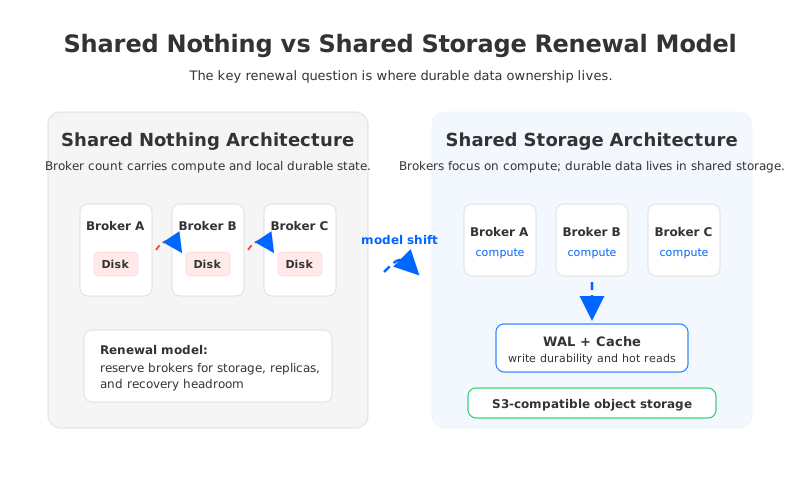
This comparison should stay pragmatic. If the existing cluster is stable, growth is modest, and the renewal term is short, tuning may be enough. If the largest pressure is audit retention, Tiered Storage may be the lowest-disruption fix. If broker count, retained bytes, cross-zone traffic, and reassignment windows keep rising together, the renewal model should include an architecture that breaks that coupling.
4Evaluation checklist for platform teams
The best renewal models are uncomfortable in a useful way. They force every stakeholder to name the assumption they are protecting. Reliability teams may protect spare capacity. Finance may protect commitment flexibility. Security may protect the data boundary. Application owners may protect offset continuity and producer behavior. Once those assumptions are explicit, the team can decide which ones are requirements and which ones are legacy habits.
Use the following checklist before turning platform options into commercial scenarios:
| Area | Questions to answer | Evidence to collect |
|---|---|---|
| Kafka compatibility | Which clients, admin tools, Connectors, Streams jobs, transactions, ACLs, and quotas must behave the same? | Client inventory, protocol versions, feature usage, integration tests |
| Cost drivers | How much spend comes from compute, broker storage, object storage, network, observability, support, and operations? | Cloud bills, chargeback tags, usage exports, monitoring data |
| Elasticity | What happens during scale-out, scale-in, broker replacement, and partition balancing? | Load tests, reassignment timing, throttling history, incident reviews |
| Reliability | What recovery time, durability, offset continuity, and replay behavior are required? | Failure tests, recovery runbooks, consumer lag history |
| Governance | Where do data, metadata, logs, metrics, control actions, keys, and support access live? | Architecture review, IAM policy review, audit requirements |
| Migration | How will topics move, producers switch, consumers resume, and rollback happen if tests fail? | Migration plan, rollback gates, pilot topic list, ownership map |
This table prevents a common renewal mistake: comparing a fully loaded current-state cost with an under-specified target-state quote. A quote can look lower because it leaves out migration labor, observability, network paths, or retained rollback capacity. It can also look higher because it includes operational coverage that the current team absorbs silently. The model needs both sides to carry the same responsibilities.
5How AutoMQ changes the operating model
After the neutral framework is in place, AutoMQ becomes relevant as a Kafka-compatible cloud-native streaming platform built around Shared Storage architecture. It keeps Kafka protocol compatibility for existing Kafka clients and ecosystem tools, while replacing broker-local persistent storage with S3Stream, WAL storage, Data caching, and S3-compatible object storage.
The renewal impact comes from changing the unit of commitment. In a broker-local model, teams often reserve compute because storage, placement, and recovery need it. In AutoMQ's model, stateless brokers primarily carry compute responsibilities, while durable stream data is stored in shared object storage. Compute and storage can be modeled independently, which makes renewal scenarios easier to tie to actual workload behavior.
Four differences matter for right-sizing:
- Stateless brokers reduce storage-coupled headroom. Broker replacement, scaling, and reassignment are less tied to bulk local data movement because persistent stream data is not owned by one broker's disk.
- WAL storage makes the write path explicit. AutoMQ uses WAL storage for durable writes and recovery buffering before data is organized in object storage. Renewal models should name the WAL type and latency target instead of treating all storage as one bucket.
- Zero cross-AZ traffic is an architecture lever. AutoMQ documentation describes patterns for avoiding inter-zone traffic through local-zone routing and shared storage. Teams should still validate client placement, routing, and cloud network configuration in their own environment.
- BYOC and Software boundaries support governance review. AutoMQ BYOC runs in the customer's cloud account, and AutoMQ Software targets private environments. That helps teams model data-plane ownership, IAM, telemetry, and support access separately from commercial pricing.
This does not mean AutoMQ should be inserted into every renewal. The right test is workload-specific. If the current platform's pain is mostly governance workflow or support process, architecture may not be the primary lever. If the pain comes from broker-local storage, cross-zone movement, slow balancing, long retention, and permanent overprovisioning, a Kafka-compatible Shared Storage architecture belongs in the renewal model.
6A renewal readiness scorecard
Before the renewal date drives the decision, score the model itself. Use 1 for "unknown," 3 for "partly measured," and 5 for "measured, reviewed, and owned." The point is not to produce a fake precision score. It is to find the assumptions that could dominate the next year of spend or reliability.
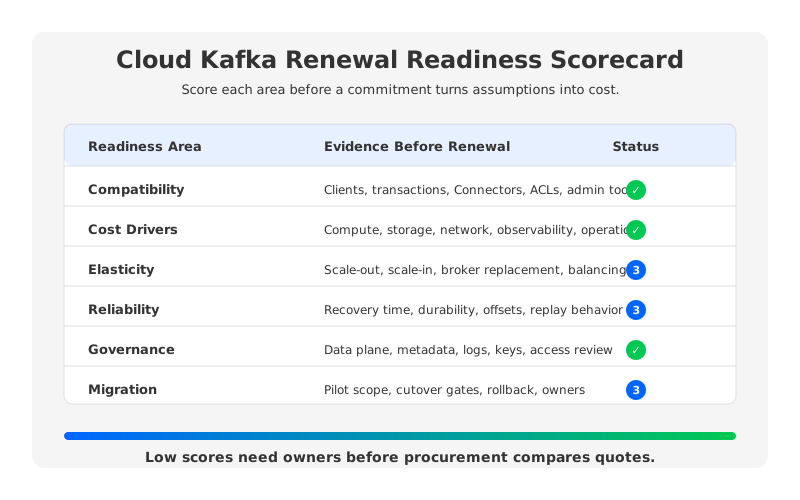
Start with compatibility. A platform change is not a cost exercise if it breaks clients, offsets, transactions, Connectors, or security workflows. Then score cost attribution. If compute, storage, network, and operations are not separated, the model cannot explain which cost will change under each architecture. Elasticity and recovery should be tested, not narrated. Governance should be reviewed with the people who can approve or block the deployment boundary. Migration should have a rollback plan that is credible before the pilot starts.
The model is ready for procurement only when the lowest scores have owners. A weak network assumption needs cloud architecture review. A weak compatibility assumption needs a test matrix. A weak rollback assumption needs a smaller pilot or a different migration tool. A weak governance assumption needs security review before pricing review, not after it.
Kafka renewal modeling works when it protects reliability and exposes architectural waste at the same time. If the next renewal forces you to buy broker count, retained bytes, and recovery headroom as one package, test whether that coupling is still necessary. To evaluate a Kafka-compatible Shared Storage path in your own cloud boundary, start with the AutoMQ product walkthrough at go.automq.com/home.
7FAQ
7.1What is cloud Kafka renewal modeling?
Cloud Kafka renewal modeling is the process of estimating the technical and commercial impact of the next Kafka contract, commitment, or platform decision. It includes workload demand, architecture constraints, reliability targets, migration risk, governance boundaries, and cloud cost drivers.
7.2How is renewal modeling different from Kafka right-sizing?
Right-sizing usually focuses on current resource utilization. Renewal modeling adds contract duration, growth uncertainty, migration optionality, support boundaries, and reliability risk. It asks whether the current operating model should be renewed, tuned, or changed.
7.3Does Tiered Storage solve Kafka renewal cost pressure?
Tiered Storage can help when long retention is the main cost driver because older log segments can move to remote storage. It does not automatically make brokers stateless or remove active local storage and balancing concerns, so it should be modeled as one option rather than a complete operating-model change.
7.4When should AutoMQ be part of the renewal model?
Evaluate AutoMQ when Kafka compatibility is required and the current renewal pressure comes from broker-local storage, cross-zone traffic, slow reassignment, long retention, or permanent capacity headroom. It should be tested with representative clients, security settings, and failure scenarios before production cutover.


