
Table of Contents
Table of Contents
Someone searching for stream processing compute waste kafka is usually past the obvious part of the cost review. The team knows some brokers are underused during normal traffic and some clusters were sized for rare incidents. The hard question is whether removing that waste will change the failure behavior of a production streaming platform.
Kafka makes that question uncomfortable because compute is rarely isolated from storage, replication, recovery, and consumer progress. A broker that looks lightly loaded on CPU might still carry hot Partition leaders, retained data, follower replicas, or catch-up traffic after a consumer outage. A stream processing job that looks idle might be holding state for a critical Consumer group or protecting a transaction boundary. Right-sizing works only when the team can separate unused capacity from reliability capacity.
That distinction is the thesis of this guide: compute waste in Kafka is an architectural accounting problem before it is a node-sizing problem. You need to know which capacity is there for throughput, which capacity is there for local storage ownership, and which capacity is there because the platform cannot move work without moving data.
1Why Teams Search for stream processing compute waste kafka
The search often starts in a budget meeting, but the root cause usually appears in operations. A FinOps report says the Kafka estate has low average CPU utilization. The platform team answers that average CPU is a poor proxy for Kafka safety. Both sides are partly right.
The waste is real. Streaming platforms are commonly sized for peak ingest, read fan-out, retention growth, broker loss, rolling upgrades, and bursty downstream consumers. Those margins accumulate as producers ask for write headroom, consumers ask for replay headroom, SREs ask for failover headroom, and storage teams ask for disk headroom. The cluster may be reliable, but it is difficult to prove which part of the capacity is still needed.
The operational concern is also real. Apache Kafka assigns records to Topic partitions, tracks progress with offsets, and coordinates consumption through Consumer groups. A wrong resize can show up as consumer lag, producer throttling, delayed rebalances, longer recovery, or missed service-level objectives. When stream processing frameworks depend on those offsets and partitions for stateful progress, the cost review becomes a reliability review.
Three signals usually indicate that a Kafka cost audit has moved beyond ordinary instance tuning:
- Capacity buffers are not tied to a named failure mode. Teams can explain that headroom is required, but cannot say whether it protects broker loss, replay traffic, storage growth, compaction, or peak producer load.
- Compute and storage decisions are made together. Scaling brokers up or down changes not only CPU and memory, but also disk placement, replica distribution, and reassignment work.
- Migration risk blocks optimization. The team sees a better operating model, but cannot accept downtime, offset changes, client rewrites, or a long dual-write period.
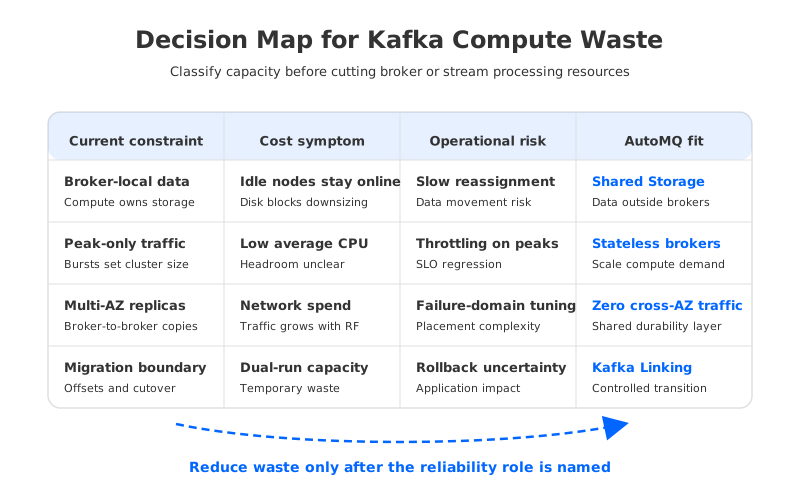
Once those signals appear, cutting nodes is the wrong first move. Map where compute is doing real work and where it is compensating for the storage architecture.
2The Production Constraint Behind the Problem
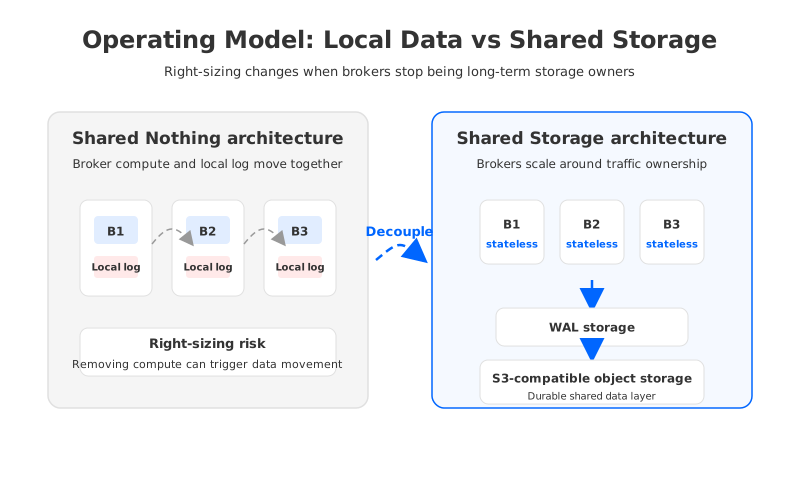
Traditional Kafka runs as a Shared Nothing architecture: each broker owns local storage, and replication keeps copies across brokers for durability and availability. This design keeps the log close to the broker that serves it, but it also couples compute placement with data placement. A broker is not only a request handler; it is also a storage owner.
That coupling changes the meaning of underutilization. If one broker has spare CPU but owns a large amount of retained data, the platform cannot always remove it without a reassignment plan. If a cluster needs room for a failed broker's partitions, the idle capacity may be protecting a recovery path. If consumers fall behind and trigger catch-up reads, the load can move from normal serving to recovery work. In each case, the capacity is not continuously used, but it exists because the architecture requires the cluster to absorb specific operational events.
Tiered Storage improves one part of this equation by moving older log segments to remote storage. It is useful when retention is the main pressure point, and Apache Kafka documents Tiered Storage as a way to keep local retention smaller while storing older data remotely. But Tiered Storage does not make brokers stateless. Recent data, leadership, and operational balancing still matter.
The practical result is that a Kafka right-sizing exercise has to classify capacity before it removes capacity. The classification is simple enough to put on a whiteboard:
| Capacity bucket | What it protects | Why average CPU misses it |
|---|---|---|
| Serving capacity | Produce, fetch, coordination, and request bursts | Peaks are short and uneven across partitions |
| Storage ownership capacity | Local log placement, replicas, and retention | Disk pressure can be high when CPU is low |
| Recovery capacity | Broker failure, reassignment, replay, and catch-up reads | Used during incidents, upgrades, and backlog events |
| Migration capacity | Dual running, traffic shift, validation, and rollback | Temporary but required for a safe change window |
The table explains why finance and platform teams talk past each other. Finance sees unused compute hours. Platform teams see latent operational work. The task is to reduce the first without deleting the second.
3Architecture Options and Trade-Offs
There are three common ways to attack stream processing compute waste in Kafka. The first is workload tuning: resize brokers, tune partitions, adjust retention, rebalance leaders, optimize producers and consumers, and remove unused topics. This should happen in every mature Kafka environment, but it does not change the coupling between broker capacity and local data.
The second path is service-level segmentation. Teams split workloads by criticality, retention pattern, fan-out, or latency sensitivity. Critical payment streams do not share the same headroom policy as telemetry topics. Segmentation makes waste visible because each cluster or tenant has a clearer job, but it can create more quotas and governance work.
The third path is an architectural shift toward Kafka-compatible systems that separate compute from storage. In this model, brokers serve the Kafka protocol and handle hot execution paths, while durable data lives in shared object storage with a write-optimized WAL (Write-Ahead Log) layer. This is the path to evaluate when the largest waste driver is not a badly sized instance, but the need to keep compute online because data is tied to that compute.
These options are not mutually exclusive. A team may tune first, segment second, and then evaluate a storage architecture shift where local storage ownership creates the most waste. The useful question is whether the platform can scale compute independently from retained data while preserving Kafka semantics.
4Evaluation Checklist for Platform Teams
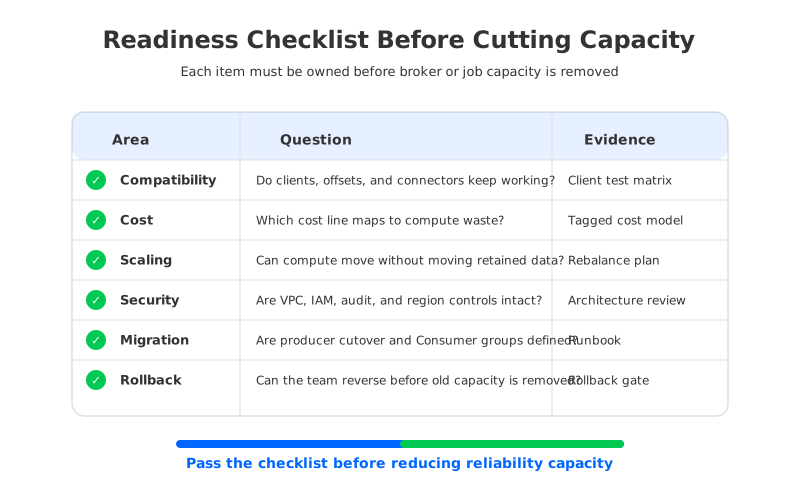
Before changing architecture, run the same checklist against every option. This avoids optimizing the bill while pushing risk into application teams. Kafka-compatible streaming is valuable because client behavior, Topic semantics, Consumer groups, offsets, and ecosystem integrations already carry years of operational knowledge. Right-sizing should preserve that contract wherever possible.
Use the following decision matrix as a working review, not as a vendor scorecard:
| Evaluation area | Question to ask | Risk if ignored |
|---|---|---|
| Compatibility | Can existing Kafka clients, Connect jobs, stream processors, ACLs, and offset workflows continue with minimal change? | Application rewrites turn cost work into a migration project |
| Elasticity | Can compute scale without moving large amounts of retained data? | Savings disappear during reassignments and peak windows |
| Durability | Where is acknowledged data persisted, and what failure domain does it depend on? | Node savings weaken the write path |
| Recovery | How does the platform handle broker loss, catch-up reads, and leadership changes? | Lower steady-state cost creates longer incidents |
| Governance | Can teams keep network, identity, region, audit, and data-boundary controls? | Procurement savings create security exceptions |
| Migration | Are offsets, producer cutover, rollback, and validation explicitly designed? | A low-cost target becomes a high-risk transition |
The checklist also clarifies what not to do. Do not use average CPU as the primary cut signal, remove headroom tied to a named failure mode, or treat object storage as an answer before the write path, read path, metadata model, and recovery model are clear. Do not count projected savings before the migration path has a rollback plan.
5How AutoMQ Changes the Operating Model
After that neutral evaluation, AutoMQ enters the discussion as a Kafka-compatible streaming platform built around Shared Storage architecture. It keeps the Kafka protocol and ecosystem interface, but changes the storage layer underneath the broker. Instead of making each broker the long-term owner of local log data, AutoMQ uses S3Stream, WAL storage, data caching, and S3-compatible object storage for durable storage.
That shift matters because brokers become stateless in the operational sense. They still process Kafka requests, own leadership at a point in time, and participate in cluster coordination. But durable data is not trapped on a broker's local disk. Scaling a broker group focuses more on traffic ownership and less on copying retained data between machines. AutoMQ documentation describes this as moving from Kafka's Shared Nothing architecture to Shared Storage architecture, with stateless brokers, continuous Self-Balancing, and partition reassignment without large local-data movement.
The cost implication is not that every cluster can run with no headroom. Production systems still need capacity for bursts, failures, upgrades, and backlog recovery. The difference is that headroom can be modeled closer to compute demand instead of being inflated by storage ownership.
Zero cross-AZ traffic is another part of the operating model for multi-AZ deployments. In traditional Kafka, replication and some client traffic patterns can create inter-zone data movement. AutoMQ's Shared Storage architecture is designed to avoid cross-AZ replication between brokers by using object storage as the shared durability layer. Teams should still validate cloud network paths, client placement, connectors, and private connectivity design.
AutoMQ BYOC also keeps the deployment boundary aligned with teams that cannot move data control to an external service account. In AutoMQ BYOC, the control plane and data plane run in the customer's cloud account and VPC, while customer data remains in customer-owned storage. That boundary matters because governance, procurement, and security teams often review the operating model alongside the bill.
Migration still deserves its own plan. AutoMQ Kafka Linking is designed for Kafka migrations that need byte-to-byte copy, Consumer group progress synchronization, producer cutover control, and reduced application change. Those properties let teams validate compatibility, traffic behavior, lag, and rollback before decommissioning old capacity.
6A Practical Right-Sizing Sequence
The most reliable right-sizing plan starts with labels, not termination events. Label each workload by throughput pattern, retention period, replay behavior, failure criticality, and owner. Then label each capacity buffer by the event it protects. A buffer without an event is a candidate for reduction. A buffer tied to broker loss, upgrade safety, or recovery needs review before removal.
Once labels exist, run the work in five steps:
- Measure by workload, not only by cluster. Break down produce throughput, fetch throughput, Consumer lag, storage growth, partition count, and rebalance behavior by application or tenant.
- Separate steady-state load from recovery load. Backlog replay, catch-up reads, and broker replacement are different from normal serving. They need different SLOs.
- Classify each cost driver. Compute, storage, cross-AZ traffic, object storage requests, private connectivity, support burden, and migration capacity should appear as separate lines.
- Choose the smallest safe change. Tune and clean up obvious waste first. Use architecture change where storage ownership blocks meaningful savings.
- Keep rollback explicit. Track offsets, producer routing, consumer progress, ACLs, observability, and incident ownership before declaring the old path removable.
This sequence gives finance a defensible savings model and gives platform teams a reliability model they can support. It also prevents a common Kafka cost optimization mistake: treating broker count as a standalone variable when the real system includes storage, network, replay, governance, and migration risk.
The closing question is the same one that started the search: which capacity is waste, and which capacity is reliability in disguise? If your team can answer that with evidence, right-sizing is an engineering exercise. If the answer depends on broker-local data that cannot move safely, it is time to evaluate a Kafka-compatible shared storage model. To explore AutoMQ's approach, start with the AutoMQ GitHub project.
7FAQ
7.1Is stream processing compute waste the same as low broker CPU utilization?
No. Low CPU utilization is a signal, not a conclusion. Kafka brokers may carry storage ownership, Partition leadership, replay risk, or recovery responsibility even when CPU is low.
7.2Should teams reduce Kafka broker count before changing architecture?
They should remove obvious waste first, such as unused topics, poor partition distribution, and outdated retention settings. Broker count reduction becomes risky when local data movement, failover headroom, or catch-up read capacity is not understood.
7.3Does Tiered Storage eliminate compute waste in Kafka?
Tiered Storage can reduce local storage pressure by moving older data to remote storage, but it does not make brokers fully stateless. Teams still need to evaluate local tier behavior, leadership, recovery, and reassignment work.
7.4Where does AutoMQ fit in a Kafka cost optimization plan?
AutoMQ fits when the main waste driver is the coupling of broker compute with durable storage. Its Shared Storage architecture lets teams evaluate compute scaling, storage retention, and recovery behavior as more independent concerns.
7.5What should a migration readiness review include?
A readiness review should include client compatibility, Topic and ACL mapping, offset continuity, producer cutover, Consumer group progress, observability, rollback, and ownership after decommissioning the source cluster.


